

Electric Nation
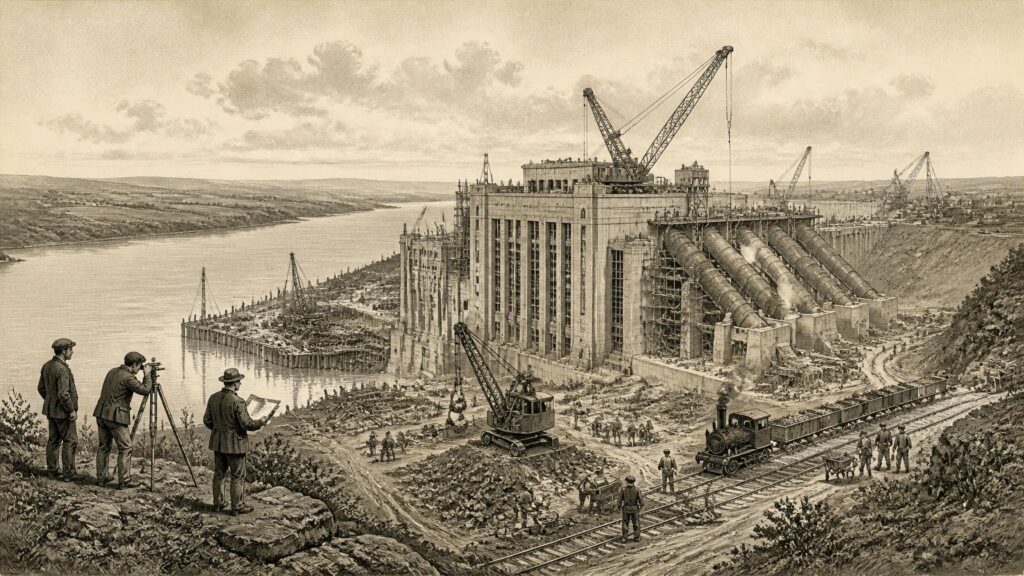
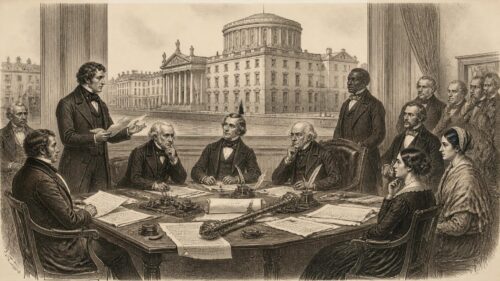
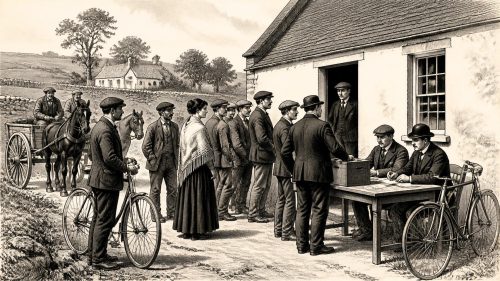
AI generated historical illustration, not a contemporary photograph.
At a Glance
The Shannon Scheme changed life in Ireland not because every household was suddenly electrified in 1929, but because it made a national electricity system imaginable, practical and permanent. At Ardnacrusha, County Clare, the young Irish Free State redirected part of its greatest river through an immense hydroelectric works, established the Electricity Supply Board, and began to replace a patchwork of costly local supplies with a public system intended to serve the whole country. The scheme altered work, industry, administration, landscapes and popular expectations. Its gains were substantial, but neither immediate nor evenly shared; river communities, fisheries and older forms of navigation also bore serious consequences.
National Ambition
When work began at Ardnacrusha in August 1925, the Irish Free State was only a few years old. The revolutionary period and Civil War had left political division, economic uncertainty and a state apparatus still being assembled. In that context, the Shannon Scheme was more than a power station. It was an unusually confident declaration that the new state could plan, finance and carry out a technically difficult national undertaking. The project used the fall of the Shannon between the upper river and Limerick to produce electricity on a scale far beyond the modest generating stations then scattered through the country.
Ireland already had electricity before Ardnacrusha, but access was limited and uneven. Town councils, private companies and individual industrial concerns supplied particular districts through separate systems. Technical standards differed, generating plant was often small, and electricity was costly. In 1927, when the Electricity Supply Board was established, there were more than 300 bodies involved in generation or supply, including local authorities and private undertakings. That fragmented arrangement made a truly national service difficult. The Shannon Scheme was designed to overcome that limitation through large-scale generation, high-voltage transmission and coordinated distribution.
Thomas McLaughlin, the Donegal-born engineer whose experience with Siemens-Schuckert in Germany informed the proposal, was central to the scheme. He did not simply advocate a dam. His plan joined a hydroelectric station, a transmission network and an organisation capable of selling electricity. This integrated conception mattered. Generating abundant power at Ardnacrusha would have achieved little without lines, substations, domestic connections, tariffs, appliances and staff who could persuade potential users that electricity was useful, safe and affordable.
State Confidence
The scale of the commitment was striking. Contemporary and later ESB accounts put the cost at roughly £5.2 million, around one fifth of government revenue in 1925. Such comparisons should be treated carefully, since public accounts and prices cannot be translated simply into modern equivalents. Yet the proportion conveys the political risk. This was a major capital commitment by a predominantly agricultural country with a small population and limited industrial base. Critics questioned whether demand would materialise, whether hydroelectric output could meet national needs, and whether the state ought to take responsibility for such an enterprise.
The government nevertheless approved the project, and the Shannon Electricity Act of 1925 gave the Minister for Industry and Commerce broad authority to acquire land, alter waterways, construct works, arrange accommodation and undertake electricity production and supply. The wording of the legislation reveals the reach of the intervention. It contemplated not merely turbines and wires, but the remaking of river channels, roads, housing, work camps and local property relations. The project’s physical footprint was therefore inseparable from an expansion of state capacity.
That confidence should not be mistaken for inevitability. The decision depended on engineering reports, political advocacy, negotiations with Siemens-Schuckert and a belief that an adequate supply of power could assist industrial development. It also prompted opposition. Concerns were raised about cost, private and municipal electricity interests, land, navigation and the Shannon salmon fishery. The scheme was a national achievement, but it was never a universally uncomplicated one.
River Engineering
The name Ardnacrusha can obscure the size of the wider undertaking. The station itself stood near the lower Shannon, but the scheme required a coordinated landscape of works. At Parteen, north of Limerick, a weir regulated water entering a purpose-built headrace canal. The canal carried the flow towards the power station, where water descended through large steel penstocks to drive turbines before returning through a tailrace to the Shannon. Bridges, embankments, sluices, roads, railways, transmission compounds and accommodation accompanied this altered watercourse.
The operation did not merely take power from the river in the abstract. It changed where, when and how much water flowed through particular channels. The 1925 legislation expressly authorised the state to impound, divert, dredge, straighten and otherwise alter the Shannon and connected waters. Such powers made the project possible, but they also explain why its effects extended beyond the station. People who lived, fished, farmed, traded or travelled beside the river encountered a new hydraulic regime rather than a distant industrial installation.
Ardnacrusha’s architecture expressed its ambition. The surviving power station, designed and built by Siemens-Schuckert between 1925 and 1929, is recognised in the National Inventory of Architectural Heritage as a structure of national architectural, historical, scientific, social and technical interest. Its great turbine hall, formal elevations and immense scale made industrial engineering visible. It was functional infrastructure, but also a public monument to technological modernity.
Building Labour
Construction created a temporary industrial world in rural Clare and the Limerick hinterland. At its peak, about 5,000 people worked on the scheme: approximately 4,000 Irish workers and 1,000 German workers, engineers and specialists. Those figures, preserved in ESB and university accounts, indicate the magnitude of the site, although they should not conceal changing labour numbers across the four-year build. Men came from many parts of Ireland, and some workers also arrived from Britain and Scotland seeking employment.
The work brought wages, skills and commercial activity into neighbouring places, but it was arduous and disciplined. Excavation, concrete production, steel erection, dredging, rail transport and the assembly of turbines demanded heavy labour as well as expert technical supervision. Siemens provided important plant and specialist knowledge; Irish workers carried out much of the excavation, construction and supporting work. The project was therefore neither simply a German import nor an uncomplicated expression of self-sufficiency. It was an international undertaking made politically meaningful in Ireland.
Workers required housing, food, medical arrangements, transport and recreation. The enabling legislation had anticipated this by authorising accommodation, canteens, clubs and recreation facilities. Accounts from local heritage collections describe camps and purpose-built housing, including provision for German families and children. Such material is valuable for showing how construction affected daily life, though individual recollections should not be generalised into a complete social history. The records demonstrate, at minimum, that Ardnacrusha temporarily created a concentrated, multilingual labour settlement beside a largely rural river landscape.
Technical Transfer
The project transferred more than machinery. It introduced organisational methods, electrical expertise and a new scale of construction management. Equipment arrived through Limerick docks; temporary railways and haulage systems moved materials inland; engineers coordinated a site of exceptional complexity. Irish personnel gained experience in generating plant, transmission, surveying, construction, administration and electrical maintenance. These skills became valuable after completion, when ESB had to operate the station, extend lines and absorb or coordinate existing local undertakings.
The opening was deliberately public. W. T. Cosgrave formally opened the scheme at Parteen on 22 July 1929, and newsreel film, photography, official reports and organised visits made Ardnacrusha a national spectacle. ESB’s early public relations activity was not an ornamental extra. The organisation had to build a market for electricity at the same time as it built a network. Films of construction appeared in cinemas, while advertisements, pamphlets, demonstrations and showrooms taught prospective customers what electric power might do.
This is one reason the Shannon Scheme changed Ireland culturally as well as materially. It familiarised people with a vocabulary of turbines, grids, appliances and national planning. The station became a place that citizens could visit and admire, not merely a remote industrial facility. In interpretation, it may be called a performance of state competence: the Free State used a vast engineering work to make its practical authority visible. That interpretation is supported by the project’s publicity, though it remains an interpretation rather than a measurable fact about every visitor’s response.
Grid Creation
The decisive innovation was the link between Ardnacrusha and a national network. ESB constructed a 110-kilovolt transmission system alongside the generating works. In 1929 this was a bold arrangement for a country of Ireland’s size, joining generation, transmission, distribution, marketing and sale into an integrated public service. Electricity could now move from a single major source to cities and towns at a distance, rather than being generated only close to individual consumers.
Commercial operation began in late October 1929 for two units, with the third entering service in November. The new supply reached the Leinster network, and in January 1930 Ardnacrusha was synchronised with Dublin’s Pigeon House station. After the Pigeon House closed later that month, Dublin City and much of its suburban supply came from the Shannon. Cork industrial users, including the Ford plant, received Ardnacrusha electricity soon afterwards. By 1931 the station produced the overwhelming majority of electricity generated nationally.
These milestones demonstrate why the scheme mattered immediately to urban life. Better lighting and more reliable power could support shops, offices, public buildings, workshops, cinemas, transport-related services and factories. Electricity did not automatically create industrial growth, nor did every business benefit equally. Ireland’s economic development continued to face limits of market size, capital and policy. But Ardnacrusha removed one important constraint: the scarcity and fragmentation of electrical supply identified by advocates of the project.
Public Authority
The Electricity Supply Act of 1927 created the ESB before the Shannon works were complete. The Board was given responsibility for operating the scheme, coordinating supply, setting charges and acquiring or regulating electricity undertakings. The Act also gave it powers concerning generating stations, lines, wayleaves, showrooms and the sale or hire of electrical apparatus. In institutional terms, the station and the Board were two halves of a single transformation. Ardnacrusha supplied the power; ESB became the permanent public body through which power was organised.
This arrangement altered the relationship between citizen and infrastructure. Electricity became increasingly associated with a national service rather than a privilege delivered by a local monopoly or private concern. The Board’s statutory obligation to manage generation, transmission and supply on an efficient and economic basis created a framework that outlasted the original hydroelectric plant. It also established one of the most influential semi-state models in independent Ireland.
Centralisation brought tensions. Local authorities and private undertakings could lose autonomy, assets or established customers as the Board consolidated supply. The legislation included provisions to manage transfers, permits and compensation, an indication that reorganisation affected livelihoods as well as machinery. The story should therefore not be reduced to a clean replacement of old by new. It was a negotiated and sometimes contested restructuring of an existing, if limited, electrical economy.
Urban Change
For urban consumers, the immediate effect was less dramatic than later memory sometimes suggests, but it was still profound. Ardnacrusha did not put an electric cooker or refrigerator into every kitchen in 1929. What it did was make a larger, more reliable and more standardised supply available to places where demand was concentrated. In the early 1930s, ESB could expand connections, open showrooms and promote electrical lighting, heating and cooking with confidence that there was substantial generating capacity behind the sales message.
Electric light extended the usable hours of shops, workplaces and homes. It reduced dependence on candles, oil lamps and gas where electricity could be afforded and connected. Electrically powered equipment also held promise for trades and industry: motors could be cleaner and more flexible than separate steam or belt-driven systems in some settings. Yet adoption depended on wiring, capital, appliance cost and tariffs. The arrival of supply was the beginning of a process, not the instant remaking of ordinary life.
ESB’s promotional work recognised this. The Board opened showrooms and used demonstrations, advertising and travelling publicity to turn a technical utility into familiar household practice. This effort tells historians something important: consumers had to be won. Electricity was not self-explanatory, and people could regard new appliances with caution, curiosity or scepticism. Marketing was part of infrastructure because demand had to grow if the costly system was to pay for itself.
Domestic Futures
The domestic promise of electricity was especially powerful. Advertisements associated it with bright, clean, orderly and efficient homes. Electric irons, kettles, cookers, heaters and lighting were presented as improvements to comfort and labour. In later decades, appliances such as refrigerators, washing machines and vacuum cleaners would become central to the remembered story of electrification. However, the chronology matters. Much of rural domestic transformation belongs chiefly to the Rural Electrification Scheme after 1946, not to the original Shannon Scheme alone.
In towns supplied from the national grid, the change began earlier. Household work could be reorganised around electric light and appliances, though access was shaped by income, tenancy, housing condition and the expense of connection. Claims that electricity simply “liberated” women require qualification. It could reduce particular repetitive tasks and improve conditions, but it did not by itself change unequal divisions of domestic labour. The evidence supports a change in tools and possibilities; it does not justify a universal claim about emancipation.
Nevertheless, Ardnacrusha helped create a new standard against which domestic life was judged. Electric power became associated with modern housekeeping, hygiene, leisure and sociability. The significance lay partly in aspiration. Even households not yet connected encountered electricity in shops, cinemas, advertisements, institutions or relatives’ homes. The scheme thus changed expectations well beyond the early map of supply.
Rural Delay
The most important corrective to celebratory accounts is that Ardnacrusha did not electrify rural Ireland in 1929. The original network concentrated on cities, towns and larger villages, where connections could be made at lower cost and demand was more certain. Many farms and isolated dwellings remained without mains electricity throughout the 1930s and during the Second World War. The distance between the station’s national symbolism and the continued use of oil lamps, candles, turf fires and hand labour in much of the countryside was considerable.
This delay was not an accidental oversight. Rural distribution was expensive. Long lines, widely dispersed homes, low initial demand and the need for indoor wiring made a universal service difficult to finance under ordinary commercial criteria. ESB first had to build the backbone network and maintain its finances. In that sense, the Shannon Scheme was a necessary foundation for rural electrification, but it was not the same project and should not be credited with achievements that required a later political decision.
Planning for rural supply developed during the 1930s, but war postponed large-scale implementation. The Rural Electrification Scheme began in 1946. Ireland was divided into 792 rural areas, usually based on parish communities, and lines were extended systematically. By the mid-1960s, hundreds of thousands of rural homes and businesses had been connected. The later scheme drew upon the organisational experience, transmission infrastructure and public legitimacy created by Ardnacrusha and ESB.
Country Transformation
Once rural electrification advanced, its effects on daily life were exceptionally wide. Electric pumps could assist water supply; lighting changed evening routines; milking equipment and other machinery could alter farm work; radios connected households to wider cultural and political life; refrigeration improved food storage; and appliances eased some forms of cleaning, cooking and laundry. These changes were gradual and depended on whether families could purchase equipment, but their cumulative effect was substantial.
It is tempting to describe this later development as the fulfilment of Ardnacrusha’s promise. That is broadly fair, provided the long interval is retained. The station was opened in 1929; the national rural programme began seventeen years later, in 1946; the most remote connections took still longer. The historical lesson is that major infrastructure often changes life through stages. A generating station, a transmission system, funding arrangements, local agreement, household wiring and affordable appliances all had to coincide.
The phrase “quiet revolution”, often used for rural electrification, belongs principally to this post-war process. It should not obscure the labour of line crews, electricians, householders and local organisers, nor should it turn rural people into passive recipients of progress. Communities discussed costs, signed up or hesitated, made decisions about appliances and adapted familiar routines. Ardnacrusha supplied a foundation, but rural modernisation was made in thousands of local negotiations.
Industrial Prospects
Industrial development was a principal justification for the Shannon Scheme. Its advocates believed that cheap, plentiful electricity could attract or support manufacturing, reduce dependence on imported fuels and allow Irish enterprise to operate more efficiently. There was sound reasoning behind that belief. Electrification was essential to modern industry, and Ireland’s previous supply arrangements were inadequate for major growth. The national grid enabled larger consumers to consider electric power with greater confidence.
Yet the station should not be treated as a solitary cause of industrialisation. Economic outcomes depended on trade policy, investment, skills, transport, markets, global conditions and the choices of firms. The interwar Irish economy did not become heavily industrial overnight. Ardnacrusha supplied an essential condition for later development rather than a guarantee of it. That distinction matters because infrastructure is often credited with every subsequent improvement in national life.
Its contribution was nonetheless real. Factories and commercial enterprises could obtain more standardised power, while the state acquired experience in operating a complex technical utility. The national grid also encouraged further generating projects. Hydroelectric development on the Liffey, peat-fired generation and later thermal stations expanded the system beyond its original dependence on the Shannon. Ardnacrusha was therefore a beginning rather than a finished energy settlement.
Skilled Careers
The scheme created pathways into technical employment. Engineers, fitters, electricians, draughtsmen, linesmen, administrators and operators were needed to construct, run and extend the system. Some skills came through Siemens and foreign specialists; others were developed and retained within Irish institutions. Over time, ESB became a major employer and training environment, giving technical careers a visibility uncommon in a country whose public image remained strongly rural.
This professional legacy deserves attention alongside the better-known imagery of turbines and dams. The enduring achievement was not simply a building in Clare but a workforce and institution capable of maintaining systems, responding to faults, planning new capacity and teaching the public to use electrical goods. The reliability of electricity in ordinary life rests on such unglamorous continuing labour. Ardnacrusha made that labour nationally significant.
It also reshaped the state’s relationship with expertise. Engineers were no longer merely advisers to isolated local projects. In the ESB, technical knowledge entered a national public corporation with statutory powers, financial responsibilities and direct contact with consumers. This was one of the clearest examples of the Free State translating professional expertise into permanent administrative form.
River Costs
The benefits of the scheme came with environmental and local costs. Diverting water through the headrace altered the old river channel below Parteen and affected the communities accustomed to its former flow. The change was fundamental rather than cosmetic: a river is a habitat, a fishery, a transport route, a source of local employment and a setting for social life. The statutory powers necessary for the scheme therefore had consequences for people whose interests were not identical with those of electricity consumers elsewhere.
Fisheries were an early source of concern. Archival descriptions in the Eoin MacNeill papers include correspondence about the livelihood of Shannon fishermen and a resolution from the Limerick Board of Conservators warning that the proposed works could jeopardise the salmon industry. Such records do not alone quantify the eventual damage, but they establish that the risk was recognised during planning. It would be misleading to claim that everyone welcomed the project simply because employment and electrification were attractive.
Fish passage, altered flow, water management and the continuing health of the Shannon ecosystem have remained matters of public and legal concern. Modern ESB environmental policy acknowledges responsibilities to manage and protect fisheries and habitats associated with hydroelectric operations. That present-day duty does not provide a complete measure of historical impact, but it underlines the fact that hydropower is not environmentally neutral simply because water is renewable.
Changed Navigation
Navigation also changed. The older Limerick Navigation, with its canals, locks and river sections, had linked Limerick with Killaloe and the wider Shannon route. The hydroelectric works bypassed and displaced elements of this earlier system, while a new lock route through the Ardnacrusha works maintained navigation in altered form. For commercial traffic already facing competition from rail and road, this was another disruptive transition. Later recreational navigation inherited a landscape shaped by the power scheme.
Some local accounts describe places as having been cut off, bypassed or transformed by the canals and diverted channels. Such language conveys real experience, but historians should separate documented physical change from broad claims of social isolation. The project certainly altered routes and water levels; the precise consequences differed between communities and require local evidence. What can be said securely is that the scheme reorganised the lower Shannon as a working landscape in favour of power generation.
There were land consequences too. Embankments, canal construction, transmission lines and ancillary works required acquisition, access and new rights over property. The 1925 and 1927 legislation gave extensive powers for these purposes. For national planners, land was a route for infrastructure. For owners, tenants and neighbours, it was a livelihood, inheritance and familiar place. The collision of those perspectives is a recurring feature of twentieth-century development, and Ardnacrusha is an early Irish example.
Public Memory
Ardnacrusha entered Irish public memory as an emblem of modernity. Its scale, dramatic machinery and association with independence made it unusually suitable for commemoration. The artist Seán Keating, commissioned by ESB, produced a celebrated series of paintings of the Shannon Scheme. These works are historical evidence of contemporary attitudes as well as artworks: they present labourers, engineers and industrial structures in a register that makes construction appear heroic, purposeful and nationally significant.
Art should not be read as a literal record of the worksite. Keating selected, composed and symbolised. His paintings make visible the dignity and muscularity assigned to labour, while framing the scheme as a national drama. Their value lies precisely in this mixture of observation and interpretation. They tell us how the project could be imagined, not simply how every worker experienced it.
Official publicity similarly shaped memory. ESB’s films, photographs, reports and advertising promoted the scheme as a demonstration of progress. Later histories often repeat the image of a small, new country daring to undertake one of Europe’s major engineering projects. The underlying facts support the project’s exceptional scale, but the narrative can become too smooth if it leaves out scepticism, rural delay, land questions and river impacts.
Legend Boundaries
Folklore and anecdote naturally attach themselves to such a conspicuous undertaking. Stories survive of workers arriving from afar, of curiosity about unfamiliar machinery, of local businesses thriving, and of visitors travelling to see the works. These accounts can illuminate atmosphere and memory, especially when collected carefully. They cannot, by themselves, prove precise wage levels, universal local attitudes or a single settled meaning of the scheme.
Similarly, the claim that Ardnacrusha was immediately capable of supplying all Ireland’s needs should be read in context. Its installed capacity was enormous relative to the country’s electrical demand in 1929, and ESB describes it as sufficient for national demand at that time. But “Ireland” did not mean a fully connected population. Capacity, transmission reach and household access are different things. The station had the potential to anchor a national system; actual universal access remained decades away.
The most defensible account is therefore neither triumphalist nor dismissive. Ardnacrusha was a genuine engineering and institutional breakthrough. It created electricity on a national scale, strengthened the administrative capacity of the state, and altered the material possibilities of towns and industries. It also diverted a river, concentrated decision-making and distributed benefits unevenly. Its historical importance lies in holding those truths together.
Lasting Legacy
Ardnacrusha still operates, though its place within the national electricity system has changed greatly. Its original units and later additions made it a dominant source in the early decades; today it forms only a small share of installed national capacity. That change is not evidence of failure. It shows how fully the country outgrew the electricity system of 1929. Demand expanded, new generating technologies emerged, and the grid became more complex than McLaughlin’s generation could have imagined.
The station’s endurance is itself significant. It remains a working industrial monument, combining heritage value with a continuing role in generation and river management. The physical complex is a reminder that national modernisation was constructed from concrete, steel, canals, wires and maintenance work, not merely from political speeches. It also reminds us that old infrastructure retains consequences: the management of water, navigation and fisheries around Ardnacrusha remains part of the Shannon’s lived reality.
Most importantly, the Shannon Scheme changed the political horizon. It showed that the Irish state could establish a public corporation, mobilise expertise, borrow and invest at scale, coordinate a network and persuade citizens to use a new service. Later semi-state development did not simply copy ESB, but Ardnacrusha supplied a powerful precedent for national planning. Electricity became not a luxury for selected streets or enterprises but a public necessity to be extended, however gradually, across the country.
Measured Verdict
How, then, did the Shannon Scheme change life in Ireland? It changed the physical landscape of the lower Shannon and the institutional landscape of the state. It made urban electricity more abundant and reliable, helped provide the conditions for industrial and commercial development, created skilled employment and founded ESB as a durable public authority. It also supplied the essential base from which later rural electrification transformed much of the countryside.
Its limitations are part of the answer. The original scheme did not bring instant equality of access. Rural families waited years, and some waited decades, for the benefits advertised in the language of electrification. Communities along the river encountered changed flows, altered fisheries and disrupted navigation. These were not side notes to the history; they were consequences of choosing national electrical power over older uses of water and place.
Ardnacrusha’s deepest legacy is therefore a changed sense of what Ireland could build and organise. The power station’s turbines mattered, but so did the grid, the Board, the showrooms, the line crews, the consumers and the communities that contested or adapted to the works. The Shannon Scheme did not complete Irish modernisation. It made modernisation a practical, visible and national project.
Living Monument
Ardnacrusha’s afterlife is important because the scheme has never been only a completed episode in the history of the Free State. The power station remains in use as a hydroelectric station, while the wider complex has national recognition for its architectural, historical, scientific, social and technical importance. That combination is revealing. It identifies the place not simply as an old building to be admired, but as working infrastructure whose meaning rests on engineering, labour, public administration and the altered river landscape together.
Its survival also complicates the usual image of a monument. Monuments are often expected to stand unchanged, preserving a single moment from the past. A generating station cannot operate on those terms. Its machinery requires inspection, repair, replacement and adaptation. Three turbines were replaced during the 1990s, demonstrating that continuity in a power system depends upon renewal as well as preservation. The station therefore embodies two histories at once: the extraordinary construction project of 1925–29 and the long, less visible history of maintenance needed to keep public electricity supply dependable.
This continuing life gives particular force to the photographs, plans and films associated with the scheme. They record temporary camps, cranes, excavators, railways, concrete works and workers at a site whose permanent structures can make construction seem inevitable in retrospect. The archive restores contingency. It shows that the great canal, penstocks and station were assembled through immense logistical effort, with materials arriving through Limerick and being moved into a landscape that had to be remade before electricity could be generated. Such evidence encourages attention to workers whose contribution can otherwise disappear behind the famous silhouette of the power house.
Public memory has tended to present Ardnacrusha as a triumph of national confidence, and there is good reason for that judgement. The project gave the young state an enduring public institution and demonstrated an ability to organise technical work on an unprecedented scale. Yet a mature commemoration need not convert that achievement into a simple story of progress. The same legislation that authorised generation and transmission authorised land acquisition, water diversion, altered routes and intervention in fisheries. The scheme’s grandeur was inseparable from powers that redistributed costs and benefits between consumers, workers, landholders and river communities.
That tension is one reason the Shannon Scheme remains historically useful. It raises questions that have not vanished: who decides where major infrastructure is placed; how are affected communities heard; what counts as fair compensation; and how should a public utility balance national demand with local environmental conditions? Ardnacrusha did not provide final answers. It did, however, establish a model in which electricity was treated as a matter of national planning rather than a collection of isolated local ventures. Later rural electrification extended that principle through a much more dispersed programme of poles, lines, household wiring and local organisation.
The phrase “Electric Nation” therefore describes more than the arrival of a new source of power. It names a change in political imagination. Electricity came to be understood as a public system connecting river engineering, professional expertise, household aspiration, industrial possibility and state responsibility. Its benefits appeared unevenly and over decades rather than all at once, while the ecological and social consequences of controlling the Shannon remained real. Ardnacrusha’s lasting significance lies in holding these truths together: it was an achievement of remarkable ambition, a working technical inheritance and a reminder that modernisation always remakes particular places as well as national life.
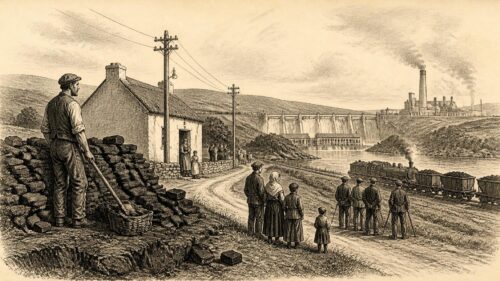
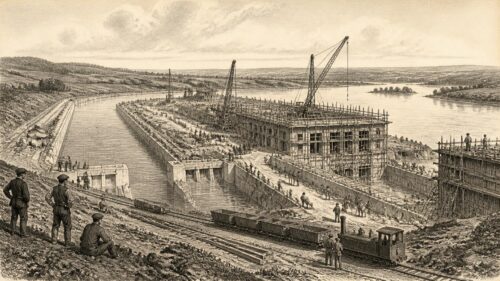
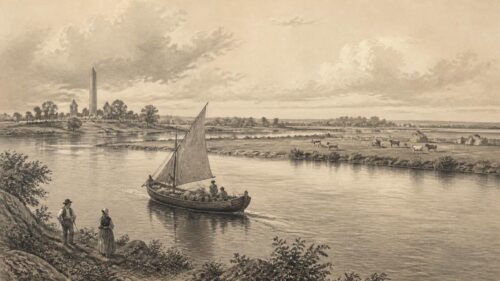

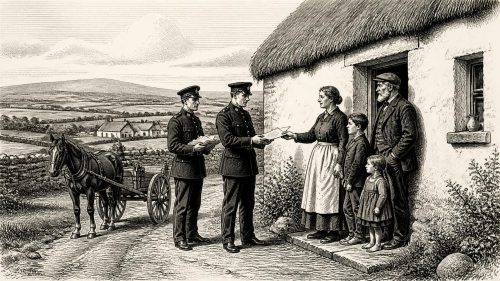
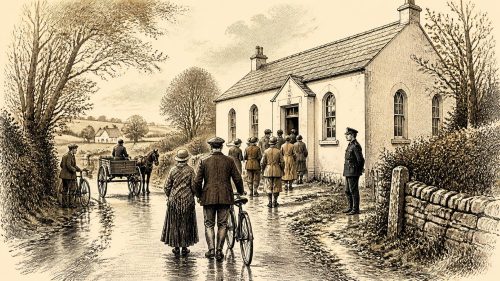
Ardnacrusha is compelling precisely because its national symbolism exceeded its reach. The scheme created a unified electricity system and projected Free State competence, yet many rural households remained reliant on fuels until postwar electrification, while communities along the Shannon experienced altered waterways and fisheries. This contrast suggests that infrastructure can redefine citizenship and expectations before benefits are shared equally. It also complicates narratives of technological progress: a public utility may be both nation-building and locally disruptive. How should we assess Ardnacrusha’s legacy when weighing urban and institutional transformation against delayed rural access and the environmental costs borne by river communities?