

Pastoral Platforms
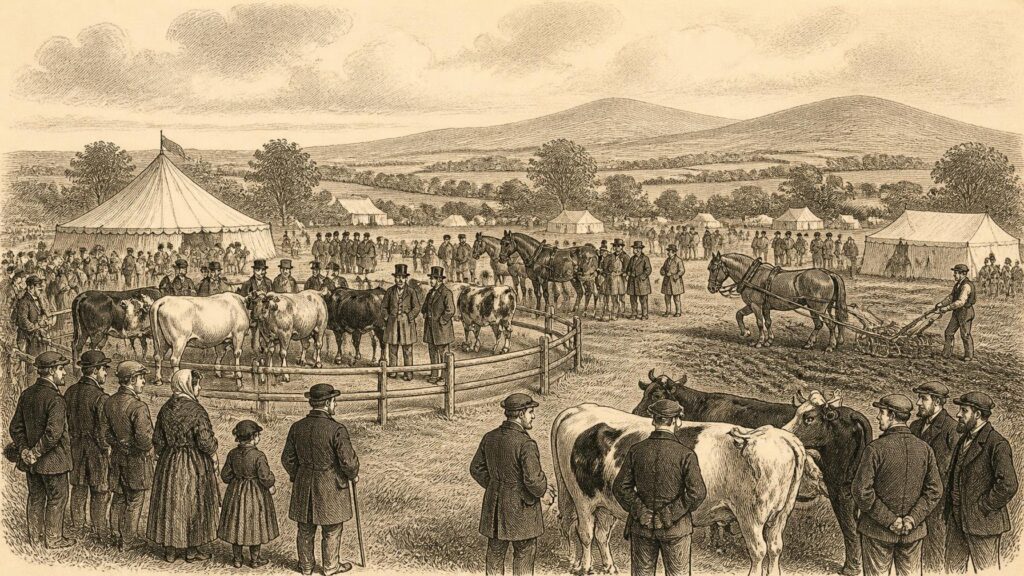
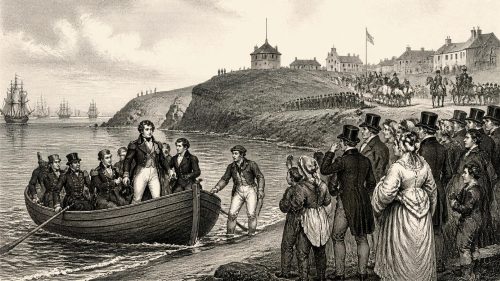
AI generated historical illustration, not a contemporary photograph.
At a Glance
Irish rural shows have long been more than agreeable interruptions to the farming year. They have been marketplaces, classrooms, theatres of local standing and laboratories of agricultural ambition: places where an animal, a plough, a crop or a household skill could be judged in public, and where ideas about what the countryside ought to become were put on display. Their history gives useful perspective on the present argument over climate policy. It does not supply easy precedents or painless solutions, but it shows that agricultural change in Ireland has repeatedly depended upon demonstration, persuasion, prizes, institutions and the hard-won confidence of rural people.
Public Improvement
The phrase “rural show” can suggest a familiar modern scene: livestock rings, machinery stands, equestrian competitions, baking tables, children’s entertainments and a temporary small town of traders, voluntary groups and food stalls. Historically, however, these elements formed at different moments and for different purposes. A nineteenth-century agricultural exhibition, a county show, an RDS cattle competition, a fair and a twentieth-century ploughing championship belong to a related family, but they should not be treated as interchangeable. Each joined practical farming to public sociability in its own fashion.
The deepest documented strand is the language of improvement. From its foundation in 1731, the Dublin Society, later the Royal Dublin Society, promoted agriculture alongside manufactures, science and the useful arts. In the eighteenth century it circulated publications, supported travelling lectures, displayed agricultural implements and awarded premiums. The word “premium” is important. It denoted a cash reward intended to encourage a practice judged desirable: planting, reclamation, crop production, livestock improvement or another undertaking thought capable of advancing the country’s productive capacity. The RDS records describe grants and premiums as instruments by which agricultural knowledge and experimentation could be encouraged beyond the capital.
This was not rural democracy in a modern sense. Much eighteenth-century improvement discourse was framed by landlords, estate interests, learned societies and official patrons. It could assume that knowledge flowed from educated improvers towards cultivators, and it did not erase the enormous inequalities of landholding, tenancy and wealth which shaped Irish rural life. Nevertheless, it created an enduring public language in which farming could be discussed as a national concern rather than solely as household custom. Fields, animals and tools became matters for comparison, inspection and argument.
The RDS’s work also makes clear that agricultural improvement was never solely about output. Its early activities included tree planting, botany and experimentation as well as crops and stock. This broad conception is worth recalling when environmental questions are presented as wholly new intrusions into agriculture. The modern science of greenhouse gases is new to the history of farming, as are statutory carbon budgets, but farmers and agricultural institutions have long confronted questions about soil, drainage, fodder, woodland, disease, water and the durability of the land.
Show Traditions
By the nineteenth century, agricultural shows had become a particularly visible means of turning improvement into public event. The RDS identifies its Spring Show, begun in 1831, its Winter Show, begun in 1856, and its National Horse Show, begun in 1864, as central parts of this history. Initially held around Leinster House, the shows later expanded at Ballsbridge. Their survival in catalogues, posters, photographs and prize records is especially valuable. Such material does not simply preserve a list of winners. It records the categories by which agricultural value was organised: species, breeds, ages, uses, classes of exhibitor and the distinctions which judges were authorised to make.
A prize animal was therefore not merely a handsome creature receiving a ribbon. It embodied a proposition about breeding and profitability. A machinery exhibit could claim to save labour, cultivate more effectively or make a particular system of farming practicable. Horticultural, dairy and domestic competitions similarly placed skills before an audience and made them open to comparison. Shows supplied a public setting in which agricultural knowledge acquired ceremony. The ring, the catalogue and the judge’s decision transformed private work into a visible standard.
The RDS Spring Show’s stated purpose was to encourage improved livestock breeding through the exhibition of leading animals. Its history also shows the connection between display and trade. Judging could offer a form of reputational endorsement, while visitors, breeders and dealers could inspect stock and make contacts. The ideal of the show was therefore practical as well as ceremonial: it would improve agriculture because information, pedigree, reputation and exchange met in one place. That ideal did not guarantee that every prize or fashion proved economically wise, but it explains why shows mattered.
The same pattern can be seen in the development of the Dublin Horse Show. The first National Horse Show in 1864 was jointly organised by the Royal Agricultural Society of Ireland and the RDS, with hundreds of entries housed at the Agricultural Hall. Horses brought farming, transport, sport, military interest, leisure and export trade into unusually close contact. The event could be at once an agricultural institution, an elite social occasion and a commercial market. A historical account of rural shows should resist reducing them to either popular amusement or agricultural instruction alone. Their force came partly from their capacity to be both.
Judged Knowledge
Judging was the mechanism at the heart of this culture. It promised that expertise could distinguish a superior specimen or practice from an inferior one. Yet judgement was never wholly neutral. Standards reflected the agricultural economy of their time: the demand for draught power, the value placed on milk or beef, the suitability of a breed to particular land, and the aesthetics associated with good husbandry. What a show rewarded could shape aspiration. Farmers did not necessarily adopt the preferences of judges, but prizes and publicity gave certain methods a special authority.
This is a useful caution in reading show history. The surviving visual record often favours owners, officials, champions and well-presented exhibits. It is less likely to record the labourers who tended animals, the women whose work sustained farm households, the unsuccessful exhibitors, or families who could not afford the journey, entry fees or preparation. A show is evidence of rural participation, but not an uncomplicated census of rural opinion. Its public grandeur can conceal unequal access to land, capital and recognition.
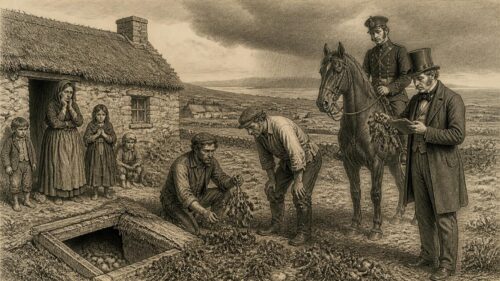
Nor should the continuity of the show calendar be mistaken for continuity in rural conditions. Nineteenth-century Ireland encompassed famine, eviction, mass migration and sharp regional differences in farming. The RDS’s historical material records that potato blight was detected at its Botanic Gardens in 1845 and that the Society sought research into a remedy. That episode demonstrates the limits as well as the ambitions of improvement. Scientific inquiry and institutional concern existed, but neither could avert the catastrophe that followed. Agricultural display did not place rural society beyond ecological vulnerability or political failure.
Local Arenas
County and local shows gave the broader culture of exhibition a more intimate scale. They could bring pedigree stock and commercial firms together with flower arranging, poultry, preserves, crafts, children’s competitions and community fundraising. Their exact form varied greatly. Some became prominent regional institutions; others were small, intermittent or dependent on the commitment of volunteers. This variety matters. There was no single Irish countryside and no uniform “show tradition”. A cattle-producing district, a tillage area, a horse-breeding locality and a mixed small-farm region would not necessarily put the same priorities in the ring.
Clonmel’s documented history illustrates the links between provincial settings and national agricultural institutions. The town hosted Royal Irish Shows in the nineteenth century, including after the merger of the Royal Agricultural Society of Ireland with the RDS in 1880. Such occasions drew attention and trade into a local place while also carrying national standards outward from Dublin. They were meeting points between centre and locality, not simply one-way broadcasts of metropolitan expertise.
Older fairs form another part of the background. Ballinasloe’s cattle and sheep fair, recorded in nineteenth-century travel writing, was first and foremost a market rather than a modern agricultural show. Its scale, seasonal rhythm and associated traffic nevertheless reveal how livestock exchange could transform a town into a gathering place for farmers, dealers, labourers and visitors. The distinction should be preserved: fairs centred on sale and movement of stock; shows centred more explicitly on exhibition and competition. In practice, both could mingle commerce with spectacle, news, recreation and social encounter.
Folklore frequently gathers around such events. Communities remember a famous bull, a champion mare, a storm that flattened tents, a judge who made an unpopular decision, or a family’s first prize. These memories have historical value as expressions of belonging, but they are not automatically documentary proof. Where show catalogues, contemporary newspapers, photographs or institutional minute books survive, they allow firmer claims about dates, entries and organisation. Where only retrospective anecdotes remain, it is better to identify them as local memory. Respect for folklore does not require pretending that it answers every factual question.
State Formation
The history of shows also belongs to the history of the Irish state and its predecessors. Agricultural exhibition flourished alongside a widening network of technical education, research, advisory work, co-operation and farmer organisation. These were not identical systems, but they shared an assumption: farming could be improved through the circulation of information and the organisation of collective effort. The show supplied visibility; the adviser, instructor, experiment station, creamery and college supplied other forms of knowledge and infrastructure.
Teagasc’s history of the agricultural advisory services describes the early twentieth century as a period in which trained instructors were sent into rural communities to assist farmers with farm enterprises. That account rightly emphasises transformation, while also reminding readers of the starting point. Rural Ireland at the opening of the century was marked by poverty, uneven opportunity and limited services. Agricultural progress cannot be measured only in prize stock or exports. It also involved the slow extension of education, advice, infrastructure and organisational capacity.
After independence, agriculture had exceptional economic and political weight in the Irish Free State. Farmers were not passive recipients of policy. They formed organisations, pursued their own interests and contested taxation, land questions, prices, trade and state intervention. A doctoral study held by University College Cork stresses the importance of farmers’ organisations in the political life of the Free State area between 1919 and 1936. The point is wider than that period: rural policy has always involved negotiation. Government programmes encounter households with different land types, debts, labour needs, market positions and expectations of fairness.
The National Ploughing Championships, founded in 1931, became one of the clearest twentieth-century embodiments of that negotiation between competition, technique and public culture. Ploughing offered a particularly legible contest. Spectators could see the line of the furrow, the depth and evenness of the work, the handling of horse or tractor and the practical discipline of the competitor. In later decades the championships expanded far beyond a technical contest, becoming a major gathering for agriculture, commerce, rural organisations and politics. Their continued cultural importance confirms that the appetite for agricultural demonstration did not disappear with mechanisation.
Changing Countryside
Mechanisation, farm consolidation, changing diets, European integration and export-oriented food production altered the world that shows represented. A twentieth-century show could display tractors, milking technologies, fertilisers and specialist breeds in ways that would have been unintelligible to an earlier generation. The object on display was no longer only the well-bred animal or skilfully turned furrow; it was increasingly a farming system linked to credit, inputs, processors, regulation and international markets.
This change complicates nostalgia. Rural shows are often remembered as survivals of a simpler Ireland, yet they were frequently vehicles for modernisation. Their stalls and demonstrations introduced new technologies and commercial relationships. They helped create a public vocabulary of efficiency and improvement. That does not mean every innovation was imposed or universally welcomed. It means that the showground was one of the places where modern rural life was argued into being.
There is, however, a difference between agricultural history and a story of inevitable progress. Increased production could bring prosperity and food security, but it could also increase dependence on purchased inputs, expose farms to price volatility and intensify pressure on soils, water and habitats. Historical interpretation should avoid judging earlier farmers by knowledge unavailable to them. It should also avoid treating the environmental consequences of productive agriculture as unforeseeable accidents. By the late twentieth century, environmental regulation and sustainability had become unavoidable parts of agricultural public life.
Climate Reckoning
Climate policy introduces a new scale of accounting. Traditional show judging asks whether this animal, crop, machine or craft meets a visible standard. Climate governance asks how the accumulated emissions of a sector affect a shared atmosphere over time. The relevant units may be tonnes of carbon dioxide equivalent, methane trajectories, fertiliser use, soil condition, hedgerow management or land-use change. Much of this is not immediately visible from the show ring. It requires measurement, modelling, record keeping and scientific interpretation.
In the Republic of Ireland, the Climate Action and Low Carbon Development (Amendment) Act 2021 established a statutory framework for climate action, including carbon budgets and sectoral emissions ceilings. Government agreed the sectoral ceilings in July 2022. Agriculture was assigned a pathway requiring a 25 per cent reduction in greenhouse-gas emissions by 2030 relative to 2018, expressed in the original ceiling as a fall from roughly 23 to 17.25 million tonnes of carbon dioxide equivalent. The Climate Action Plan 2025 remains part of the statutory annual planning process under that framework.
These are policy facts, not a verdict on individual farmers. They nevertheless have direct consequences for farm decision-making and for the organisations that speak to farmers. Teagasc identifies areas including methane reduction, nitrogen efficiency, soil carbon, biodiversity, diversification, adaptation and circular food systems within its climate strategy. Its Signpost work and demonstration farms explicitly use peer learning and on-farm events to share practices. In this respect, the historical comparison is real: contemporary climate action again relies on public demonstration as well as written regulation.
The comparison has limits. A nineteenth-century premium for a tree plantation or an admired shorthorn did not amount to a climate plan. Today’s challenge is governed by binding national objectives, international scientific assessment and quantified emissions inventories. Agricultural methane, nitrous oxide from soils and fertiliser, energy use, forestry and drained organic soils cannot be addressed simply by choosing a new champion at a show. The evidence required is broader, the stakes more collective and the trade-offs more explicit.
Farm Emissions
For Irish agriculture, the issue is especially politically charged because livestock production is central to the rural economy and to national food exports. It is also environmentally complex. Cattle and sheep systems differ; land quality differs; a dairy enterprise, a suckler herd, a tillage farm and a mixed holding cannot be treated as identical. Measures that reduce emissions intensity are not necessarily the same as measures that reduce absolute emissions. Measures that suit one farm can impose difficulty or cost on another. A historically serious discussion must acknowledge these distinctions rather than speak of “the farmer” as a single type.
Climate policy also intersects with biodiversity, water quality and land use. A field cannot be understood only as a production surface or only as a carbon store. It may be a source of livelihood, a habitat, a cultural landscape, a site of drainage history and an inheritance shaped by generations of work. Policies that seek hedgerow protection, better nutrient management, woodland creation, wetland restoration or altered grazing systems may provide public benefits, but their local effects depend on design, funding, tenure and trust.
Interpretation is necessary here. The history of rural shows suggests that farmers are more likely to engage seriously with change when it is made practical, observable and open to discussion among peers. It does not prove that demonstration will secure compliance with climate targets. Nor does it show that financial incentives, regulation or market reform can be dispensed with. Rather, it suggests that policy communicated only in distant abstractions may struggle, whereas policy connected to credible local evidence has a better chance of being tested and adapted.
Demonstration Futures
The modern farm walk, climate-smart demonstration and showground discussion may be understood as descendants of older exhibition culture. A demonstration farm makes a claim visible: cover crops, reduced tillage, slurry management, grass measurement, hedgerow care, energy saving or another practice can be examined in conditions closer to ordinary farming than a ministerial speech or a technical report. Visitors can ask about labour, cost, weather, risk and results. That questioning is not resistance to knowledge; it is part of how practical knowledge is assessed.
Yet the best historical lesson is not that every problem has a showground answer. Agricultural shows have always selected what can be displayed well. They favour the visible, the competitive and the celebratory. Climate adaptation also involves less photogenic work: repairing drainage in ways consistent with ecological needs, improving animal health, managing grass in difficult weather, reducing input dependence, protecting soils, gathering accurate data and planning for financial uncertainty. Public events can launch conversations, but sustained advisory support and fair policy instruments are needed to make change viable.
There is a democratic question too. Show culture has often made rural expertise visible, but it has also conferred prestige unevenly. A climate-conscious revival of its best traditions would widen rather than narrow participation. It would recognise women’s work, farm workers, younger entrants, smallholders, contractors, organic and conventional producers, advisers, scientists and communities affected by agriculture. It would admit disagreement without treating every disagreement as bad faith. The point is not to manufacture consensus, but to build forums in which evidence can be understood in relation to lived conditions.
Such an approach should not romanticise the past. Earlier improvement programmes could be paternalistic, and prizes sometimes encouraged narrow ideals of productivity or appearance. The historical value of the rural show lies instead in its reminder that farming has long been a public craft. Rural people have repeatedly encountered change through things they could inspect: a crop, an animal, a machine, a field, a trial plot, a neighbour’s account. Climate policy must work through more complicated evidence, but it cannot afford to abandon the human institutions through which agricultural knowledge becomes credible.
Shared Landscapes
Irish rural shows offer a record of the changing relationship between land, labour, knowledge and public life. From RDS premiums and nineteenth-century stock exhibitions to local shows and the National Ploughing Championships, they made agricultural ambition visible. They connected private farms to wider networks of commerce, expertise and national identity. Their history also reveals exclusions, inequalities and the danger of mistaking display for universal experience.
Climate policy now asks rural Ireland to undertake another far-reaching transformation, one measured not only in output and income but in emissions, resilience, biodiversity and the long-term condition of land. That programme must be judged by evidence and outcomes, not by heritage sentiment. Still, the old showground offers one enduring insight. Change becomes more durable when people can see what is proposed, question those proposing it, compare it with their own experience and share fairly in its risks and rewards. The future of the countryside will not be decided by spectacle alone, but it will be poorer if the public places where farming explains itself are allowed to lose their purpose.

The article usefully contrasts the visible judgements of historic rural shows with climate governance, whose measures of methane, soil carbon and biodiversity depend on records, modelling and scientific interpretation. This suggests that demonstration farms and gatherings may build confidence, yet cannot by themselves resolve questions of accountability or fairness between dairy, suckler, tillage and mixed holdings. The history of prizes also reminds us that standards influence what farmers regard as progress. How might Ireland adapt the persuasive strengths of its show traditions while ensuring that climate measures are transparent, locally appropriate, properly verifiable and attentive to farm circumstances and livelihoods?