

Unequal Warmth
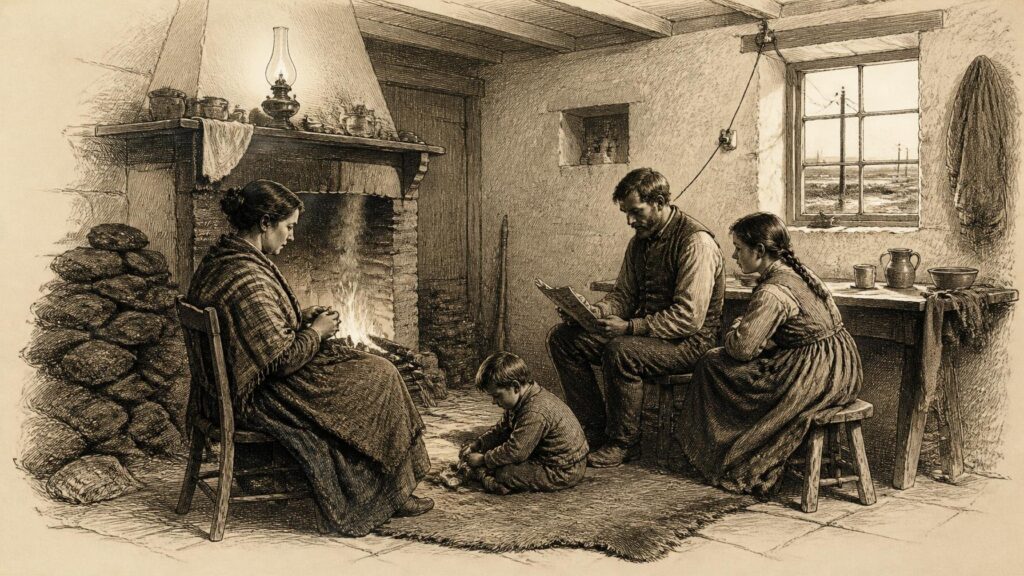
AI generated historical illustration, not a contemporary photograph.
At a Glance
Cold Houses
Energy poverty is a modern expression for an old Irish predicament: the inability to secure enough warmth, light and power for an ordinary home without sacrificing other necessities. The phrase belongs largely to the policy vocabulary of the twenty first century, but the hardship it describes has a far longer history. In Ireland, the cost and availability of domestic energy have been shaped by geography, landholding, uneven industrial development, housing standards, imported fuel, public infrastructure and social welfare. Climate policy now adds another dimension. The country must reduce the carbon emissions associated with heating homes, while ensuring that the people living in the least efficient dwellings are not asked to bear an unfair share of the cost.
That is a historical problem as much as an environmental one. A house could be poor in energy even where fuel was locally available. Turf still had to be cut, dried, carried and stored; coal and oil had to be bought; a hearth could heat one room while leaving the rest of the dwelling cold. Electricity, once it arrived, transformed domestic life but did not abolish unequal access to comfort. In later decades, central heating, bottled gas, mains gas, oil boilers, electric storage heaters and insulation altered the material meaning of a warm home. None removed the underlying importance of income.
Documentary evidence is strongest where the story intersects with state schemes, energy statistics, official reports and surviving institutional archives. It is weaker when considering the private experience of cold rooms, damp bedding, rationed fires or the seasonal calculation of whether another bag of fuel could be afforded. Such experience is nevertheless central. Statistics measure expenditure, self reported deprivation and dwelling efficiency; they cannot wholly capture domestic anxiety, illness, embarrassment or the discipline of living in only one heated room. Historical interpretation must therefore join official evidence to a cautious reading of household life.
The history is also not identical across the island. This account chiefly concerns the Republic of Ireland, whose social welfare system, energy institutions and climate legislation are distinct. Northern Ireland has its own administrative history, though its dependence on oil heating, rural settlement pattern and exposure to wider energy shocks create important parallels. It would be misleading to compress those different jurisdictions into a single uncomplicated Irish story.
Inherited Fuels
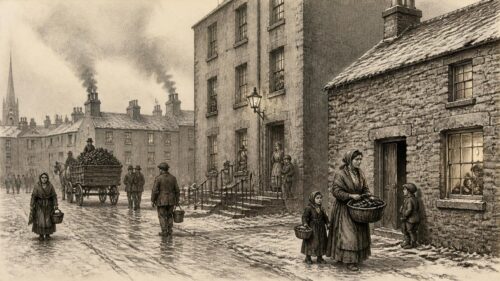
Before modern networks, warmth depended upon fuels that were close at hand, tradable, or laboriously gathered. Wood, turf and coal all had their place, varying by locality, class, landscape and period. The open fire was not merely a source of heat; it was a centre for cooking, drying, work and sociability. Yet the familiar image of the Irish hearth should not be allowed to become sentimental evidence. A glowing fire in a remembered kitchen may signify hospitality, but it may equally conceal smoke, labour, poor ventilation, a cold scullery and a household whose warmth was confined to a single room.
Coal was especially important to urban and industrial households, while peat was deeply associated with many rural districts and the Midlands. Neither association was absolute. Fuel could move through markets, and households often used mixtures of fuels according to price, availability and appliance. The distinction matters because present debates sometimes treat traditional fuels as fixed identities rather than changing economic choices. People heated homes with what they could obtain and afford, with what their grate or range would burn, and with what the surrounding infrastructure supplied.
Domestic energy was also inseparable from gendered work. Gathering kindling, cutting and footing turf, carrying water, tending ranges, cleaning ash and managing laundry imposed a repeated burden, much of it undertaken by women and children. Later electrification and household appliances reduced some forms of drudgery, although they did not automatically redistribute domestic labour. Oral histories preserve vivid recollections of lamps, candles, range fires and the first electric light. They are valuable testimony, but they are not a substitute for a complete social record. Memory often gives special brightness to the moment of change.
The historical point is not that all earlier homes were uniformly miserable, nor that modern energy automatically delivers well being. Rather, a dwelling’s warmth has always rested upon an unstable settlement between fuel, money, labour and building fabric. That settlement is the ancestor of today’s energy poverty debate.
Peat Landscapes
Peat occupies an unusually powerful place in Irish energy history. Peatlands are archaeological landscapes as well as fuel reserves. The Heritage Council notes evidence of trackways, platforms, turf stacks and industrial remains across bog environments, while research into early Irish fuel use indicates that peat cutting was common by the medieval period. Claims that turf was used in Ireland at a precise prehistoric date should be treated more carefully. Peatlands have preserved evidence from many eras, but the dating and meaning of particular uses vary greatly from site to site.
By the modern period, hand cut turf was a practical seasonal fuel. The specialised sleán, the drying bank and the stacked clamp were parts of a working landscape. Turf could be locally accessible where cash income was limited, but accessibility did not mean ease. It required rights of access, physical capacity, favourable weather, time and storage. A household without land, transport, health or labour could not simply draw comfort from the presence of a bog. The distance between a resource in the landscape and warmth in a room is one of the recurring themes of Irish energy history.
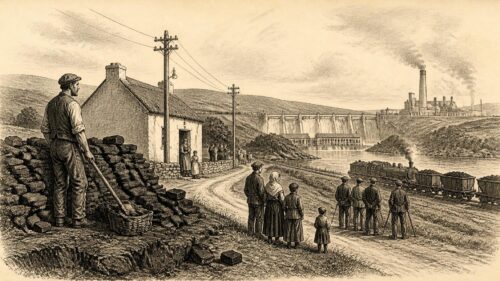
Twentieth century state development altered the scale of peat use. The Turf Development Board was established in 1934 and became Bord na Móna in 1946. Mechanised extraction, railways, briquette production and peat fired generation made the bog a site of employment, industrial policy and national energy planning. In the midlands, this infrastructure provided jobs and gave tangible form to the promise that indigenous resources could reduce dependence on imported fuel. It also created landscapes and communities whose relationship with peat cannot fairly be reduced to nostalgia or environmental damage alone.
Climate science and environmental regulation have changed the public meaning of peat. The carbon stored in peatlands, the emissions associated with extraction and combustion, and the ecological importance of bog restoration have brought a long energy tradition into direct conflict with decarbonisation. That conflict should not be caricatured as a contest between modern knowledge and backward custom. It is better understood as a collision between legitimate historical attachments, employment histories, household habits, public health concerns and the compelling need to reduce emissions.
Folklore and family recollection often make turf a symbol of self reliance. There is truth in the memory of skill, labour and local knowledge. But no historical account should infer from this symbolism that turf was free, universally available, harmless, or sufficient to heat every home adequately. The evidence instead shows an energy practice embedded in social inequality and changing state policy.
National Power
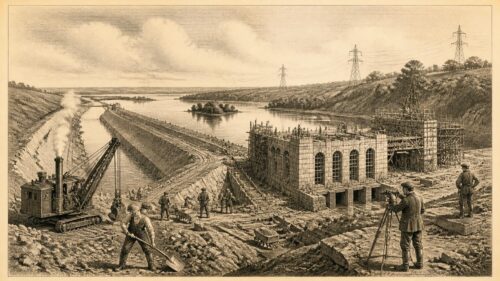
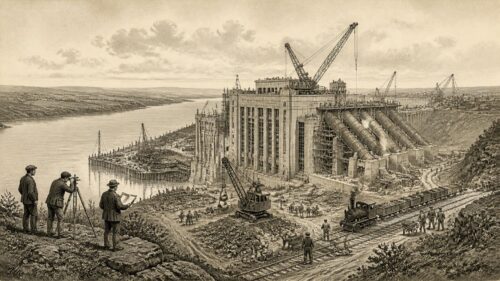
The foundation of the Electricity Supply Board in 1927, following the Shannon Scheme at Ardnacrusha, represented a major assertion of public capacity by the young Free State. Electricity was initially unevenly distributed and concentrated where demand and infrastructure made supply more economical. The national system nevertheless created a framework through which energy could be imagined as a public service rather than only a local commercial arrangement. That institutional inheritance remains important whenever modern policy debates the cost of networks, the ownership of infrastructure or the social obligations of suppliers.
Electricity did not initially replace the hearth as the principal source of domestic heat. For many households it first meant lighting, a radio, an iron, a kettle, a pump or machinery. Its social significance was therefore broader than the meter reading. It extended the usable day, enabled new forms of household work and communication, and made modern appliances imaginable. Still, the ability to use an appliance depended on the ability to pay for supply and consumption. Electrical connection and electrical comfort were not identical things.
The ESB archives show how strongly the national electricity project was bound up with a vision of social development. This did not make it costless or politically simple. Rural lines were expensive, scattered households were difficult to serve, and the question of who should pay lay at the centre of planning. Decisions about public subsidy, connection charges and cross subsidy between consumers were already recognisably questions of energy justice. They demonstrate that the present argument over whether climate investment should be paid for through bills, taxes or public borrowing has historical predecessors.
Public energy systems can be read in two ways. One reading stresses technical achievement: dams, generating stations, pylons and wires. Another stresses distribution: which homes were connected first, who paid, who was left waiting, and how a national service reconciled commercial accounts with social purpose. The second reading is indispensable to the history of energy poverty.
Rural Light
The Rural Electrification Scheme, launched in 1946, became one of the defining infrastructural projects of independent Ireland. ESB Archives records that its first phase ran from 1946 to 1965, dividing rural Ireland into 792 areas. By 1964, more than 50,000 miles of line had been strung and over one million poles erected. The programme connected places that had long been beyond the economic logic of private supply and helped to transform farming, domestic work, local business and social life.
The phrase “quiet revolution” is frequently applied to the scheme. It conveys something genuine: electric light and power profoundly altered rural daily life. Yet it is an interpretative label rather than a complete explanation. Electrification reached households at different moments, appliances took time to acquire, and pre existing inequalities did not disappear once a switch was fitted. The arrival of a line ended one form of exclusion while beginning a new relationship with bills, tariffs and electrical appliances.
Recorded recollections frequently dwell on the first bulb illuminating a kitchen or parish hall. Such accounts deserve respect because they preserve an emotional history absent from engineering tables. They should, however, be distinguished from folklore in the strict sense. A tale of a village first turning on its lights may have been repeated and embellished over generations; archive records, installation files and contemporary broadcasts provide firmer evidence of dates and sequence. The historical value of memory lies not only in literal precision but in showing what people believed the change had meant.
Rural electrification also offers a lesson for climate policy. Large scale transition works when it is treated as a collective undertaking, supported by planning, public investment and local participation. But it also shows that infrastructure does not by itself create equality. A grid connection can enable modern heating, yet a poorly insulated home, low income or high unit prices may still keep that heating beyond reach.
Oil Dependence
Postwar development broadened the Irish fuel mix. Peat stations, oil fired generation, imported coal, natural gas and electricity all played parts, while domestic heating increasingly shifted according to urban access, building design and market conditions. Oil became especially important in homes beyond the gas network. Its convenience was considerable: a tank could serve a detached or rural dwelling without the need for a coal scuttle or daily fire tending. But that convenience also linked households to international price movements over which they had no control.
The oil crises of 1973–74 and 1979 exposed the vulnerability of energy importing states. Ireland’s policy response included support for solid fuel boiler systems, an intervention later noted by Environmental Protection Agency research when examining the historical pattern of air pollution. The episode is revealing. A measure designed in one crisis to help households secure heat could contribute to another problem, namely particulate pollution. Energy policy rarely produces a single uncomplicated outcome.
The environmental costs of domestic combustion became more visible as monitoring, public health research and air quality regulation developed. Smoke was not an unfamiliar nuisance in Irish towns, but formal regulation gave it a new administrative significance. The Local Government Sanitary Services Act of 1962 gave local authorities powers relating to smoke, dust, grit and gas pollution. Later measures refined the effort to control dark smoke and eventually restrict the sale of more polluting solid fuels.
These changes complicate any simplistic account of fuel choice. Households using peat, coal or wood may be responding to price, appliance, tradition, availability or the need to heat a room quickly. The health and climate effects of solid fuels do not disappear because a choice is understandable. Conversely, the existence of those effects does not make households morally responsible for long standing failures of housing, income support or affordable alternatives. Historical explanation must hold both truths together.
Welfare Responses
The modern welfare response to heating costs emerged from older, more local arrangements. Before 1988, the Urban Fuel Scheme administered by local authorities gave certain pension and welfare recipients an entitlement in defined urban or local authority areas. The national Fuel Allowance scheme was introduced in 1988. The Department of Social Protection’s operational guidance is explicit about its limited purpose: it assists qualifying households with heating costs but is not intended to meet those costs in full.
That limitation is historically important. Fuel Allowance acknowledges that winter heating is not an optional consumer purchase. It is a recurrent necessity that can threaten the budgets of pensioners, people with disabilities, carers, unemployed people and families on low incomes. At the same time, a cash contribution cannot repair a leaking roof, insulate a cavity wall, replace a failing boiler or make an inaccessible rented dwelling more efficient. Income support eases immediate hardship; it cannot alone alter the energy performance of the home.
The language of “fuel poverty” entered Irish public debate gradually. Evidence cited in Oireachtas material traces references in newspapers and parliamentary debate from the late twentieth century, while dedicated research gathered pace in the 2000s. The change in language mattered because it moved the issue beyond charity or seasonal welfare. It identified a structural relationship between household resources, energy prices and dwelling conditions.
In historical terms, the Fuel Allowance scheme marks a recognition that the social state has responsibilities for warmth. Its design nevertheless leaves difficult questions. Eligibility rules can exclude people whose incomes are low but who do not fit a qualifying category. Payments may arrive when prices have already risen. A household above a formal threshold may still be trapped by debt, disability, caring responsibilities or exceptionally poor insulation. These are not arguments against the scheme; they explain why it has had to coexist with wider measures.
Measured Hardship
Energy poverty is difficult to count because it has more than one form. A household may spend a very high share of income on fuel, fall behind on bills, keep rooms unheated, use less energy than health and comfort require, or cut food and other essentials to pay for warmth. It may have a technically adequate heating system but be unable to run it. It may also appear to have modest bills because it is under heating. No single measure captures every case.
Official Irish analysis has used expenditure thresholds, including the familiar ten per cent measure, alongside indicators derived from survey responses. SEAI’s residential research recorded a sharp deterioration after the financial crisis: the proportion reporting that they could not afford to keep their home adequately warm rose from four per cent in 2006 to ten per cent in 2013, while those reporting that they had gone without heating at some point rose from six to sixteen per cent. The figures later improved, but they established that fuel poverty could expand rapidly when prices, unemployment and falling incomes converged.
The ESRI has cautioned that energy poverty is multidimensional and closely connected to general poverty, housing quality and inequality. This is not a mere academic refinement. It explains why two homes with similar bills can experience very different hardship. The tenant in a damp rented house, the lone pensioner in a large older dwelling, the rural household dependent on delivered oil, and the family with medical equipment requiring electricity may face distinct risks even where their annual expenditure appears similar.
Measurement also carries political consequences. A narrow metric can make hardship invisible; an over broad one can obscure the people in greatest need. The best historical reading is therefore cautious. Numbers are indispensable evidence, but they do not cancel testimony. Nor should a temporary fall in one indicator be treated as proof that the underlying vulnerability has vanished.
Housing Legacy
Energy poverty is partly a history of buildings. Ireland’s housing stock contains homes constructed under very different standards, with varying levels of insulation, ventilation, glazing and heating control. Many older houses were designed around open fires or ranges rather than whole house thermal comfort. Later suburban and rural building expanded home ownership but did not always produce low energy dwellings. A large detached house can be an asset in one sense and a financial burden in another when it is difficult to heat.
SEAI has noted that Ireland had among the highest energy intensities per dwelling in the European Union until the mid 2000s. This does not mean every Irish household was wasteful. It points instead to the combined effect of building fabric, fuel choices, home size, occupancy patterns and climate. A home may consume substantial energy simply because it loses heat rapidly. Asking occupants to solve this by turning down the thermostat converts an infrastructure problem into a personal discipline.
The condition of the home also affects health. Cold and damp are associated with respiratory and cardiovascular risk, while poor heating can deepen stress and isolation. The causal pathways are not always simple, and a historical article should avoid claiming that every cold house produces a particular illness. Yet government strategy and public health initiatives have long treated energy efficiency as relevant to well being, not merely to fuel bills or carbon accounting.
Housing tenure matters. Owner occupiers may have access to grants but lack savings or borrowing capacity. Private tenants may bear bills but lack authority to undertake works. Social housing providers may be able to organise upgrades at scale, though their programmes depend on funding, stock condition and administrative capacity. The history of energy poverty is therefore not a story of households alone; it is also a story of ownership and power.
Policy Language
Irish policy moved from the older term “fuel poverty” towards the wider expression “energy poverty.” The newer language reflects the fact that household need includes electricity and other energy services as well as space heating. It also better captures a changing domestic environment in which refrigeration, cooking, communication, lighting, digital access and medical equipment may all depend upon affordable power.
The government’s Strategy to Combat Energy Poverty, published in 2016 and retained as a public policy reference, sought to coordinate income support, consumer protection and energy efficiency. Its significance lies not in a single initiative but in the acknowledgement that no department or agency can solve the problem alone. Social protection, housing, public health, energy regulation and climate policy meet in the same kitchen.
That coordination is difficult. Emergency payments can be arranged more quickly than deep retrofits. Grants can be announced before enough trained workers, assessors and contractors are available. National targets can be clear while local delivery remains uneven. The distinction between policy intention and achieved change is crucial historical evidence. Announcements tell us what governments intended or wished to signal; completed works, bills, health outcomes and household experience tell us what changed.
The terminology also shapes public understanding. “Affordability” can sound neutral and technical, while “poverty” names inequality more plainly. Both have uses. Affordability brings attention to prices and the wider market; poverty directs attention to unequal resources and human need. A durable policy must address both.
Carbon Dilemmas
Climate policy has made domestic energy more politically sensitive because the fuels that provide immediate heat often create carbon emissions. Ireland’s residential sector has remained dependent on oil, gas, coal, peat and electricity generated within a changing national system. The Environmental Protection Agency records that residential emissions are driven by space and water heating, and that the pace of reduction depends heavily on retrofit and the movement away from fossil fuels.
The carbon tax illustrates the dilemma. In principle, putting a price on carbon encourages lower emission choices and helps fund transition. In practice, the immediate capacity to choose differs sharply. A household with savings, access to finance and a suitably insulated home may be able to install a heat pump or change car. A low income household in an inefficient dwelling may face the tax chiefly as a higher bill. The policy is not rendered illegitimate by this inequality, but its fairness depends on what happens to the revenue and whether alternatives are genuinely available.
Irish governments have committed carbon tax receipts to social welfare, fuel poverty measures, retrofit and support for a wider just transition. This is a historically significant principle because it accepts that environmental taxation requires social reciprocity. Revenue is not merely a fiscal gain; it is intended to help households adapt. The effectiveness of that promise depends on allocation, delivery and continuity, not on principle alone.
Climate policy can therefore deepen or lessen energy poverty. It deepens it when it raises costs without providing support, locks tenants into poor homes, or assumes all consumers can make capital investments. It lessens it when it reduces a home’s demand for heat, replaces costly and polluting systems, protects vulnerable consumers and improves resilience against imported fuel shocks.
Health Burdens
Domestic fuel has always involved more than a question of warmth. Burning coal, peat and wood releases pollutants, and the EPA has identified residential solid fuel combustion as a major contributor to fine particulate pollution in several Irish towns. Research in Killarney, Enniscorthy and Birr found that the burning of peat, coal and wood for home heating was by far the largest source of wintertime PM2.5 in those locations.
This evidence challenges the idea that a warm fire is automatically a healthy fire. Open hearths and solid fuel stoves may provide immediate heat and emotional comfort, but they can expose households and neighbours to harmful pollution. The effects are especially important for older people, children and those with respiratory conditions. Again, the historical interpretation must avoid blaming households whose options have been constrained by income, infrastructure or dwelling design.
The Solid Fuel Regulations introduced in 2022 sought to limit the sale and distribution of the most polluting fuels for domestic combustion. Their principal purpose is air quality, though they also sit within a wider movement away from carbon intensive heating. Such regulation illustrates a recurring tension: public authorities may reasonably restrict a damaging fuel, but a fair transition requires that cleaner alternatives are affordable, reliable and practical for households accustomed to solid fuel appliances.
The link between health and housing has encouraged more integrated approaches. The Warmth and Wellbeing Scheme, established in 2016, joined energy, health and social policy in providing extensive upgrades to eligible homes occupied by people with chronic respiratory conditions. Its importance is conceptual as well as practical. It treats a warmer, more efficient dwelling as part of preventive health policy.
Retrofit Turn
The turn towards retrofit is one of the clearest developments in modern Irish energy policy. The Better Energy Warmer Homes Scheme, rooted in a programme operating since 2000, targeted vulnerable and fuel poor owner occupiers with upgrades such as insulation and other efficiency measures. Over time, policy shifted from relatively shallow works towards deeper whole house renovation and renewable heating where suitable.
Retrofit is attractive because it brings several aims together. Better insulation can reduce heat loss; heating controls can improve comfort; upgraded systems can reduce fuel use and emissions; and lower demand can make households less exposed to price shocks. But these outcomes should not be assumed mechanically. Residents may choose to use some of the gained efficiency to heat rooms they previously left cold. This is often described as comfort taking. In a fuel poor household, it should not be dismissed as failure. Greater warmth may be precisely the social benefit the work was meant to produce.
The modern Warmer Homes scheme provides fully funded upgrades for qualifying homeowners receiving specified welfare payments, subject to conditions concerning the dwelling. This is a powerful intervention, but its eligibility rules reveal a continuing challenge. People who rent privately, who live in unsuitable buildings, who are just above an income threshold, or who cannot navigate an application process may remain outside the most generous assistance.
Retrofit also requires patience. A national programme needs surveyors, designers, installers, quality assurance, supply chains and public trust. The Comptroller and Auditor General has observed the rising cost and changing depth of works in residential schemes. These are not reasons to abandon retrofit; they show why quick numerical targets must be reconciled with sound work, household disruption and the practical realities of older homes.
Uneven Access
Not all households can use the same route out of energy poverty. Gas network access remains geographically uneven. Oil dependence is especially consequential in many rural areas. Apartment dwellers may depend on landlords or management companies. Older people may be reluctant or unable to manage major building works. People with disabilities may have higher energy needs, while households in precarious employment may be unable to bear a large winter bill even if their annual income appears adequate.
Electricity adds another layer. As heating, transport and everyday services become more electrified, the reliability and affordability of power assume greater social importance. A transition to heat pumps and electric vehicles may reduce fossil fuel use, but it must not create a system in which households without capital pay high standing charges while better off households gain the principal benefits of self generation, storage or flexible tariffs. This is an interpretation of the historical evidence, not a prediction. The earlier history of grid extension suggests that distributional arrangements will matter as much as technology.
Recent energy shocks have demonstrated this point sharply. ESRI analysis has found that price increases fall more heavily on lower income households because energy forms a larger share of their spending. Broad tax reductions can ease pressure, but they may also direct substantial public support to households that are not in acute hardship. Targeted payments are usually more progressive, although they rely on workable systems for identifying need. There is no entirely frictionless solution.
The central lesson is that energy policy must see households in context. A bill is not simply a bill. It is connected to tenure, health, family composition, location, transport, weather, building condition and access to public services.
Climate Statute
Ireland’s Climate Action and Low Carbon Development framework, strengthened by the 2021 amendment, gives statutory force to the long term objective of climate neutrality by 2050 and structures carbon budgets and sectoral ceilings. The annual Climate Action Plans turn that legal framework into programmes of action. Buildings and residential heating are necessarily central because homes produce emissions and because upgrading them can reduce both demand and exposure to fuel price volatility.
The legal framework does not answer every social question. A carbon budget tells government that emissions must fall; it does not decide which household should pay first for a new heating system, how a tenant should obtain a better home, or what level of winter support is sufficient. Those questions return policy to the older history of public responsibility for warmth.
Recent planning for a Social Climate Plan has explicitly recognised households in energy poverty and people vulnerable to the effects of rising fossil fuel prices. This is a significant development because it connects Irish climate action to European social funding and places distributional protection within transition planning. It should not be treated as proof that justice has been achieved. Plans are commitments whose value must be judged by implementation.
There is a temptation to regard climate law as abstract and domestic heating as private. Irish history shows the opposite. Energy systems are public creations, built through laws, subsidies, public bodies, regulation and collective payment. The warmth of a kitchen has never been entirely private when it depends on national grids, imported fuel, building standards, welfare rules and environmental limits.
Just Transition
A just transition is sometimes presented as a new phrase, but its underlying question is familiar: how can society change an essential system without abandoning people who relied upon the old one? In Ireland, that question applies to households using peat or coal, workers and communities shaped by peat extraction, rural homes dependent on oil, and consumers worried about the cost of electrification.
Justice does not mean preserving every existing fuel practice indefinitely. The evidence on emissions, air pollution and climate risk makes a transition away from high carbon domestic heating necessary. It does mean that policy should recognise unequal starting points. A household cannot be expected to embrace a cleaner system if the capital cost is prohibitive, the dwelling is unsuitable, installers are unavailable, or the replacement energy is unaffordable.
Historical comparison is useful here. Rural electrification succeeded not because every resident independently bought their way into modernity, but because a national system accepted the need for organised infrastructure and public support. The comparison should not be pushed too far: decarbonising heat involves different technologies and a more complex housing stock. Yet the earlier project remains a reminder that transition can be understood as a public work rather than merely a sequence of private consumer choices.
The strongest interpretation of the Irish record is that fairness and effectiveness reinforce one another. A policy that leaves people cold will struggle for durable legitimacy. A policy that makes homes warmer, cleaner and less expensive to run can build consent while cutting emissions. The difficulty lies in ensuring that its benefits reach those who need them first.
Evidence Limits
Historical writing on energy poverty must acknowledge what its sources cannot prove. National statistics reveal trends, but they cannot perfectly identify every household in need. Official scheme records show payments and upgrades, not necessarily the quality of each person’s life afterwards. Oral histories provide depth and feeling, but they are selective and shaped by later experience. Newspaper reports can reveal public controversy, but they often privilege dramatic cases.
Folklore deserves particular care. Stories of miraculous first lights, endlessly warm turf fires or universally self sufficient rural households carry cultural meaning. They should not be dismissed as false merely because they are simplified. But neither should they become evidence for general conclusions about income, health or fuel availability. The proper historical task is to identify the kind of source being used and to avoid making it say more than it can.
Likewise, present policy language should not be projected carelessly into the past. A nineteenth century household did not describe itself as experiencing energy poverty, and a mid twentieth century family awaiting an electricity connection was not participating in a modern climate transition. The underlying issues of warmth, cost, access and public provision may be connected across time, but the concepts and institutions changed.
Historical Balance
The Irish history of energy poverty and climate policy is not a tidy march from darkness to enlightenment. Turf, coal, oil, electricity, gas and renewable technologies have each solved problems while creating or exposing others. Public electrification widened opportunity, yet bills still mattered. Solid fuels offered accessible heat, yet damaged air quality and intensified carbon emissions. Welfare payments protected households, yet could not repair inefficient homes. Retrofit promises lasting relief, yet access remains unequal.
What the record demonstrates is a continuing public argument about the terms of ordinary comfort. Who has the right to a warm home? Who finances the systems that make warmth possible? How should the state protect people during a price shock? What obligations arise when familiar fuels threaten health and climate? These are historical questions because earlier generations confronted them in different forms; they are urgent questions because the answers now shape the legitimacy of decarbonisation.
Ireland’s most durable energy achievements have generally combined collective planning with social purpose. The lesson is neither that every past policy was successful nor that nostalgia offers a programme for the future. It is that climate action will be more credible when it understands warmth as a necessity, housing as energy infrastructure, and affordability as a condition of democratic consent. A lower carbon home that remains unaffordable is not a completed transition. A just energy future must make room for both the atmosphere outside and the people inside.
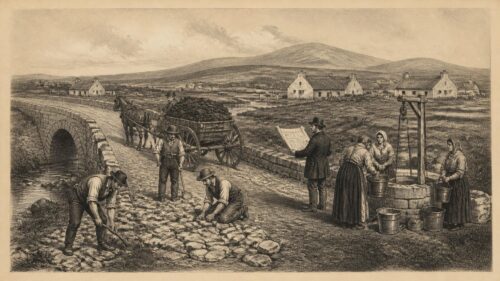
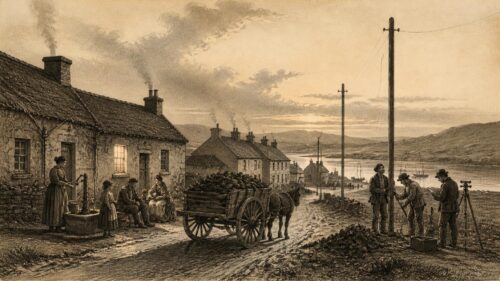
The article’s account of rural electrification and later fuel supports reveals a persistent tension: infrastructure can widen access, yet a connected home may remain cold because of poor insulation, low income or volatile prices. Its comparison of turf’s local significance with its health and climate costs also suggests that decarbonisation cannot be judged solely by emissions targets. Historical transitions repeatedly shifted burdens between labour, household budgets and public investment. As Ireland expands retrofitting and low-carbon heating, how should policy balance universal infrastructure, targeted income support and recognition of regional fuel traditions so that warmer, cleaner homes do not deepen inequalities?