Bann Fleet and Kingship734 CE
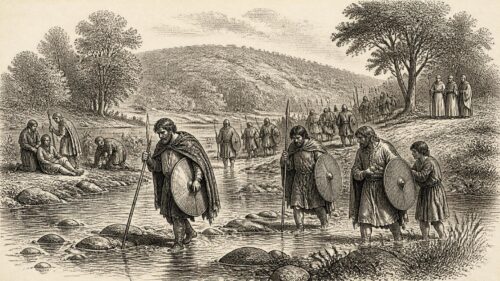
In 734, Áed Allán of Cenél nÉogain displaced Flaithbertach of Cenél Conaill as leading claimant to Tara after conflict at Mag nÍtha and a failed Dál Riata-supported naval effort near the Bann. Annals indicate slaughter on both sides but record Áed’s rule, while Flaithbertach retired into religion. The change strengthened Cenél nÉogain and curtailed Cenél Conaill’s wider influence, without creating a unified Irish monarchy. Regional rulers, including Munster’s Cathal, remained powerful. Churches supplied political and intellectual authority through relics, learning and patronage. Most people continued rural mixed farming, though warfare affected supplies, travel and local obligations across Ireland in practice.
Dateline
In 734 CE, a struggle within the northern Uí Néill reached its decisive political moment. Áed Allán, son of Fergal of Cenél nÉogain, emerged as the leading claimant to the kingship of Tara after years of warfare against Flaithbertach son of Loingsech, the Cenél Conaill ruler who had previously held that pre-eminent position. The surviving annals are terse and their year-numbering is not perfectly uniform, but the combination of the Annals of Tigernach, later Irish tradition and modern prosopographical scholarship securely connects 734 with Áed’s accession and with the collapse of Flaithbertach’s political dominance. This was not the creation of a united Irish monarchy. It was a major change in the shifting hierarchy of kings, kindreds and churches through which power was exercised across Ireland.
A Northern Contest Decided
Áed Allán and Flaithbertach belonged to rival branches of the northern Uí Néill. Flaithbertach was of Cenél Conaill, rooted in the north-west, while Áed belonged to Cenél nÉogain, whose principal power lay farther east and north around Ailech. Both dynasties claimed descent from Niall Noígiallach, but that shared ancestry was no guarantee of harmony. Rather, it supplied a language of legitimate rule within which rival families competed for land, clients, tribute, hostages and precedence.
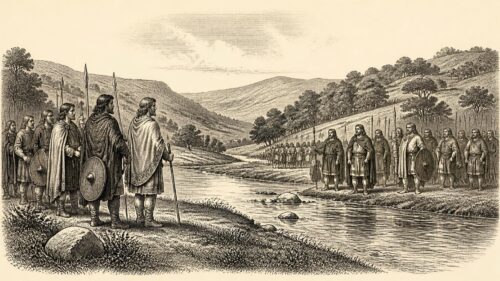
The contest had been intensifying since the early 730s. Earlier fighting at Mag nÍtha, the Finn valley in what is now east Donegal and west Tyrone, had demonstrated that Flaithbertach’s hold over the north-west was vulnerable. In 734 the annalistic record again places a battle there between Flaithbertach and Áed Allán. The Annals of Tigernach say that slaughter was made on both sides: a formulation which deliberately withholds a simple victor. Yet the same annal immediately records that Áed Allán “rules”. The sequence strongly suggests that, even if the field battle itself was indecisive, it formed part of the pressure that made Flaithbertach’s withdrawal unavoidable.
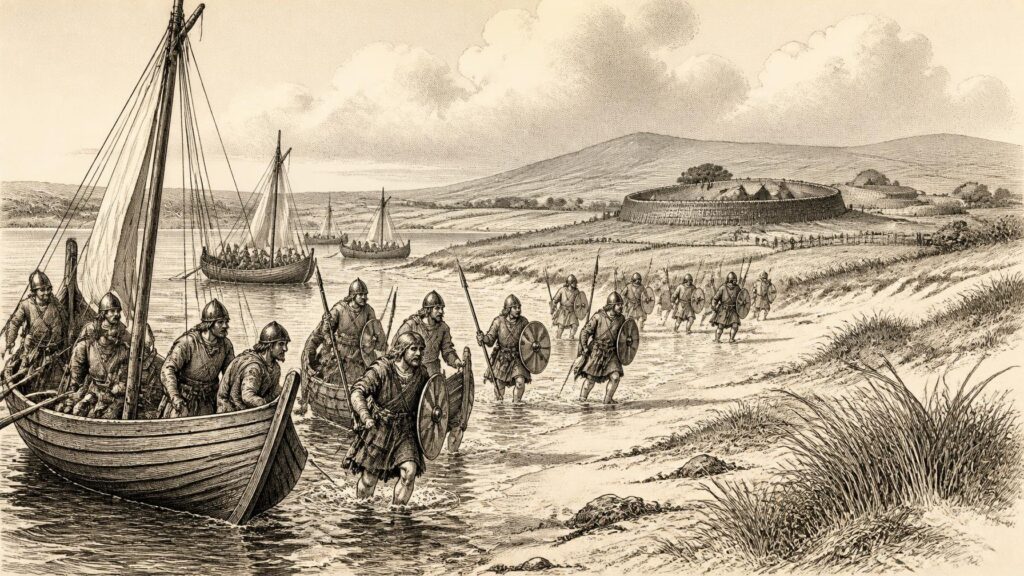
Modern historical reconstruction also associates 734 with a naval confrontation at the mouth of the River Bann. Flaithbertach had sought assistance from Dál Riata, the Gaelic polity spanning north-eastern Ireland and western Scotland, and a fleet was employed against Cenél nÉogain. The precise narrative cannot be recovered from the sparse entries: medieval annals do not describe formations, vessels, commanders’ orders or casualty totals. What can responsibly be said is that the maritime effort failed, that Dál Riata auxiliaries suffered badly, and that the Bann—an outlet to the north coast—was a strategically meaningful place to contest movement between north-east Ulster, the sea-lanes and the rival northern kingdoms.
The sea fighting matters because it corrects any image of eighth-century Irish politics as confined to inland forts and cattle routes. Fleets could move warriors, allies and supplies; the North Channel connected, rather than divided, communities in Ireland and western Britain. Flaithbertach’s resort to Dál Riata shows both the resources available to a powerful overking and the scale of the crisis confronting him. It also reveals the limits of those resources. A force drawn from across the sea could not preserve his position when Cenél nÉogain had gained the initiative on land and water.
Áed Allán Takes the Kingship
The Fragmentary Annals of Ireland explicitly place Áed Allán’s taking of the kingship in 734, and the Annals of Tigernach record his rule in their entry for that year. Medieval Irish sources often call such a position the kingship of Ireland, but the phrase should not be understood as a modern national office governing a single state. No central bureaucracy ruled the island, no uniform law was administered from one capital, and regional kings retained their own followers and ambitions. “Tara” was above all a claim to seniority among the Uí Néill and, in favourable circumstances, to wider supremacy.
Still, the transition was consequential. Flaithbertach was the last Cenél Conaill ruler to possess the paramount Uí Néill kingship for a very long time. His abdication and entry into religious life did not end Cenél Conaill rule in its own homeland, but it weakened that dynasty’s place in the larger politics of Ireland. Cenél nÉogain now held the advantage in the north. The outcome also helped set the terms for later rivalry: after Áed’s death in 743, the leading kingship would be contested principally by Cenél nÉogain and Clann Cholmáin of the southern Uí Néill, rather than returning readily to Cenél Conaill.
That longer consequence must not be mistaken for inevitability in 734. Áed’s new authority rested on relationships that had to be renewed constantly—through military success, assemblies, gift-giving, the taking of hostages, marriage links and ecclesiastical support. His immediate position was strong, but it faced powerful neighbours. Ulaid lay to the east; Airgialla and other peoples occupied the approaches southwards; southern Uí Néill dynasties commanded the midlands; Leinster and Munster remained formidable kingdoms beyond them. The annals for the following years show that Áed’s reign would be active, contested and violent.
A Kingdom of Local Powers
Elsewhere, the evidence for calendar year 734 is thinner but still revealing. The Annals of Inisfallen record the death of Áed son of Conaing, king of Iar Mumu, or western Munster. A single obituary does not explain a succession, but it is a reminder that the island’s political map was densely layered. Munster was not simply one kingdom ruled without interruption from Cashel: it contained subordinate and regional kingships, including Iar Mumu in the west. Death at this level could alter local alliances even when it did not make the wider annals.
Cathal son of Finguine, king of Munster, was still one of the most formidable figures in Ireland in 734. His campaigns and claims had already reached into Leinster, Brega and the politics of Tara. Yet the fighting commonly associated with Cathal against Leinster at Belach Éle belongs to 735 in the principal annalistic sequences, not securely to 734. It should therefore not be imported into this year merely to furnish a dramatic Munster episode. Its importance for 734 is contextual: Cathal’s continued power meant that Áed Allán’s accession in the north did not make him master of Ireland in any uncomplicated sense.
The same caution applies to the famous battle of Fochart in Muirthemne, where Áed Allán defeated the Ulaid and where rulers including Áed Rón were killed. Although some compilations and modern retellings can create confusion through differing annal dates, the event is conventionally placed in 735. In 734 it was still future. This distinction is worth making because Irish annals are indispensable evidence, but their chronological headings were copied, calculated and sometimes displaced across centuries of manuscript transmission.
Churches, Learning and Authority
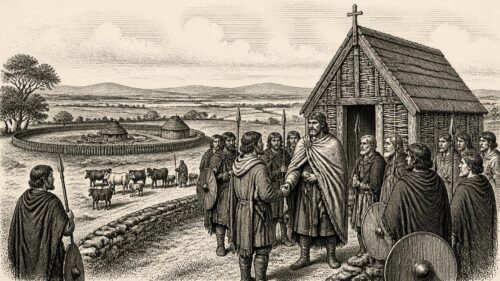
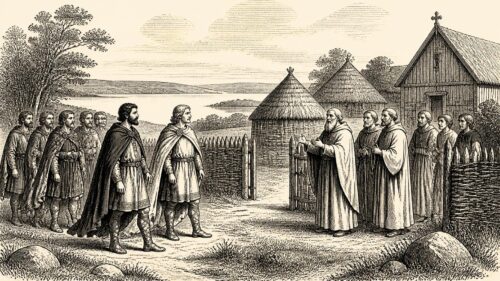
Christian institutions were integral to this political world. They were not separate from secular affairs, but landholders, centres of literacy, guardians of saints’ cults and places where elite families sought prestige, burial and religious protection. Armagh’s influence was especially relevant to the northern Uí Néill, while communities such as Iona, Bangor, Kildare, Clonmacnoise and many smaller churches connected regions through prayers, personnel, books and patronage.
An annal entered under 734 in the Annals of Tigernach records the ceremonial bringing forth and enshrining of relics of Peter, Paul and Patrick “to fulfil the law”. The accompanying tradition is too compressed to permit a detailed reconstruction of location, organisers or the law being enforced. Nor should it be treated as firm evidence for a precisely dated island-wide ceremony. Nevertheless, its placement in the annal shows how relics could be presented as instruments of public order. Apostolic saints and Patrick, Ireland’s foremost ecclesiastical patron, supplied moral authority that rulers and churches could invoke in disputes.
Another entry notes a lunar eclipse in the annal’s 734 section, though the calendrical detail differs between related chronicles. Such notices demonstrate the learned interests of Irish ecclesiastics: calculating lunar cycles and recording unusual celestial phenomena belonged to a wider intellectual culture shared with Britain and continental Europe. The death of the Northumbrian scholar Bede is recorded nearby in some annalistic traditions, but Bede died in 735 and should not be treated as an event of 734. His presence in Irish historical memory nevertheless reflects the close scholarly horizons of the Irish Sea world.
Life Beyond the Annals
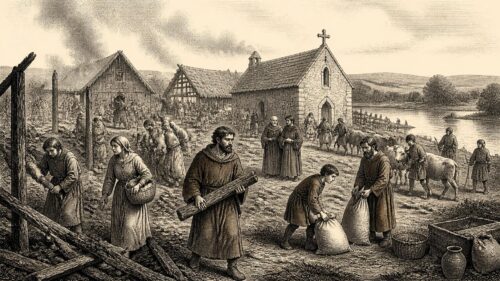
Most people living through 734 did not appear in written records. They cultivated crops, tended cattle, repaired houses and boundaries, travelled to local churches and negotiated obligations to lords and kin. Archaeology suggests a predominantly rural landscape of dispersed farmsteads, many enclosed by earthen ringforts or stone cashels. These were homes and working places as much as defensive sites: enclosures protected people, livestock, stores and status. Buildings of timber, wattle and thatch rarely survive, but animal bones, cereal evidence, hearths, field systems and the earthworks themselves show communities sustained by mixed farming.
The wars recorded in 734 would have touched that ordinary world. Armies required food, animals, guides and transport; defeated groups lost leading men and perhaps dependants; coastal and riverine zones could become routes for war-bands as well as trade and pilgrimage. Yet it would be wrong to turn every farmstead into a battlefield. The annals preserve elite crises precisely because they were exceptional. Daily labour, seasonal husbandry and local exchange continued beneath the movements of kings.
Thus 734 is best understood as a year of northern political reordering. At Mag nÍtha and around the Bann, the long rivalry of Áed Allán and Flaithbertach reached its end. Flaithbertach’s retreat from the kingship opened a new phase for Cenél nÉogain and diminished Cenél Conaill’s wider prospects. The change was real, but not final: Ireland remained a landscape of competing regional powers, church-centred communities and maritime connections, in which authority was continually won, displayed and renegotiated.
Primary Sources
- The Annals of Tigernach: Entries T733–T737
- The Annals of Ulster
- Fragmentary Annals of Ireland
- Annals of Inisfallen
- Áed Allán
- Flaithbertach
- Cathal
- CELT Project: The Annals of Tigernach
- CELT Project: The Annals of Ulster
- CELT Project: Fragmentary Annals of Ireland
- CELT Project: Annals of Inisfallen
- The Annals of Ulster, Part 304
- The Annals of Ulster, Part 305
- The Annals attributed to Tigernach
- Contributions Towards the Political History of Munster, 450–800 A.D. (continued)
- An Eighth-Century Royal Conversation: Cathal mac Finnguini and Áed Allán at Tír dá Glás, AD 737
- Nation and Kingship in Early Ireland
- Landscapes of Kingship in Early Medieval Ireland, AD 400–1150
- Ringforts / Ráthanna
- Dunleer – Rathdrummin
- Patrician and Early Christian Architecture
- The Earthen Rath or Lios