Cúl Raithin and Bealach Éle730 CE
In 730, the Annals of Ulster securely records the burning of Cúl Raithin, probably later Coleraine, but supplies no perpetrators, cause or consequences. The destruction nevertheless highlights the vulnerability and importance of church settlements as religious, economic and political centres. A battle at Bealach Éle between Munster and Leinster, involving Osraige and Déisi leaders, belongs to the early 730s, although annals date it variously to 730 and 735. Heavy losses are reported, without proof of a decisive outcome. These events reveal decentralised authority, intertwined secular and ecclesiastical networks alike, and rural communities dependent upon farming, patronage and vulnerable material resources.
Dateline
In 730 CE, Ireland’s surviving record is both revealing and frustrating. The clearest contemporary-style annalistic notice, preserved in the Annals of Ulster, states simply that Cúl Raithin was burned. The place is normally identified with Cúil Raithin, later Coleraine, on the lower River Bann. Yet the entry names neither attackers nor victims, gives no cause and describes no aftermath. Other material conventionally placed under 730, most notably a major battle between Munster and Leinster at Bealach Éle, survives in later and chronologically conflicting annalistic traditions. The year therefore cannot responsibly be presented as a single, fully documented national crisis. It is better understood through a securely dated northern burning, a disputed southern battle dossier, and the everyday political and ecclesiastical structures that made both events consequential.
A Year of Difficult Dating
Irish annals are indispensable for the eighth century, but they are not modern calendars. Their compilers copied, combined and sometimes differently arranged older notices; individual chronicles can also be offset from modern dating by a year or more. This matters especially in 730. The Annals of Ulster places the burning of Cúl Raithin under an entry explicitly synchronised to AD 730. It also notes Echaid’s entry into clerical life and records the deaths of several religious figures, including Faeldobur Bec of Fobar, Adomnán, bishop of Ráith Maige Aenaig, and Colmán grandson of Lítán, described as a doctor of religion.
By contrast, the Annals of the Four Masters, compiled in the seventeenth century from earlier materials, assigns the battle of Bealach Éle to 730 and makes it the first year of Áed Allán’s kingship over Ireland. The Annals of Tigernach preserves what is plainly a closely related account, naming the same principal belligerents and major dead, but puts it in its entry for 735. This discrepancy is not a reason to discard the battle; rather, it requires precision. Bealach Éle belongs securely to the political world of the early 730s, but its exact placement in the calendar remains uncertain. The burning at Cúl Raithin is the event that can be most firmly discussed as occurring in 730 itself.
The Burning of Cúl Raithin
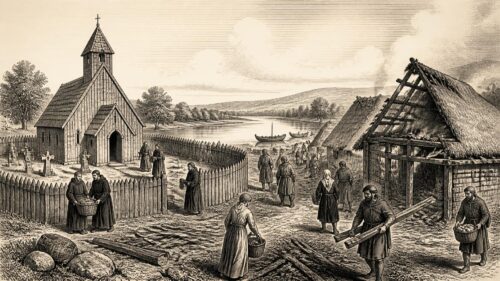
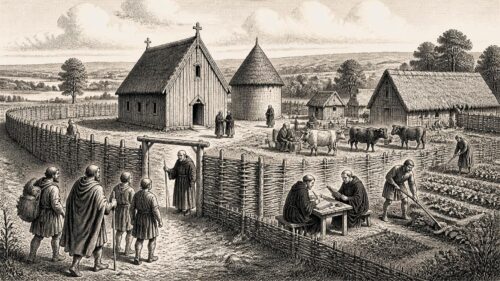
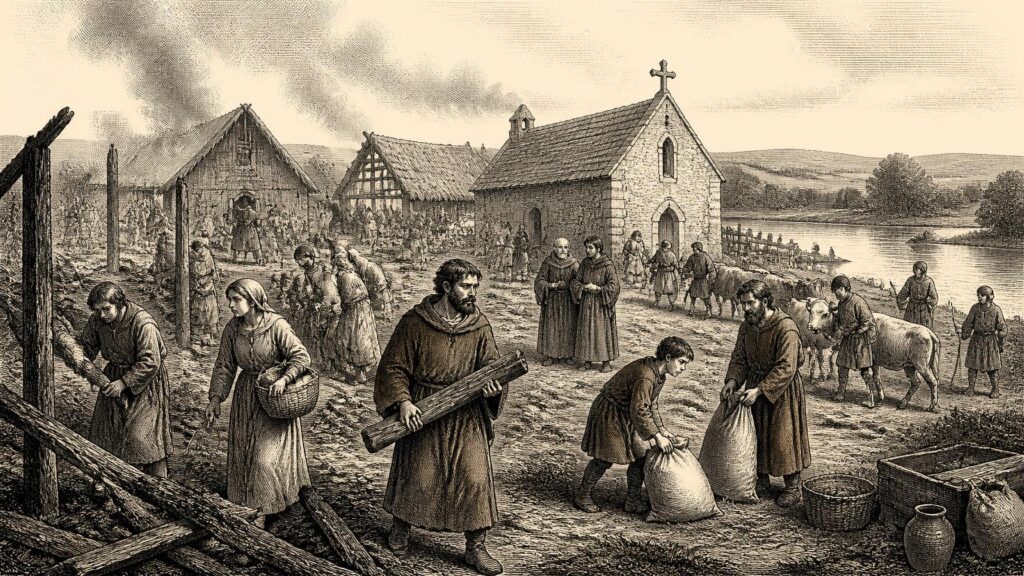
The word “burning” is stark. Early Irish annalists often recorded destruction in a few words, assuming that an informed audience understood the local importance of a church, settlement or dynasty. Cúl Raithin lay in the northern coastal zone associated with the Bann and with the territories of the north-east. Its later identification with Coleraine should not tempt us to imagine a medieval town of streets and stone civic buildings. In 730, this was a religious and settlement landscape of timber structures, cultivated ground, river traffic and local lordship. A fire could consume a church roof, houses, food stores, books, livestock shelters and the accumulated materials on which a community depended.
No source says whether the burning was accidental, punitive, raiding-related or part of a feud. It would be irresponsible to supply an enemy force or a heroic defence. Nor can the scale of loss be calculated. Nevertheless, an annalistic notice itself suggests that the place mattered beyond one household. Churches were not detached spiritual islands. They were centres of worship, burial, hospitality, education, landholding and food collection, connected to lay patrons and neighbouring farming families. Damage to such a centre could interrupt liturgy and learning, but also the storage and redistribution of grain, dairy produce and renders owed by clients.
The notice gains additional weight from the political geography of the north. The lower Bann formed part of a region in which church sites, fertile land, routes along river and coast, and competing peoples could not easily be separated. Control of ecclesiastical communities conferred standing as well as material advantage. A burning did not necessarily change a kingdom’s ruler, but it could expose the vulnerability of a local power and demand a costly response: rebuilding timberwork, replacing utensils and books, gathering dependants, and restoring the prestige of the community.
Bealach Éle: A Battle in the Early 730s
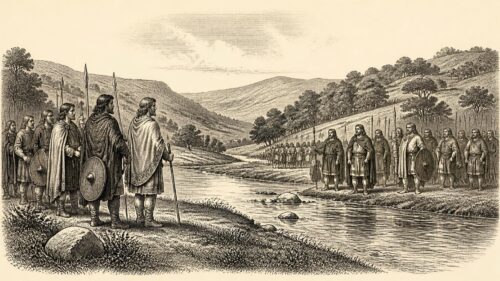
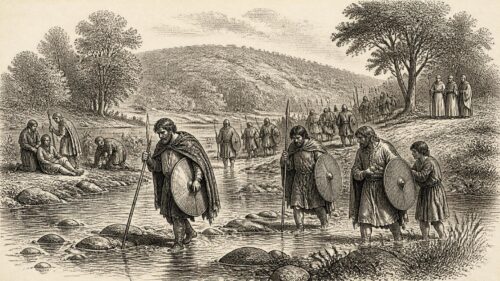
The battle at Bealach Éle has long been associated with 730, but its date must remain qualified. The Four Masters says that Cathal mac Finguine, king of Munster, fought the Leinstermen there; it reports many Leinster deaths and records serious Munster losses as well. Cellach son of Fáelchar, leader of Osraige, was killed, as were two sons of Cormac Rossa, leader of the Déisi. The annal adds a figure of three thousand dead with them. Tigernach’s account likewise stresses the devastating losses suffered by Munster and says Cathal escaped.
These are valuable traditions, but neither permits a modern reconstruction of the field, manoeuvres or exact casualty total. Large numbers in annals communicate the gravity of slaughter and should not be treated as a census. Bealach Éle is generally located in the Thurles district, near a routeway across the Munster–Leinster borderlands, though the identification is not beyond debate. Its strategic meaning is clearer than its precise topography. This was a contested corridor between powerful neighbouring overkingdoms, with Osraige and Déisi forces deeply involved rather than standing outside a simple Munster–Leinster contest.
Cathal mac Finguine was a formidable Éoganacht king of Munster, whose long reign was marked by efforts to strengthen Munster’s position against rivals and, at times, against the wider claims of the Uí Néill. Leinster was not a unitary state obedient to a single modern-style government, but a field of dynasties and local kingships. Osraige, situated between the two larger provinces, could be an ally, subordinate partner or obstacle. The reported death of its ruler at Bealach Éle shows how warfare could reshape the politics of an intermediate kingdom as well as the fortunes of the two provincial powers.
If the battle did occur in 730, it was one of the year’s most important events; if, as the chronological divergence suggests, it belongs a few years later, it remains essential context for the tensions visible around 730. Either way, it should not be used to claim that Ireland was politically unified or that Cathal won a decisive conquest of Leinster. The sources describe heavy loss and Cathal’s survival, not an enduring settlement. Early medieval victory often meant plunder, prestige, hostages or a temporary advantage, rather than permanent control of a territory.
Kingship Beyond a High-Kingdom
The Four Masters connects its 730 notice with Áed Allán, son of Fergal, presenting this as his first year “over Ireland”. Such language reflects the powerful ideal of a king of Tara or overking of Ireland, but political reality was more layered. Áed Allán was a leading ruler of Cenél nÉogain in the northern Uí Néill world; Cathal ruled Munster; Leinster, Connacht, Ulaid, Osraige, the Déisi and many lesser kingdoms had their own rulers, obligations and rivalries. Recognition of a dominant king could vary by region and by moment.
This decentralised order made local events significant. A burned church in the Bann valley and a battle in a Munster–Leinster pass did not belong to separate worlds. Both were shaped by networks of kin, tribute, military followings and ecclesiastical patronage. Kings sought the loyalty of churches and clients; churches sought protection, legal privilege and resources; farming communities bore the direct burden of provisioning households, hosting travellers, supplying renders and recovering from raids or fires.
Church Communities and Learned Labour
The religious notices attached to 730 offer a glimpse of a literate Christian society whose institutions were dispersed across Ireland. The death of a bishop and of a “doctor of religion” indicates offices of learning and authority, even though the annalist gives little biography. Echaid’s entry into clerical life is equally brief, but such a transition could alter the relationship between a kin-group and a church community. Clerical careers were not marginal to political society: bishops, abbots, scribes and teachers belonged to family networks and could act as custodians of property, learning and legal influence.
The legacy of Adomnán of Iona remained especially relevant. He had died in 704, but his name and cult continued to link Ireland with Iona and the Irish Sea world. His law of 697, Cáin Adomnáin, had asserted protections for clerics, women and children in warfare, backed by leading secular and ecclesiastical guarantors. Nothing in the evidence proves that the burning of Cúl Raithin violated that law or that its sanctions were invoked. Still, the contrast is instructive: Ireland possessed ambitious ideals of protection and peace, while its annals continued to register violence against communities and losses in war.
Learning was also material work. Scribes needed parchment, ink, light, food and institutional security. Churches required farmers, craftworkers and patrons as well as priests. The burning of a religious settlement thus reminds us that intellectual life depended on vulnerable buildings and stores. The year’s obituaries preserve only elite names, but behind them were pupils, labourers, tenants, cooks, herders and craftspeople whose lives rarely entered the written record.
Life Beyond the Annals
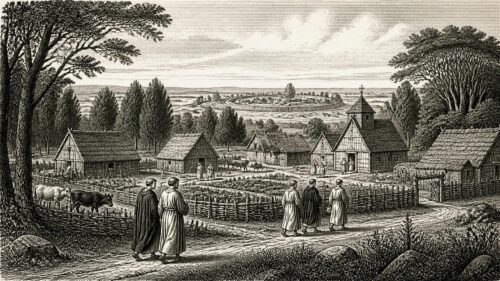
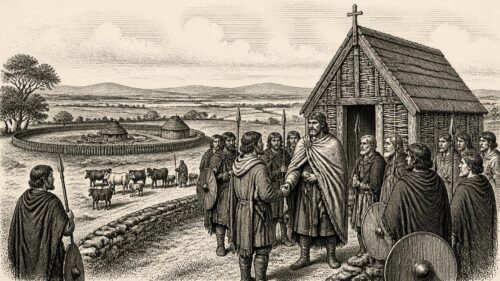
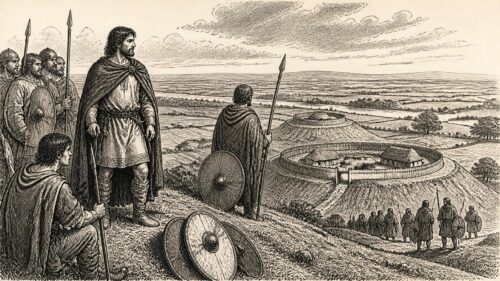
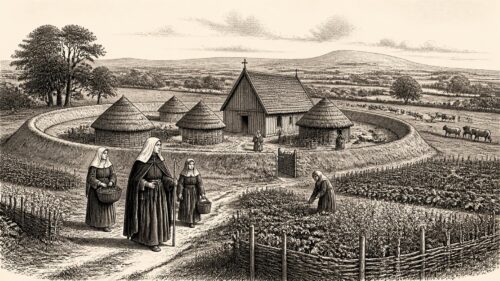
Archaeology supplies the broader setting that the annals omit. Most people in eighth-century Ireland lived in rural communities, commonly in enclosed farmsteads now known as ringforts or raths. These usually contained timber houses, pens, workshops and storage areas, protected by earthen banks, ditches and sometimes palisades. Their practical purpose included keeping livestock secure and marking the standing of a household. Cattle, dairying, grain cultivation and seasonal labour underpinned wealth, while clientship bound producers to lords and churches.
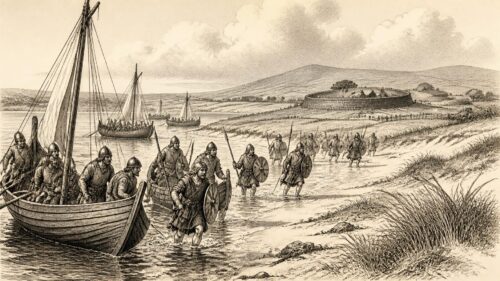
There is no evidence for a nationwide famine, epidemic or climatic disaster specifically in 730. Nor should the year be described as an era of Viking attack: the first recorded raids on Ireland lay decades ahead. Travel and exchange nevertheless crossed the sea. Ecclesiastical ties connected Irish communities to Iona, Northumbria and the wider Latin Christian world; imported ideas, books and people moved along the same maritime routes as political news and commercial goods. The annals’ attention to northern events, church personnel and conflicts beyond Ireland’s shores reflects an island deeply connected to its neighbours, not an isolated fringe.
What 730 Reveals
730 CE does not yield a tidy national narrative. Its best-attested Irish event is a destructive fire at Cúl Raithin, an entry whose very brevity warns against invented detail. The battle of Bealach Éle conveys the scale and danger of provincial warfare in the same period, but its calendar position is disputed and must be treated as such. Together, these records show an Ireland in which authority was regional, churches were economically and politically important, and even a single blaze or battle could affect far more people than the annals named. The year survives not as a complete chronicle, but as a careful reminder of how much early medieval history depends on reading brief evidence without forcing it to say more than it can.
Primary Sources
- The Annals of Ulster, Year U731 (AD 730)
- The Annals of Ulster
- The Annals of Ulster, Latin Text, Year U730
- Annals of the Four Masters
- Annals of the Four Masters, Original Irish Text
- The Annals of Tigernach
- Annals of Inisfallen
- Fragmentary Annals of Ireland, Part 10
- Cathal
- Adomnán
- Colum Cille (Columba)
- The Life of Columba, written by Adamnan
- A New Jerusalem ‘At the Ends of the Earth’: Interpreting Charles Thomas’s Excavations at Iona Abbey 1956–63
- Ways of Death: Cremation and Belief in First-Millennium AD Ireland
- The Practicalities of Communication between Northumbrian and Irish Churches, c.635–735
- Early Medieval Archaeology Project (EMAP) Report 2:1
- The Economy of Early Medieval Ireland
- Early Medieval Dwellings and Settlements in Ireland, AD 400–1100: Volume 1
- Ringforts / Ráthanna
- Patrician and Early Christian Architecture
- County Louth – The Monuments
- Cúil Raithin/Coleraine
- Review: The Annals of Inisfallen, edited by Seán Mac Airt
- How Texts Are Made Available at CELT