Faughart and Bélach Éile735 CE
In 735, battles at Faughart in Muirthemne and Bélach Éile reshaped Irish political relationships. Áed Allán of the northern Uí Néill defeated the Ulaid, killing King Áed Róin and demonstrating influence along strategically important northern routes. At Bélach Éile, Munster and Leinster suffered severe losses, including Cellach of Osraige and Déisi princes; conflicting annals leave Cathal mac Finguine’s victory or defeat unresolved. Connacht lost its king and another leading ruler, while an abbot was slain and Nendrum’s bishop died. Agrarian communities and churches underpinned power. Irish annalists also recorded Bede’s death and an ominous celestial prodigy reported at autumn’s end.
Dateline
In 735 CE, Ireland’s political map was redrawn by fighting at two crucial frontiers: Muirthemne in the north-east and Bélach Éile on the Munster–Leinster approaches. The annals place both battles in this year, but they are terse, partisan records rather than neutral dispatches. Their agreement on death, destruction and major participants is strong; their account of who prevailed at Bélach Éile is not. Taken together, the entries reveal an island of many kingships, in which military success depended on control of routes, alliances and agricultural resources, while churches and monasteries remained central institutions of authority, memory and learning.
Áed Allán’s Northern Victory
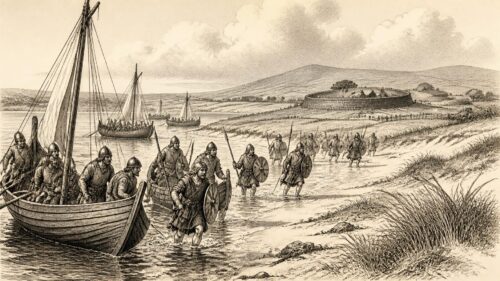
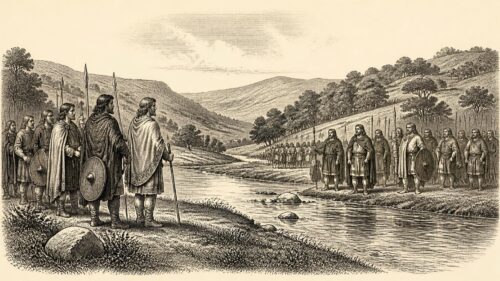
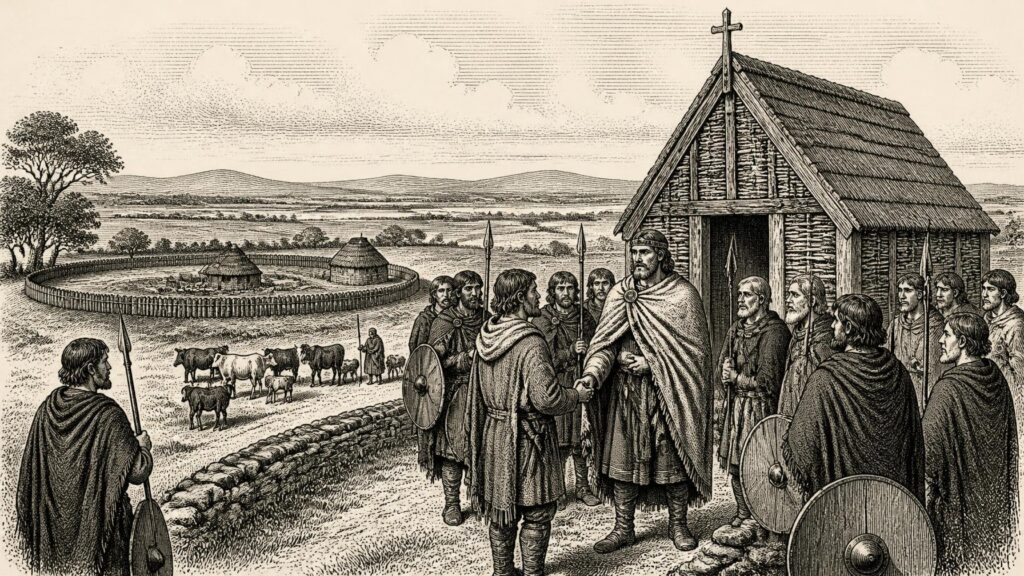
The most consequential firmly dated event was the battle in Muirthemne, the fertile coastal district around Faughart in present-day County Louth. The Annals of Ulster and Annals of Tigernach record a conflict between the Uí Néill and the Ulaid. Áed Róin, king of Ulaid, was killed, as was Conchad son of Cúanu, identified in the principal annals as king of Coba or Cuib. Áed son of Fergal — Áed Allán of Cenél nÉogain, the northern Uí Néill — was the victor.
This was more than a clash between two neighbouring rulers. Muirthemne lay between the core territories of the Ulaid and the northern Uí Néill, near routes linking the Boyne valley, the northern coast and Armagh’s ecclesiastical heartland. A victory there advertised the reach of Áed Allán’s power beyond his own north-western base. His father, Fergal mac Máele Dúin, had been killed in Leinster in 722, and Áed had spent the preceding years overcoming rivals, including the Cenél Conaill. By 735 he was able to press south-eastwards against Ulaid and to present himself as a ruler whose authority could be felt across northern Ireland.
The surviving sources also attach sacred associations to the battle. The Annals of Tigernach say that Áed Róin was taken into the oratory at Faughart to be killed. The later Fragmentary Annals of Ireland add the striking claim that his thumb was preserved in the church there. These details should not be treated as an eyewitness narrative of the king’s final moments. They do, however, show how later memory fused battlefield, church and royal death. In a society where churches held relics, guarded sanctuary and recorded dynastic history, the fate of a defeated king could be remembered through a local sacred site as well as through a genealogical succession.
The defeat was a grave blow to the Dál Fiatach dynasty of Ulaid. It did not abolish Ulaid, whose component peoples and kingships endured, but it removed its leading king at a moment of Uí Néill expansion. The annals do not provide a casualty total, troop dispositions or a formal settlement. It would therefore be unsafe to claim that Áed Allán permanently conquered the whole region. What can be said is that the battle demonstrated northern Uí Néill military predominance in Muirthemne and weakened a rival kingship at a strategically sensitive border.
The Bloodshed at Bélach Éile
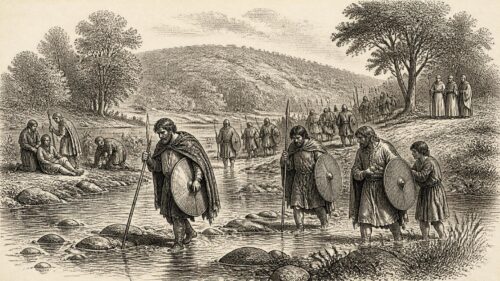
A second major battle exposed the volatility of the southern half of the island. The Annals of Ulster and Annals of Tigernach call it the battle of Bélach Éile, fought between the men of Munster and Leinster. Their language is unusually emphatic: many Leinster men died, while the Munster losses were “almost countless”. Cellach mac Fáelchair, king of Osraige, fell, along with two sons of Cormac Rossa, king of the Déisi. Cathal mac Finguine, king of Munster, escaped.
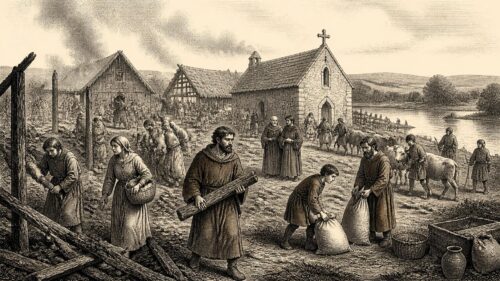
Osraige and the Déisi mattered greatly in this conflict. Neither was simply an anonymous provincial contingent. Osraige, centred broadly on the Barrow–Nore region, stood between Munster and Leinster and could determine which larger power commanded the inland routes. The death of its king therefore made the battle a dynastic crisis as well as a military disaster. The fallen sons of the Déisi ruler likewise indicate the cost borne by subordinate or allied peoples within the Munster sphere. For ordinary households, such losses meant more than aristocratic grief: warfare could take cattle, interrupt cultivation, demand food for travelling forces and leave dependants exposed to subsequent raids.
Yet the outcome is disputed. The northern and midland annalistic tradition records Cathal’s escape amid devastating Munster losses, an account that strongly suggests a Leinster success or, at minimum, a costly check to Munster’s ambitions. The Munster-oriented Annals of Inisfallen, by contrast, says that Cathal was victorious. Both traditions agree that Cellach of Osraige died at the battle; they disagree on the political verdict. The responsible conclusion is not to choose a winner with false certainty. Bélach Éile was plainly a large and bloody encounter in which Cathal survived but lost important allies, while Fáelán of Leinster remained a powerful opponent.
The dispute itself is historically revealing. Irish annals were compiled and copied within ecclesiastical and regional settings, and a victory notice could preserve a community’s political memory as much as a bare fact. In 735, kings fought for hostages, tribute, cattle and prestige; monasteries and churches helped preserve the language through which those contests were understood. The opposing accounts of Bélach Éile are evidence not merely of uncertainty, but of competing claims to honour and overlordship.
Deaths and Political Openings
Connacht also suffered a notable double loss. The annals report the deaths of Airechtach, grandson of Dúnchad of Muirisc and king of Uí Fhiachrach Muaide, and Cathal son of Muiredach, king of Connacht. Uí Fhiachrach Muaide held territory around the River Moy in the north of the province, while the kingship of Connacht was contested among several leading dynasties. The entries do not explain whether either death was violent, nor do they name a successor. Even so, the simultaneous removal of a provincial king and a prominent northern Connacht ruler would have created opportunities for rivals and required fresh negotiations among kin-groups and client peoples.
Another killing underlines the exposure of church leaders to secular conflict: Flann son of Conaing, abbot of Cell Mór Díthruib, was slain. The annal gives no motive. It is tempting to imagine a raid, feud or succession dispute, but the evidence does not decide between them. What is clear is that an abbot was not secluded from the world of political violence. Major churches were landholders, employers, hosts for travellers and repositories of status; their leaders could be participants in local power structures and targets within them.
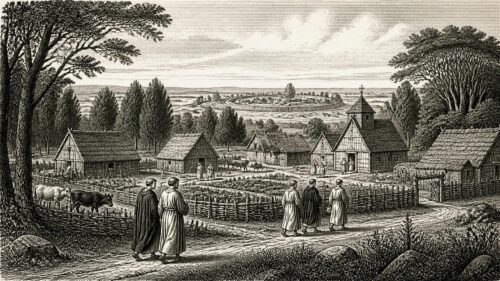
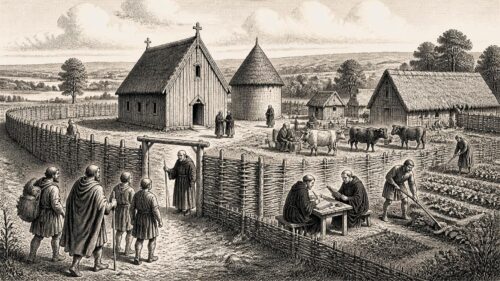
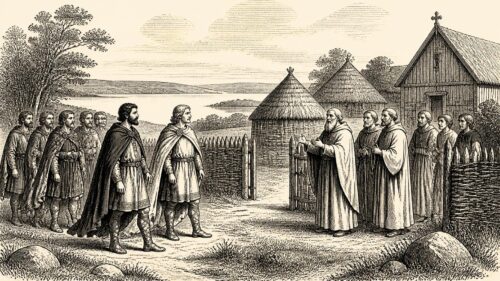
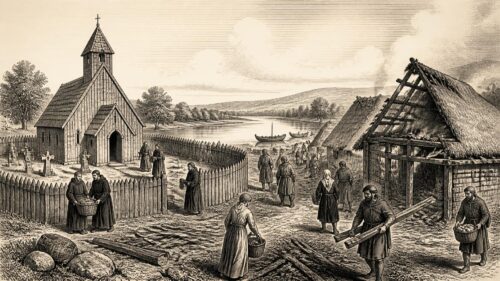
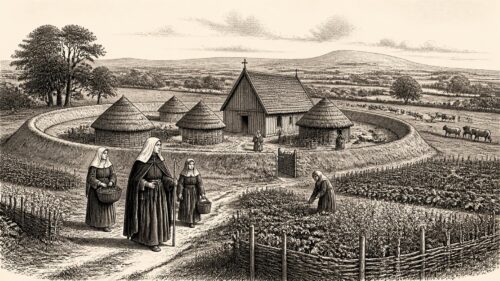
The death of Oegedchar, bishop of Nendrum, was also recorded. Nendrum, on Mahee Island in Strangford Lough, belonged to the dense ecclesiastical landscape of the north-east. Its layered enclosures and waterside setting illustrate a wider reality of early medieval Ireland: religious communities were settled places, with churches, dwellings, workshops, livestock and cultivated land, not isolated buildings devoted only to prayer. The passing of a bishop mattered because episcopal office brought sacramental authority and local standing, while monasteries and churches were woven into the kin-based politics around them.
Farmsteads, Food and Fighting Men
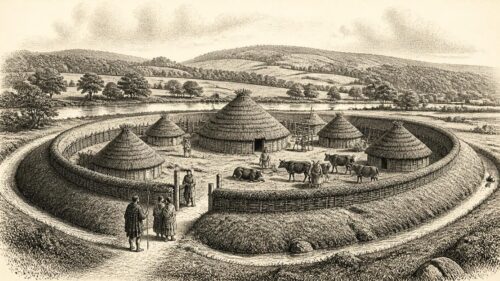
No surviving Irish source describes a harvest, market or building project specifically for 735. Broader archaeological and legal evidence nevertheless provides the essential setting for the year’s warfare. Most people lived in dispersed rural communities, often in ringforts or stone cashels, with circular houses, hearths, storage buildings and spaces for livestock. Cattle were a principal measure of wealth and a means of exchange; cereals were grown, dried, ground and made into food. Land, herds and labour sustained rulers, churches and armed followings alike.
That context gives the annals’ sparse notices their human weight. A king’s hosting was fed from agricultural surplus. A defeated lord’s household could lose its cattle and dependants as well as its fighting men. The risk of conflict encouraged defended farmsteads and places of refuge, including underground souterrains in some regions. But ringforts should not be imagined as permanent military castles. They were chiefly working homesteads, where weaving, metalworking, leatherworking, milling and animal husbandry formed part of daily life. The battles of 735 were extraordinary moments imposed upon a predominantly agrarian society.
Learning Across the Irish Sea
One death in the annals occurred outside Ireland but belongs in the year’s Irish history: Bede, the Northumbrian monk and scholar, died on 26 May 735. Irish annalists noticed his passing, calling him a learned or wise man of the Saxons. Their inclusion of him is significant. Bede’s writings dealt extensively with the Irish and with Irish-founded Christian communities in Britain, even when he criticised practices that differed from Roman custom. His lifetime also belonged to a continuing world of travel between Ireland, Iona, Northumbria and other shores of the Irish Sea.
By 735, movement across that sea linked clerics, students, manuscripts and news, as well as merchants and political envoys. Ireland’s monasteries had long offered instruction and hospitality to visitors from Britain; conversely, learning produced in Northumbria could become known in Irish ecclesiastical circles. Bede’s death therefore marked the loss of a major neighbouring voice in the Latin learned culture shared, though never uniformly, by Irish churches.
The annals close their year with a prodigy: a huge “dragon” seen at the end of autumn, accompanied by great thunder. This cannot responsibly be identified as a comet, meteor or any particular atmospheric event. Medieval writers used such imagery to record a startling sight and to give it moral significance. Its presence beside battles, deaths and ecclesiastical notices captures the texture of the annalistic year: political catastrophe, religious continuity and a heaven that contemporaries believed could send signs.
Thus 735 CE was not a year of national unity or a single Irish campaign. It was a year in which Áed Allán’s victory at Faughart elevated northern Uí Néill power; Cathal of Munster’s struggle with Leinster inflicted conspicuous losses on Osraige and the Déisi; Connacht lost rulers; and churches recorded both their own bereavements and the death of a famed scholar across the sea. Ireland remained a mosaic of kingdoms, but the violence of this year altered the balance within it.
Primary Sources
- The Annals of Ulster, Year U735
- The Annals of Tigernach, Annal T735
- Annals of Inisfallen, Annal AI735
- Fragmentary Annals of Ireland, Annal FA 228
- Annals of the Four Masters
- CELT Project: The Annals of Ulster
- CELT Project: Annals of Tigernach
- CELT Project: Annals of Inisfallen
- The Chronology and Sources of the Early Irish Annals
- Exploring the Irish Annals
- Cathal
- Cathal mac Finnguini and Áed Allán at Tír dá Glás, AD 737
- Kingship, Society, and Sacrality: Rank, Power, and Ideology in Early Medieval Ireland
- Religion and Society in Ireland
- Early Medieval Farmsteads
- Farming and Archaeology
- Early Christian Monasteries
- Churches and Ecclesiastical Enclosures
- The Practicalities of Communication between Northumbrian and Irish Churches, c.635–735
- Seventh-Century Ireland as a Study Abroad Destination
- Bede: The Greatest Hits
- A Middle-Irish Fragment of Bede's Ecclesiastical History