Mag Éo and Mag nÍtha732 CE
In 732, Áed Allán of Cenél nÉogain defeated Flaithbertach of Cenél Conaill, initiating a long decline in Cenél Conaill’s northern dominance, though warfare continued and Ireland remained politically fragmented. Other conflicts killed rulers in Airgíalla and Déisi, accompanied fighting between Leinster, Munster and Connacht. Ecclesiastical deaths included Flann Sinna of Clonmacnoise, Sebdann of Kildare and Gerald of Mayo, demonstrating churches’ political, cultural and cross-channel importance. Magnus, philosopher of Ireland, and Armagh scribe Ferdomnach also died. Annals preserve elite events, while most people lived rurally through farming, pastoralism and dependence, supporting kingdoms and monasteries whose resources sustained religious and secular authority.
Dateline
In 732 CE, Ireland’s recorded history is dominated by rival kings, religious communities and the deaths of people whose offices linked local power to wider networks. The annals are terse, and their chronological systems do not always align perfectly: the same cluster of notices appears under 732 in the Annals of Tigernach and later compilations, while the surviving Annals of Ulster preserve a one-year discrepancy in this section. Yet modern historical treatment places a decisive encounter between Cenél nÉogain and Cenél Conaill in 732. It was an important turning point in the northern struggle for pre-eminence, even though neither its battlefield nor its full course is known.
Áed Allán’s Northern Victory
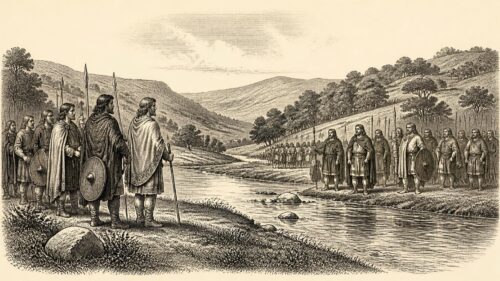
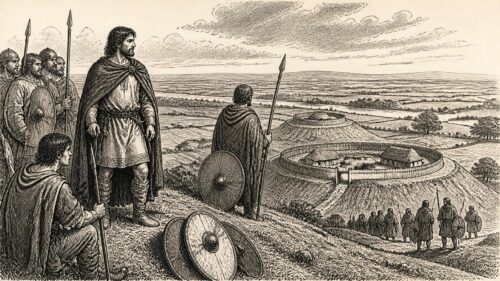
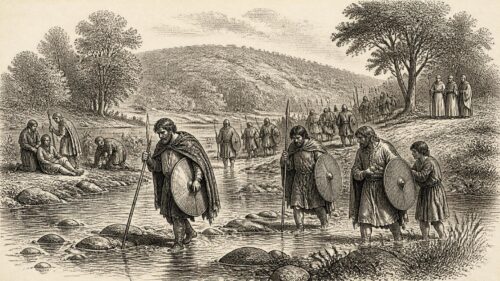
The principal political event was a battle between Cenél nÉogain and Cenél Conaill, the two major northern branches of the Uí Néill. Áed Allán, son of Fergal, led Cenél nÉogain against Flaithbertach, son of Loingsech, the dominant ruler of Cenél Conaill and claimant to the kingship of Tara. The annal gives Áed the victory and names two men killed on Flaithbertach’s side: Flann Goan, son of Congal son of Fergus, and Flaithgus, son of Dub Díberg. It does not provide a place-name, numbers, tactics or a treaty. Those omissions matter. This was certainly a significant battle, but it is not responsible to furnish it with speeches, charges or a precise location that the evidence does not preserve.
Its importance lay in the political geography of the north-west. Cenél Conaill’s leading territories lay in what is now Donegal, while Cenél nÉogain’s core power was further north and east. Between them lay Mag nÍtha, the valley of the River Finn, a strategically valuable corridor connecting territories, routes and subordinate kingdoms. The conflict of 732 was not the final settlement: fighting between the rival kindreds continued through the following years, and Flaithbertach did not surrender the kingship immediately. Nevertheless, the victory marked the beginning of a sustained reversal for Cenél Conaill. Áed Allán’s subsequent advance would help make Cenél nÉogain the leading northern Uí Néill dynasty for generations.
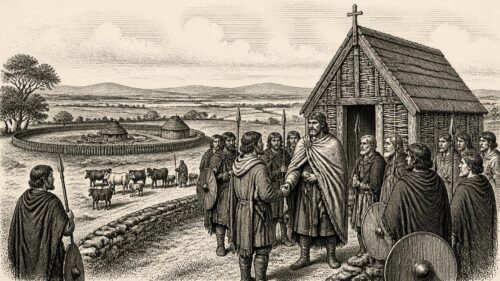
The language of a “kingship of Ireland” or of Tara should not be mistaken for rule over a united state. Eighth-century Ireland consisted of many small and medium-sized kingdoms, bound by kinship, tribute, fosterage, ecclesiastical alliances and force. A powerful king could claim precedence, receive hostages or lead expeditions far from home, but authority was negotiated and uneven. In 732, Flaithbertach’s standing was therefore vulnerable not merely because he lost men in battle, but because defeat encouraged rivals and clients to reconsider their loyalties.
Violence Across Several Provinces
The northern contest was not the year’s only recorded violence. Cellach, son of Tuathal, king of Uí Chremthainn, was killed. Uí Chremthainn lay within the complex political world of Airgíalla in the north and centre of the island. The annals do not say who killed him or whether his death was connected to Áed Allán’s campaign. It would be tempting to join the notices into one grand northern war, but the sources do not permit that certainty. Still, the death of a king in this region illustrates how difficult it was for any northern ruler to secure dependable support beyond his own immediate dynasty.
Elsewhere, Daithgus son of Báeth, king of the Déisi, was slain. The Déisi were an important people of southern Ireland, especially associated with the region later known as the Déise in and around modern County Waterford, though titles in early Irish records can cover shifting political groupings. The notice is brief, but a royal killing was a serious disruption: succession, control of livestock and food renders, and relations with neighbouring rulers all had to be renegotiated.
Another annal reports a battle between the southern Leinstermen and the men of Munster, in which Áed son of Colgú won. Again, neither locality nor political settlement is supplied. The record nevertheless shows that the pressure of armed competition extended well beyond the Uí Néill north. Leinster and Munster faced each other across a broad and contested zone; their rulers and subordinate peoples had reasons to dispute boundaries, cattle, prestige and obligations. The same year also saw a battle in Connacht in which Muiredach son of Indrechtach fell. The annalist’s interest in naming the dead, rather than explaining causes, is a reminder that the record preserves outcomes more readily than lived experience.
Monasteries in Transition
Deaths at major churches give 732 another, quieter significance. Flann Sinna, grandson of Colla, abbot of Clonmacnoise, died. He must not be confused with the much later king of the same name. Clonmacnoise stood beside the Shannon at a crossing-place between regions, and its abbot headed not simply a devotional household but a community with land, dependants, learning and political connections. An abbatial succession could therefore concern local dynasties as well as monks and clergy. The annal identifies Flann as belonging to Uí Chremthainn, an indication of how ecclesiastical office and aristocratic kinship overlapped.
Sebdann, daughter of Corc, abbess of Kildare, also died. Her office is particularly revealing. An abbess could be the head of a wealthy and influential religious institution, and the prominence of Kildare’s female leadership was exceptional but not accidental. Early medieval Irish religious life included communities of women and men, and high-ranking abbesses possessed recognised authority within church and society. Sebdann’s obit does not tell us the scale of her household or name her successor, but its preservation in several annalistic traditions reflects Kildare’s national standing.
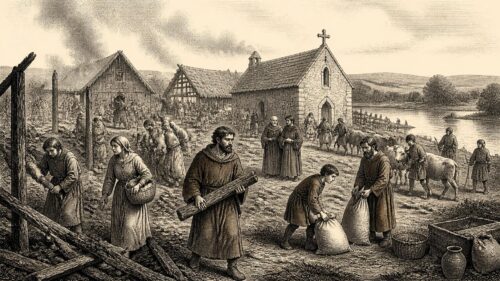
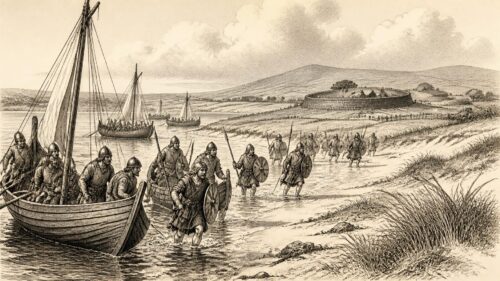
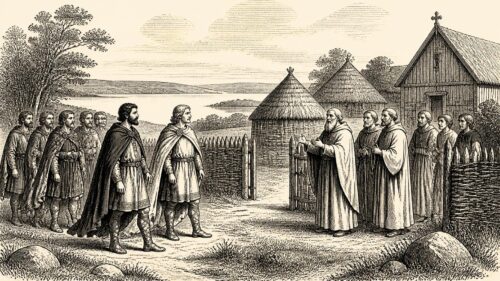
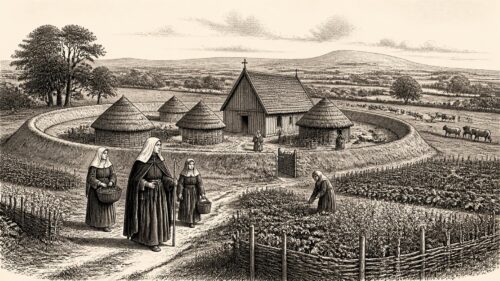
The death of Gerald, described as pontifex of Mag Éo na Saxan, or Mayo of the Saxons, connected the year to Ireland’s western-sea world. The title suggests a bishop as well as a senior ecclesiastical leader. Mayo had been founded for English-speaking monks associated with Colmán of Lindisfarne after disputes within the Northumbrian church. Writing shortly before 732, Bede described the community as English and praised its disciplined life and manual labour. Gerald’s death thus did not mark the arrival of foreign influence; rather, it shows a well-established Irish monastery whose identity had long been shaped by movement between Ireland and Northumbria.
This connection was religious, intellectual and practical. Travel across the Irish Sea carried people, books, liturgical customs and news. It did not mean that Mayo was detached from its Irish surroundings: its community depended on local land, labour, patronage and protection. Nor is there evidence for a major commercial voyage or overseas military expedition from Ireland in 732. The year belongs before the Scandinavian raids that would begin to appear in Irish annals later in the century. Its cross-channel story is instead one of monastic mobility and institutional continuity.
Writing, Learning and Memory
The annals also record the death of Magnus, grandson of Míthrebtha, styled “philosopher of Ireland”. In early medieval Latin and Irish usage, a philosopher was not necessarily a thinker in the modern academic sense. The term could signify a learned Christian scholar, teacher or wise religious figure. Magnus’s name survives without a school, book or teaching assigned to him, but the honourific is important evidence for the value attached to learning. The same annal records the death of Ferdomnach, scribe of Armagh. A scribe’s work sustained the copying of scripture, legal and liturgical texts, genealogies and historical memory; his notice places the labour of writing alongside the deaths of kings.
Other commemorated figures include Teimnén of Cell Garad, called a devout cleric; Fergus son of Conall Oircnech; Tomaltach son of Duinechaid; Congalach of Cnucha; and Cellach, daughter of Dúnchad of Uí Liatháin, praised as an excellent and gracious queen. Such notices offer only fragments, but they show the annals’ social range. Queens, clerics, scribes, abbots and regional kings could all be judged worthy of remembrance. The praise for Cellach should not be read as a biography, yet it signals that royal women mattered within the alliance-building world of aristocratic marriage and kinship.
The Unrecorded Majority
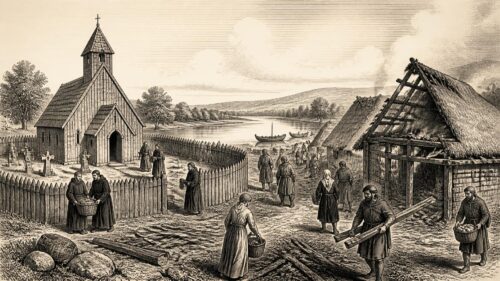
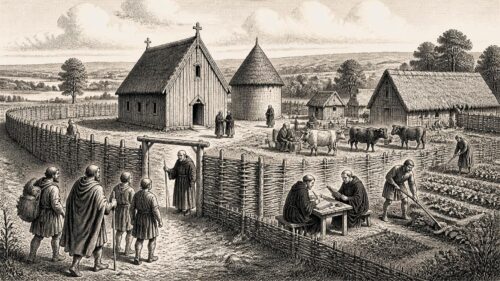
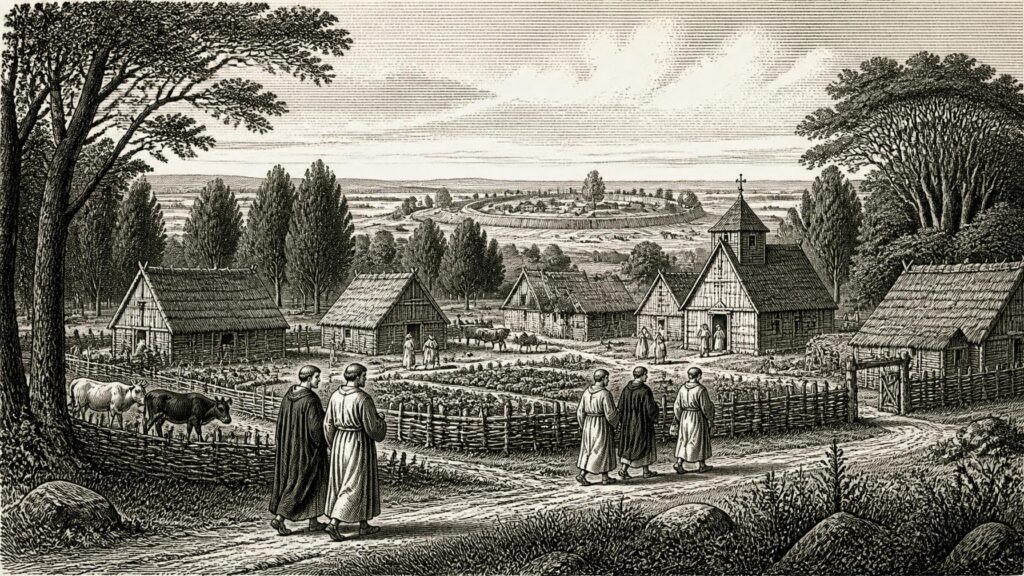
For most people in 732, life was not lived at the level of annalistic names. Ireland remained overwhelmingly rural, its settlement pattern made up of dispersed farmsteads, enclosed raths and cashels, small churches and monastic precincts rather than towns. Cattle were central to wealth, food and status, while cultivation of cereals was increasingly important during the eighth century. Households milked animals, made butter and cheese, ground grain, repaired enclosures, tended fields and managed woodland and pasture. Dependants, tenants and enslaved people carried much of this work, while elite households drew renders and service from those beneath them.
Nothing securely dated to 732 allows us to reconstruct that year’s harvest, weather or prices. The annals record no island-wide famine, plague, flood or extraordinary cold for it. Nor should the several battles be treated as evidence that all Ireland was in continuous warfare. They do show, however, that military mobilisation imposed real demands: warriors needed food, animals, transport and local support, while defeated groups faced bereavement and altered political obligations. Monasteries such as Clonmacnoise, Kildare, Armagh and Mayo were embedded in this agricultural world, receiving resources from it and helping organise its religious, cultural and social life.
Seen together, the notices of 732 reveal an island of regional powers rather than a single kingdom. Áed Allán’s victory opened a northern transformation whose full consequences would emerge only later. In Connacht, the Déisi, the Leinster–Munster borderlands and Airgíalla, separate conflicts demonstrated the fragility of local rulership. Meanwhile, the deaths of an abbot, abbess, bishop, philosopher and scribe show that ecclesiastical institutions were not marginal to public life: they were centres of authority, literacy, memory and connection. The year’s surviving record is narrow, but it catches Ireland at a moment when the fortunes of dynasties and churches were being reshaped together.
Primary Sources
- The Annals of Ulster, Year U732
- CELT Project: The Annals of Ulster
- The Annals of Tigernach, Annals T729–T736
- The Fragmentary Annals of Ireland, Annals FA 221–232
- The Annals of Inisfallen, Annals AI728–AI737
- CELT Project: Annals of the Four Masters
- Áed Allán
- Flaithbertach
- Gerald (Garald)
- Áed Allán mac Fergaile: (d. 743), high-king of Ireland
- Flaithbertach mac Loingsig: (d. 765), high-king of Ireland
- Book IV — The Ecclesiastical History of the English People
- Of Saxons, a Viking and Normans: Colmán, Gerald and the Monastery of Mayo
- Tech Saxan. An Anglo-Saxon monastic settlement in early medieval east Galway
- Agriculture, settlement and society in Early Medieval Ireland
- Early Medieval Ireland: Archaeological Excavations, 1930–2009
- Early Medieval Dwellings and Settlements in Ireland, AD400–1100. Vol. 1: Text
- Abbesses and other High-Ranking Holy Women
- The primatial claims of Armagh, Kildare and Canterbury
- Early medieval Ireland: investigating social, economic and settlement change, AD 400–1100
- The Economy of Early Medieval Ireland
- The Economy of the Ringfort and Contemporary Settlement in Early Medieval Ireland
- Exploring the Irish Annals
- Irish Texts at CELT