

Recovered Names
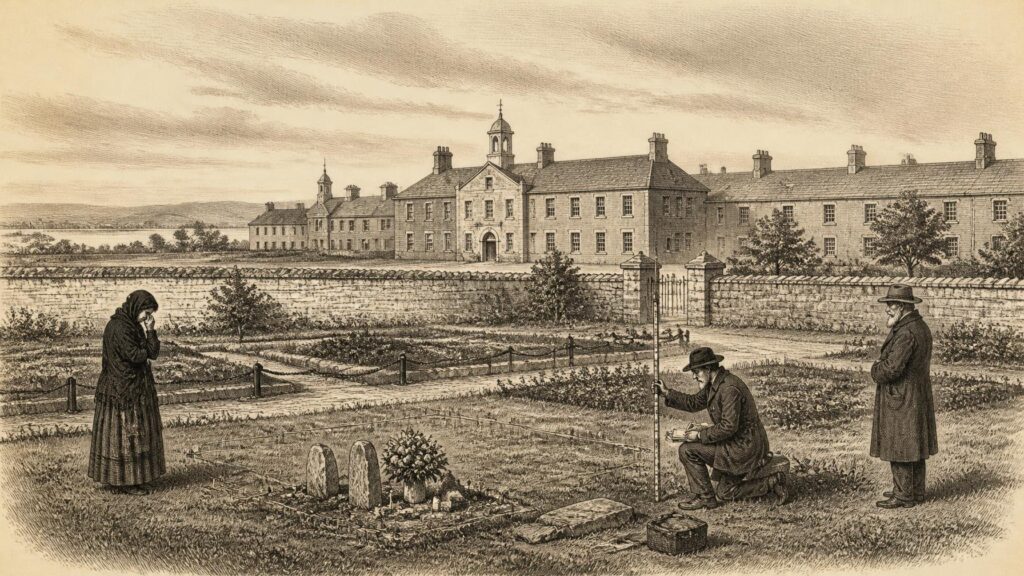
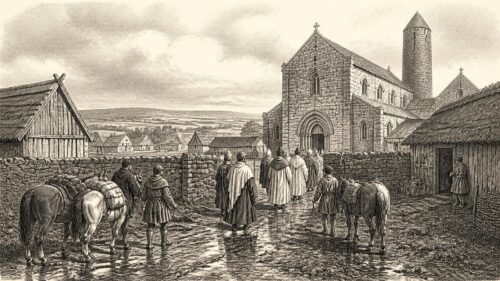
AI generated historical illustration, not a contemporary photograph.
At a Glance
At Tuam, the prospect of DNA identification is not simply a scientific development. It is an attempt to restore connection where an institution, a burial practice and decades of social silence severed it: between children and their names, mothers and their histories, families and their missing relatives, and the Irish public and a part of its own past. The work is necessarily forensic, legal and technical; it is also an act of historical memory, conducted in the presence of survivors, relatives and a town whose landscape has become inseparable from a national reckoning.
Historical Ground
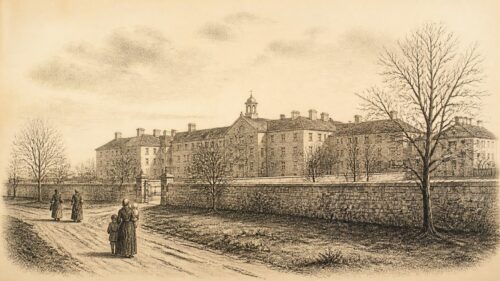
The former Bon Secours Mother and Baby Institution at Tuam, County Galway, operated between 1925 and 1961. It occupied the former workhouse complex, a setting that matters historically. Irish workhouses had been created within the nineteenth-century Poor Law system, and their buildings carried forward an architecture of segregation long after the Great Famine era from which they are so often remembered. In the twentieth century, the premises became part of a different but related institutional world: one in which poverty, unmarried pregnancy, childhood, illness, adoption and social respectability could all be administered away from ordinary family life.
Mother and baby homes were not a uniquely Irish invention, nor can Tuam be understood in isolation from British and European traditions of poor relief, maternity care and institutional welfare. Yet Ireland gave such institutions a distinctive force. The social condemnation of pregnancy outside marriage, the limited position of women in public life, the role of religious congregations in welfare provision, and the participation of public authorities created a system in which many women entered institutions under severe pressure. The language of charity and care existed alongside discipline, surveillance and shame. Historical explanation must not become excuse: the fact that a practice was widespread or inherited does not lessen its consequences for those compelled to live through it.
Institutional Silence
Institutional memory is often mistaken for a storehouse of facts. In reality, institutions remember selectively. They create registers, correspondence, financial accounts and medical files for administrative purposes, but these records do not automatically preserve a person’s full story. The woman admitted to a home may appear first as a case, the child as a birth entry, a transfer, a vaccination, a death or an adoption-related file. What was said in private, what was withheld, what a mother understood of her child’s fate, and what relatives were later told may leave no formal trace at all.
At Tuam, this distinction is fundamental. Surviving documentation can establish much about the existence and administration of the institution, and can assist in reconstructing the lives and deaths of people associated with it. It cannot by itself answer every question about burial, kinship or individual identity. A death record proves that a child died; it does not alone prove where that child was buried. A burial ground may contain human remains; it does not on its own produce a name. The distance between those propositions is where forensic archaeology, genetics, archival research and family knowledge must meet.
The public history of Tuam has consequently been shaped by a difficult truth: records are indispensable, but incomplete. Silence can appear in missing files, but also in records made without the language necessary to recognise grief, coercion or bereavement. The historical task is not to fill every gap with certainty. It is to identify the gap, establish what evidence survives, and listen closely to the people whose lives were never adequately represented in official paperwork.
Local Inquiry
The rediscovery of Tuam as a matter of national concern did not begin in a laboratory or a government department. It grew from local historical research, above all the work of Catherine Corless, who examined civil death records and institutional material in seeking to account for children who had died while connected with the home. Her work gave names and dates to a population that had largely vanished from public consciousness. That achievement is important in its own right. Lists can be emotionally stark, but they challenge the old institutional habit of treating children as a numerical problem rather than as members of families.
Local inquiry also exposed the differences between evidence and repetition. Over time, public discussion of Tuam developed dramatic shorthand: a former home, a septic system, hundreds of children and an apparent absence of conventional burial. Some elements were grounded in documents and later scientific investigation; others were broadened, simplified or stated too confidently in headlines and conversation. Responsible history must resist the temptation to replace one silence with another form of distortion. The reality established by the evidence is grave enough without embellishment.
Corless’s research helped create the conditions in which a larger inquiry became unavoidable. It did so by insisting that official records should be read against a moral question: what became of these children? That question transformed a local archive into a public demand for accountability. It also demonstrated a recurring feature of Irish institutional history. Formal bodies may possess records, but survivors, relatives, voluntary researchers and local communities are often those who first assemble the questions that force institutions to answer.
Public Reckoning
In February 2015 the Irish Government established the Commission of Investigation into Mother and Baby Homes and Certain Related Matters. Its remit covered named mother and baby homes and a representative sample of county homes, examining the period from 1922 to 1998. The span itself is historically revealing. It places Tuam within the long life of the independent Irish State rather than treating it as a distant aberration from an undefined past. The Commission submitted its final report in October 2020; it was published on 12 January 2021.
The Commission’s work created an extensive official account, but official accounts are not final accounts in the sense of closing discussion. Their authority lies in their access to evidence, statutory remit and method; their limitations arise from the materials available, the legal framework governing testimony and privacy, and the human impossibility of recovering every lost experience. Survivors and advocates criticised aspects of the report’s interpretation and emphasis. That disagreement is itself part of institutional memory. Historical understanding advances not when every voice is forced into one conclusion, but when evidence, testimony and interpretation are honestly distinguished.
The State apology delivered in January 2021 acknowledged profound failures towards women and children in these institutions. Apology has historical significance because it marks a change in the public language of responsibility. Yet it cannot be treated as a substitute for records access, tracing, redress, memorialisation or the recovery of the dead. The later legislative and administrative measures concerning birth information, tracing and institutional burials show that recognition must be accompanied by practical means of repair, however incomplete those means may be.
Forensic Discovery
In March 2017 the Commission confirmed that a test excavation at the Tuam site had found juvenile human remains in significant quantities within subsurface chambers associated with a historic sewage system. This was a decisive documentary and scientific moment. It replaced speculation about whether human remains were present with an established finding. It did not, however, resolve every surrounding question: the number of individuals represented, the identity of each child, the exact extent of the burial area, the condition of the remains, or the circumstances in which individual children died and were placed there.
The physical setting compounds the difficulty. The remains are described by the current intervention office as commingled or intermixed, and the chambers have limited access. In such circumstances, excavation is not comparable to opening a marked grave containing one coffin and one named person. The process involves careful archaeological recovery, recording of location and context, sorting and re-association where possible, biological examination, contamination control, genetic testing and review by specialists. Every stage may produce information, but every stage also has limits.
This is why the language of discovery must be precise. The remains were not an abstract symbol, nor were they merely an archaeological curiosity. They are human remains from a site attached to a twentieth-century institution. At the same time, investigators cannot ethically or scientifically promise outcomes before the evidence has been recovered and analysed. The proper response to uncertainty is not indifference. It is a careful process designed to ensure that uncertainty is neither concealed nor exploited.
Burial Evidence
Documented evidence supports several important propositions: juvenile human remains were found at the Tuam site; the former institution operated there from 1925 to 1961; historical sources indicate that children connected with the home died during that period; and the site requires a forensic rather than merely commemorative response. Evidence does not presently permit a simple assertion that every child whose death was recorded at the institution lies in the recovered area. Nor does it warrant assigning a name to a particular set of remains without the multidisciplinary process now provided for.
The distinction may seem cautious to the point of formality, but it protects families and the historical record. Families have lived for decades with uncertainty about what they were told, what they were not told, and where relatives may be. A mistaken identification, an overconfident statement of numbers, or the repetition of unverified detail can create a further injury. Historical dignity includes the discipline to say ‘not known’ when the evidence does not yet permit more.
Folklore has a place in this history, but not the same place as a civil register or a forensic report. Recollections of local practice, stories passed within families, memories of buildings and grounds, and accounts of what was believed at the time can guide questions and illuminate atmosphere. They may preserve truths ignored by official records. Yet they remain memories requiring context and corroboration, especially where details have travelled through decades of retelling. The most respectful approach is neither to dismiss such testimony nor to convert it automatically into proof.
Legal Framework
The Institutional Burials Act 2022 provided the legal architecture for intervention at sites of inappropriate burials associated with former institutions. It allows for excavation, exhumation and, where possible, identification, followed by dignified reinterment. The legislation matters because ordinary burial law was not designed for the unusual combination present at Tuam: a historical institution, substantial quantities of juvenile remains, commingling, living relatives seeking answers, complex privacy interests and a strong public interest in recovery and commemoration.
The Office of the Director of Authorised Intervention, Tuam, known as ODAIT, was established to manage the site-specific intervention. Its remit makes explicit that the work is not solely about excavation. It includes recovery, forensic analysis, identification and individualisation where possible, investigation of circumstances and cause of death where evidence permits, and memorialisation. This range recognises that physical recovery alone would leave the historical work unfinished. Remains must be treated as evidence, as persons deserving dignity and, potentially, as relatives whose families retain legitimate interests.
The full forensic excavation commenced on Monday, 14 July 2025. ODAIT has stated that it will excavate the whole site within the authorised boundary, rather than limiting work to the known chambers. Historical maps, ground-penetrating radar, documentary sources and witness statements all inform that decision. The wider approach is significant: it accepts that the visible or previously tested feature may not contain the whole story of the site. It also reflects the basic archaeological principle that context matters. Where remains are found is itself part of the evidence.
Genetic Promise
DNA offers a new kind of historical evidence. Unlike a register, it can demonstrate biological relatedness between a recovered person and a living participant. Unlike memory, it does not depend on recollection. Yet genetics does not speak without interpretation. A DNA profile must be obtained from remains that may have been affected by time, soil, water, microorganisms, temperature and other environmental conditions. The result must then be compared with samples from eligible relatives. Finally, its meaning must be considered alongside all other available information.
The identification programme is therefore rightly described as DNA-led, not DNA-only. ODAIT explains that the eventual reconciliation process may compare ante-mortem information, such as personal, medical or dental material where available, with post-mortem findings from the recovered remains. Given the age of the children and the period in which the institution operated, such ante-mortem information is likely to be limited. This makes genetic evidence especially important, but it does not remove the need for professional judgement or corroboration.
The potential achievement is profound. A successful familial link could replace an unidentified set of remains with an individual connection to a living family. It may permit a relative to make wishes known about final arrangements. It may confirm what had been feared or suspected for generations. It may also answer a question that records alone could not settle: whether a particular child is present at the site. Such knowledge can be both consoling and painful. It should never be presented as a simple technological cure for a historical wound.
Scientific Limits
DNA identification at Tuam faces serious scientific constraints. The remains are historical, juvenile and in some cases likely to be fragmentary or mixed. DNA may be degraded beyond useful recovery. A profile may be partial, and a partial profile may be insufficiently informative for a confident familial conclusion. The availability and closeness of living relatives also matter. A direct parent or sibling relationship is generally more informative than a more distant connection, but the relevant family structures may themselves have been disrupted by adoption, secrecy, migration, early death and the passage of time.
For these reasons, no honest historical account should promise that all children will be individually identified. ODAIT explicitly acknowledges that the quantity and quality of recoverable DNA, the number and kind of relatives who come forward, the volume and complexity of remains, and the capabilities of forensic testing will influence outcomes. An unidentified person is not a person without value, nor evidence that the work has failed. A process can still establish age range, biological information, site context and dignified reburial even where a name cannot be securely restored.
There is also an ethical limit. Genetic evidence reveals family connection, and family connection can touch upon identities that were hidden for reasons of shame, protection, coercion or privacy. The programme therefore operates through consent and eligibility rules. Its purpose is confined to establishing familial links to remains recovered at Tuam, rather than creating an unrestricted genealogy project. Such boundaries may frustrate some people who seek broader answers, but they reflect the difficult balance between identification, privacy and the rights of living relatives.
Family Records
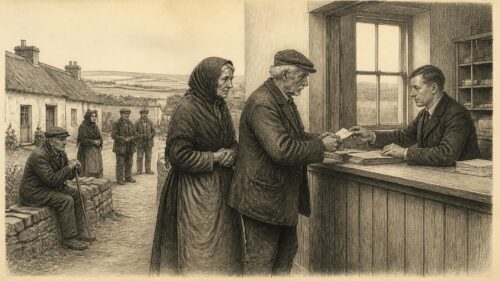
The DNA programme depends on records even as it seeks to transcend their limitations. Applicants must establish reasonable grounds to believe that a relative is buried at the site and must demonstrate an eligible relationship. Public certificates may be used; where these are inadequate, institutional, medical or baptismal records may assist; affidavits may become relevant where documentary proof remains thin. This is a striking feature of the process. The historical record, once a mechanism of classification and secrecy, becomes part of the route through which families seek recognition.
That route will not be equally easy for every family. Institutionalisation and adoption fractured names, addresses and kin networks. People may have been told inaccurate stories about a child’s death, burial or removal. Some may never have known that a relative was connected with Tuam. Others may possess family knowledge that is emotionally compelling but poorly documented. The process cannot abolish these inequalities, but it can acknowledge them and provide assistance in assembling the evidence needed for participation.
Records access has a wider importance beyond the forensic programme. The Birth Information and Tracing Act 2022 created routes through which eligible people can seek birth certificates, birth and early-life information, and certain health information. This does not undo the concealment experienced by many affected people. It does, however, recognise that personal history is not a discretionary favour to be granted by an institution. For people separated from relatives or denied reliable knowledge of their origins, access to records is part of historical justice.
Survivor Authority
Survivors and relatives are not simply sources of information for a state project. They are participants with interests that ought to shape the work. ODAIT’s stated approach includes engagement with families, survivors and the Tuam community. That language is important only if it becomes practice: clear communication, accessible support, time to consider decisions, respect for differing wishes and candour when scientific answers are not available.
Survivor testimony has often been treated in public debate as an alternative to archives. It is better understood as a distinct form of evidence and historical knowledge. Testimony can communicate the lived reality of stigma, separation, fear, uncertainty and institutional power in ways that an admissions ledger cannot. It can also contain ambiguities common to all memory, particularly when experiences were traumatic or when decades have passed. Neither point cancels the other. The historian should assess testimony carefully without adopting the old institutional reflex of assuming that the written file is neutral and the survivor is unreliable.
The authority of survivors also changes the meaning of commemoration. A memorial imposed from above may reproduce the distance that caused injury. A memorial shaped through consultation can acknowledge named people, unnamed people, surviving mothers, adopted people, bereaved relatives and the local community without forcing every experience into one narrative. The need for such care follows directly from the history: the institution controlled information; memorialisation should not repeat that control.
Memory Practices
Institutional memory has physical, archival and ceremonial forms. The former site at Tuam is physical memory: ground, walls, housing development, memorial garden and the altered footprint of a workhouse. Registers, certificates, correspondence and reports are archival memory. Anniversaries, vigils, family visits, public apologies and funerals are ceremonial memory. DNA adds another layer, biological memory, which can make a relationship legible even after documents have failed to do so.
These forms do not always align. A family story may conflict with a certificate. A site map may fail to locate a person recorded as having died. A DNA result may establish kinship but not explain every circumstance of a death. An official memorial may speak of collective loss while a relative seeks the particularity of one child’s name. The work at Tuam must accommodate these different scales. National history is present, but so are intimate histories that cannot be reduced to a national symbol.
Interpretively, Tuam can be seen as a test of whether a democracy can remember institutions that once normalised exclusion. This is an interpretation, not a forensic finding. It rests on the way the site joins several histories: poor relief, religious welfare, women’s social position, local government, public health, adoption, secrecy and the changing relationship between citizens and the State. Its force comes from refusing the comforting claim that responsibility belonged only to a vanished world of individual wrongdoers.
Public Language
Words matter especially in a history marked by euphemism. Terms such as ‘illegitimacy’, ‘fallen woman’, ‘home’, ‘care’ and ‘adoption’ could obscure unequal power and personal loss. Modern language can also conceal if it becomes excessively technical. ‘Intervention’, ‘remains’, ‘casework’ and ‘data’ are necessary terms, but they should not erase the fact that the work concerns children and families. The challenge is to speak accurately without either sensationalism or bureaucratic numbness.
Accuracy requires avoiding claims that outrun evidence. It is not responsible to state that every death connected with Tuam has a known grave, that every set of remains can be named, or that DNA will settle every contested feature of the past. It is equally irresponsible to use uncertainty as a reason to minimise what has been established. There were juvenile remains at the site in significant quantities; there were children whose deaths were recorded in connection with the institution; and there was a burial situation serious enough to require a dedicated statutory intervention and full forensic excavation.
Public language should also recognise historical change without suggesting that the past is safely over. The former home closed in 1961, but the consequences continued through family separation, incomplete information, stigma and delayed recognition. The Commission’s remit reached as late as 1998 because the wider system of mother and baby and county home institutions outlasted Tuam itself. The history is therefore not merely one of an old building. It is a history of lives shaped across generations.
Future Questions
As recovery and analysis continue, several questions will remain open. How many individuals can be distinguished within the recovered material? How many can be linked to living relatives? What can be said, if anything, about health, disease and cause of death in particular cases? What evidence will emerge from parts of the site beyond the previously identified chambers? How should unidentified remains be memorialised and reinterred? The proper answer to these questions, at present, is not prediction but process.
The public information campaign envisaged for 2026 may reach families in Ireland and abroad who do not yet know of a possible connection to Tuam. Migration is an important consideration. Irish family histories extend across Britain, North America, Australia and elsewhere, while the secrecy surrounding unmarried pregnancy and adoption could make a connection difficult to recognise. A programme that relies on relatives coming forward must therefore communicate widely, sensitively and in language that does not assume people possess complete family records.
There are implications beyond Tuam. The Institutional Burials Act allows for interventions at other former institutional sites when the statutory conditions are met and a director is appointed. Tuam should not be treated as a template that mechanically decides every other case; each site has its own records, terrain, community and evidence. But it has created a public standard. Where credible evidence of inappropriate institutional burial exists, the questions of recovery, identification, commemoration and family participation can no longer be regarded as peripheral matters.
Restored Dignity
Identification is often described as giving the dead their names back. In Tuam, some names were never wholly lost: they persisted in civil records, local research, family recollection and survivor advocacy. What was missing was recognition commensurate with their humanity. DNA may, in some instances, supply a verified bridge between a named child and living kin. In other instances, it may narrow possibilities without producing a formal identification. In still others, the remains may remain unknown. Dignity cannot depend entirely on the success of testing.
A historically responsible commemoration must therefore hold together two commitments. The first is individualisation: every possible effort should be made to recognise persons as persons, rather than as an undifferentiated mass. The second is collective remembrance: where a name cannot be restored, the unknown dead must not be treated as beyond mourning or history. Their anonymity is itself part of what the institutions produced, and it must be remembered rather than hidden.
Tuam’s enduring significance lies in this convergence of science and memory. Archaeology recovers context; forensic examination studies remains; genetics tests kinship; archives reconstruct administrative lives; testimony restores experience; law sets duties; memorialisation makes public space for grief. None is enough alone. Together, and only with continued honesty about their limits, they offer the possibility of a different relationship to the past: not closure in the easy sense, but acknowledgement, care and a measure of truth for people long denied all three.

Tuam’s programme shows that identification is both a forensic undertaking and a form of public memory: DNA may reconnect families, yet degraded, commingled juvenile remains and fractured records mean that some names may remain unknown. The article’s insistence on preserving uncertainty is particularly important, because dignified recovery cannot depend solely on achieving individual genetic matches. It also raises a wider question about how testimony, archival evidence, archaeology and relatives’ wishes should be weighed together when they point to different possibilities. How should the Tuam intervention define a meaningful measure of justice and remembrance for children who cannot be individually identified?