

Silent Kin
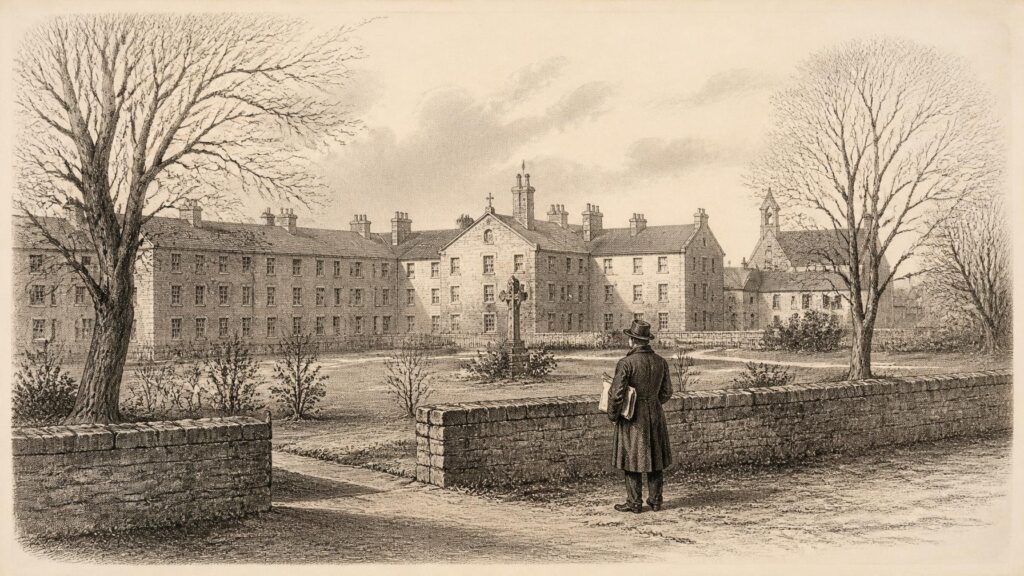
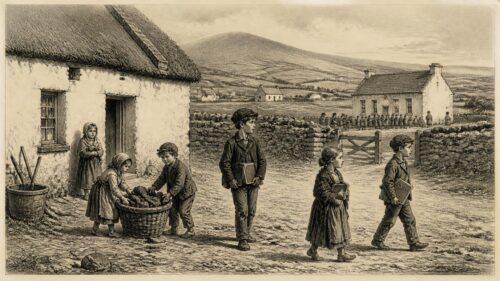
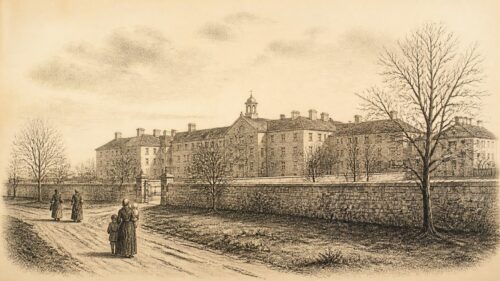
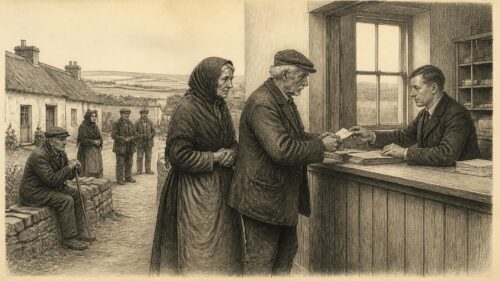
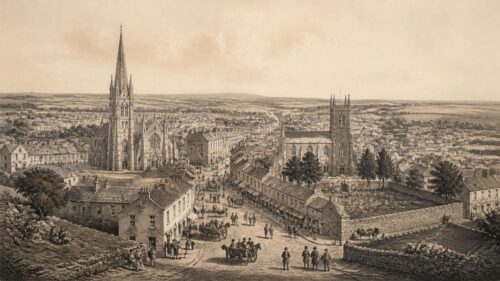
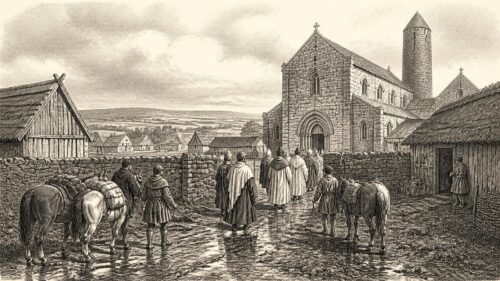
AI generated historical illustration, not a contemporary photograph.
At a Glance
At Tuam, DNA is not merely a forensic instrument. It has become a means of confronting an Irish institutional past in which names, kinship, burial and official responsibility were too often separated from one another. The recovery and possible identification of children’s remains at the former Bon Secours Mother and Baby Home is therefore bound to a larger question: how does a society remember people whom its systems recorded, administered and yet failed properly to acknowledge in death?
Hidden Ground
The former Mother and Baby Home at Tuam, County Galway, occupies a particular place in the historical reckoning with twentieth-century Irish institutions. Operated by the Bon Secours Sisters from 1925 until 1961, it received unmarried mothers and their children within a system shaped by poverty, stigma, public administration, religious welfare and limited social choices. Its story cannot be reduced to a single institution or a single religious congregation. It belongs to a wider history of county homes, maternity services, adoption arrangements, boarding out and the harsh consequences borne by women and children whose lives were judged against prevailing moral expectations.
Yet Tuam acquired an exceptional force in public memory because of the relationship between a documented list of child deaths and the apparent absence of a corresponding ordinary burial record. Local historian Catherine Corless assembled evidence from civil death registrations relating to children who died while associated with the home. Her work brought together names that had remained dispersed across official paperwork and made an absence visible: the absence of clear, individual burial information for children whose deaths had been registered.
This distinction matters. A death certificate records a death; it is not itself proof of an exact burial place or manner of burial. Nor does a list of deaths, however distressing, establish the precise circumstances of every death. Historical method requires those distinctions. But the list made a compelling question unavoidable. If children had died in such numbers, where were they buried, how were their burials recorded, and why had their identities not been preserved in a manner readily available to relatives?
The question joined documentary evidence to long-standing local recollection. People in Tuam had remembered a former home, a changed landscape and stories about a burial area. Such recollections are historically important, particularly where formal documentation is incomplete, but they are not identical to forensic proof. Folklore can retain a place, a fear or an unresolved question across generations. It can also alter in retelling. The importance of the Tuam investigation is that it did not ask the public simply to choose between memory and documentation. It required each to be tested against maps, registers, administrative files, archaeology and human remains.
The site itself had undergone alteration after the home closed. Buildings were demolished, residential development occurred nearby, and land use changed. The physical past was therefore not waiting intact beneath an untouched field. It had to be reconstructed through a difficult combination of archival research, technical survey and excavation. This is one reason why simple public images of a single, easily defined ‘mass grave’ can mislead. The site is historically and forensically complex, and the investigation has had to recognise that complexity without letting it dilute the seriousness of what was found.
Paper Lives
Institutional memory often survives first as paper. In the Irish case, that paper was created by several authorities for different purposes: civil registration, local government, religious administration, health bodies, adoption agencies and later State services. None was designed primarily to give an adult survivor or bereaved relative a complete, intelligible account of family history decades later. Records might describe admission, discharge, medical treatment, foster placement, adoption or death, while leaving the person at the centre of the record with only fragmentary access to the story it told.
Tuam illustrates the moral difficulty of such archival systems. Records are not neutral simply because they exist. They can preserve institutional categories that were painful, coercive or stigmatising. They may include language that reduced women to a condition, children to an administrative case, and kinship to an obstacle in the management of poverty or respectability. Nonetheless, they are indispensable evidence. Without them, it would be far harder to establish who passed through an institution, which public authorities knew of its operation, and what routes children took after leaving it.
Tusla, the Child and Family Agency, holds records connected with several mother and baby homes, including Tuam. Its description of the material indicates the range involved: admissions and discharges, maternity registers, records relating to children who were boarded out or adopted, and statistical returns. The Adoption Authority of Ireland likewise directs people seeking information towards the agencies holding relevant files. These arrangements recognise a central historical fact: institutional records concern living people and families, not merely a closed past. Privacy, data protection and personal dignity cannot be treated as inconveniences to public curiosity.
At the same time, confidentiality has historically had an ambiguous role. It can protect vulnerable people from exposure; it can also keep those people apart from knowledge of their own origins. In the history of mother and baby institutions, secrecy was frequently entwined with stigma. A woman might be expected to conceal a pregnancy; a child might grow up without reliable knowledge of birth family; relatives could be excluded from information about a death, placement or adoption. The archive may thus be both a resource for truth and a monument to prior silences.
For historians, the appropriate response is neither to treat every surviving form as transparent fact nor to dismiss bureaucracy as meaningless. A register is evidence of an administrative act. A certificate is evidence of civil registration. A letter may show what one official knew or believed. Together, records can establish patterns of authority and neglect. They cannot always recover intention, private feeling or every missing event. The most responsible history makes that limit visible.
In Tuam, the surviving record has acquired unusual public significance because it makes individual naming possible. A number written in a report may convey scale; a name returns personhood. Names also enable a different kind of historical work: the tracing of mothers, siblings, descendants and extended families. This is where the archive begins to meet genetics. Neither can substitute for the other. A DNA match without context may establish biological relatedness but not explain an institutional decision. A file without a match may tell a story but not confirm the identity of remains. Their value lies partly in their combination.
Forensic Turning
The decisive change came when the Commission of Investigation into Mother and Baby Homes examined the former Tuam site. The Commission had been established in 2015 to investigate a range of issues concerning mother and baby homes and certain county home institutions. Its remit was broader than Tuam, but Tuam required a distinct technical response because of concerns about children’s burials and the particular configuration of the site.
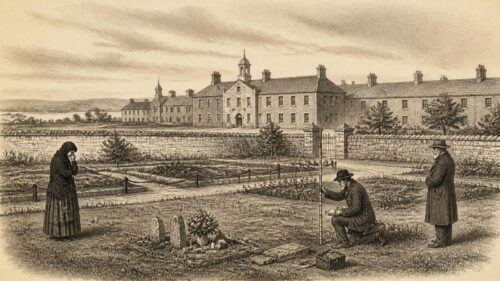
Test excavation confirmed the presence of significant quantities of human remains in underground chambers within the former home grounds. The remains were those of infants and young children. The finding did not validate every dramatic assertion circulated in public discussion, nor did it settle every question about who was buried in each part of the site. It did, however, establish a fact of the highest importance: children’s remains had been deposited in a manner the State later described as manifestly inappropriate.
That language should not be softened. The discovery concerned human beings whose deaths had been registered and whose burial arrangements had not received the ordinary safeguards of commemoration, traceability and familial knowledge. But precise language remains essential. It is historically inaccurate to claim that forensic work has proved that every child associated with the home lies in one chamber, or that the cause of death of every child is known, or that a comprehensive identification has already taken place. Such statements move beyond the evidence.
The physical task is exceptionally difficult. Infant and very young child remains are delicate; their bones are small and, after decades in a disturbed and confined environment, can become commingled. The individualisation of remains is therefore not a routine matter of matching a skeleton to a name. It requires the careful recovery, sorting and analysis of material that may contain bones from more than one person and may have been affected by water, soil conditions, later disturbance and the original structure of the chambers.
Forensic archaeology is not simply excavation carried out more slowly. It is a method of preserving evidential relationships. Where was a bone found? At what depth? Near what other remains or objects? What does the surrounding structure indicate? Which deposits are earlier or later? A hurried recovery could destroy precisely the contextual information needed to understand the site. This explains both the long preparation and the insistence on a forensic standard. Time can feel intolerable to families who have waited for answers, yet care is itself part of the respect owed to the dead.
The Irish Government created the Office of the Director of Authorised Intervention, Tuam, under the Institutional Burials Act 2022, to oversee a staged intervention involving recovery, analysis, identification where possible and respectful reinterment. The legal framework is significant in historical terms. It acknowledges that ordinary burial law and ordinary archaeological practice were not sufficient on their own for a site involving institutional responsibility, surviving relatives, possible evidential needs and the recovery of children’s remains.
The language of ‘intervention’ can sound bureaucratic, but it describes an ethical and technical undertaking of rare sensitivity. It must safeguard human remains, respect relatives, preserve possible evidence, deal with the expectations generated by public attention and avoid promises science cannot fulfil. The process is directed not towards an abstract excavation but towards restoring, so far as possible, the identities and dignities that institutional treatment denied or obscured.
Genetic Witness
DNA has an immense symbolic power in this setting because it seems to answer the question the records left unresolved: who were these children? That promise is real, but conditional. DNA can indicate biological relationship between recovered remains and a living reference donor. It may assist in identifying an individual where usable genetic material can be recovered and where an appropriate familial comparison is available. It does not create a complete social history, and it cannot guarantee that every child will be identified.
In the case of Tuam, the practical obstacles are formidable. DNA degrades over time, and its survival depends on environmental conditions. The remains are young and may be fragmented. Commingling makes it difficult to ensure that genetic samples belong to a single individual. A possible match also depends upon living relatives participating in the programme and upon the closeness and suitability of the relationship for comparison. A person may have descendants or collateral kin who do not know the family history, live abroad, lack information about a possible connection, or choose not to take part.
For these reasons, genetic identification is best understood as a process of probabilities and corroboration rather than an automatic revelation. A strong biological match may be compelling, but the best conclusion will normally be one that accords with all available evidence: DNA, age assessment, institutional records, civil registration, family testimony and the known chronology of the site. Where evidence does not converge, honesty requires that uncertainty be retained.
The DNA programme also raises questions of consent and control. A reference sample is intimate information. It may reveal a familial connection that a participant hoped to find, feared to find, or had never imagined. It may disclose relationships beyond the immediate purpose of the scheme. A responsible programme must therefore proceed with informed consent, strict limits on use, secure handling and clear communication about what results can and cannot mean. The goal of identification does not extinguish the rights of the living.
There is a further historical irony. Institutions once managed kinship through paperwork, sometimes severing or concealing relationships. Genetic testing can now reconstruct aspects of biological connection that those systems obscured. Yet biological connection is not the whole of kinship. Adoptive parents, foster families, siblings raised apart and women forced by circumstance or pressure to relinquish children all belong to the human story. DNA may identify descent; it cannot measure love, loss, care, coercion or belonging.
For that reason, the phrase ‘DNA and institutional memory’ should not be read as a claim that science can correct history by itself. Rather, DNA becomes another witness. It speaks within a larger record made up of documents, places, survivor accounts, public policy and family remembrance. Its special strength is that it can link the living and the dead across a gap created by secrecy and poor record-keeping. Its limitation is that it cannot speak alone.
Public Reckoning
Tuam became a national and international story not only because of the discovery of remains but because it touched a deeply unsettled question about the Irish State. How had institutions serving unmarried mothers and children operated within the social order of independent Ireland? What responsibility belonged to religious bodies, local and national government, medical professionals, families and the wider public? No serious answer can assign all agency to one actor while exempting the others. Nor should distributed responsibility become a way of making responsibility disappear.
Mother and baby homes were embedded in systems of funding, inspection, regulation and social referral. Religious congregations administered particular institutions, but public authorities exercised responsibilities in welfare, health and local governance. Families also operated under powerful social pressures, and some individuals acted with kindness in constrained circumstances. None of those truths cancels the structural reality that unmarried mothers and their children were frequently treated as a problem to be managed apart from ordinary community life.
The Commission’s final report brought much documentation into public view and offered a nationwide framework for understanding the homes and county institutions within its remit. Its conclusions have also been debated and criticised by survivors, advocates and scholars, particularly over interpretation, emphasis and the degree of institutional accountability represented in its narrative. Such disagreement is not a sign that history has failed. It is part of an open reckoning, provided that claims remain anchored in evidence and that survivor testimony is not reduced to an afterthought.
Historical interpretation must distinguish between explanation and excuse. High infant mortality, infectious disease, poor nutrition and inadequate medical resources formed part of the social and medical environment of the period. They help explain why children died; they do not excuse failures of care, record-keeping, burial practice or social policy. Likewise, the moral norms of the past explain how stigma acquired authority; they do not make that stigma harmless or inevitable.
Tuam also exposes the limits of official memory. A State may preserve statistics while failing to preserve relationships. It may retain files while leaving people unable to see them. It may create inquiries decades later because the ordinary administrative record never delivered an adequate account. Institutional memory in this sense is not the same as public remembrance. An institution can remember a person as an entry while a family remains denied the information needed to mourn them.
The later response has attempted, imperfectly, to change that relationship. Access to birth information, tracing services, redress arrangements, archival preservation and the Tuam intervention all signal a recognition that records should serve affected people as well as administrative systems. These measures cannot undo a childhood lost, a mother’s separation, an unmarked burial or decades of uncertainty. Their historical importance lies in their acceptance that the past continues to make claims upon the present.
Local Memory
Tuam’s story is often narrated at the scale of nation, Church and State. That scale is necessary, but it can obscure the local world in which the home stood. Institutions were not abstract buildings. They existed beside streets, shops, schools, housing estates and families. People observed comings and goings, heard rumours, worked in connected services, knew someone who had been there, or chose not to ask. In small communities, knowledge can be partial, indirect and shaped by fear of causing hurt or attracting condemnation.
Local memory should therefore be approached with sympathy and discipline. A recollection may preserve an invaluable clue about a site, a practice or a person. It may also compress years, attach an event to the wrong date, or merge one story with another. Historians do not honour community memory by repeating each tale as fact. They honour it by recording what is remembered, asking how the memory travelled, and comparing it carefully with documentary and physical evidence.
The most persistent local memories surrounding Tuam concerned children, a disused institutional landscape and a burial place not marked in a way that gave ordinary public recognition. Their endurance helps explain why the later documentary research resonated so strongly. The story did not arrive from nowhere. It gave names, records and national attention to an unease already present in the town’s remembered geography.
That geography also cautions against spectacle. The children at the centre of the investigation must not become symbols so powerful that their individual humanity vanishes again. A site may draw cameras, official statements and international headlines; it still concerns families whose relationships to the dead are intimate and unequal. Some may seek public acknowledgement. Others may want quiet, private information. A humane historical culture allows both.
Measured Hope
What, then, can the forensic and DNA work at Tuam achieve? At its fullest, it may recover remains with proper care, establish the presence and circumstances of burials more precisely, identify some children through familial genetic links, return information to relatives, and support respectful reinterment. It may also set standards for how Ireland approaches other institutional burial questions. Even where an individual identification is impossible, recovery and dignified burial can reject the anonymity imposed by earlier neglect.
What it cannot do is produce a total restoration. Some names may never be conclusively connected to remains. Some relatives may never be found. Some records may remain absent, incomplete or contested. Scientific results may complicate rather than resolve family stories. The ethical duty is not to promise certainty where certainty is unavailable, but to ensure that uncertainty is no longer hidden behind institutional silence.
That is the deepest importance of DNA in this history. It offers an evidential connection between bodies, records and descendants. More broadly, it challenges the old administrative habit of treating vulnerable people as separable from family, place and future. A child recorded as dead, a mother recorded as admitted, or a person recorded as adopted is not exhausted by the document. Each belongs to a chain of relationship that can survive secrecy, distance and time.
Tuam will remain difficult history. It should. The task is not to make it consoling, nor to force every ambiguity into a preferred narrative. It is to preserve the distinction between what is documented, what is reasonably inferred and what remains unknown; to listen to those whose lives were shaped by the institutions; and to treat recovered remains not as an archaeological curiosity but as persons owed care.
In that sense, institutional memory is not simply a storehouse of files. It is a public practice. It is expressed in whether records can be accessed, whether names can be restored, whether survivors are heard, whether uncertainty is admitted, and whether the dead are treated with dignity. Tuam has made those questions unavoidable in Ireland. DNA may supply part of the answer, but the larger answer depends on what the country chooses to remember, repair and refuse to obscure again.

Tuam’s proposed DNA programme reveals the tension between individual identification and the wider, often incomplete history of institutional separation. The article argues that genetics can reconnect relatives and support forensic conclusions, yet cannot by itself explain care, coercion, burial decisions or lived kinship. This suggests that commemoration should not treat biological matching as the sole route to recognition, especially where remains cannot be identified or families choose not to participate. How might the Tuam intervention combine DNA evidence, archival access, survivor testimony and reinterment in ways that honour both family claims and the history of children whose identities remain uncertain?