Tuam Remembered
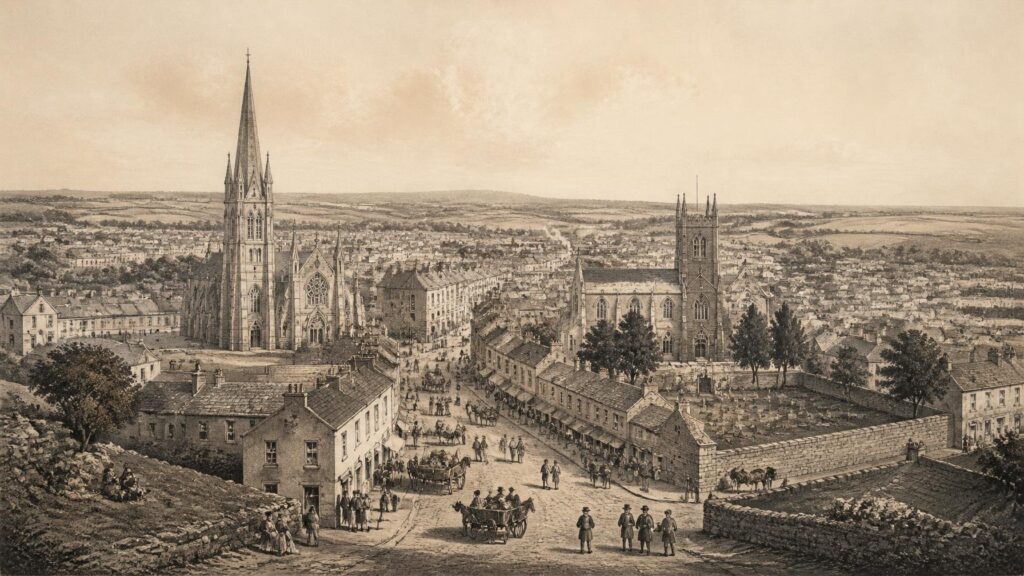
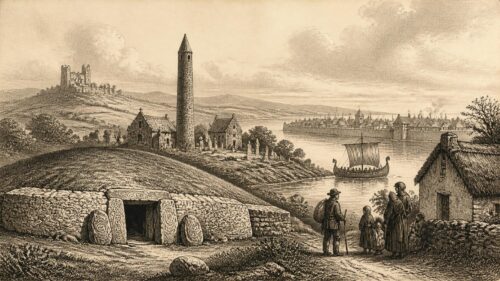
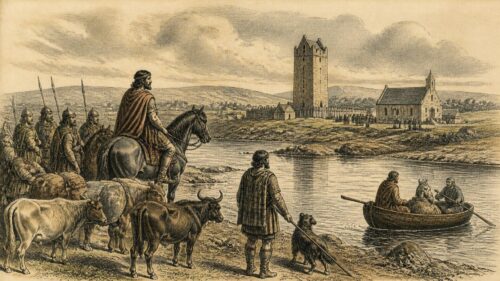
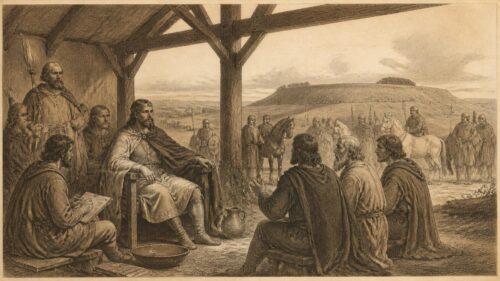
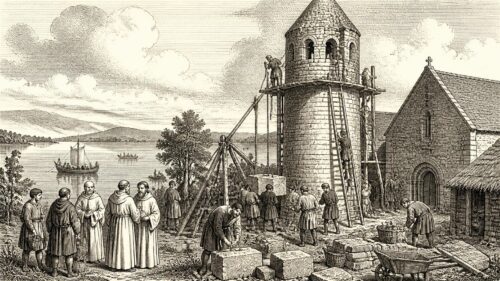
AI generated historical illustration, not a contemporary photograph.
At a Glance
Tuam is a place where several Irish histories meet: early Christian tradition, the reorganisation of the medieval Church, Gaelic kingship, market-town commerce, famine poverty, denominational change and the difficult public recovery of institutional memory. Its importance does not rest on one monument or one episode. Rather, the town’s surviving buildings, dispersed archaeological fragments, documentary records and living testimonies reveal how a small Connacht centre repeatedly acquired national significance.
Place Names
Tuam stands in north County Galway, on comparatively open ground between the limestone plains of east Galway and the more broken country leading towards Mayo and Connemara. Its Irish name, Tuaim, is generally understood to refer to a burial mound or tumulus. The name is suggestive, but it should not be treated as proof of a known prehistoric monument beneath the modern town. Irish placenames frequently preserve broad descriptions of landscape long after their precise original reference has become uncertain. In Tuam’s case, the name is an early clue that the site was recognised as a place of distinction before it became a medieval episcopal town.
The physical setting helped to make Tuam a meeting point. Roads running through north Galway connected it to Mayo, Roscommon, Sligo and the wider province of Connacht. Its later commercial importance was therefore not accidental, nor merely a product of nineteenth-century transport. Medieval ecclesiastical centres required access to people, land, food, patronage and communications. Tuam possessed these advantages, although its fortunes depended greatly on political changes beyond its boundaries.
Modern readers can be tempted to picture an ancient Irish town as a continuous urban settlement, developing steadily from monastery to market square and then to railway town. The evidence recommends greater caution. Early medieval religious settlements, royal sites, episcopal centres and later towns did not necessarily share the same scale, street pattern or social character. Tuam’s history is better understood as a sequence of renewals. A religious community gave the place prestige; twelfth-century kings and church reformers enlarged that prestige; later market, administrative and transport functions gave it new forms; and twentieth- and twenty-first-century memory work has obliged the town and the country to confront another, painful layer of its past.
Sacred Origins
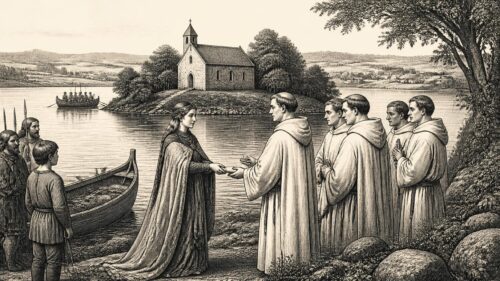
Tuam’s traditional founder is St Jarlath, or Iarlaith, whose name remains central to the town’s religious identity. Later ecclesiastical tradition presents him as establishing a school or monastery at Tuam after leaving Cloonfush, south of the town. The story forms part of the familiar pattern of Irish hagiography in which a saint receives a sign directing him to a new foundation. Such accounts are valuable evidence of how communities remembered their origins, but they are not straightforward contemporary biographies. They were composed, transmitted and reshaped in religious settings with devotional and institutional purposes.
The historical core is more modest but still important. Tuam was an established church site by the early medieval period, and the cult of Jarlath supplied a sacred ancestry that later patrons could employ. In Ireland, saints and their churches were not isolated from secular power. Churches held land, received gifts, educated clerics, preserved learned culture and served as focal points for communities whose political allegiances were constantly negotiated. A foundation associated with a respected saint could thus acquire influence far beyond its immediate locality.
What cannot safely be claimed is an exact foundation year, a detailed plan of Jarlath’s community, or an unbroken institutional continuity from his supposed lifetime to the later archbishopric. The surviving evidence does not permit that precision. Nor should the lack of such precision diminish the site. Early Irish history often survives in annals, genealogies, saints’ lives, later compilations and archaeological traces rather than in the administrative records familiar from later centuries. The proper historical approach is to distinguish the tradition of Jarlath from demonstrable dates, while recognising that the tradition itself shaped Tuam for generations.
By the eleventh and twelfth centuries, the town’s religious standing was sufficiently well established for it to become a focus of large-scale patronage. This was the point at which an old sacred site entered a new political order. Tuam would become not simply a monastic settlement, but an archiepiscopal centre tied to reforms affecting the whole Irish Church.
Royal Ambition
The transformation of Tuam is closely connected with Toirdelbach Ua Conchobair, usually rendered Turlough O’Connor, king of Connacht and later high king of Ireland. His career belongs to a period when powerful provincial rulers competed for authority across Ireland and when church organisation was being reshaped on more territorial and diocesan lines. Patronage of churches was one means by which rulers displayed legitimacy, secured prayers and alliances, and made a claim to public authority. In this setting, Tuam became a particularly conspicuous statement of O’Connor power.
The Synod of Kells in 1152 recognised Tuam as one of four metropolitan sees, alongside Armagh, Cashel and Dublin. The creation of an archbishopric did not mean that the town suddenly controlled the religious life of the west in a modern bureaucratic sense. It did, however, give Tuam a rank of exceptional importance. Its archbishop received a pallium, the symbol of metropolitan authority, and the see became the centre of an ecclesiastical province. The change was part of a wider movement towards defined dioceses, episcopal hierarchy and stronger links with Rome.
Áed Ua hOissín, the first archbishop associated with the new metropolitan see, is linked by inscription and tradition with the great cross now preserved at St Mary’s Cathedral. The monument is crucial because it is more than an object of later legend. Its inscriptions name both a royal patron and an abbot: one asks for prayer for Turlough O’Connor and refers to the successor of Iarlath; another asks for prayer for O’Hossin, identified as abbot. These texts bind kingship, local saintly succession and ecclesiastical leadership into one carved public declaration.
The cross is conventionally dated to the mid twelfth century, and its sandstone carving speaks of skilled workmanship, considerable resources and deliberate display. It has often been called the Market Cross, a name reflecting its later urban setting. Its original context was different: it belonged to the cathedral precinct of the newly elevated ecclesiastical centre. The cross should therefore be read not simply as devotional art, but as a monument of political theology. O’Connor’s patronage joined royal authority to reforming church structures, while the invocation of Iarlath rooted that innovation in local sanctity.
The first cathedral associated with this moment did not survive intact. Later accounts record its destruction by fire in 1184. Fire was an ever-present danger in medieval settlements, where timber construction, candles, hearths and dense occupation made conflagration common. It would be unsafe to reconstruct the entire building from the brief notices that remain. Yet the loss helps to explain why the most impressive material witnesses to twelfth-century Tuam are fragments, sculpture and architectural survivals rather than a complete Romanesque cathedral.
Stone Witnesses
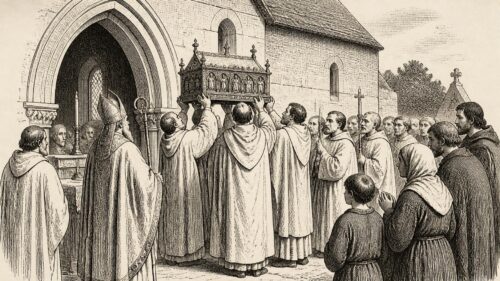
The high cross is Tuam’s most celebrated medieval survivor, but it is not an uncomplicated relic. It was broken into sections, dispersed and reused over time. Antiquarians and local researchers identified fragments in the nineteenth century, and restoration involved choices about arrangement, setting and conservation. The object seen today is therefore both medieval sculpture and the product of modern custodianship. Its removal from the open square to the shelter of St Mary’s Cathedral in 1992 was a practical response to weathering, pollution and vulnerability.
Its decorative programme includes clerical figures, interlace and scenes conventionally identified with biblical subject matter. Some readings of damaged panels remain tentative. Weathering and fragmentation necessarily limit certainty, and labels attached to figures may reflect scholarly interpretation rather than inscriptions naming the persons represented. The most secure evidence lies in the surviving inscriptions and the monument’s form. It belongs to the late high-cross tradition, when monumental stone sculpture could communicate scriptural teaching, commemoration and patronage to a broad public.
Other fragments within the cathedral compound widen the picture. The medieval chancel arch, generally dated to the later twelfth century, is a major example of Hiberno-Romanesque architecture. Its carved capitals and chevron ornament preserve an architectural language that linked Irish church building with styles circulating across western Europe, while retaining local characteristics. This was not evidence that Ireland had become culturally derivative. Rather, it demonstrates participation in an interconnected Christian world through craftsmen, clerics, liturgy, travel and patronage.
Stone is often treated as if it speaks with an authority unavailable to texts. It does not. It has to be read in context, and its present location may not be original. But the cathedral’s stones provide unusually direct testimony that Tuam was a site of major ambition in the twelfth century. They also show how later generations dismantled, repaired, preserved and reinterpreted the material past. Heritage is not merely what survives; it is what communities choose, or fail, to protect.
Medieval Fortunes
The decades after Tuam’s elevation were unsettled. The Anglo-Norman invasion began in the late twelfth century, and although Connacht was not absorbed in the same manner or at the same speed as eastern Ireland, its rulers and churchmen had to operate within a changed political environment. The archbishopric survived, but its history cannot be reduced to a simple contrast between an autonomous Gaelic past and a colonial future. Clerics, kings, Anglo-Norman lords and papal officials entered relationships that were sometimes hostile, sometimes pragmatic and often complex.
Tuam’s provincial position mattered. It remained the metropolitan centre for a large western ecclesiastical province, but an archbishopric was not the same thing as a populous commercial city. Medieval Ireland’s settlement pattern differed from that of England, and many important religious centres had modest urban populations. Tuam’s standing rested on its see, its church lands, its learned associations and the networks of power around Connacht rather than on continuous metropolitan growth.
Episcopal appointments demonstrate this changing world. Medieval occupants of the see were drawn from both Gaelic and Anglo-Irish backgrounds, especially as the thirteenth and fourteenth centuries progressed. The shift should not be read as a complete replacement of one society by another. Church careers were shaped by local kinship, royal favour, papal provision, learning and the politics of benefices. The archbishopric placed Tuam in communication with Dublin, England, Rome and continental ecclesiastical administration, even while its social foundations remained western Irish.
The surviving record is uneven. Annals tend to preserve deaths, conflicts and notable events; papal and governmental documents preserve matters that reached formal administration; architectural remains record only what was built in durable materials. The ordinary people of medieval Tuam are therefore much harder to see than archbishops and patrons. Farmers, servants, craftsmen, women in religious households, traders and the poor appear only intermittently. Their absence from the record is a limitation of evidence, not evidence that they were unimportant.
Folklore has sometimes filled these gaps with colourful stories of hidden passages, vanished palaces and named figures attached to particular stones. Such tales can be culturally revealing, especially where they preserve a sense of loss or local attachment. They should not, however, be used as proof of medieval topography without archaeological or documentary support. Tuam’s past is strongest when legend is respected as legend and evidence is allowed to remain incomplete.
Confessional Change
The Reformation altered the institutional landscape of Tuam, as it did across Ireland, but the chronology and practical consequences were neither uniform nor immediate. The medieval cathedral and its endowments passed into the reformed established Church. The archbishopric continued within the Church of Ireland, while the Roman Catholic Church maintained its own hierarchy and religious life under increasingly difficult political conditions. Thus one medieval see became associated with two different confessional histories, both claiming continuity with older Christian tradition in different ways.
St Mary’s Cathedral became the cathedral church of the Church of Ireland archbishopric. Its fabric contains medieval survivals, but much of what visitors encounter reflects later rebuilding and repair. That layered appearance is historically appropriate. A cathedral is rarely a frozen medieval object; it is a working institution continually adapted to worship, finance, fashion and changing congregations. In Tuam, the building embodies both the survival of a medieval episcopal site and the post-Reformation history of an established Protestant church in a predominantly Catholic region.
The Roman Catholic community developed its own prominent institutional presence. The Cathedral of the Assumption of the Blessed Virgin Mary, commonly known as St Jarlath’s Cathedral, was designed by the architects Dominick and Peter Madden and begun in the period after Catholic Emancipation. Its Gothic form and scale proclaimed confidence at a time when Catholic public worship, education and organisation were becoming more visible. The cathedral was consecrated in 1837, during a century in which Catholic churches reshaped the visual character of many Irish towns.
It is tempting to describe the two cathedrals as symbols of simple division. They are indeed reminders of confessional difference, and Ireland’s religious history includes discrimination, unequal legal status and political conflict. Yet they also show continuity of place. Both stand within the history of an ancient ecclesiastical centre associated with Jarlath and the medieval archbishopric. The town’s religious landscape is better understood as overlapping inheritances than as a sequence in which one tradition simply erased another.
Market Town
By the eighteenth and nineteenth centuries Tuam had developed as a regional market town. Its streets, shops, fairs and service trades connected rural producers with merchants, carriers and consumers. Market activity was fundamental to the economic life of inland Irish towns. Farmers brought livestock, grain, butter, textiles and other produce; local people purchased necessities, arranged business, heard news and met relatives or acquaintances. The market was as much a social institution as an economic one.
Directories and local historical material record a varied commercial life. In the early nineteenth century the town supported linen-related activity, tanning, brewing, milling, retailing and professional services. The existence of several tanneries indicates the importance of leather production and agricultural supply networks. Brewing, too, depended on capital, malt, transport and a ready market. Such enterprises should not be romanticised as signs of general prosperity: town economies could be lively while labouring families remained precarious. Nevertheless, they reveal Tuam as more than an ecclesiastical relic.
The town’s built environment reflects this commercial role. Streets such as Shop Street and High Street developed mixed uses, with houses, premises, workshops, inns and public institutions standing close together. The nineteenth-century streetscape did not replace older history so much as overlay it. Market functions occupied ground already dense with ecclesiastical associations, and the familiar name of the high cross as the Market Cross captures that changing relationship between sacred monument and civic space.
Transport intensified Tuam’s regional importance. The railway reached the town in the nineteenth century, connecting it to Galway and, through wider networks, to other parts of Ireland. Railways altered the speed and scale at which goods, livestock, letters and people moved. They also changed expectations. A town with railway access could compete for trade, attract services and maintain links with emigrants and seasonal workers. Yet rail connection did not abolish dependence on agriculture or protect communities against the structural crises of poverty, land pressure and emigration.
Local civic confidence found expression in public buildings, newspapers, clubs, schools and associations. The Tuam Herald, founded in the nineteenth century, became an important recorder of local life. Like every newspaper, it must be read critically: its selection of stories reflected editorial priorities, social assumptions and the interests of those able to appear in print. Even so, it remains an indispensable witness to the rhythms of trade, politics, sport, religion, crime, entertainment and civic controversy in the town and its hinterland.
Famine Crisis
The Great Famine made devastating demands on Tuam and its surrounding district. The town’s workhouse, built under the Irish Poor Law system, was intended to provide relief only within a deliberately harsh institutional framework. Workhouses were designed to deter all but the desperate from seeking aid. Families were separated, routines were tightly controlled, and the stigma of entry could be profound. When potato failure, disease, eviction and unemployment produced mass distress, these institutions were overwhelmed.
Tuam Union was among the Poor Law unions of County Galway. By 1848, workhouses operated in Tuam, Galway, Loughrea, Gort, Ballinasloe and Clifden, but available accommodation and medical provision were grossly inadequate to the scale of need. County-wide figures recorded extraordinarily high mortality in the workhouses during the famine period. These totals cannot be mechanically assigned to Tuam alone, yet they establish the wider environment in which the Tuam institution functioned: overcrowding, fever, malnutrition and death were not exceptional failures at the edge of the system but central features of a crisis that exceeded it.
The workhouse should not be imagined as isolated from the town. It drew people into Tuam from a broad rural catchment; it required supplies, staff, administrators, medical attendance and burial arrangements; and it was visible to local ratepayers and residents. The boundary between institutional and civic history was therefore porous. The workhouse’s later conversion into other forms of public and charitable accommodation made the site a continuing part of Tuam’s twentieth-century history.
Famine remembrance must avoid two simplifications. It is wrong to treat all sufferers as passive victims without social ties or agency; people sought work, migrated, petitioned, traded, relied on kin and made difficult choices. It is equally wrong to use stories of individual resilience to soften the structural violence of hunger, disease and inadequate relief. The history of the Tuam workhouse points to both realities. The institution became a refuge of last resort because rural society had been made desperately vulnerable.
The Sisters of Mercy arrived in Tuam in 1846 and opened a House of Mercy amid famine distress. Accounts preserved through local heritage collections describe nursing, relief and work with poor girls. Such evidence records genuine charitable activity, but it should be set within the wider limitations of voluntary relief. Religious women and local philanthropists could alleviate suffering; they could not substitute for adequate public welfare, medical provision or equitable economic arrangements. The famine remains essential to understanding why institutional care acquired such a large place in Irish social history.
Civic Fabric
The later nineteenth century brought expansion in public institutions and education. Tuam’s churches, convents, schools, courthouse, market facilities and railway buildings created a civic landscape in which authority was visibly expressed through architecture. Gothic churches pointed to religious revival; institutional buildings represented discipline and provision; commercial premises advertised enterprise; and the railway station marked connection to the wider economy. These buildings organised daily movement as well as public symbolism.
Education had special importance. St Jarlath’s College, established in the early nineteenth century, became one of the town’s best-known institutions and contributed to Tuam’s role as an educational centre for north and west Galway. Schooling was not socially neutral. Access, curriculum, language, denominational control and the cost of education all affected who could benefit. Still, the growth of schools and colleges enlarged the town’s catchment and gave it a significance beyond its population.
National political movements were also felt in Tuam. The town participated in the dense associational life of nineteenth- and early twentieth-century Ireland: constitutional nationalism, cultural revival, land agitation, sporting organisations and local government all found expression in places such as Tuam. It would be misleading to present the town as politically uniform. Local society contained farmers, labourers, shopkeepers, clergy, professionals, landlords, nationalists, unionists and people whose politics were practical rather than ideological. Public events and electoral contests nonetheless connected Tuam to national arguments about land, representation and sovereignty.
During the revolutionary period, Tuam experienced the tensions of war and reprisal that marked many Irish towns. The burning of the Town Hall in July 1920, following an ambush in which members of the Royal Irish Constabulary were killed, remains one of the town’s starkest material reminders of the War of Independence. Such events should be located within a broader cycle of insurgency, policing, reprisals and fear rather than used as uncomplicated symbols of national struggle. They affected ordinary residents as well as combatants and officials.
Independence did not bring a clean break with every older institution. The new Irish state inherited local government structures, public-health responsibilities, poor-law buildings and entrenched assumptions about family, morality and welfare. Tuam’s later history illustrates the consequences of that inheritance with particular force.
Institutional Legacy
The former Tuam workhouse became associated with the Tuam Children’s Home, commonly called St Mary’s Mother and Baby Home, which operated from 1925 until 1961. The institution was owned and controlled by Galway County Council and run day to day by the Sisters of Bon Secours. This distinction matters. It corrects the misleading idea that the home was solely a private religious enterprise or, conversely, solely a state institution. Its governance, maintenance, finance, staffing and oversight involved intertwined local-authority, religious and state systems.
Women entered the home because pregnancy outside marriage carried severe social stigma and because practical alternatives were often absent or inaccessible. The Commission of Investigation’s final report emphasised the roles played by fathers, families, communities, churches and state structures in constraining unmarried mothers. A historical account must therefore resist explanations that place responsibility entirely on one group. That does not diffuse responsibility; it identifies the social system within which women and children were marginalised.
The conditions recorded at Tuam were grave. The Commission found that the physical state of the premises was poor and reported that 978 children who had been in Tuam or its linked Glenamaddy institution died. The great majority were infants, with causes of death recorded in contemporary documentation including respiratory disease, gastroenteritis, congenital conditions and other illnesses common in an era of high infant mortality. Such explanations provide medical context but cannot make the mortality rate morally or historically ordinary. Official records show that authorities were aware of serious problems in institutions of this kind.
It is vital to use precise language about what is documented. Catherine Corless’s research into death certificates brought national attention to the number of children who died in the home and to the absence of conventional burial records for most of them. Her work was a major act of local historical investigation, grounded in civil-registration evidence and persistent questioning. It prompted wider scrutiny, survivor testimony, official investigation and eventually forensic work. The discovery was not the creation of a legend; it was an evidence-led challenge to longstanding silence.
At the same time, some early public descriptions went beyond what had then been established. The site was sometimes described as a “mass grave” in a way that suggested a single undifferentiated pit and a settled account of every burial. The subsequent forensic investigation made the picture both clearer and more complex. In 2017, investigators confirmed the presence of significant quantities of human remains, predominantly of infants and young children, in underground structures within the former home site. The remains were found in a location associated with a disused sewage system. The investigation did not establish the identity of every child or a complete sequence of burial practices.
This distinction is not semantic. Precision honours the dead and protects the integrity of survivor-centred remembrance. The evidence supports the conclusion that human remains connected to the institutional period were deposited in a manifestly inappropriate manner. It does not permit historians to invent mechanisms, intentions or individual stories where records are missing. The truth is already grave enough without embellishment: vulnerable children died in striking numbers; many were not afforded documented individual burial arrangements; and the site came to embody a wider history of stigma, secrecy and institutional failure.
Public Reckoning
Public attention to Tuam reshaped Irish historical consciousness. The Commission of Investigation into Mother and Baby Homes was established in 2015 and issued its final report in January 2021. It examined a range of institutions and the broader social history surrounding them. Its findings have been debated, particularly by survivors and advocates who argued that the report did not fully reflect their experiences or the evidence they offered. That disagreement is itself part of the historical record. Official reports are substantial sources, but they are not the final word on lived experience.
The Irish Government issued an apology after publication of the report, acknowledging profound wrongs inflicted on mothers and children. Apology has significance, especially where official institutions formerly denied, minimised or ignored harm. It cannot itself restore lost family histories, establish identities of all those who died, or erase the pain caused by adoption practices, separation and secrecy. Its value depends partly on the practical measures that follow: access to records, counselling, memorialisation, financial recognition and a credible process for recovery and identification where possible.
The Institutional Burials Act 2022 created a legal framework for intervention at sites where people may have been buried in a manifestly inappropriate manner. It provides for excavation, recovery, forensic analysis, an identification programme and DNA databases, while stressing dignity and the involvement of relatives. This legislation arose from a national need but has particular relevance to Tuam. It recognises that the recovery of remains is not only an archaeological operation. It concerns kinship, identity, mourning, human rights and public trust.
As of the evidence consulted for this article, the Office of the Director of Authorised Intervention, Tuam has continued preparations for forensic excavation and analysis through specialist procurement and planning. The process is necessarily slow. Archaeology must be integrated with forensic science, legal safeguards, genetic identification, site safety, family liaison and ethical oversight. Delay is painful for relatives, yet haste could destroy evidence or foreclose identification. The most responsible approach is one that makes progress without treating the dead as objects of spectacle.
Tuam’s place in public debate has sometimes been distorted by international headlines that isolate the town from the rest of Irish history. The town was not uniquely cruel, and its people should not be made to carry a collective hereditary blame for systems created and maintained across church, family, local government and state. Equally, concern about stigma must not become a reason to mute the evidence. Tuam matters precisely because it brings national systems into local focus. It asks how ordinary institutions, routine practices and accepted moral judgments could produce lifelong harm.
Living Memory
Historical memory in Tuam is not confined to official reports or monuments. It lives in families who know fragments of a parent’s story, in survivors seeking records, in local historians who preserve documents, in clergy and congregations who care for inherited buildings, and in residents who negotiate the town’s public identity. These perspectives are not identical. A good local history does not impose an artificial consensus. It makes room for grief, anger, uncertainty, pride in heritage and the wish for careful truth.
The medieval cross and the former home site may seem to belong to entirely different worlds, but both demonstrate the power of place to carry meanings beyond its physical scale. One is a monument commissioned amid royal and ecclesiastical ambition; the other is a site where the dignity owed to children and mothers was catastrophically compromised. Both require interpretation. Neither should be turned into a decorative emblem. The cross needs its political and religious context; the burial site needs its forensic, institutional and human context.
Tuam also remains a working town rather than a museum. Its schools, shops, sporting clubs, churches, voluntary groups and families continue to make new history. The temptation to define it only through a terrible twentieth-century chapter is understandable but inadequate. To do so would obscure the medieval achievement that made Tuam nationally important, the long social history of its hinterland and the efforts of people who have sought truth. Conversely, to celebrate its ecclesiastical monuments while passing quickly over institutional suffering would reproduce the selective memory that historical research has challenged.
There is a special responsibility in writing about sites of trauma. Numbers must not replace persons, but historians should not invent personal details to create emotional effect. Records can tell us names, dates, administrative decisions and patterns of death; testimony can reveal experience, feeling and aftermath; archaeology can establish facts about place and remains. Each kind of evidence has strengths and limits. Where evidence is absent, silence should be acknowledged rather than filled with confident narrative.
Tuam’s history ultimately resists easy conclusions. It is neither a tale of uninterrupted decline nor a simple story of progress from medieval splendour to modern justice. It shows how institutions can endure by changing their form, how memory can be lost and recovered, and how local research can alter national understanding. The town’s past is difficult because it contains artistic achievement, religious devotion, commercial resilience, poverty, exclusion and care in close proximity. To remember Tuam honestly is not to choose one of these histories over another. It is to see that they belong, uneasily but inseparably, to the same Irish place.