

Wired State
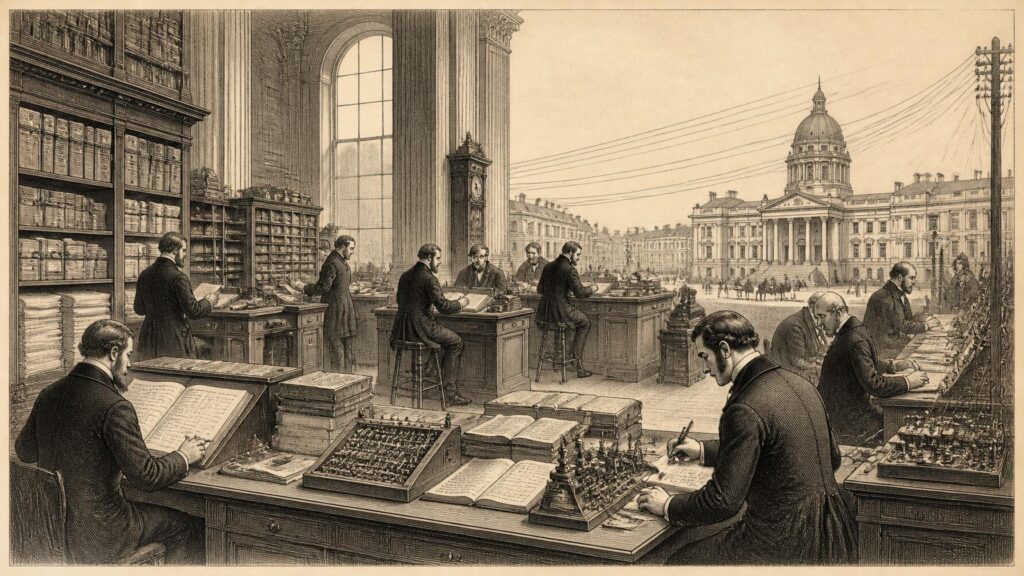
AI generated historical illustration, not a contemporary photograph.
At a Glance
Digital government in Ireland was not created in a single technological moment. It was assembled gradually from departmental databases, tax systems, welfare administration, public websites, shared standards and changing ideas about what citizens should expect from the State. Its history belongs to the history of Irish public administration: a story of offices attempting to serve a growing and more mobile population, to collect revenue efficiently, to prevent error and fraud, and eventually to make public services available beyond the counter, the post and ordinary office hours.
The phrase “digital government” can sound contemporary, even futuristic, but it describes a long transition. For much of the twentieth century, the Irish State depended upon paper files, local offices, printed forms, handwritten signatures and correspondence carried through the post. Computers first entered that world as administrative machinery: tools for processing large volumes of tax, social welfare and other records. Only later did the internet alter the public face of government. By the early twenty first century, citizens and businesses could increasingly obtain information, submit returns and make payments without entering an office. The later development of shared identity systems, interoperable data and mobile services extended that ambition.
This was neither a simple tale of progress nor merely an Irish version of an international trend. Ireland’s route reflected the structures of its State, the importance of taxation and social protection administration, the influence of European policy, and the country’s position as a major location for international technology firms. It also exposed enduring questions. When should public bodies share information? How can a person prove identity online? What happens to those without suitable devices, skills, connectivity or confidence? And how far may convenience be pursued without weakening privacy, legality or trust?
Paper Foundations
The prehistory of digital government lies in the older administrative State. Governments have always depended upon information: registers of births and deaths, tax ledgers, land records, electoral rolls, welfare claims, school returns and departmental correspondence. The creation of the Irish Free State in 1922 did not remove that practical need. Rather, a new administration inherited and adapted systems of registration, collection and record keeping. The work was labour intensive. Clerks copied figures, sorted files and reconciled accounts; members of the public repeatedly supplied proofs of identity, address and entitlement.
Computerisation did not abolish these administrative habits at once. It initially translated them into new forms. Large organisations with repetitive transactions had the strongest incentive to adopt automated processing. Taxation was especially important, because Revenue dealt with substantial numbers of employers, taxpayers, traders and agents while handling payments central to the State’s finances. Social welfare likewise involved a large caseload and a continuing requirement to establish entitlement accurately. The digital State was therefore built first in the less visible spaces behind the public counter: data centres, departmental systems, records management and internal communications.
That beginning matters because it corrects a common but misleading image of eGovernment as a collection of websites. Public websites are only the outer layer. A form cannot be submitted online unless there is a system capable of receiving it, identifying the sender, checking the information, routing the case, recording a decision and communicating an outcome. The later Irish policy language of back office transformation recognised this plainly. Government was not simply placing old forms on screens; at least in ambition, it was reworking how public bodies organised information and decisions.
The growth of personal computing and electronic communications in the late twentieth century created a new horizon. By the 1990s, the internet promised a means of contact that was not confined to office hours or geography. This prospect had particular appeal in Ireland, where public services served dispersed rural communities as well as rapidly expanding urban areas, and where emigration and international business gave many citizens practical reasons to deal with the State from a distance. Yet the internet did not make older channels obsolete. The public service had to remain available to those who preferred, or required, paper, telephone and face to face assistance.
Networked Revenue
Revenue provides one of the clearest documented examples of the transition. Its own institutional history records that an automated customs entry procedure, introduced in 1991, accepted declarations from traders through a secure digital channel. This was a specialised service rather than universal online government, but it demonstrated how electronic exchange could be useful where transactions were frequent, regulated and commercially time sensitive. In 1997 Revenue launched a public website, transferring guidance, leaflets and tax material from paper into an accessible online form.
The more consequential step was the Revenue Online Service, generally known as ROS. Revenue’s annual report for 2000 records that its first phase began in September of that year. It allowed electronic filing of certain PAYE and VAT returns and secure online payment. Further phases extended electronic filing to employer and corporate returns, and offered taxpayers and agents access to tax information. The significance was not just technical. The service joined identification, submission, payment and record access in a single administrative channel. It gave business users a reason to change established routines because it could reduce delay and make compliance possible outside normal office hours.
ROS also reveals a wider feature of the Irish experience: successful digitisation commonly began where a service had a clear user group, a high transaction volume and an obvious gain in speed or certainty. Businesses and tax agents had strong incentives to use an online revenue service. Revenue, in turn, benefited from cleaner data, faster processing and fewer paper transactions. By 2002, its annual report recorded that more than half of the electronic payments it received had come through ROS. This is documentary evidence of uptake, not proof that every user found the system easy; nevertheless, it indicates that online tax administration had moved rapidly beyond experimentation.
Revenue’s advance was important symbolically as well as administratively. It demonstrated that a public service could become a regular digital destination rather than a static information page. The service helped establish expectations later applied to other parts of government: secure access, immediate acknowledgement, online payment, account visibility and self service. Its history also cautions against treating digital government as wholly new. Revenue’s system was built upon long standing administrative powers and obligations. The technology altered the means of compliance, but tax administration remained an exercise of public authority governed by law.
Policy Momentum
The success of individual services did not automatically create a coordinated digital State. During the late 1990s and early 2000s, Irish governments placed information society policy and eGovernment within broader programmes of economic modernisation. The Comptroller and Auditor General later noted that two government action plans, launched in 1999 and 2002, had sought to exploit information and communications technology for public service delivery. The first plan required departments and agencies to develop specific eGovernment strategies; subsequently, the emphasis shifted towards making technology part of each body’s wider business strategy.
That adjustment was revealing. A separate technology plan could produce websites and pilot projects, but it could also leave ordinary administrative processes untouched. Treating digital development as part of departmental strategy implied something more demanding: senior officials were expected to consider how technology related to service design, staffing, governance and expenditure. The approach was sensible in principle, although the Auditor’s examination found considerable variation among public service providers in their focus on user needs and their capacity to reshape services accordingly.
This variation should not be mistaken for a uniquely Irish failure. Digital transformation has been difficult in most states because government is not a single organisation. Departments and agencies are created at different times, possess different statutory responsibilities and operate distinct information systems. A citizen may see “government” as one entity, while the State is composed of bodies with separate budgets, databases and legal duties. Connecting them requires more than technical compatibility. It requires authority, standards, agreements about data, trained staff and public confidence that information will not be used inappropriately.
European integration supplied an additional framework. Ireland’s public administration increasingly developed digital services in conversation with European Union programmes, rules and targets. This did not mean that Brussels designed Irish services. Rather, European work encouraged common aims: online public services, cross border compatibility, electronic identification, accessibility, cybersecurity and data protection. EU membership also made digital administration relevant to the movement of people, goods and businesses across borders. A small State with a highly international economy had particular reason to make its systems capable of communicating with wider European structures.
By the middle of the 2010s, policy language had become more integrated. The Public Service ICT Strategy described objectives including shared services, digital first design, data as an enabler, improved governance and increased capability. Its definition of digital government was expansive. It included front end services, core digitisation, infrastructure, processes and back office reform. That was an important conceptual change. The earlier aim of putting information online had matured into an argument for redesigning public administration around digital possibilities.
Shared Identity
One of the hardest problems in digital government is identity. A department may publish information freely, but it cannot safely disclose tax details, welfare records or personal documents without confidence that the person seeking access is who they claim to be. For years, Irish online services largely developed their own arrangements. This was workable for individual bodies but inconvenient for citizens, who could face repeated registrations, passwords and requests for supporting documents.
The Public Services Card, SAFE registration and MyGovID were intended to address that fragmentation. The Public Services Card was introduced in 2011, first among recipients of social welfare payments. The wider identity framework was introduced from 2010 and combined the Standard Authentication Framework Environment, the card and the MyGovID online platform. In 2017, the government formally launched MyGovID as a secure sign in intended to work across public services. Revenue’s myAccount and the Department of Social Protection’s MyWelfare were among the services linked at launch.
The administrative attraction was clear. A verified identity could, in theory, mean that citizens did not have to prove the same facts repeatedly to multiple bodies. It could support online access to high value services and make a more joined up State possible. The phrase “only once” later became common in digital government discussions: information supplied to one part of government should not need to be supplied again when lawful, necessary and technically feasible sharing could achieve the same end.
But identity systems carried political and legal weight. The Public Services Card became the subject of public concern and regulatory scrutiny, particularly where its use appeared to extend beyond the purposes for which people understood it to have been created. The State insisted that the card was a public services instrument rather than a general compulsory identity card. That distinction was more than semantic. Ireland has no general legal requirement for a person to carry an identity card, and the question of whether a service can require a particular form of authentication goes to the relationship between administrative efficiency and individual liberty.
Here it is important to separate evidence from interpretation. The documentary record establishes that the identity framework sought to support secure access and reduce duplicated verification. It also establishes that its expansion provoked privacy and legal debate. It is an interpretation, though a reasonable one, that the controversy marked a turning point in public understanding of digital government. Earlier online services could be viewed as optional conveniences. A shared identity system made the deeper logic of digitisation visible: modern public administration increasingly depended upon the ability to connect a person, a record and a transaction across institutional boundaries.
Privacy Boundaries
Data protection was therefore not a peripheral issue but a condition of legitimacy. Ireland had data protection legislation before the internet became central to public life, notably the Data Protection Act 1988, later supplemented by the 2003 Act. These laws reflected a growing recognition that computerised personal information could create risks distinct from paper files. Data could be copied more easily, searched at scale, linked across systems and retained indefinitely unless rules limited its use.
The legal environment changed again with the European Union’s General Data Protection Regulation, applicable from 25 May 2018, and Ireland’s Data Protection Act 2018. These measures did not prevent public bodies from processing data. Government cannot administer taxation, social protection, healthcare, education or justice without information. Instead, they reinforced duties concerning lawful basis, fairness, transparency, security, purpose limitation and individual rights. In historical terms, they show how the digital State grew alongside new restraints upon its power.
The need for restraint is particularly apparent in data sharing. To a service designer, sharing can appear self evidently beneficial: it may spare a claimant from producing documents that another body already holds and may reduce mistakes created by inconsistent records. To a citizen, the same practice can look like surveillance unless its purpose, safeguards and limits are clear. Both perspectives are real. The history of digital government cannot be written honestly as a contest between innovation and obstruction. It is instead a continuing effort to reconcile practical administration with the democratic requirement that public power be intelligible and bounded.
Open government formed another side of this story. Digitisation increased the capacity to publish official information, datasets, consultation papers and policy documents. It could improve transparency, but publication itself did not guarantee comprehension or accountability. Data must be accurate, contextualised and usable. Nor is everything that government holds suitable for release. Personal information, confidential material and sensitive security records require protection. The achievement of a digital public realm therefore depended not only on putting material online but on developing judgement about what should be shared, how it should be explained and who could realistically use it.
Service Design
The vocabulary of public service reform gradually changed from “electronic delivery” to “user centred” and “digital first” design. This reflected an important lesson from the first internet phase. A scanned paper form or a departmental website does not necessarily make a service easier. People encounter government at consequential moments: starting employment, paying tax, becoming ill, applying for a passport, registering a birth, losing a job, establishing a business or seeking a pension. Their need is rarely to interact with a particular database. Their need is to solve a practical problem.
Irish strategies in the 2010s increasingly treated the citizen experience as a central concern. The eGovernment Strategy for 2017 to 2020 connected digital delivery with the wider Public Service ICT Strategy and with European eGovernment work. It envisaged a more coherent system in which data and digital tools improved access, interaction and customer experience. The language should not be read as proof that coherence had already been achieved. Strategies express an intended direction. Their historical value lies in showing what officials and ministers considered the principal deficiencies: fragmentation, uneven capability, weak integration and a need for services designed around users rather than institutional convenience.
Shared platforms offered a partial answer. A common identity service, standard online forms, payment facilities, document systems and reusable software could reduce duplication between bodies. The Office of the Government Chief Information Officer came to occupy an important coordinating role in this field. Its work illustrates a broader shift from isolated departmental computer projects towards central support for common infrastructure. Yet centralisation had limits. Different services retained specialised legal requirements, and a uniform digital process could be inappropriate where a person needed discretion, advice or advocacy rather than a fast transaction.
Accessibility and inclusion became increasingly explicit within policy. This was not merely charitable language. A digital channel that excludes people can transfer costs and difficulty onto those least able to bear them. Older people, some disabled people, those with limited English or Irish literacy, people without reliable broadband, people experiencing homelessness, and others facing insecure circumstances may need alternatives. A historically mature account of digital government must therefore recognise the continuing importance of staffed offices, telephone support, trusted intermediaries and paper pathways. “Digital first” is not the same as “digital only”.
Pandemic Acceleration
The COVID 19 pandemic gave the digital State an abrupt practical test. Restrictions on movement and physical contact made remote communication essential. Public bodies, like private employers and voluntary organisations, had to expand online channels, remote working and digital communication at speed. The experience did not begin Ireland’s digital transformation, but it exposed both the value of capabilities already developed and the costs of gaps that remained.
There is a temptation to describe the pandemic as a complete rupture. It was more accurately an accelerator. Services such as Revenue’s online systems and MyGovID had been developed over years before 2020. Their existence gave the State foundations on which to build. Equally, the pandemic made visible the unequal distribution of digital access. A household without adequate connectivity or devices experienced public services, education and work very differently from one with reliable broadband and digital confidence. The period strengthened the case for treating inclusion as infrastructure rather than an afterthought.
In 2022, the government’s Digital Ireland framework set digitalisation of public services within a broad national agenda covering business, infrastructure, skills and regulation. It spoke of trusted, user driven, intuitive, inclusive and efficient public services, while setting a target for the online consumption of public services by 2030. Such ambitions should be understood carefully. They record a political objective, not an accomplished historical fact. The useful question for historians is what their repetition indicates. It indicates that digital public service delivery had become a central measure of administrative modernity and national competitiveness.
The pandemic also sharpened the relationship between the State and private technology. Public bodies relied on communications networks, devices, cloud services and software often supplied by commercial firms. Ireland’s role as a European base for major technology companies made this relationship especially salient. The State sought to benefit from digital investment and expertise while retaining responsibility for public records, cybersecurity, procurement, service continuity and democratic accountability. Digital government was never simply “the government using technology”; it was government exercising public responsibilities within technical systems it did not wholly own or control.
European Horizons
By the 2020s, Irish digital government was being framed within the European Union’s Digital Decade. This placed national services in a wider programme of targets and common infrastructure. Electronic identity, interoperable public services, cybersecurity, digital skills and data governance could no longer be treated entirely as domestic matters. A person moving between member states, a business trading across borders or a student presenting qualifications might need trusted digital documents recognised outside Ireland.
Irish plans consequently began to emphasise digital public infrastructure and a prospective government digital wallet. The proposed wallet is intended to allow individuals to hold and present verified credentials through a mobile application associated with MyGovID. Examples mentioned by government include documents such as a driving licence, civil certificates and a European Health Insurance Card. The proposal represents continuity as much as novelty. It extends older ambitions for secure identity, less paper, reusable verified information and cross border compatibility.
It also revives familiar cautions. A wallet may be convenient, but its value depends on voluntary confidence, accessibility, security and a clear legal framework. A system designed for a smartphone must not leave behind people who cannot or do not wish to use one. Historical experience suggests that digital services earn durability when they are useful in ordinary life, transparent in their safeguards and accompanied by credible alternatives. Technology can reduce repetitive bureaucracy, but it can also make bureaucratic exclusion faster unless institutions deliberately prevent that outcome.
Unfinished Republic
The history of digital government in Ireland is therefore best understood as unfinished state building. Its material achievements are considerable: online tax administration, public information portals, electronic payments, shared authentication, expanding digital welfare and Revenue services, and more systematic strategies for common infrastructure. These developments changed the practical encounter between person and State. Tasks once dependent on queues, stamps and opening hours may now be completed from home, at work or through a mobile device.
Yet the history is not one of inevitable replacement. Physical service points, letters, telephone calls and personal assistance remain part of the democratic State precisely because citizens’ circumstances differ. The strongest version of digital government is not a State that refuses human contact. It is a State able to offer secure, comprehensible and convenient digital routes while preserving fair non digital routes for those who need them.
There is little folklore attached to this subject in the traditional sense. Its myths are modern ones: that a website automatically makes a service simple; that data sharing is always either liberation or surveillance; that technological change is politically neutral; or that a digital identity can solve every administrative difficulty. The documentary evidence tells a more sober story. Irish governments have repeatedly attempted to use technology to make administration quicker, more coherent and more responsive. Each advance has required choices about law, design, funding, institutional power and the rights of the individual.
That is why the subject deserves a place in Irish history. Digital government records how the Republic has sought to govern itself in an age of networks. It links the older clerical State to the online citizen, the local office to the shared platform, and national administration to European systems. Its future will be shaped not only by artificial intelligence, wallets or new software, but by the enduring public questions that have accompanied every stage of the transition: who is included, who decides, what is recorded, what is shared, and how power remains answerable to the people it serves.


Digital identity emerges in the article as more than a convenient login system: it is a test of how far public bodies may coordinate records while retaining legitimacy. Shared verification could spare people repetitive paperwork and enable smoother access to taxation, welfare and other services. However, the Public Services Card controversy shows that efficient administration can generate concern when purposes or expectations appear to widen. As Ireland develops interoperable services and proposed digital wallets, how should it balance secure data sharing with meaningful choice, accessible non-digital routes, and clear limits on state use of personal information in democratic practice today?