

Irish Childhood
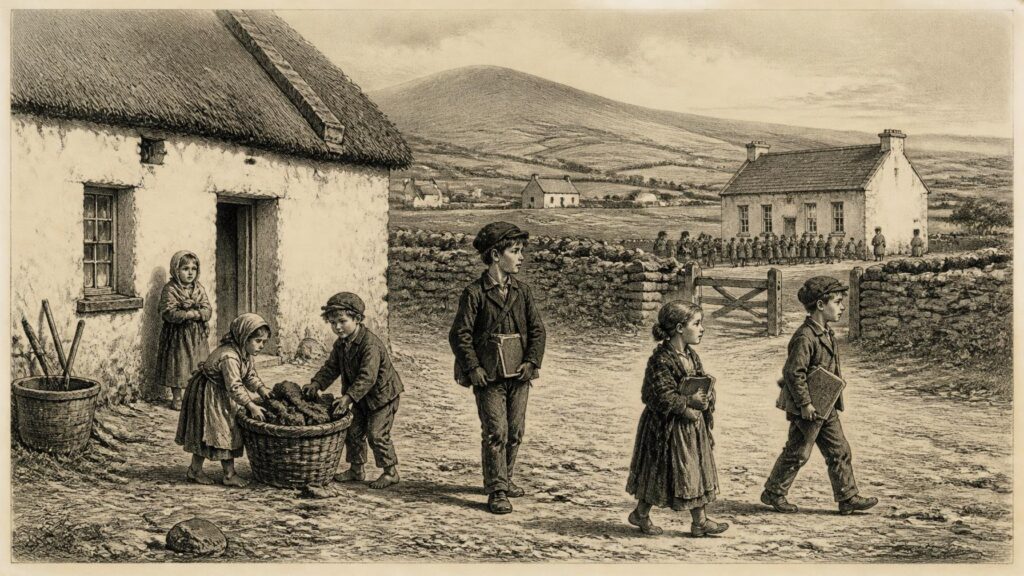
AI generated historical illustration, not a contemporary photograph.
At a Glance
The history of children in Ireland is not a decorative margin to the national story. It is a record of work and play, schooling and speech, hunger and migration, family affection and institutional separation. Yet it is also unusually difficult to recover. Adults created most surviving records: census enumerators, clergy, teachers, inspectors, judges, charitable bodies and government departments. Children often appear within those papers as numbers, dependants, pupils, inmates or objects of policy rather than as speaking individuals. To write their history responsibly is therefore to attend both to what the sources reveal and to the silences they preserve.
Historical Evidence
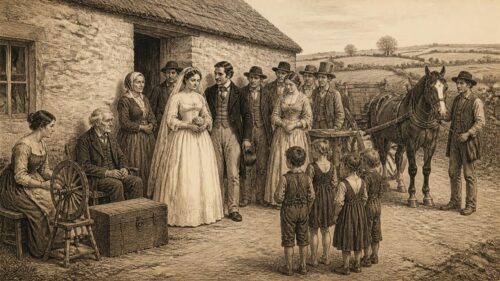
There is no single Irish childhood. A child growing up in a tenant household in Connemara, an artisan family in Belfast, a Dublin lodging house, a Protestant farm in Ulster, a merchant household in Cork, or an Irish-speaking community on the western seaboard encountered different material conditions and expectations. Class, religion, gender, place, language and family circumstance could determine whether a child attended school, worked for wages, cared for siblings, migrated, inherited land or entered an institution. The experience of a child with a disability, or of a child born outside marriage, could be shaped by additional and often severe social stigma.
For earlier periods, historians must proceed carefully. Medieval legal texts, religious writings and archaeological evidence show that kinship, fosterage, inheritance and household obligations mattered deeply in Gaelic Ireland, but they do not give a straightforward account of ordinary children’s feelings or daily routines. Later sources are fuller but still uneven. Parish registers may record baptism and burial; school rolls measure attendance; workhouse records expose administrative routines; newspapers recount exceptional tragedies; census returns make households visible at ten-year intervals. Such material makes patterns discernible, but it should not be mistaken for a complete account of childhood.
Oral history, memoir and folklore are equally valuable, especially for the twentieth century, although each needs contextual reading. A remembered schoolmaster, a frightening institution, a beloved grandparent or an imagined rural freedom may be wholly sincere without standing for every child’s experience. Folklore can preserve a social truth about anxiety, discipline or community values, but it is not automatically proof that a particular practice was universal. The distinction matters in a field where sentimental images of innocent rural childhood long competed with evidence of hard work, early responsibility, illness and poverty.
Children were also frequently used as symbols. Nationalists, imperial commentators, religious reformers and charitable campaigners all represented childhood as a measure of Ireland’s condition or future. Such imagery can tell historians much about adult politics. It tells less, by itself, about what children thought. The most revealing evidence often lies in the friction between ideal and reality: in a school attendance register beside a family’s seasonal labour needs, in an inspector’s report beside a survivor’s recollection, or in an official claim of care beside records of overcrowding and loss.
Family Worlds
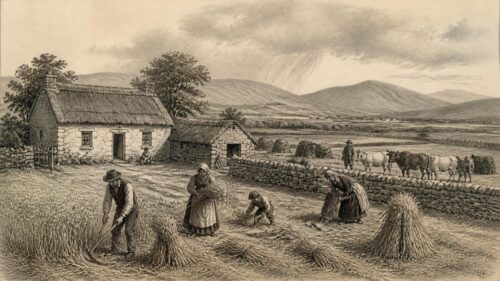
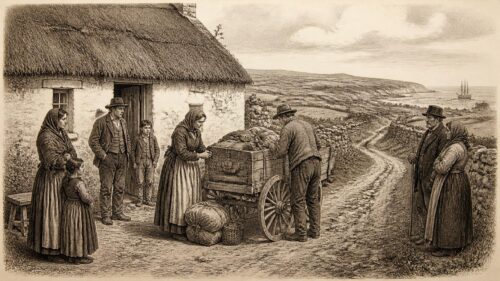
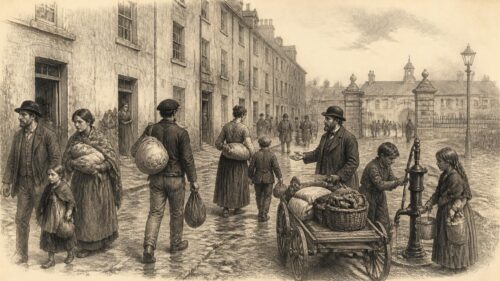
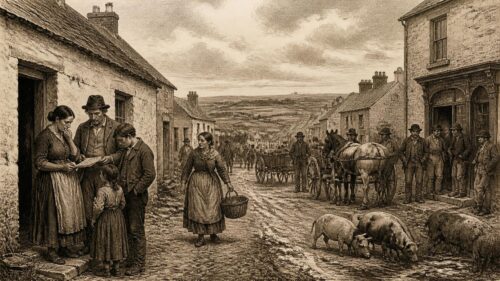
For most of Irish history, childhood was embedded in the household economy. Children’s labour did not necessarily mean a childhood without affection or recreation; families commonly depended on every capable member, and work, learning and play overlapped. In rural communities, children carried water and turf, minded younger siblings, gathered fuel, tended animals, helped at harvest and undertook domestic tasks. In towns they might run errands, assist in workshops, sell goods, carry messages or contribute to a family trade. The boundary between childhood and adulthood was often less sharply drawn than modern readers expect.
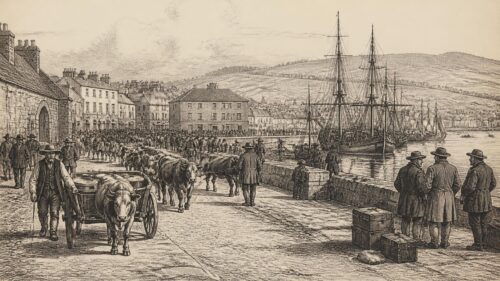
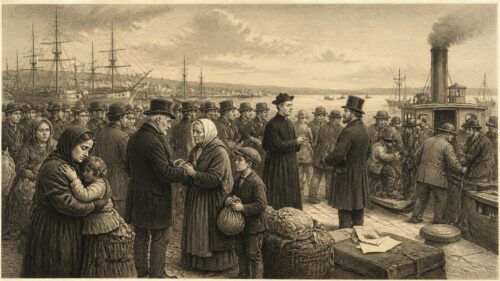
This household setting also made childhood precarious. A death, illness, eviction, failed harvest or loss of employment could alter a child’s prospects rapidly. Large families could provide mutual support, but they could also spread scarce food and expose children to infection in overcrowded homes. Ireland’s long history of emigration complicated family life further. Young people left, remittances returned, grandparents and siblings became carers, and childhood could be shaped by an absent parent in Britain, North America, Australia or elsewhere. In many families, migration was not a single dramatic departure but a recurring strategy across generations.
Gender influenced expectations from an early age. Girls were commonly expected to care for younger children and acquire domestic skills, while boys were more visibly associated with agricultural, street or craft work. These were tendencies, not unbreakable rules. Poor households adapted tasks to necessity; girls worked in fields and boys performed domestic duties. Nevertheless, the social training of children often prepared them for gendered adult roles, reinforced through family practice, school curricula and religious instruction.
Family authority was never the only authority children encountered. Landlords, employers, clergy, teachers, doctors, police and local officials could all affect young lives. Nor should the family be treated as either a uniformly safe refuge or an uncomplicated site of oppression. The documentary record contains evidence of care, sacrifice and attachment, as well as neglect, violence and abandonment. Historical explanation requires room for both. Poverty did not cause cruelty, but it constrained choices and placed families under pressures that wealthier households could often avoid.
Schooling Paths
Education offers one of the clearest routes into the changing history of Irish childhood. Before the national system, provision was varied. Fee-paying schools, charity schools, parish schools, private tutors and the institutions retrospectively called hedge schools served different communities. The popular image of every hedge school meeting secretly in the open air is misleading. Many operated in houses, barns or modest rooms, and their forms changed across time. Their importance lies in showing a widespread demand for literacy, numeracy and advancement among people who had limited formal provision.
The establishment of the National Board of Education in 1831 marked a major institutional change. The new system aimed to provide elementary education through a state-supported framework, though its implementation depended upon local initiative, denominational realities, finance and inspection. It did not instantly make schooling equal or universally accessible. Distance, weather, inadequate clothing, household labour, fees for ancillary needs and family hardship could all interrupt attendance. Nonetheless, it expanded the reach of formal schooling and created a far larger archive of registers, reports and educational debate.
School was not politically or culturally neutral. English became central to the state system, while Irish-language speech was often discouraged. The well-known stories of the tally stick, or bata scoir, have a documented place in accounts of nineteenth-century language decline, but they should not be used to imply an identical practice in every classroom. More securely, the broader evidence shows that English was associated with official life, employment and migration, while the Famine and emigration devastated many Irish-speaking districts. For many parents, English education represented opportunity even as it accelerated cultural loss.
Religious bodies had a profound role in schooling. Catholic religious congregations expanded educational provision across the nineteenth century, while Protestant churches and communities maintained their own institutions. School buildings themselves could embody separation: boys and girls might have distinct entrances, rooms and playgrounds, and denominational identity often shaped the curriculum and moral atmosphere. The national system was therefore a framework within which religious influence remained powerful rather than a simple replacement for it.
Attendance must not be confused with uninterrupted learning. A child might appear on a roll yet miss weeks during planting, harvesting, fishing seasons, domestic crises or illness. The UCD material on children in the years around 1916 underlines how normal it could be for children to work before or after school. Children in rural households had farm duties; urban children might trade in streets and markets, fetch fuel or water, clean, mind siblings or take casual employment. The modern assumption that school and childhood are naturally synonymous does not fit much of the historical record.
Famine Childhood
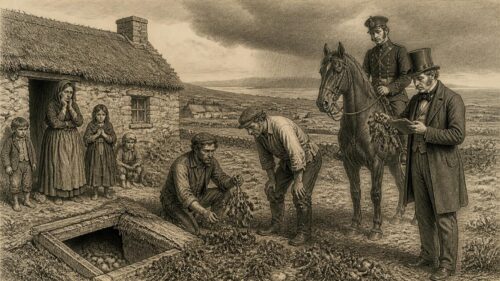
The Great Irish Famine of 1845 to 1852 transformed the lives and life chances of children across the island. Its effects were not evenly distributed: regions dependent on the potato and households with the least land or security were especially vulnerable. But the disaster reached far beyond crop failure. Hunger, fever, dysentery, eviction, family separation, overcrowded relief facilities and emigration produced a crisis in which children were both victims and survivors.
University College Cork’s work on the Famine stresses the scale of catastrophe: around one million people died and at least one and a quarter million emigrated. These totals include children, although the surviving aggregate figures can obscure their particular vulnerability. Young children depended upon adults already weakened by hunger or disease; older children could be drawn into begging, care work, labour and migration. In workhouses, age was often an administrative category rather than a shield from danger. Crowding and infectious disease made institutions intended for relief places of acute risk.
A contemporary source must be read with special care. Charles Edward Trevelyan’s The Irish Crisis, preserved by the CELT project, recorded enormous relief operations and noted that more than 755,000 children received separate rations at the programme’s height in 1847. The figure is historically significant, but Trevelyan was a senior official defending policy, not a detached observer. His language and conclusions cannot be accepted uncritically. Read alongside death registers, local distress papers, workhouse records and later scholarship, such evidence reveals both the scale of administrative relief and its catastrophic inadequacy in the face of mass hunger and disease.
The Famine also altered the structure of childhood after the immediate emergency. It reduced the number of children in many communities through death and emigration, changed inheritance patterns, weakened the smallest holdings and accelerated the movement away from Irish-speaking districts. A child who survived might carry memories of loss throughout life, although historians should not presume that every later family story can be verified in surviving records. Famine remembrance is one of the strongest strands of Irish historical memory, but it must be connected to evidence rather than made into a uniform inherited experience.
The language of rescue could disguise coercion. Families confronted by starvation sometimes sought help from charities, workhouses or religious organisations at the cost of separation. This was not a free choice in any ordinary sense. The history of Famine childhood therefore cannot be reduced to tragedy alone; it is also a history of constrained decisions made by parents, neighbours, officials and institutions amid circumstances few could control.
Institutional Care
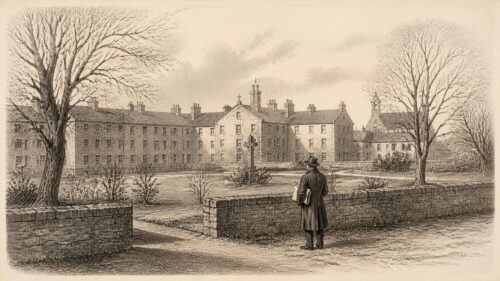
The nineteenth and twentieth centuries saw the growth of systems intended to manage poverty, neglect, perceived delinquency and family breakdown. Workhouses, orphanages, reformatories, industrial schools, boarding-out arrangements and later residential institutions did not form a single, unchanging system. Their rules, populations and purposes differed. Yet they shared a tendency to remove some children from family settings and make their lives subject to inspection, discipline and institutional routine.
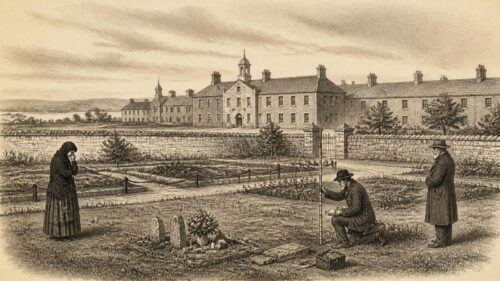
The Irish Poor Law was established in 1838, before the Famine, and workhouses became central sites of relief. Their records are vital but impersonal. They identify admissions, discharges, deaths and categories of need; they rarely preserve a child’s own voice. The evidence nevertheless makes clear why workhouse childhood was feared. Separation from family, regimented daily life, poor diet, sickness and the stigma of pauperism were all real features. During the Famine, when numbers surged beyond intended capacity, conditions could be lethal.
From the later nineteenth century, industrial schools increasingly became places to which children were sent or committed. The language of protection was central to the system: children could be described as neglected, destitute, beyond parental control or at moral risk. Some genuinely lacked safe family care. But the categories were broad, and poverty itself could place a family under official suspicion. The historical question is not whether every placement had the same cause, but how economic hardship, moral judgement and state authority came to combine in decisions about children’s lives.
The Ryan Report, made accessible through UCD’s Industrial Memories project, is indispensable for understanding the institutional system and survivor evidence. Its findings challenged any comforting assumption that residential care was simply charitable. The report documented widespread physical, emotional and sexual abuse in institutions, together with neglect, harsh discipline, inadequate education and failures of inspection. Its historical importance lies not only in what it established about particular institutions, but in its demonstration that a system presented as protective could repeatedly fail to protect children.
Care is a word that requires precision. Religious congregations and lay staff supplied education, accommodation and daily labour in institutions where the State often relied on them. Many individual workers may have acted conscientiously. That fact cannot erase systemic failures or the testimony of survivors. Conversely, historical accuracy requires resisting claims not sustained by evidence about every house, every period or every person. The strongest account is neither blanket exoneration nor unsupported generalisation; it follows the records, the inquiry findings and the survivors’ accounts.
National Futures
Children occupied a prominent place in the cultural politics of the late nineteenth and early twentieth centuries. Revivalist organisations, educators and writers often imagined young people as bearers of an Irish future: learners of the language, players of Gaelic games, readers of national literature and potential citizens of a self-governing state. UCD scholarship on children and the Irish revival rightly warns that this idealisation can make children appear as emblems rather than people. Their writings and diaries, where they survive, complicate the adult tendency to cast them as pure symbols.
The years of revolution, partition and state formation affected children in different ways across Ireland. Political violence could bring bereavement, displacement, disrupted schooling and fear. The new Irish Free State inherited poverty, uneven health provision and an institutional welfare structure deeply entangled with religious bodies. In Northern Ireland, children’s experience was shaped within a different political jurisdiction and educational framework, but also by enduring divisions of class, religion and national identity. A history of Irish childhood must recognise this shared island history without collapsing its distinct political contexts after 1921.
Public health remained a pressing concern. Infant and child mortality were far higher than modern readers may find imaginable. In 1911, as UCD’s account of children before the Rising notes, children under five comprised one fifth of recorded deaths. Diseases such as measles, scarlet fever, bronchitis and whooping cough could be fatal, especially where housing, nutrition and medical access were poor. Improvements in sanitation, nutrition, housing, vaccination and medical care changed these outcomes over the following decades, but progress was neither immediate nor equal.
Work also remained part of many children’s lives. Legislation gradually restricted some forms of child labour and street trading, but regulation did not remove household dependence on children’s contribution. Rural labour, domestic service, informal work and family trades continued to make the transition from childhood to adulthood gradual. The absence of the modern term “teenager” in earlier usage is a useful reminder that age categories are historical constructions. Young people could be treated as children in one setting and as workers or near-adults in another.
Hidden Harms
The history of twentieth-century childhood in Ireland cannot be honestly told without addressing the experiences of children in industrial schools, reformatories, county homes and mother and baby homes. These histories are painful, but they are not peripheral. They concern the exercise of public, religious and familial power over children whose circumstances placed them at particular risk of separation, stigma or neglect.
The Commission of Investigation into Mother and Baby Homes examined institutions and related arrangements from 1922 to 1998. Its final report assembled a large body of evidence on the treatment of unmarried mothers and their children, including adoption, boarding-out, mortality, discrimination and institutional administration. The Commission’s work must be distinguished from public memory and political speech about it. Its findings are evidence produced through a formal inquiry; survivor accounts are essential testimony; later interpretations and disputes about responsibility remain part of the continuing historical conversation.
One conclusion is particularly important: children born to women in these institutions did not merely experience private misfortune. Their prospects were shaped by social attitudes to unmarried motherhood, poverty, sexuality, disability and respectability, alongside decisions made by State agencies, local authorities, medical personnel, religious orders and families. The State apology delivered after publication of the report acknowledged a profound generational wrong. An apology is itself a historical event, but it is not the end of historical inquiry. Questions of records, burial, identity, adoption and access to information continue to matter profoundly to survivors and relatives.
It is tempting to isolate institutional abuse within a supposedly exceptional past. That risks misunderstanding the wider social conditions that made removal and confinement seem acceptable to many authorities. Ireland’s institutions developed within international welfare models, British and Irish legislation, Catholic and Protestant charitable traditions, and local anxieties about poverty and morality. Their distinctive Irish history lies in the particular relationships among Church, State, family and community, and in the persistence of systems that survivor testimony later exposed as damaging.
Historical language should avoid euphemism. Abuse was abuse; neglect was neglect; and children’s inability to complain safely was often part of the harm. At the same time, historians should avoid taking institutional labels at face value. A record calling a child “delinquent”, “illegitimate” or “unmanageable” reveals an administrative judgement, not a settled truth about that child. Recovering this distinction is one way of restoring personhood to people who were too often reduced to files.
Changing Rights
Modern ideas of children’s rights altered the terms through which Irish society discussed welfare, education and protection. The Child Care Act 1991 represented an important change in the Republic of Ireland’s legal and service framework, placing child welfare and protection on a more comprehensive statutory footing. Later inquiries, redress measures and archival initiatives reflected growing recognition that the State had obligations not only to regulate institutions but to hear those harmed by them.
These changes should not be narrated as a simple march of progress. Laws matter, but practice depends on resources, professional judgement, reporting systems, family support and public willingness to confront failure. The establishment of commissions and redress schemes shows that public institutions can investigate past harms. It also shows how long survivors may wait before their accounts are believed, recorded or acted upon. Historical justice is therefore not only about establishing what happened; it concerns the conditions under which testimony became possible.
Children’s history has also become richer because archives are being read differently. Admission books, school records, photographs, letters, institutional correspondence and family papers once used mainly to trace administration can reveal fragments of childhood experience. Digital projects have widened access, while survivor-led campaigns have changed the questions researchers ask. Yet openness has ethical limits. Records may contain intimate personal information, and the desire for historical knowledge must be balanced with privacy, dignity and the rights of living people.
The national story is often told through political leaders, wars, constitutions and elections. A history centred on children changes the scale of vision. It asks who carried turf before school, who missed lessons to nurse a sibling, who learned English for departure, who entered a workhouse, who was committed to an institution, and who left no record except a line in a register. It also asks who played, learned, formed friendships, cherished language and made futures beyond the expectations adults placed upon them.
Historical Reckoning
Irish childhood cannot be represented fairly by either nostalgia or despair. The archive contains evidence of strong family ties, community care, educational ambition, cultural creativity and remarkable resilience. It also contains famine death, preventable illness, exploitative labour, institutional violence and the long afterlife of silence. These realities are not contradictory. They belong to the same history because children lived within social worlds capable of tenderness and cruelty, sometimes at once.
The most responsible historical approach is therefore specific. It names places, periods and institutions where the evidence permits; it separates documented fact from interpretation; it treats folklore and memory with respect but does not turn either into automatic proof. Above all, it refuses to let children remain merely symbols of Ireland’s past. They were individuals whose lives were shaped by decisions made around them, and sometimes by choices they made themselves. Recovering those lives, however incompletely, is essential to understanding Irish history as a human history.
The article’s insistence on reading official records alongside survivor testimony and memory highlights an interpretative difficulty: children were often classified as dependants, inmates or pupils, while their own voices were seldom preserved. This matters especially when examining institutions described as protective, because administrative categories can obscure how poverty, stigma, separation and discipline were experienced by individuals. It also warns against treating nostalgic recollections of rural life or institutional archives as complete pictures. How might historians most effectively combine registers, inquiries, oral histories and evidence to recover children’s agency, while acknowledging the effects of class, language, gender, disability, religion and locality?