

Lost Chimes
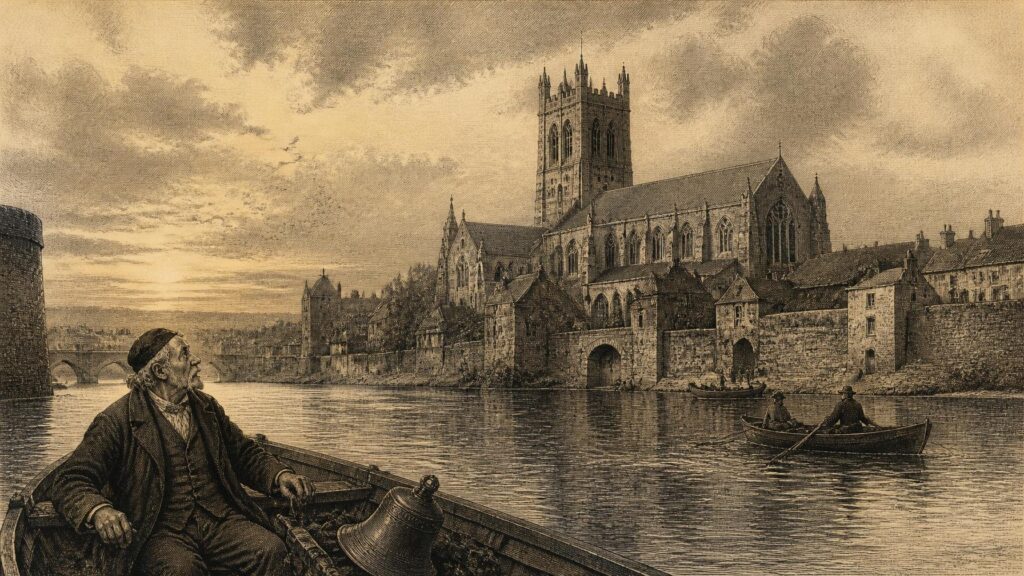
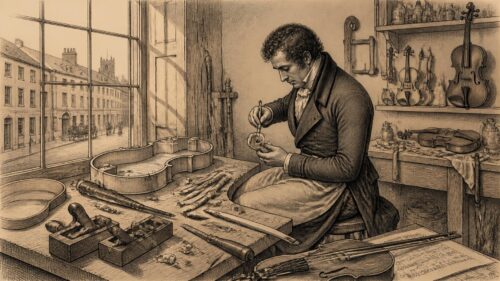
AI generated historical illustration, not a contemporary photograph.
At a Glance
The legend behind the bells of Saint Mary’s Cathedral, Limerick, is not chiefly a story of a local bell being cast, but of loss, recognition and return. It tells of an Italian founder whose beloved bells were carried away after disaster overtook his native place; decades later, old and dispossessed, he is said to have heard their unmistakable music floating from Saint Mary’s as he travelled up the Shannon. Overcome by the discovery, he died with the sound of his own workmanship in his ears. It is a moving tale, but it is folklore rather than proved history. The documented history of the cathedral bells is no less remarkable: it joins a medieval Limerick benefactor, seventeenth-century civic patronage, English bell-founders, burial monuments, siege, repair and the continuing sound of eight bells over the city.
Cathedral Setting
The first necessary clarification is one of place. The bells belong to Saint Mary’s Cathedral, not simply to an ordinary parish church. Standing on King’s Island in Limerick, the cathedral is among the city’s most enduring medieval buildings. Its site has long been associated by tradition with the Norse-Gaelic settlement’s Thingmote and later with the O’Brien rulers of Thomond. The present cathedral is conventionally linked to Domhnall Mór O’Brien’s gift of the site to the Church in 1168. Whatever parts of the inherited story must be treated cautiously, the building itself is indisputably a profound repository of Limerick’s medieval, early-modern and modern past.
That setting matters to the bell legend. A bell is never merely an object of metal. From a high tower it makes a claim upon distance: it marks worship, time, alarm, mourning, festival and civic occasion. In a river city, where the Shannon and Abbey River formed routes of movement as well as boundaries, the imagined moment when a traveller hears bells before he sees their tower has particular force. The legend gives Saint Mary’s a sound that is both local and international. Italy supplies art, craftsmanship, memory and exile; Limerick supplies the river, the tower and the final resting-place of the sound.
The tale has also been repeatedly retold because the cathedral’s bells really do possess a long and complicated history. They were not static heirlooms. Bells crack, are recast, are rehung and altered; towers require repair; fashions in ringing change. The present ring therefore embodies continuity through replacement rather than the survival of one unbroken medieval set. That physical truth is crucial when separating what documents can establish from what legend poetically proposes.
Italian Founder
In its best-known form, the legend begins in Italy. A young bell-founder spends years producing an exceptionally musical set of bells. He takes such pride in them that, after selling them to the prior of a neighbouring monastery or convent, he acquires a small house within hearing of their daily ringing. The bells are not simply merchandise. They have become the founder’s companions, almost an extension of his own life and skill. Their music confirms both his technical mastery and his domestic contentment.
Then calamity intervenes. Accounts vary in their wording: some speak generally of civil or foreign disorder; others make the monastic community’s home the scene of destruction and plunder. The important narrative fact is that the bells disappear in the violence. They are carried away from Italy, eventually reaching Limerick. The founder, ruined and bereft, becomes a wanderer. The story declines to name him, identify his town or date the disaster. Such omissions are not accidental defects in a failed chronicle; they are features of a legend. They remove the event from ordinary verification and make the founder a universal figure of the displaced craftsman.
At the end of his life, he travels by water up the Shannon. As Saint Mary’s bells begin to chime, he knows their voices. In some versions he rises or strains to listen; in others he fixes his gaze upon the tower. The recognition is immediate and absolute. He has found the work he thought irretrievably lost. The emotional climax is not a recovery of property, nor the punishment of thieves, nor a reunion with family. It is the recovery of sound. The old man dies in joy when the ringing ends, having heard his past restored to him.
This is the core legend. It should not be embroidered into false historical certainty. There is no identified Italian founder, no documented shipment of such bells to medieval Limerick, and no contemporary account of the dying traveller. Nor is there evidence that the bells now in Saint Mary’s are the bells of the story. The tale survives because its emotional logic is strong, not because it is authenticated by the kind of records that establish a bell’s casting, weight, inscription or installation.
River Arrival
The Shannon is more than scenery in the legend. It is the route by which the founder encounters Limerick and by which sound seems to travel outward from the cathedral. Bells have a peculiar capacity to make a place audible across water. The traveller can be outside the city’s streets and still be claimed by its tower. The river passage turns a local bell story into a voyage narrative: the bells have crossed seas and the founder has crossed Europe, but the final recognition occurs on the approach to Limerick.
There is a second Limerick bell tradition, recorded by the antiquary Thomas J. Westropp in 1916, which uses the city’s other watercourse, the Abbey River. Westropp placed the story after his notice of the documentary gift of bells by John Budston in 1401. He recounted the Italian founder’s recognition of the bells from the Shannon, then added a further tradition that earlier silver bells had been thrown into the Abbey River to preserve them from plunder. Those submerged bells, it was said, were never recovered, though they might be faintly heard under the water on Christmas nights.
The two stories need not be forced into one coherent event. They share familiar motifs: endangered sacred bells, theft or plunder, water, hidden sound and a music that persists despite apparent loss. But they may represent separate strands of local imagination gathered around the same cathedral. One makes bells travel from Italy to Limerick; the other leaves bells beneath Limerick water. One ends in personal recognition and death; the other in a recurring Christmas audition available, in theory, to those capable of hearing it.
This distinction is important. Folklore is often treated too crudely, either dismissed because it cannot be proved or accepted as if it were a ledger entry. The better approach is to ask what a story does. These river tales make Saint Mary’s bells symbols of continuity in a city marked by conflict, religious change and material rebuilding. Their sound survives dispossession. It may be stolen, hidden or silenced, yet it returns to the ear. That is historical meaning of a different order from documentary proof.
Medieval Gift
The earliest firmly reported documentary tradition for the cathedral bells concerns John Budston, also rendered Buston in some accounts. Saint Mary’s bell history places the first reference to bells at the cathedral in the late fourteenth century, while other local historical accounts identify the year as 1401. The latter date aligns with Budston’s appearance as a civic officer in Limerick records. The surviving tradition states that he gave four brass bells to the cathedral. Westropp described this as the first record of cathedral bells.
The material detail is significant. These were brass bells, not the silver bells of the submerged-bells story. “Brass” in such descriptions should not be casually translated into modern metallurgical precision, but it plainly belongs to the practical language of donation and manufacture, rather than the language of enchantment. The legend’s silver chime is richer in symbolism: silver suggests value, purity and a sound unlike ordinary metal. The documented Budston gift, by contrast, places bells within late-medieval civic piety and patronage.
Budston was remembered as a prominent Limerick citizen and benefactor, and the cathedral retains an association with his family through a monument in the south transept. Later historical writing connected his gift with the Arthur family, prominent in the city’s story. A later account also links the gift to the marriage of Budston’s daughter Margaret and Peter Arthur. This gives the bells a social setting: they may be understood not simply as ecclesiastical equipment but as a public gift from an urban household with standing, memory and descendants.
Yet even here certainty has limits. The cathedral’s own bell history sensibly states that no further mention of Budston’s bells appears in its records until around 1670. The gap is substantial. It cannot be filled simply by assuming that the four medieval bells remained in use, that they were Italian, or that they were later thrown into the river. The possibility that older bell-metal was reused in a later casting has been suggested, but it remains an inference, not an established fact. Medieval bells commonly disappeared through damage, recasting, war, sale or alteration; absence of a record is not proof of any particular fate.
Documentary Silence
The space between Budston’s gift and the seventeenth-century ring is where legend flourishes. A historian must acknowledge the gap without pretending that it resolves the story. It is tempting to make the Italian founder’s bells the four given by Budston, or to say that Budston purchased bells already famous for their tone. Neither conclusion follows from the evidence presently available. The Italian legend itself is not a medieval record, and its versions do not provide a date that can be matched securely to the 1401 donation.
There is also a practical reason for caution. Bells that have hung for centuries are frequently remade. Their identity is often carried forward in name, place, tone and purpose rather than in the uninterrupted survival of the original metal. The present bells cannot be treated as unaltered witnesses to a fifteenth-century story. The very process of recasting complicates any attempt to identify a legend’s objects with a particular physical ring.
The silence, however, is historically productive. It reminds us that institutional records do not preserve every sound that mattered to a community. Donations and repairs may be recorded, while ordinary ringing, individual memories and the circulation of stories are not. The legend could have passed orally long before it was printed, but the date of its oral origin cannot be recovered merely by asserting that it was ancient. Conversely, a story’s first surviving printed appearance does not prove it was newly invented at that moment. Responsible history must leave both possibilities open.
Westropp’s 1916 account is valuable precisely because he distinguishes, however briefly, the first recorded bell gift from what he calls the well-known story of an earlier chime. His wording preserves a boundary between record and tradition. Modern retellings should preserve that boundary too. The charm of the narrative is not weakened by admitting uncertainty; it is strengthened when the reader understands why the legend cannot be made to bear evidential weight it was never designed to carry.
Yorke Peal
The documentary ground becomes firmer in the later seventeenth century. Saint Mary’s records and bell histories associate a peal of six bells with William Yorke, an alderman of Limerick and three-time mayor. The cathedral’s current account dates the presentation to 1670, while its broader historical timeline gives 1673. A remarkable near-contemporary source, Thomas Dineley’s manuscript account of Ireland, records that Saint Mary’s had six tunable bells “founded lately” by Mr Perdue and that William York was the chief contributor in 1677. The small variations in date likely reflect the difference between fundraising, casting, completion and later commemoration; they should not be concealed beneath a falsely exact single date.
Dineley’s account is especially important because it is not a modern summary written many generations later. Preserved in National Library of Ireland manuscript material and presented by the University of Galway’s Ireland Illustrated project, it describes the tower, the six bells, their founder and Yorke’s contribution while the memory of the work was fresh. It also transcribes the celebrated epitaph of William Perdue, the bell-founder associated with the work.
According to the cathedral’s bell history, the six-bell peal was cast by William and Roger Perdue, founders associated with Salisbury in England. William Perdue died while working in Limerick and was buried in the cathedral. The epitaph, in its familiar form, describes him as a bell-founder “honest and true” who lay there until the resurrection. The verse is a tangible counterpoint to the unnamed Italian craftsman of folklore. One founder has no name but receives an immortal emotional legend; the other has a name, trade, grave and memorial verse, but is less romantic. Both became inseparable from the bells in later memory.
It would be a mistake to set the two figures against each other as though one must displace the other. The Perdue evidence does not prove that the Italian tale was invented to explain his bells. It does, however, show why the tale cannot be used as an account of the documented seventeenth-century peal. The historical bells were associated with named English founders, a named civic patron and a visible monument. Their provenance is not obscure enough to require an Italian origin story.
Changing Metal
Saint Mary’s ring grew from six bells to eight in 1703, when two further bells were added. The cathedral and Irish bell-ringing histories identify those additions as the treble and second of the present ring. Over the succeeding centuries, however, the Yorke bells did not survive intact. The six bells of that peal were eventually recast or replaced. This is not a failure of preservation in any simple sense; it is the normal working history of bells. A bell intended to be rung has to endure enormous mechanical strain. Cracks, poor tuning, worn fittings and changes in the tower can all lead to intervention.
The later history is unusually well outlined. A defective bell was replaced through the gift of Everard Hewson of Castlehewson in 1907. Sir Alec W. Shaw had the third bell recast by John Taylor and Company of Loughborough in 1923. Hewson also supported the recasting of several bells between 1930 and 1938, including the treble, second, seventh and tenor, and gave a call bell. A report in the bell-ringing press from 1907 also records the practical challenges of restoring the Limerick ring and returning its music to the tower.
These details explain why questions about “the bells” require care. The cathedral’s ringing tradition is old, but the present eight bells are the result of additions, repairs and recastings. Their continuity is cultural, liturgical and musical. It does not mean that a single set of physical objects has hung unchanged since Budston’s day, still less since an unspecified Italian disaster. Indeed, the careful preservation of a ringing tradition may itself demand the replacement of metal.
There is something fitting in that. The Italian legend imagines a founder recognising an unchanged voice after a lifetime of loss. Real bell history is more complicated: a bell’s voice can be renewed, adjusted and carried forward by later founders and ringers. The community hears continuity even when the metal has changed. Saint Mary’s bells therefore offer two kinds of permanence: the folklore of a recovered masterpiece, and the documented practice of renewal.
Hidden Bells
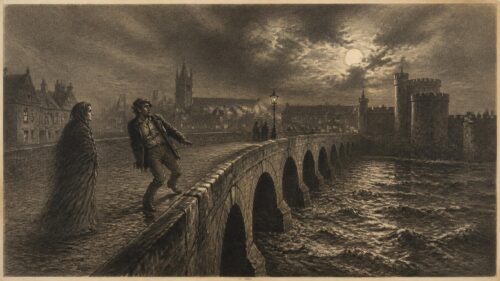
The submerged-bells tradition did not disappear with Westropp’s antiquarian note. A version entered the Schools’ Collection of Irish folklore in the twentieth century. In a manuscript collected at Latsey and now made available by Dúchas, the teller describes Saint Mary’s bells as the sweetest-toned in Ireland but “lost”. The tale says that, when the cathedral passed from Catholic to Protestant hands, a priest rescued the bells and concealed them beneath the Shannon. The secret was supposedly passed from priest to priest, to be used when the cathedral might be restored; meanwhile, the bells were said to ring in their hiding-place once every seven years.
This account must not be used as evidence for what physically happened to the cathedral bells. Its religious framing is historically revealing, but its factual claims conflict with the documentary history of bells still present, replaced and rung at Saint Mary’s. It is best read as a later folk narrative about loss after the Reformation and about the hope of restoration. Its narrator even recalls a mother hearing beautiful bells from the river near Thomond Bridge. The remembered hearing is central: sound lends authority to the story, even when the listener cannot produce the bells themselves.
Such tales are widespread in Ireland and elsewhere: church bells are hidden in lakes, rivers or bogs to protect them from enemies, and their muted sound is heard at sacred times. Limerick’s version gains particular power from Saint Mary’s actual prominence and from the visible proximity of water. It makes the city’s religious divisions audible. The bells are imagined as withheld, not destroyed; their music continues beneath the surface, preserving a claim upon a contested sacred past.
That folklore should be treated respectfully without being converted into polemic or proof. It gives historians evidence of memory, belief and local storytelling. It does not supersede the record of Budston, Yorke, Perdue, later founders or the present ring. Its value lies in showing how communities made meaning from the cathedral’s bells long after the events it invokes.
Legend Meaning
Why has the Italian story endured? First, it dignifies craft. The nameless founder is not a wealthy donor or a bishop; he is a maker whose labour possesses such excellence that it outlives disaster, displacement and death. The bells are loved because they sound beautiful, but also because they embody painstaking work. The story therefore turns the familiar civic sound of the cathedral into a memorial to skilled hands.
Secondly, it expresses the experience of exile. The founder’s loss is double: he loses both the bells and the peaceful life they made possible. His final hearing does not restore his home, but it restores recognition. Limerick becomes the place in which a displaced person discovers that something of his identity has survived elsewhere. That idea could travel easily across generations and communities, which may explain why the tale appears in different printed and oral forms.
Thirdly, the legend attaches Limerick to a wider European imagination. The city is not presented as remote from continental art but as the eventual home of an Italian masterpiece. Historically, that precise connection is unproved. Symbolically, it reflects the long-standing reality that Irish churches, merchants, books, artistic styles and religious ideas were connected to wider European worlds. Folklore often supplies an emotional map where documentary detail is absent.
Finally, the story gives sound a moral force. Bells can be stolen, buried or carried abroad, but their voice remains recognisable. In the Italian tale, the sound proves authorship. In the river tale, the sound proves survival. In the documentary history, the sound is maintained through civic generosity, technical labour and organised ringing. These are three different propositions, but together they explain why the bells have become more than a feature of the cathedral tower.
Living Sound
Saint Mary’s continues to maintain an eight-bell ring, with a tenor recorded at approximately 1,220 kilograms. This living practice is the best safeguard against treating the bells as relics detached from the city. They remain instruments, sounded for worship and maintained by people who inherit both a musical tradition and a demanding material responsibility. Their history is not complete because it is still being made.
For that reason, the correct answer to the question of the legend is both simple and qualified. The legend says that Saint Mary’s bells were made in Italy by a founder who later heard his stolen masterpieces ringing from the cathedral as he travelled up the Shannon, and died in joy at recognising them. A related Limerick tradition says earlier bells were hidden beneath the river to save them from plunder and may still be heard at special times. Neither story can be verified as literal bell history.
The recorded history points elsewhere: to John Budston’s medieval gift of four brass bells, to the late-seventeenth-century peal supported by William Yorke and cast by the Perdue founders, to the burial of William Perdue in the cathedral, and to the many recastings and restorations that produced the present ring. The legend should therefore be cherished as folklore, not cited as provenance. Its truth is poetic and communal. It tells Limerick that music can outlive violence, that craft can survive the loss of its maker, and that a bell heard across water may carry a whole city’s memory.





Saint Mary’s bells reveal a compelling tension between material change and cultural continuity. The article shows that the present eight-bell ring emerged through patronage, recasting and repair, whereas legends imagine lost bells retaining an unchanging, recognisable voice across water and time. Rather than competing, these accounts may express different ways communities preserve heritage: documents trace metal, makers and donors, while folklore protects emotional memory of displacement, faith and return. The uncertainty surrounding Budston’s medieval gift further highlights how documentary silence can invite narratives. How should historians and communities balance documentary evidence with folklore when interpreting the cathedral’s sonic heritage today?