

Stone Memory
At a Glance
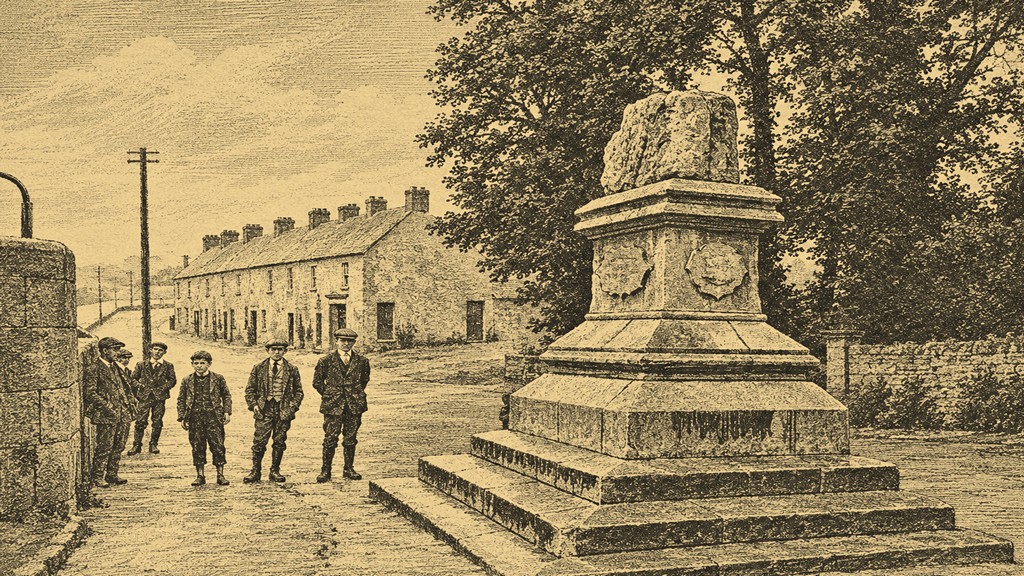
Beside Thomond Bridge, across the Shannon from King John’s Castle, an irregular block of limestone stands on a nineteenth-century pedestal. It is one of Limerick’s most recognisable public monuments, known as the Treaty Stone. Local tradition identifies it as the table upon which the Treaty of Limerick was signed on 3 October 1691. That claim cannot be demonstrated from the surviving contemporary record; nonetheless, the stone’s history is neither trivial nor reducible to a simple question of authenticity. It is a material focus for Limerick’s memory of siege, surrender, exile, broken assurances and civic identity.
River Crossing
The setting matters. Limerick developed around the lowest practical crossing points of the Shannon estuary, where the river divided the historic urban area from the Clare bank. Thomond Bridge linked the walled town and King’s Island to routes leading north and west. It was therefore much more than an item of infrastructure. For centuries it was a military gateway, a commercial threshold, a place of tolls and traffic, and an obvious stage upon which authority could be displayed or contested.
The bridge visible today is not the bridge of 1691. The present seven-arch limestone structure dates from the late 1830s and opened in 1840. Its predecessor had a far longer and more complicated past. Documentary and cartographic evidence assembled in the Irish Historic Towns Atlas traces bridges, repairs, towers, gates and drawbridges at the crossing from the medieval period onwards. The exact sequence of early construction remains open to scholarly debate, but it is clear that the old bridge was repeatedly rebuilt and repaired, and that it was a fortified passage by the later seventeenth century.
In 1691 the older Thomond Bridge had defensive importance. It led towards the Clare side, where Williamite forces had established a position during the second siege. A bridge defended by gates, towers and a drawbridge could control access to the city, yet it also exposed both sides to the hazards of artillery and assault. The Shannon was at once Limerick’s protection, its supply route and its strategic difficulty. Any settlement ending the siege had to take account of a city physically divided by water and connected to its northern approaches by this heavily charged crossing.
The Treaty Stone’s present location encourages a misleadingly simple visual story: castle, bridge, river and monument appear to belong to one preserved scene. In reality, each has its own chronology. King John’s Castle incorporates medieval fabric and later alterations; the bridge was replaced long after the war; and the pedestal under the stone was erected in 1865. The modern observer is therefore looking at an assemblage of different periods, joined by commemoration rather than survival unchanged from the seventeenth century.
That distinction is historically useful. The memorial is close to the place traditionally associated with the agreement, and it stands within a landscape central to the siege. It cannot, however, be used as straightforward physical proof that the rough stone itself lay in precisely that position on 3 October 1691. The history of the site supports the importance of the location; it does not settle the biography of the individual block.
Dynastic Conflict
The agreement remembered by the stone arose from a conflict much larger than Limerick. In 1688 James II, a Catholic king of England, Scotland and Ireland, was displaced by the invasion of William of Orange, who ruled jointly with his wife Mary. The ensuing struggle was bound into the wider European war against Louis XIV, but in Ireland it became a contest with immediate consequences for landholding, religion, political power and military allegiance.
Many Irish Catholics supported James II, hoping that his restoration might secure gains made during his brief Irish parliament and reverse aspects of the post-Cromwellian settlement. William’s Irish supporters included many Protestants anxious about their property, security and political position. These broad descriptions should not obscure complexity: loyalties were affected by local interest, family, military calculation and survival. Yet the war became inseparable from questions of confessional power in Ireland, and later memory would interpret Limerick through that lens.
James landed in Ireland in 1689 and established a Jacobite administration at Dublin. Williamite forces held parts of the north and east. The war produced sieges, campaigns and acute civilian hardship. Limerick emerged as a principal Jacobite stronghold after the Williamite victory at the Boyne in July 1690. Its defence that year frustrated William’s first attempt to take the city. The result gave Limerick a powerful military reputation and made a second campaign likely.
Patrick Sarsfield, later Earl of Lucan, became the best remembered Jacobite commander associated with the city. His daring raid against Williamite artillery at Ballyneety in August 1690 entered popular history as a dramatic intervention in the first siege. It is important, though, not to reduce the defence of Limerick to a single heroic figure. The city’s survival depended on its garrison, civic population, engineers, fortifications, river position and the weaknesses of the besieging force as well as on individual leadership.
The failed siege of 1690 did not end the war. By 1691 the Jacobite position had narrowed. Williamite troops under Godert de Ginkel, later Earl of Athlone, advanced after important successes elsewhere. Limerick became the last great obstacle to Williamite consolidation in Ireland. The city’s fate mattered to both armies, but it also mattered to inhabitants whose homes, trade, crops and security had already been shaped by years of conflict.
Second Siege
The second siege began in the late summer of 1691. Limerick’s defences had been strengthened after the previous year’s attack. The Irish Historic Towns Atlas records the extensive system of outworks developed around Irishtown and the reinforcement of positions around Englishtown and King’s Island. Maps and military documents from the period provide unusually detailed evidence for the siege landscape, even if they do not answer every later question about the Treaty Stone.
The Williamite army pressed the southern side of the city, while operations around the Shannon and the Clare approaches affected the strategic balance. Contemporary and near-contemporary accounts describe bombardment, sorties, fighting at defensive works and the gradual pressure on the garrison. The siege was not a ceremonial prelude to a ready-made agreement. It was a sustained military crisis in which the prospects of relief, supply, casualties and command all shaped the bargaining that followed.
By late September, negotiations became possible. A cessation was made after the garrison beat a parley on 24 September. The Jacobite narrative edited by John T. Gilbert, now made available by University College Cork’s CELT project, records talks between Irish commissioners and the Williamite leadership. It places the final conclusion and exchange of the articles on 3 October. This basic chronology is supported by the texts of the agreement and is the secure documentary core behind later memorialisation.
The popular phrase “Treaty of Limerick” is useful and deeply rooted, but it can conceal the legal and political character of the settlement. Scholars have pointed out that contemporaries often called the arrangements articles or capitulations. They were not a treaty between two independent sovereign states in the modern sense. They were terms agreed after the surrender of a Jacobite-held city and army to the forces of William and Mary. That technical point does not diminish their importance; it clarifies the unequal circumstances in which they were made.
The military settlement dealt with the Jacobite army. The civil articles concerned named classes of inhabitants and landholders, religious practice, property, oaths and protections. The coexistence of these two sets of articles is essential. Limerick was not simply the place where one army laid down arms. It was the point at which military defeat was translated into a contested framework for the future of Catholic soldiers, civilians and proprietors in Ireland.
Written Articles
The surviving text is a better guide to the settlement than later slogans. The civil articles begin by naming Williamite representatives, including the Lords Justices Sir Charles Porter and Thomas Coningsby and General Ginkel, and Irish commissioners acting for inhabitants of Limerick, Clare, Kerry, Cork, Sligo and Mayo. The wording reveals that the arrangement reached beyond the walls of Limerick. It was intended to regulate the position of a wider group within a kingdom emerging from war.
Article one promised Roman Catholics covered by the agreement religious privileges consistent with the law of Ireland and with those they had enjoyed in the reign of Charles II. It also stated that William and Mary would endeavour, when circumstances allowed a parliament to be summoned, to secure Catholics against disturbance on that account. The wording was qualified, not absolute. It did not amount to a modern declaration of equal religious liberty. Nevertheless, it became central to later Catholic arguments that the settlement had offered protections subsequently narrowed or disregarded.
Other provisions addressed the retention and restoration of estates for those comprehended by the articles, subject to conditions including an oath of allegiance. Property was the material heart of the matter. The Irish wars of the seventeenth century had repeatedly altered ownership through confiscation, restoration and forfeiture. A promise about estates was consequently a promise about family survival, status and influence as well as income.
The military articles offered soldiers choices. They could enter Williamite service, remain in Ireland under stated conditions, or leave for service abroad. The provision for transportation overseas is one of the sources for the powerful later image of the Wild Geese: Irish Jacobite troops departing for continental armies, particularly French service. The image is historically grounded in a substantial migration of soldiers after the surrender, although later nationalist memory often made it more uniform and romantic than individual experiences warrant.
The articles also regulated practical matters that demonstrate how close the negotiations were to the realities of an army’s departure: marching out with arms and colours, the disposition of ammunition and artillery, ships, transport, provisions, prisoners and the sick and wounded. Such clauses remind us that the settlement was not composed in abstraction. It was an instrument intended to move men, weapons and families from an occupied military landscape into an uncertain future.
The famous later charge of a “broken treaty” requires careful expression. It is defensible to say that the settlement acquired that reputation because later legislation and administrative practice did not fulfil the expansive security that Catholic advocates believed the civil articles promised. It is less satisfactory to imply that all provisions were instantly annulled or that every Catholic in Ireland was protected by them. Eligibility was specific and disputed; implementation unfolded over years; and the terms themselves contained limits. The importance of the Treaty Stone rests partly on this gap between written promises, contested interpretation and historical outcome.
Signing Place
What, then, is known about the place of signing? Documentary evidence establishes that the articles were concluded and exchanged at Limerick on 3 October 1691. It names parties and records terms. It does not, in the readily accessible contemporary texts, identify a particular rough limestone block as the writing table. Nor does it provide a detailed description that permits an individual stone now on display to be securely matched with an object present at the negotiations.
The tradition locates the signing at the Clare end of Thomond Bridge, in sight of the opposing armies. This is plausible as a commemorative geography: the bridge lay at a militarily significant interface between positions, river and city. Yet plausibility is not proof. Negotiations could involve tents, camps, rooms, temporary tables, officers and commissioners moving between controlled spaces. The ceremonial image of rival armies watching signatures being made upon a single stone may preserve a local recollection of an outdoor or bridge-side settlement, but it may equally simplify a more complicated process.
One reason for caution is the difference between the date of the event and the date at which the stone becomes visible in evidence. The identifiable tradition is attested much later. History Ireland’s study of nineteenth-century Limerick monuments notes accounts by late eighteenth-century travellers who were shown a Treaty Stone, including John Harden in 1797 and Bishop John Milner in 1810. This is valuable evidence that the association was established by then. It is not contemporary evidence from 1691.
That interval matters. A tradition repeated for generations can carry real cultural authority, but historians must describe what kind of authority it is. The stone cannot be authenticated merely because the story is old, and the story cannot be dismissed merely because it was recorded after the event. Local memory may retain places with remarkable persistence; it may also attach a vivid object to a famous episode in order to make an abstract historical settlement tangible.
Accounts of the object’s more ordinary use sharpen the point. The stone has been described as a mounting block used by people leaving Limerick on the old road towards Ennis, allowing riders to mount horses. Such a practical object could readily become a relic when positioned near a site of national importance. It is possible that a pre-existing stone, already familiar to travellers, acquired an historical identification over time. It is also possible that it had a closer connection to the negotiations. The present evidence does not allow a firm choice between these possibilities.
The responsible conclusion is therefore modest but meaningful. The Treaty Stone is traditionally, rather than demonstrably, the surface upon which the articles were signed. Its association with Thomond Bridge is historically intelligible. Its present form as an official monument tells us with certainty about nineteenth-century civic commemoration, and with less certainty about the precise furniture of a seventeenth-century negotiation.
Local Tradition
Folklore is sometimes treated as the opposite of history, as though one must either believe it literally or discard it altogether. The Treaty Stone demonstrates why that choice is too crude. Folklore can preserve a community’s interpretation of a past event, reveal what later generations considered worth remembering and show how a landmark became embedded in everyday life. It should not be silently converted into documentary fact, but it is itself historical evidence of memory.
By the nineteenth century, the stone was a known object of interest for visitors and antiquarians. Mary Agnes Hickson’s 1892 article, “The Treaty Stone of Limerick”, shows that it had entered antiquarian discussion. The National Library of Ireland catalogue record for that article is modest in itself, but it marks an important stage: the stone was no longer merely a familiar local landmark. It had become a subject for formal historical inquiry and debate.
Maurice Lenihan, the nineteenth-century historian of Limerick, was sceptical of the tradition. His scepticism is valuable because it demonstrates that doubt is not a recent attempt to strip the monument of meaning. The stone’s identification was contested even while civic pride in the Treaty City was growing. Such disagreement is a sign of a living historical culture, not a defect to be concealed.
At the same time, visitors and residents alike helped consolidate the association. A stone is especially suited to popular commemoration because it appears durable, local and unmediated. A manuscript agreement is remote, written in difficult legal language and held in archives or printed editions. A rough block of limestone can be seen, touched and pointed out. It offers the reassuring impression that history happened exactly here and that some part of that moment remains accessible.
The attachment was sufficiently strong that fragments were reportedly sought as keepsakes. An 1851 newspaper anecdote, preserved in a modern local-history account, described a woman chipping at the stone to send a piece to a brother in New Orleans. The story should not be expanded beyond what it can bear: it is a report of an incident, not proof of widespread practice. Yet it captures the relic-like quality the stone had acquired before its elevation onto a formal pedestal.
The desire for a fragment also illustrates a paradox. Veneration can threaten preservation. A monument valued as a tangible remnant of national history may be damaged precisely because people want a personal share of it. Municipal intervention in 1865 transformed the object from a vulnerable roadside stone into a protected civic emblem.
Victorian Pedestal
In May 1865 the Corporation of Limerick placed the stone upon a pedestal. The municipal heritage record identifies John Rickard Tinsley, then mayor, as responsible for the erection. The inscription records the date and the mayor’s name; another face identifies the subject as the Treaty of Limerick, signed in 1691. This was not simply a protective measure. It was an act of interpretation, making official what tradition had associated with the stone.
The pedestal deserves as much attention as the rough block above it. It is a carefully designed Victorian monument, made of limestone and decorated with civic imagery. The National Inventory description notes a relief of King John’s Castle and a tower and cross associated with Limerick’s civic insignia. A Latin inscription, drawn from Virgil’s description of ancient Troy, presents the city as old and skilled in war. The classical reference elevated local memory into a language of urban dignity, endurance and martial distinction.
Such language reveals how nineteenth-century Limerick wished to see itself. The city’s seventeenth-century wars could be remembered as destruction and division, but they could also be framed as evidence of courage, antiquity and public consequence. The pedestal did not merely say that an agreement had been signed. It made the stone a civic monument in an era when Irish towns and cities increasingly expressed identity through statues, plaques, public buildings and ceremonial spaces.
The placement altered the object’s status. A mounting block, if that was indeed one of its earlier uses, belongs to the everyday movement of people and horses. A stone raised on an inscribed base belongs to public history. Its roughness was retained, an important decision. The contrast between unworked boulder and ordered pedestal gave the monument a claim to authenticity: nature or humble utility above, municipal authority and explanatory text below.
History Ireland has observed that the newly elevated stone quickly became politically resonant. In 1867, during a Limerick procession mourning the Manchester Martyrs, the monument was covered with a pall and decorated with nationalist emblems. Participants debated how it should be treated. Was it a symbol of violated promises and therefore an object of contempt, or a memorial to Catholic rights supposedly secured in 1691? The respectful commemorative reading prevailed. That episode shows that the stone’s meaning was not fixed by the Corporation’s inscription.
The monument could accommodate different politics because the Treaty itself carried different lessons. For some, it represented honourable surrender and the military reputation of the Jacobite defenders. For others, it was evidence of promises betrayed. For municipal patriots, it reinforced Limerick’s distinctive title, the Treaty City. For visitors, it was a picturesque relic beside castle and river. These interpretations overlapped without being identical.
Broken Promises
Later memory of the Treaty of Limerick became inseparable from the belief that its civil guarantees were broken. This belief was not merely rhetorical invention. The late seventeenth and eighteenth centuries saw the Protestant political order in Ireland consolidated and a series of penal measures imposed upon Catholics. Restrictions concerning religious practice, education, property, arms and public life shaped Catholic experience in ways difficult to reconcile with the broad security later readers found in the articles.
However, historical precision remains necessary. The civil articles did not promise unrestricted equality, and they did not automatically cover every Catholic person in Ireland. They protected particular people and interests according to negotiated conditions. Nor were all their provisions ignored at once. The implementation of the settlement involved legal argument, petitions, official decisions, parliamentary action and disputes over wording. The history of the articles is therefore one of partial application, contention and erosion rather than a single uncomplicated act of repudiation.
A particularly revealing difficulty concerned the drafting of the civil articles. A memorandum connected with George Clarke, preserved in the CELT material on ratification, states that words concerning people under the protection of those named had been omitted when a fair copy was transcribed. Clarke represented this as a clerical error, while acknowledging its significance. The episode became central to later arguments over the scope of protection. It demonstrates that historical consequences could turn on the transmission of a few words as much as on military action.
This documentary complexity helps explain why the Treaty Stone was so useful to popular memory. The legal history of the articles is difficult: it involves qualifications, copies, seals, oaths, lists of beneficiaries and changing political conditions. A stone offers a concentrated alternative narrative. It stands for the moment before later dispute, when terms were supposedly agreed openly between enemies. That symbolism is powerful precisely because it simplifies.
The phrase “broken treaty” should therefore be understood as both a historical judgement and a cultural inheritance. It expresses the conviction, held by many Irish Catholics and nationalists, that the post-war order violated assurances given at Limerick. It also became an enduring shorthand for a broader experience of dispossession and exclusion. The monument did not create that interpretation, but it gave it a place in the city’s streetscape.
There is no need to choose between law and memory. The surviving articles show why people could make claims about rights and property; the later political record shows why those claims acquired such force. The Treaty Stone, whether or not it was the literal signing table, became a public witness to the moral argument generated by the settlement.
Changing Location
The monument has not remained immobile. Limerick City and County Council records that the stone rested for years on the ground opposite its nineteenth-century position, near the old route taken by the Ennis mail coach. The 1865 work placed it on its pedestal at the Clare end of Thomond Bridge. In 1990 it was moved again, to its present position on Clancy’s Strand, for road-safety reasons. A pavement plaque records the move and names Alderman Gus O’Driscoll, mayor at the time.
This movement should not be regarded as an embarrassment to the monument’s authenticity. Most public monuments are moved, repaired, recontextualised or provided with new access arrangements as cities change. In this case, relocation highlights the difference between the stone’s symbolic site and an exact archaeological coordinate. The object was preserved close to the historic crossing because its association with the bridge and siege landscape was more important than an unalterable spot in the carriageway.
It is also worth noting that the bridge itself had already changed before the pedestal was erected. The old fortified crossing associated with the war had been replaced by the present bridge in 1840. Thus the 1865 monument was established within a reconstructed nineteenth-century urban scene. It commemorated a seventeenth-century event through a combination of surviving place, inherited tradition and Victorian civic design.
Photographs preserve stages in this later history. The National Library of Ireland holds a glass negative from the Lawrence collection, made between about 1865 and 1914, showing the Treaty Stone in Limerick. A 1905 stereographic image catalogued by the Smithsonian also labels it as the stone on which the famous treaty was signed. Such captions are evidence of the monument’s established public identity by the early twentieth century; they should not be mistaken for independent confirmation of the seventeenth-century claim.
The difference is important but not pedantic. Historical photographs reveal what people of a particular period believed they were looking at and how the city presented itself to visitors. In the case of the Treaty Stone, they show that the object had become a recognised landmark in the tourist and visual culture of Limerick. They document the monument’s reputation, which is itself a central part of its history.
Civic Emblem
Limerick’s nickname, the Treaty City, owes much to the continuing public life of this memorial. The name turns a military capitulation into a civic identity. It allows the city to claim a prominent role in national history while retaining a specifically local point of reference: the Shannon crossing, the castle, the siege and the stone.
There is a productive tension in that identity. A treaty can suggest peace, compromise and reconciliation. In Limerick’s case it also recalls defeat, departure and contested promises. The city did not memorialise an uncomplicated victory. It memorialised the ending of a war in which the defenders negotiated terms under pressure. This ambiguity may be one reason the Treaty Stone has remained meaningful across changing political cultures.
The monument’s civic power also derives from scale. It is not a colossal statue of a ruler or general. Its rough upper stone is modest and almost domestic in form. Visitors can stand near it and easily imagine it as a table, a step or an object handled by ordinary people. Yet its pedestal and inscriptions assert that this small object bears a large history. The result is an unusually intimate monument to a national turning point.
Its position opposite King John’s Castle intensifies this effect. The juxtaposition may tempt viewers to compress centuries into one image of medieval fortress, seventeenth-century siege and nineteenth-century commemoration. Properly interpreted, it offers something richer: a reminder that Limerick’s urban landscape is layered. The Treaty Stone is not an untouched survivor sitting in a frozen seventeenth-century scene. It is a nineteenth-century memorial object, based on an older tradition, in a place that has repeatedly been rebuilt.
This layered quality makes the site especially useful for public history. It can introduce visitors to the Williamite war, to the civil and military articles, to the migration of Jacobite troops, to the penal era and to the politics of commemoration. It also offers a lesson in method. A monument may be historically important even when one of its most familiar claims cannot be proved beyond doubt.
Material Evidence
The stone itself is limestone, a fitting material for a city built amid extensive limestone fabric. University College Cork’s urban fossil trail records fossil-bearing dark grey limestone in the building stones beneath the monument, including marine fossils such as brachiopods, corals, crinoids and gastropods. This geological information does not date the monument’s use or confirm its role in 1691, but it places the object within the deep natural history of the region.
Care is needed here too. Geological age is not the same as human history. The rock formed in a prehistoric marine environment unimaginably earlier than the siege, while the stone’s quarrying, shaping, transport and placement belong to a wholly different chronology. Its fossil content can enrich appreciation of the material, but it must not be used to invent a specific ancient human origin for the block.
What material evidence can establish is more limited. The object is an irregular, rough-hewn limestone block mounted upon an 1865 pedestal. The pedestal bears inscriptions and ornament that can be dated and read. The monument’s movement in 1990 is recorded. Historic photographs show its nineteenth- and early twentieth-century public existence. These facts make it a well-documented heritage object of the modern city.
What material evidence cannot presently establish is that the block was unquestionably used in the signing ceremony of 1691. Such a claim would require contemporary description, secure chain of custody, unmistakable depiction or other evidence not currently available in the public sources consulted. Absence of that proof is not proof that the tradition is false. It is a limit on the certainty historians can claim.
That limit should be made visible rather than hidden. Heritage interpretation is strongest when it distinguishes between documented event, physical survival, local tradition and later symbolism. The Treaty Stone can sustain all four categories. The articles were signed in 1691; a limestone monument now stands at Thomond Bridge; tradition identifies its upper block as the signing table; and nineteenth- and twentieth-century Limerick gave it major civic significance.
Historical Balance
The Treaty Stone is sometimes presented in a single sentence: the stone on which the Treaty of Limerick was signed. That formula is understandable for a visitor guide, but it is too absolute for historical writing. A better formulation is that it is the stone traditionally said to have served as the signing table. This does not diminish the landmark. On the contrary, it respects the difference between the monument’s powerful tradition and the surviving evidence.
Equally, a narrowly sceptical approach can miss the point. To say only that the claim cannot be proved would leave unexplained why the stone was remembered by travellers, studied by antiquarians, raised by a mayor, draped during nationalist commemoration, photographed for visitors and retained through urban change. The tradition had consequences. It shaped how Limerick understood the 1691 settlement and how the city represented itself to others.
The strongest historical account therefore proceeds in two directions. Backwards, it reconstructs the siege, the negotiations and the written articles through contemporary texts and modern scholarship. Forwards, it traces the emergence of a local relic and its conversion into a municipal monument. The first history concerns 1691. The second concerns the generations who needed a visible object through which to remember 1691.
Both histories belong to Ireland. The Treaty of Limerick helped end the Williamite war and opened a new political order. The Treaty Stone helped give that settlement a durable civic afterlife. Its rough surface carried meanings that changed from loyal urban antiquarianism to Catholic grievance, nationalist remembrance, tourism and contemporary heritage interpretation.
Standing near the Shannon today, the monument does not settle every question it raises. It asks rather than answers: where precisely were the articles completed, what did their guarantees mean, who was included, who departed, and how did a city make the memory of surrender part of its own name? Its importance lies in that capacity. The Treaty Stone is not merely a relic of the past. It is evidence of the long, contested work by which Limerick has made the past visible.


Stone Memory usefully separates the Treaty Stone’s uncertain physical biography from its undeniable role in Limerick’s civic memory. The article suggests that the monument’s significance derives not only from whether it served as a signing table in 1691, but also from generations who located siege, surrender, religious insecurity and emigration within one visible object. This raises an interesting question about heritage: can a traditionally identified landmark communicate complexity more effectively than a documented artefact, provided its uncertainties are clearly explained? How should Limerick present the stone so that visitors understand both the negotiated articles and evolving memories attached to it?