

Limerick Luthiery
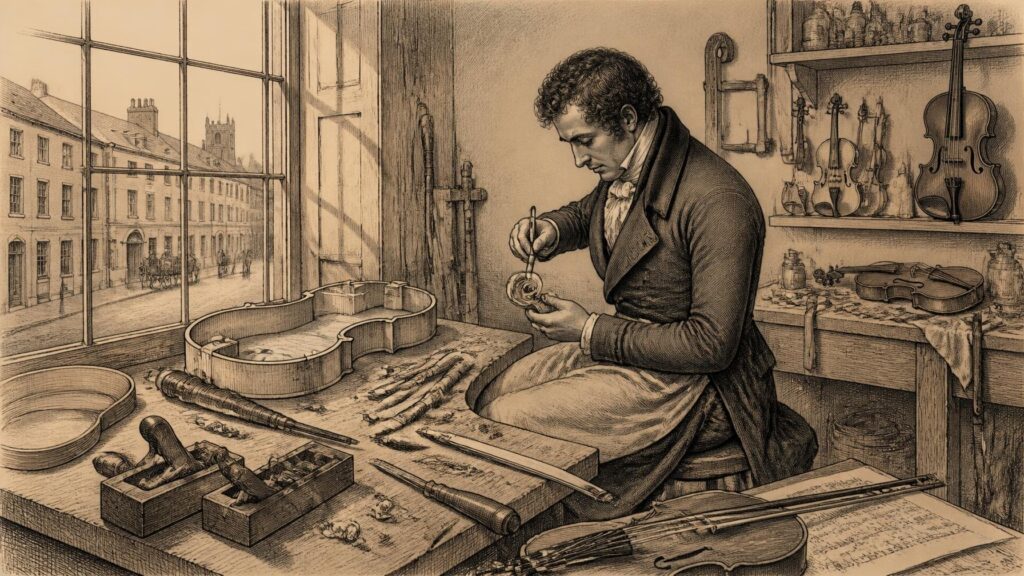
AI generated historical illustration, not a contemporary photograph.
At a Glance
Violin making in Limerick has left a smaller and more discontinuous paper trail than the city’s trade in music, teaching and performance. Yet the surviving record is sufficient to show that the craft was not merely imported into Limerick from Dublin, London or continental Europe. From the manuscript label of an early nineteenth-century local maker, through music warehouses and teachers who supplied the practical world of violin playing, to the instrument-making department founded at Limerick School of Music in 1975, the city has repeatedly provided places where bowed instruments could be made, adjusted, repaired, sold and understood.
Limited Evidence
The history of a violin maker is often reconstructed from fragile things: a label glued inside an instrument; a trade directory entry; an advertisement; a workshop tool; a receipt; an auction description; a surviving instrument whose varnish, woodwork and repairs preserve the hand of its maker. Limerick presents the historian with precisely this sort of fragmentary evidence. It does not offer, at least in the readily accessible record, a grand and uninterrupted local school comparable to the celebrated workshops of Cremona or to the better documented Dublin makers of the eighteenth and nineteenth centuries. That absence is important. It should prevent a local history from claiming more than its sources permit.
At the same time, sparse evidence is not no evidence. The most direct early indication is the record of a maker described as Reegan, or Regan, active about 1806. The identification derives from a manuscript label reading, in effect, “Reegan, Musical Instrument Maker, Limerick”. The violin reference work used by the Amati archive describes the work as untutored. That is a terse assessment, and it does not supply a biography, workshop address, apprenticeship, number of instruments or certainty about the spelling of the maker’s name. But it records something more consequential than a passing local association with music: a Limerick-based person represented himself as a musical-instrument maker and left a label sufficiently associated with a violin to enter specialist documentation.
A label is evidence, but it is evidence of a particular kind. It may identify the maker, retailer, repairer, owner or later dealer; it may have been copied, altered or inserted. In this case the careful conclusion is not that Reegan founded a distinctive Limerick violin school, nor that every instrument carrying the name is necessarily authentic. The defensible conclusion is narrower: a specialised source records an early nineteenth-century violin connected with a manuscript label naming a musical-instrument maker in Limerick. It is a valuable point of departure, not a completed biography.
This qualification matters because violin history has long attracted attractive legends. A famous-name label does not make a violin a Stradivari; a local label does not automatically establish an extensive workshop; and a family story, however cherished, does not by itself prove the date or origin of an instrument. The craft is peculiarly susceptible to such embellishment because instruments circulate across generations. They are opened for repair, relined, revarnished, refitted and relabelled. A historically responsible account must therefore distinguish the physical surviving object, the documentary record surrounding it, the expert attribution made later, and the folklore that may gather around it.
European Origins
The violin was not indigenous to Ireland or to Limerick. Its recognisable form emerged in northern Italy during the sixteenth century, within a wider European culture of bowed strings. Over subsequent generations the violin family achieved a status that few musical instruments have matched: it could lead dance music, fill a domestic room, serve a church or theatre, take a part in an orchestra and, in the hands of virtuosi, command concert halls. Its construction demanded a blend of woodworking, acoustical judgement and patient fitting. Spruce was generally favoured for the table, maple for the back, ribs and neck, ebony for fittings, and carefully prepared varnish for protection and visual finish. But materials alone do not account for an instrument’s character. Arching, thickness, bass bar, soundpost, neck setting, bridge, strings and set-up work together.
By the eighteenth century, makers and models associated with Cremona had acquired extraordinary authority. The names Amati, Stradivari and Guarneri became touchstones not only for players but for later craftsmen attempting to learn from their proportions and working methods. The prestige of those Italian instruments should not obscure the fact that violin making spread widely. Makers in Britain and Ireland adapted continental patterns, borrowed from one another and developed local habits of trade. Some were trained artisans; others came to the work from cabinet-making, repair, retail or general musical-instrument manufacture. The division between maker, dealer and repairer was often less tidy than modern catalogues suggest.
For Limerick, the relevant point is that the city’s involvement in violin culture was part of a connected archipelago and European economy. Wood, strings, printed music, instruments and technical ideas moved along commercial routes. Travelling musicians, military bandsmen, teachers and theatrical companies carried repertory and fashions. A provincial port and market city did not need a famous resident master to sustain practical violin work. It needed players, pupils, buyers, teachers, suppliers, repair needs and access to materials. Limerick had each of these conditions at different times, although the evidence does not allow every individual craft transaction to be recovered.
Irish Context
Ireland’s most celebrated historical violin maker was Thomas Perry of Dublin, active from the later eighteenth century until his death in 1818. The Dictionary of Irish Biography places his workshop in Dublin and records the reputation he acquired as one of the finest makers in Britain and Ireland. Perry’s work is often described in later admiration as that of an “Irish Stradivarius”, a flattering phrase that tells us more about his posthumous stature than about a literal equivalence with Antonio Stradivari. What matters for Limerick is that Perry demonstrates the existence of a highly developed Irish market in bowed instruments during the very period in which Reegan’s Limerick label is dated.
Dublin had advantages Limerick did not: larger concentrations of wealthy patrons, more extensive publishing and retail networks, access to political and institutional society, and a more fully documented music trade. The historical imbalance in surviving evidence follows those advantages. It would be misleading to make Limerick into a rival centre on the basis of one name and scattered commercial references. Yet it would be equally misleading to treat Dublin’s prominence as proof that provincial cities had no makers. Trade seldom works in such simple hierarchies. Workshops beyond the capital could supply local needs, alter imported instruments, undertake repairs, make inexpensive instruments or operate in conjunction with teaching and sales.
The terms used in records also require care. “Musical instrument maker” is broader than “violin maker”. It might include keyboard instruments, wind instruments, fretted strings, drums, fittings or general repairs; it may also conceal a business principally engaged in retailing. Conversely, a person who made or repaired violins might appear under another occupation, such as cabinet-maker, turner, music seller or teacher. The historical vocabulary does not always isolate the violin in the way that a modern specialist would. Reegan’s label is especially valuable precisely because it links the broad designation of instrument maker to a violin-related record.
Irish fiddle practice supplies another part of the context. The fiddle is, materially, a violin; the distinction normally concerns repertory, manner of playing, social setting and musical language rather than a separate instrument. In Ireland, the instrument was at home in dance music, domestic music-making, local teaching, formal concerts and military-associated repertories. A Limerick maker, repairer or seller could therefore have served overlapping worlds. The same workshop might encounter a student’s violin, a dance musician’s fiddle, an imported classical instrument and a cheap trade fiddle needing a bridge, peg or soundpost.
River Commerce
Limerick’s situation on the Shannon helps explain why such overlapping worlds could exist. The city was an important port, regional market and administrative centre. Its streets, quays and commercial premises linked rural Munster to coastal and international traffic. Economic life was not confined to grand merchants. It depended upon an intricate population of carpenters, cabinet-makers, coopers, smiths, printers, shopkeepers, teachers, carriers and small retailers. Instrument work belongs to that urban ecology. A violin maker needed timber and tools, but also customers with enough disposable income to buy, maintain or learn an instrument.
The Irish Historic Towns Atlas study of Limerick makes clear that the early nineteenth-century city possessed a varied artisanal economy. Its use of commercial directories identifies musical-instrument makers among the occupational categories recorded for 1824. That does not prove that each listed business constructed violins from raw timber. It does establish that the category had sufficient local presence to be printed, and it places instrument work among other specialised crafts. The city’s commercial life sustained not only necessities but objects connected with leisure, education, status and performance.
Woodwork was central to many of these trades. Cabinet-makers and upholsterers, coach-makers, shipwright-associated trades, carvers, joiners and turners used related skills, although violin making should not be reduced to furniture making on a smaller scale. A violin’s thin plates, curved ribs, arched surfaces and acoustical requirements demand a distinct discipline. Nevertheless, an urban culture accustomed to skilled work in wood and metal could provide relevant hand skills, suppliers and potential apprentices. The undocumented possibility that a maker might have crossed from another craft into instrument work is historically plausible; it must remain an interpretation rather than a claim about a named Limerick artisan.
Commerce also meant circulation. Instruments made elsewhere entered Limerick, and Limerick musicians travelled elsewhere. The city’s music economy was consequently not only about production in one room. It was about maintenance, selection and adaptation. A violin arriving through a dealer might need a new bridge after a change in climate or use; a child’s instrument might need adjustment as the player advanced; an old fiddle might acquire replacement pegs, a neck alteration or a new fingerboard. Such work is often invisible in conventional histories because repaired instruments rarely preserve the repairer’s name. Yet it may have been the everyday foundation of the craft.
Urban Music
Evidence from Limerick in 1813 provides a vivid glimpse of the demand side of that economy. A local newspaper notice, preserved by Limerick Local Studies, announced that I. A. Keil, a German-born professor of music and recently master of the band of the 76th Regiment, intended to settle in the city. Keil advertised tuition on violin, tenor and violoncello, as well as flute, clarinet and other wind instruments. He offered composition and arrangement, and directed prospective customers to his house in Denmark Street or to Corbett’s Music Warehouse.
The advertisement does not name a violin maker. It is nonetheless significant for several reasons. First, it shows bowed-string teaching being publicly marketed in Limerick in the early nineteenth century. Secondly, it connects a military musician, formal instruction and a local commercial music establishment. Thirdly, it demonstrates that the violin, viola or tenor, and cello formed part of an organised musical vocabulary in the city rather than appearing only in informal dance settings. A maker or repairer working locally would have found potential clients in precisely this environment: pupils, teachers, military performers, amateur ensembles and households seeking instruction.
Keil’s notice also corrects any simplistic opposition between “foreign” classical music and local Irish practice. The musical life of a port city was porous. A German musician with military experience could settle in Limerick, teach string and wind instruments, compose and arrange, and rely on a local music warehouse. Local pupils might learn written notation, dance tunes, song accompaniments or concert repertory. The paths through which music travelled were international, but their consequences were local: instruments had to be acquired, maintained and fitted for use.
Corbett’s Music Warehouse, mentioned in the notice, later appears in the commercial history of Limerick’s music trade. The Corbett family operated as teachers and music sellers, and their business had a long association with the city. Such premises were more than shops. They were points of contact where printed music, concert tickets, tuition, instrument sales and repairs might converge. In an age before specialist violin shops were common outside major centres, the music warehouse was an important intermediary. It could connect a customer with a maker, order an imported instrument, arrange repair, sell strings or provide the sheet music that made an instrument useful.
Reegan Record
Against that lively musical background, Reegan or Regan becomes more intelligible. The recorded date, about 1806, falls only a few years before Keil’s Limerick advertisement and within the same broad period in which the city’s music retailers and teachers were visible in print. The surviving reference calls the work “untutored”. Modern readers may be tempted to read that as a dismissal, but it should not be overstated. It indicates that the specialist source found no identified formal apprenticeship or recognised stylistic lineage. It does not tell us that the maker lacked skill, customers or local knowledge; nor does it establish that the maker was an amateur in the ordinary sense.
The spelling itself warns against certainty. Reegan and Regan could represent variant spellings, a transcriber’s reading of handwriting, or a maker whose own usage varied. Irish names were frequently rendered inconsistently in English-language records. Without a securely identified baptismal record, address, will, advertisement or instrument group, it would be unsafe to attach a detailed family history to the name. There is no adequate basis, from the evidence presently available, to say where Reegan learned, whether he worked alone, whether he made violas or cellos, or whether he supplied professional musicians.
Still, the manuscript label is unusually direct material testimony. It signals self-description. Someone wanted the object with which the label was associated to carry the words “Musical Instrument Maker” and “Limerick”. That could have been a claim of manufacture, an advertisement of a workshop, or both. It suggests an awareness that place mattered commercially. The maker was not represented merely as “Reegan”; he was located in a city whose name could confer practical recognition in a market.
The limited survival of named Limerick violin makers may reflect the fragility of workshop records rather than the rarity of all local work. Small craftspeople seldom left the archival abundance of large firms. Rent books, account books and correspondence might be discarded; unsigned repairs disappear into the object; cheap instruments are more likely to have been worn out, altered beyond recognition or discarded. There is therefore a distinction between the history that happened and the history that survives. Historians may recognise the likelihood of more activity while refusing to turn likelihood into fact.
Directory Trade
Pigot’s 1824 directory gives a broader view of Limerick’s music commerce. Under “Musical Instrument Makers and Sellers”, it listed George Thomas Hill at Lower Glentworth Street and Sarah Flanagan at George’s Street. The heading also included William Wilson at George’s Street, while other nearby listings identified James and Patrick Corbett as music teachers and music sellers, and named additional sellers or teachers of music. The directory is a snapshot rather than a census of all activity, but it confirms that specialised musical commerce had several visible addresses in the city.
The language of the heading remains deliberately broad. Hill and Flanagan may have made instruments, sold them, repaired them, or combined those functions. The directory does not specify violins. Its value lies in showing a structured marketplace rather than proving individual specialisms. A customer seeking a fiddle, violin strings, a bow, sheet music, a tutor or a repair could find businesses publicly categorised around musical instruments. This is the commercial setting within which a local maker such as Reegan, active earlier in the century, should be considered.
One should also notice Sarah Flanagan’s appearance in the directory. Her entry does not reveal her precise role in the business or whether she personally made instruments. Nonetheless, it is a useful reminder that the public musical trade was not exclusively represented by male artisans and teachers. Women could own, manage, inherit or trade through commercial premises, and directories sometimes preserve their names where workshop practice remains hidden. It would be unwarranted to call Flanagan a violin maker on this evidence; it is fully warranted to recognise her as part of the documented instrument market.
The 1824 directory also helps distinguish musical culture from manufacture. Limerick could sustain music sellers, music teachers and instrument traders even where evidence for named violin construction is scarce. This distinction is not a deficiency. A violin-making tradition depends upon an ecosystem, and the ecosystem can be historically important in its own right. The seller who imported strings, the teacher who required pupils to own instruments, the warehouse that displayed a violin, and the tuner or repairer who kept it usable all formed part of the material history of music.
By 1841, the Census of Ireland recorded musical-instrument makers as an occupational category in Limerick City. The published table does not provide a named roster in the available extract, and it should not be used to identify any particular violin workshop. It does, however, reinforce the directory evidence that musical-instrument work was recognised within the city’s occupational structure. The historian can safely say that the trade existed as a recorded category. Beyond that, the exact scale, specialisms and continuity of the work remain uncertain.
Military Influence
The military had a significant presence in nineteenth-century Limerick, and its musical consequences deserve attention. Army bands required trained musicians, instruments, repairs, reeds, strings, music and uniforms. Their members could teach civilians, arrange music, play at civic occasions and introduce instruments or repertories into local circulation. Keil’s move from regimental bandmaster to civilian teacher offers a concrete example of such movement. It shows how military musical expertise could be retained in the city after a regiment’s departure.
The violin was not the principal visual emblem of a military band in the way that brass or drums became, but military personnel and their associated social world could still expand the demand for string instruction and ensemble playing. Officers’ families, local amateurs and public concert organisers inhabited overlapping circles. Music warehouses could serve those networks, selling music and facilitating events. In this setting, instrument craftsmanship did not need to be confined to a single profession. A maker might also repair, retail, teach or undertake related woodwork.
It is tempting to imagine a direct line from the military to a particular Limerick violin workshop, but no surviving evidence presently supports that claim. The more cautious interpretation is that military music enlarged the city’s practical musical infrastructure. It produced teachers, audiences, repertory and a need for instruments in serviceable condition. That infrastructure created opportunity for the varied kinds of instrument work documented in labels, directories and later institutions.
Rural Fiddles
County Limerick’s relationship with the violin cannot be confined to the city. The instrument had a strong life in the county’s dance music, domestic teaching and local social occasions. The Irish Traditional Music Archive’s account of Francis Roche is especially revealing. Roche was born at Elton in south County Limerick in 1866 and was a violinist, pianist, dancer and teacher. His father and two brothers shared his professions, and the family ran an academy in Limerick city from about 1900 before working from Elton with outreach to neighbouring districts.
Roche’s achievement was not violin making, but it illuminates the demand that made violin work meaningful. He compiled and arranged Irish airs, marches and dance tunes for publication, addressing players of violin, mandolin, flute and pipes. His work arose from teaching, performing and collecting. Here the fiddle was not an isolated folk relic but an instrument connected to literacy, publishing, dance instruction and family enterprise. A violin in this world needed not only to sound good but to withstand frequent use, travel and the practical demands of learners.
The Roche family academy complicates modern assumptions about musical boundaries. They taught Irish music and Irish dancing, but also popular classical music and ballroom dancing. This combination was common in many local settings. A player could pass between different repertoires; a teacher might use notation while also valuing learning by ear; an instrument might serve a parlour, a dance platform, a class and a competition. Consequently, it is unhelpful to imagine a strict division between the violin of formal music and the fiddle of traditional music. The physical object could move freely, even when styles and social meanings differed.
For the history of luthiery, Roche’s world points towards repair and supply as much as new manufacture. A growing number of pupils and dancers meant bows to be rehaired, strings to be replaced, bridges to be cut and instruments to be adjusted. Much of that work may have been performed by local general instrument dealers or sent to larger centres. The available sources do not permit a confident allocation. What they do show is that Limerick possessed a deep and continuing constituency of bowed-string players.
Craft Knowledge
What did it mean, in practical terms, to make a violin in Limerick? The answer must begin with humility. No detailed eighteenth- or nineteenth-century Limerick workshop manual has been identified here, nor is there a securely documented sequence of local apprentices. But the broad process is well understood from the history of violin making. The maker selects and seasons wood, joins plates, carves an arch, hollows the inside surfaces, bends thin ribs around a mould, cuts purfling channels, fits the neck and scroll, prepares and applies varnish, and then completes a set-up involving fingerboard, pegs, nut, bridge, tailpiece, strings, soundpost and adjustments.
Each stage involves decisions. A bridge is not merely a piece of shaped maple; its thickness, feet, curve and placement influence response. The soundpost must fit precisely between table and back, close to but not directly under the bridge foot, and its position can alter tone and balance. The bass bar supports and shapes the function of the table. Varnish has protective and aesthetic roles, but its application can affect the wood’s behaviour. The craft therefore joins sculpture, joinery and acoustic experimentation. A maker may work from inherited patterns, measurements and models, but also develops judgement through repeated adjustment.
Repair is equally skilled. Many historically important violins have been altered as musical fashions changed. Necks were reset, fingerboards lengthened, bass bars replaced and fittings modernised. Less spectacular repairs—cracks, open seams, worn peg holes, loose purfling or damaged edges—have kept innumerable instruments in music-making life. The person who makes a new instrument and the person who restores an old one need overlapping yet distinct knowledge. In Limerick’s documentary record, repairers are especially likely to vanish, because repaired instruments often bear no label and business advertisements may describe only general musical-instrument services.
That invisibility should encourage historians to value objects as well as texts. If a violin carrying a Limerick label can be physically examined, its construction, materials, tool marks, varnish, later interventions and provenance may reveal more than a directory entry. Conversely, an attribution based only on a label should be tested against the instrument itself. The ideal research programme would unite archival work, conservation examination, dendrochronology where suitable, comparison with authenticated instruments and careful study of ownership history. Until then, many questions remain open.
Modern Revival
The clearest institutional chapter in Limerick’s violin-making history begins in 1975, when the Instrument Making Department at Limerick School of Music was established. The school states that the department has developed an international reputation and that its courses encompass violins, violas, cellos, double basses, guitars, harps, mandolins and ukuleles. The breadth is significant. It positions violin making within a wider practice of stringed-instrument construction, while retaining the violin as a foundational exercise in craft.
The department’s stated approach draws upon the models and methods of the seventeenth- and eighteenth-century classical masters for bowed instruments. This does not mean that Limerick claims direct descent from Cremona. It means that students study historically influential forms and methods as a working discipline. Such teaching is an example of transmission by reconstruction: one learns from the accumulated technical language of violin making—templates, arching, outlines, scrolls, rib structures, varnish practice and set-up—while producing new instruments in a modern Irish school.
A 2012 account of the workshop described students at benches working on a range of stringed instruments, with every student beginning by attempting a violin. The report identified Ger O’Neill as the teacher and emphasised the workshop’s engagement with Stradivari models and diagrams. It also described a strikingly varied student body, including people pursuing a new vocation and retired people making instruments for the satisfaction of the work itself. That breadth recalls an older truth about craft: the making of an instrument is not only a commercial activity. It can be a disciplined form of musical participation for people who may never become professional players.
The modern course helps answer a historical problem posed by Limerick’s earlier record. Reegan’s label offers a tantalising name but no visible lineage. The school, by contrast, makes transmission explicit. Students learn in a dedicated workspace, under tutors, through hand-tool skills, models and repeated practice. The craft is thereby preserved not merely in individual instruments but in teaching routines: how to sharpen a plane, graduate a plate, bend a rib, fit a soundpost, judge a neck angle, cut a bridge and listen critically to the result.
There is also an important social difference between a nineteenth-century independent maker and a late twentieth- or twenty-first-century educational department. The early maker relied on a local market and personal reputation, perhaps combining several forms of work. The school system provides structured tuition, defined courses and a deliberate environment for learning. Yet the connection is real. Both depend on the proposition that the violin is a crafted object whose quality cannot be reduced to mass production. Both require patience with wood, hand tools and minute adjustments. Both belong to Limerick’s material musical history.
Living Tradition
Limerick School of Music’s instrument-making programme also demonstrates why the history should not end with an antiquarian search for old labels. Craft traditions survive through practice. New instruments require makers; old instruments require conservation and repair; players need bridges adjusted, bows attended to, strings chosen and instruments fitted to changing needs. The department’s inclusion of other instruments acknowledges the practical realities of Irish musical life, in which classical, traditional, folk and contemporary musicians may share techniques, workshops and materials without sharing a single repertoire.
It would be rash to call this modern programme the direct institutional heir of Reegan. No documentary chain proves such succession. The stronger claim is that it renews a local capacity for stringed-instrument craftsmanship, and does so in a city where musical-instrument making and selling had already been recorded two centuries earlier. This is continuity of place and need, not necessarily continuity of workshop descent.
The programme further complicates the distinction between amateur and professional. Historical trade sources often value recognised apprenticeship and named schools, while local makers may have learned through observation, related crafts or self-directed experiment. Modern structured education does not erase the worth of independent making, but it gives learners access to techniques that were once guarded within workshops. The result is a more visible craft community. Instruments made in Limerick can now emerge from a documented setting, with tutors, students and an educational institution able to preserve part of their story.
Historical Balance
The central lesson of Limerick luthiery is not that every gap should be filled with romance. Documentation supports an early nineteenth-century maker or instrument maker called Reegan or Regan, associated with a Limerick manuscript label and dated about 1806. It supports a city in which violin, tenor and cello teaching was advertised in 1813; in which music warehouses operated; in which directories listed musical-instrument makers and sellers in 1824; in which musical-instrument making remained an occupational category in the 1841 census; and in which bowed-string culture flourished in urban and rural teaching, dance and publication. It also supports the establishment of a dedicated instrument-making department at Limerick School of Music in 1975.
Interpretation begins when these facts are put together. It is reasonable to see them as evidence of an environment capable of sustaining violin making, repair and trade. It is reasonable to suppose that more work occurred than can now be named. It is reasonable to regard the modern school as a major revival and formalisation of craftsmanship in the city. But it is not justified to invent a long roll of lost masters, to attribute every old Irish fiddle in the region to Limerick, or to announce an unbroken school without evidence.
Folklore has its place, provided it is named as folklore. A family may remember that a grandfather’s fiddle was made locally; a dealer may repeat that an instrument is “a Limerick violin”; a label may acquire prestige through repetition. Such stories can guide research by preserving names, places and objects. They become historical evidence only when tested alongside physical examination, contemporary records and secure provenance. This is not an insult to local memory. It is the method that gives genuine local history its durability.
Enduring Sound
Limerick’s violin-making story is therefore best understood as a history of resilient conditions rather than a parade of famous masters. The city’s port commerce, artisan economy, military connections, music teachers, retailers, rural dance traditions and educational institutions created recurring opportunities for bowed instruments to matter. A labelled instrument from about 1806 offers the earliest sharp focus. Nineteenth-century advertisements and directories widen the frame. Francis Roche and his family reveal a county culture in which violin playing, dancing and teaching were deeply intertwined. The school founded in 1975 makes the craft visible again through systematic instruction.
There is a particular value in such a history. It restores attention to the ordinary but essential labour behind music: the planing of wood, the fitting of a peg, the cutting of a bridge, the mending of a crack, the sale of a string, the patient instruction of a beginner. Great performers and famous instruments attract deserved admiration, but neither can exist for long without craftspeople and commercial networks. In Limerick, those networks survive unevenly in the record, yet they are sufficiently documented to merit recognition.
The unfinished character of the story is also an invitation. Further work in newspaper archives, rate books, probate records, museum stores, private collections and family papers may identify additional makers, repairers, dealers or instruments. Physical study of any violin associated with Reegan or Regan could clarify methods and authorship. Oral testimony may help locate instruments, though it must be assessed carefully. The history of Limerick luthiery is not complete. What can be said with confidence is that the making and sustaining of violins has been part of the city’s cultural fabric for more than two centuries, and that its modern teaching tradition gives that craft a continuing voice.
Limerick’s violin history is compelling precisely because it resists the familiar story of a continuous, celebrated school. The article suggests that repair, teaching, retail and performance may have mattered as much as instrument manufacture, while labels and directory categories require careful interpretation. This raises an intriguing possibility: a city’s musical craft identity can be sustained through networks of use and maintenance, even when individual makers remain obscure. How should historians weigh a manuscript label such as Reegan’s against evidence of music warehouses, military teaching and commercial directories when assessing whether Limerick possessed a distinctive violin-making culture during the nineteenth century?