

Besieged Neighbours
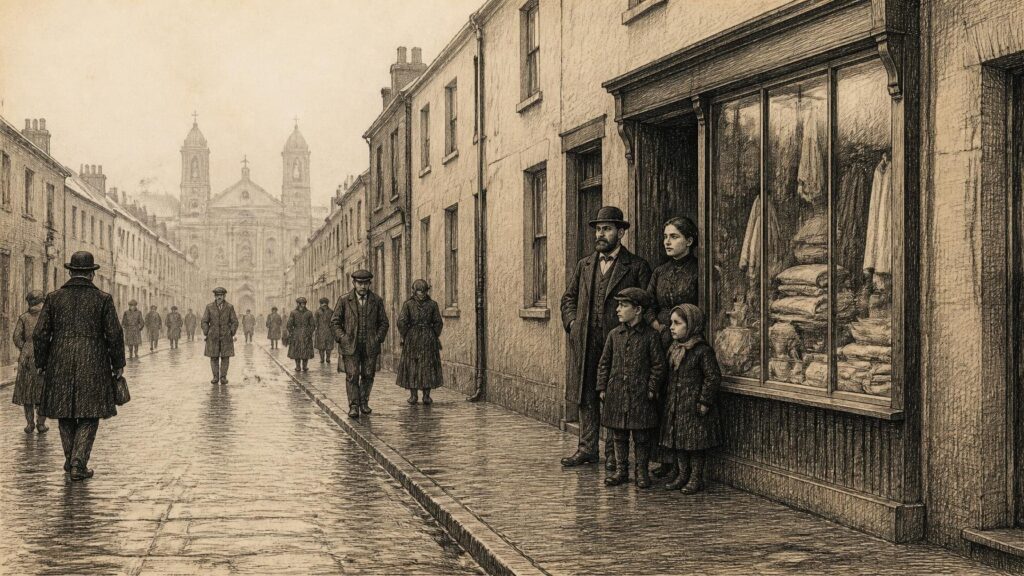
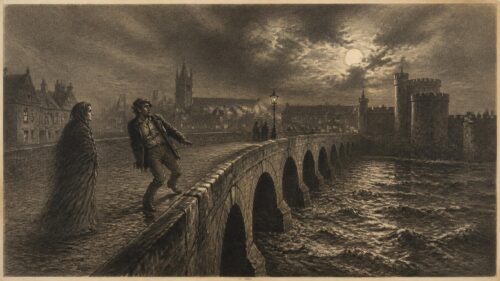
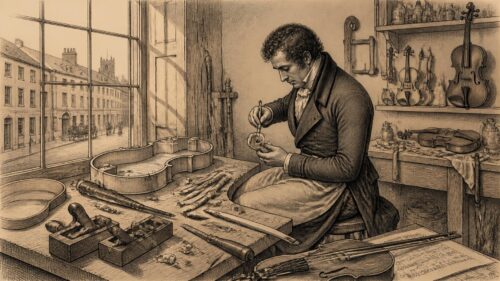
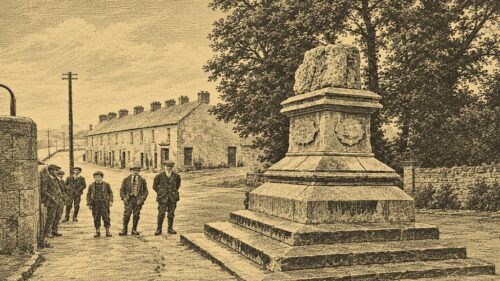
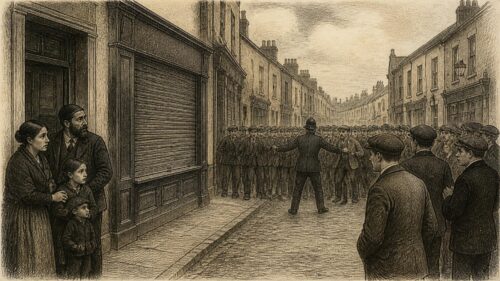
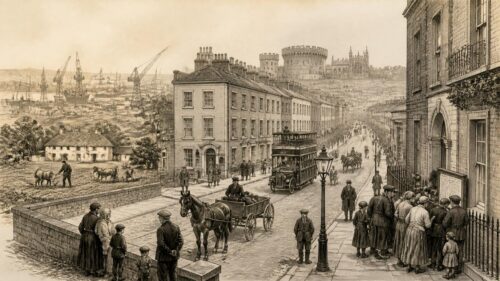
AI generated historical illustration, not a contemporary photograph.
At a Glance
In January 1904, Limerick’s small Jewish community became the target of a campaign of antisemitic preaching, intimidation and economic exclusion. Known conventionally as the Limerick Boycott, the episode was neither an invented legend nor a simple local quarrel: it exposed how religious prejudice, commercial anxiety and the politics of belonging could combine against migrant families who had made a home in an Irish city.
Arrival Routes
Jewish life in Limerick was a comparatively recent development when the boycott began. Jewish residents had been recorded elsewhere in Ireland over earlier centuries, but the community that took shape in Limerick belonged principally to the great east European migration of the later nineteenth century. Families fleeing poverty, discrimination and recurrent violence within the Russian Empire travelled west through European ports, Britain and Ireland. Many Irish Jews of this generation had roots in Lithuania, then under Russian rule, and migration was often neither direct nor final. A family might spend time in England, Scotland or another Irish town before settling, moving again, or attempting a further journey to North America or South Africa.
By about 1881, Jewish settlement in Limerick had become sufficiently visible to form the basis of a recognisable communal life. The city was a port and regional market centre, connected to commercial routes beyond Munster, and it provided scope for small-scale retailing, peddling and credit trading. These occupations did not make Jewish newcomers prosperous as a group. Rather, they were familiar routes into livelihood for people with limited capital, few local connections and an urgent need to turn mobility into security. The families who established themselves in Limerick were therefore part of both Irish urban history and a wider migrant history stretching from eastern Europe across the Atlantic world.
Settlement centred on Collooney Street, now Wolfe Tone Street, and nearby Lord Edward Street. The concentration was practical as well as social: neighbours could share information, religious observance, language and trade connections, while relatives and acquaintances offered a first defence against the isolation of a new city. It should not be imagined, however, as a sealed enclave. Jewish traders served non-Jewish customers; Jewish children attended local schools; and the community depended on relations with suppliers, landlords, creditors, officials and the wider street. Its members were at once distinctive in religious and migrant identity, and deeply entangled in Limerick’s daily economy.
Urban Livelihoods
The 1901 census recorded approximately 168 Jewish people in Limerick. Figures in contemporary and later accounts vary slightly according to how households and temporary residents were counted, but the essential point is clear: this was a small minority within a city of many thousands. Its small size made communal institutions especially important. A synagogue had been founded in the late 1880s, and worship took place in premises on Collooney Street after earlier meetings in private houses and an ale house. In 1902 the community acquired land at Castletroy for a cemetery and prayer house, a telling sign of an intention to belong locally across generations.
Its economy rested largely on modest shops, hawking and the sale of goods through weekly instalments. Clothing, drapery, pictures, books and household articles could be bought gradually by customers unable to pay the full cost at once. Such arrangements were common forms of working-class and lower-middle-class consumption in Britain and Ireland. Yet instalment selling exposed traders to a particular danger: credit requires confidence, and a customer who is encouraged not to pay, or a supplier who suddenly calls in debts, can destroy a small enterprise very quickly. The Jewish trader was consequently vulnerable not only to lost custom but to a cascading withdrawal of credit.
Some local competitors and customers regarded Jewish commercial practice with suspicion. The existence of genuine tensions surrounding debt, prices and competition must be acknowledged, but it cannot explain or excuse the language that followed. Economic disagreement was translated into inherited antisemitic stereotypes: Jews were portrayed as collectively alien, exploitative, grasping and hostile to Christianity. This was not neutral criticism of individual trading practices. It was a racialised and religious attack upon an entire people, rendering every Jewish shopkeeper answerable for an imagined Jewish conspiracy and every Jewish household a supposed threat to the city.
January Sermons
The immediate catalyst came from Father John Creagh, a Redemptorist priest and spiritual director of Limerick’s powerful Arch Confraternity of the Holy Family. On 11 January 1904, speaking at the Redemptorist church at Mount Saint Alphonsus, Creagh delivered an antisemitic sermon to a large male confraternity gathering. He returned to the subject on 18 January. Transcripts reproduced in recent scholarship demonstrate that these were not vague or accidental expressions of ill feeling. They drew upon old anti-Jewish accusations concerning Jewish hostility to Christianity, economic exploitation and alleged ritual wrongdoing.
Creagh framed his argument in the language of self-protection. He invoked Irish hospitality and Christian charity, only to argue that a community had a higher obligation to defend itself from what he represented as a collective danger. This rhetorical manoeuvre was important. It allowed an assault upon neighbours to be presented not as cruelty but as a moral duty. Jewish people were not treated as individual Limerick residents, with diverse livelihoods and histories, but as members of a hostile abstraction. The sermon associated commerce with moral contamination and suggested that the expulsion of Jewish economic influence would benefit the city.
It is necessary to distinguish the documented content of the sermons from later simplification. Creagh’s words were plainly antisemitic and helped legitimise action against Jewish businesses. They cannot be reduced to a passing objection to debt collection or instalment sales. At the same time, a historian should avoid treating a sermon as a magical command that explains every subsequent decision by every Limerick resident. Prejudice already existed; commercial rivalry supplied some of the local energy; institutions and individuals made choices. Creagh’s intervention gave those forces authority, vocabulary and a public focus. It was an act of incitement situated in a receptive social environment.
Public Response
The sermons did not pass without protest. Rabbi Elias Bere Levin, who had served the Limerick congregation since the late nineteenth century, acted swiftly to defend his community. He communicated with Jewish authorities in Dublin and London, sought public support and helped secure relief for households facing financial distress. His work illustrates that the victims were not passive figures in another community’s story. They documented events, appealed to networks beyond Limerick and attempted to hold local leaders responsible for the protection of fellow residents.
Michael Davitt was among the most significant public critics. His intervention carried particular weight because he was a Catholic nationalist associated with the Land League and with campaigns against oppression. Davitt had travelled in Russia in 1903 to investigate anti-Jewish persecution and had written about it. In his response to the Limerick events, he rejected the allegation that Jews had injured Ireland and recalled the long history of Jewish suffering in Europe. His condemnation made a vital point: Irish memories of dispossession and persecution could lead to solidarity with Jewish neighbours, but those memories did not automatically prevent antisemitism.
Other voices, including Protestant and Catholic clergy and laypeople, objected to the boycott and violence. Such opposition matters, particularly against a later tendency to portray all of Limerick as unanimous. There is evidence that some priests disapproved and that a minority of residents maintained normal relations with Jewish neighbours. Yet opposition did not end the campaign. It is one of the hardest facts of the episode that moral condemnation by prominent people could coexist with the continuing economic isolation of ordinary families. Public sympathy was not always matched by the practical courage of buying goods, extending credit or defying pressure on the street.
Economic Pressure
The principal weapon was boycott. Jewish shopkeepers found customers staying away, while existing debts and arrangements became more precarious. In a credit-based retail economy, a loss of custom was only the first injury. Contemporary reports and later archival assessments indicate that suppliers who had previously dealt with Jewish traders on credit became reluctant to continue, or sought payment of outstanding accounts. There were also reports that some farmers refused to supply milk. Such acts may appear mundane beside physical violence, but they could make ordinary life impossible: food stocks diminished, trade ceased and debts accumulated.
The pressure extended beyond the shop counter. A boycott tells customers that purchasing is a public act and traders that their neighbours may punish them for being who they are. It converts the street into a tribunal. Jewish families could not easily separate business from home, because many lived above or close to their premises, and because the community was small enough for every incident to carry quickly. The insecurity of parents was necessarily shared by children and older relatives. Even where no assault occurred, the knowledge that customers, suppliers or neighbours had become unreliable altered the texture of daily life.
Accounts have sometimes spoken of an uninterrupted two-year boycott, ending only after Creagh left Limerick in 1906. The evidence supports the conclusion that the campaign had a serious and enduring economic effect, but its intensity is harder to measure month by month. It is more accurate to say that the boycott began in January 1904, remained a grave problem over an extended period and contributed to the departure of several households. The documentary record does not support easy precision about every lost sale, every family decision or the exact moment at which hostility diminished. That uncertainty should sharpen, rather than soften, the historical judgement: sustained exclusion was real even when its rhythm cannot be reconstructed perfectly.
Violence Records
The boycott was accompanied by intimidation and episodes of physical violence. Contemporary reporting and later research record assaults, threatening behaviour and harassment in the months after the sermons. Some Jewish residents were beaten in the streets, and hostile crowds were reported. More recent scholarship has identified numerous anti-Jewish incidents between February and July 1904, although the precise classification and count of every event requires caution. The best-supported conclusion is that violence was sporadic rather than continuous, but that it was serious enough to create fear and to reinforce the commercial campaign.
This distinction is essential. To say that the Limerick events did not involve mass killing or wholesale destruction of property is not to say that violence was absent. Conversely, to describe intimidation accurately does not require enlarging every report into a catastrophe for which the evidence is lacking. The experience of a small community should not be assessed solely by a body count. A thrown stone, a street assault, the loss of a customer, a hostile shout outside a home or the sudden refusal of a creditor all had amplified meaning where there were few Jewish households and no margin for further loss.
Police and official records form part of the story, but they are not complete windows onto it. Victims may not have reported every incident; minor attacks could go unrecorded; witnesses might have feared involvement; and authorities could categorise events narrowly. Nor should later recollections automatically be treated as literal transcripts of 1904. Memory often condenses a prolonged atmosphere of fear into a single dramatic narrative. The historian’s task is to respect testimony while comparing it with census data, press reports, institutional correspondence and surviving administrative evidence. The result is a history of genuine persecution that remains alert to the limits of the surviving archive.
Contested Language
The term “pogrom” has frequently been attached to Limerick. It carries powerful associations with the violent anti-Jewish attacks of the Russian Empire, including killings, rape, organised destruction and official complicity or indifference. For Jewish migrants who had come from, or whose families remembered, eastern Europe, the comparison was emotionally and politically understandable. It expressed the terror of seeing antisemitic ideas that had ravaged other places emerge in a city expected to offer refuge. It also helped attract attention from Jewish organisations in Britain and beyond.
Yet the term remains contested among historians. Some use it to emphasise the organised antisemitic character of the campaign and its lasting consequences. Others argue that it is misleading because the Limerick boycott did not resemble the lethal, large-scale pogroms to which the word is commonly applied. Recent scholarship has particularly stressed the need to avoid turning a complex local episode into a simplified Irish equivalent of Kishinev. That caution is well founded. Historical comparison should illuminate differences as well as similarities, and the distinctive features of Limerick must not vanish beneath an evocative label.
The dispute is not merely semantic. Language shapes moral memory. Calling the event a pogrom can prevent minimisation, but it may also lead readers to assume facts not established by the evidence. Rejecting the term can improve precision, but it can also be used carelessly to diminish antisemitism or to protect a comforting civic reputation. “Limerick Boycott” remains the clearest descriptive name because it identifies the central mechanism of persecution. A careful account can then state plainly that the boycott was antisemitic, coercive and accompanied by violence, while explaining why its relationship to the wider history of pogroms is debated rather than settled.
Departures Aftermath
Several Jewish families left Limerick as a result of the economic crisis and insecurity. Cork was an important destination. Families who had hoped to continue from Cobh to America sometimes remained there, assisted by a more established Jewish community. The Goldberg family was among those associated with this movement; their later history became part of Cork’s Jewish civic story. Migration, therefore, was not simply an escape from one city but a reshaping of Jewish geography within Ireland. Limerick’s loss contributed, in small but meaningful measure, to the growth and consolidation of other communities.
However, the claim that the boycott immediately expelled every Jew from Limerick is not borne out by the demographic record. A detailed 1905 report indicated that, of thirty-two Jewish families resident in January 1904, eight families comprising forty-nine people had left by March of the following year. Census data also show a reduced but continuing Jewish population in 1911. Synagogue life persisted, and Rabbi Levin remained an active communal leader until his departure for Leeds in 1912. These facts correct a dramatic legend, but they do not negate the harm. A community need not disappear overnight for a boycott to have wounded it deeply.
Continuity and decline existed together. Some households remained because they had nowhere better to go, because family and business ties held them, or because resistance itself was an assertion of belonging. Others departed under pressures that cannot be reduced to a single cause. The boycott was decisive for some and contributory for others; wider economic change and ordinary migration also affected numbers. What can be said securely is that the episode impaired confidence, weakened livelihoods and cast a long shadow over Limerick Jewish life. Its consequences were social as well as numerical: a city that had promised opportunity had demonstrated how quickly security could be withdrawn.
Historical Memory
For much of the twentieth century, the Limerick Boycott occupied an uneasy place in Irish historical memory. It was recalled within Jewish families and organisations, but often sat awkwardly beside a cherished national image of Ireland as a country uniquely sympathetic to the oppressed. That image had real foundations in Irish experiences of conquest, famine, religious discrimination and emigration. It also had limits. The Limerick episode shows that a people’s own history of suffering does not confer immunity from prejudice towards another minority.
Popular retellings have often preferred extremes. One version makes Limerick a city of uniform hatred and presents the boycott as a straightforward replica of eastern European pogroms. Another treats it as a minor misunderstanding, inflated by outsiders and unfair to the city. Neither reading does justice to the available evidence. The former can obscure the resistance offered by Davitt, Levin, sympathetic clergy and individual neighbours. The latter ignores that antisemitic sermons triggered an organised economic campaign, that violence and intimidation occurred, and that families suffered sufficient hardship to seek new lives elsewhere.
Commemoration has gradually encouraged a more responsible conversation. The Irish Jewish Museum places the boycott within the wider history of Jewish communities in Ireland. Limerick local-history work has restored attention to Rabbi Levin and the institutional resilience of the community. New scholarly work has also brought close scrutiny to the sermons, policing, political response, economic context and cultural memory. This is valuable not because history must supply an uncomplicated civic lesson, but because it permits a fuller one: belonging is fragile when neighbours allow inherited myths to govern ordinary dealings.
Methodological Caution
The history of 1904 requires disciplined attention to categories of evidence. Documented facts include the existence of a Jewish community in Limerick, Creagh’s January sermons, the subsequent boycott, reports of intimidation and assaults, public protests, Jewish relief efforts and the departure of some families. Interpretation begins when historians weigh motives, decide how far commercial resentment mattered, estimate the boycott’s duration and assess the relationship between local events and Russian precedents. Folklore enters where later family stories, civic anecdotes or sweeping claims outrun records that can presently be checked.
Folklore is not worthless. It can preserve emotional truths, family loyalties and details overlooked by official sources. A story passed down by descendants may reveal what a frightened household felt when its customers vanished, even if the exact date or wording cannot be verified. But folklore cannot be allowed to displace evidence. Claims that all Jews were driven out, that no neighbour helped them, or that the city’s entire population acted as one body require proof. So too do claims that the boycott was insignificant because Limerick did not witness mass murder. Historical honesty demands a refusal of both denial and embellishment.
The most convincing account of the Jews in Limerick in 1904 is consequently sober but unsparing. A small migrant community had developed religious institutions, family networks and commercial lives in an Irish city. A prominent priest publicly mobilised antisemitic fictions against it. Those fictions were translated into boycott, fear and material damage, while some contemporaries protested and others acquiesced. The community endured, though diminished and altered. Remembering that history accurately is not an indictment of every Limerick person, nor a demand that Ireland be judged by a single episode. It is a recognition that Irish history, like every national history, contains both solidarity and exclusion—and that the choice between them is made in the conduct of ordinary life.
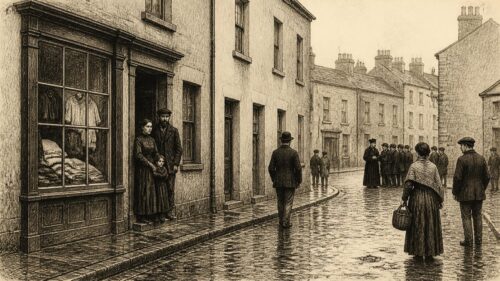
The article’s distinction between an antisemitic boycott and the contested label pogrom is particularly revealing. It shows how terminology can acknowledge Jewish families’ fear, economic losses, intimidation and migration, yet also influence assumptions about the scale of violence and official involvement. The fact that some households remained further complicates narratives of either complete expulsion or a minor dispute. This suggests that historical memory needs precision without minimising coercion or overlooking continuing Jewish life in Limerick. How should historians and communities describe the 1904 campaign in ways that recognise its antisemitic consequences, compare it with pogroms, and include departure and persistence?