Fínnechta’s Accession675 CE
In 675, Fínnechta Fledach mac Dúnchada defeated and killed his cousin Cenn Fáelad mac Blathmaic, succeeding to the kingship of Tara. The battle, later called Aircheltair and possibly fought at Tech Uí Máine in Dál Céltra, cannot be securely located. It marked a dynastic change within Síl nÁedo Sláine, the southern Uí Néill kindred based in Brega, rather than national unification. Control of Tara depended on descent, military strength, alliances and recognition. The conflict affected communities supplying royal retinues, although the annals record few details. Fínnechta’s reign lasted until 695, while later traditions and events should not be assigned to his accession year.
Dateline
In 675 CE, a battle brought down Cenn Fáelad mac Blathmaic and raised his cousin Fínnechta Fledach mac Dúnchada to the kingship of Tara. The event was a decisive change within the dominant southern branch of the Uí Néill, rather than the founding of a new Irish state or the conquest of a unified island. The contemporary annalistic tradition is terse but emphatic: Cenn Fáelad was killed, Fínnechta was victorious, and Fínnechta then began to reign. For a year with few securely dated Irish happenings, this violent transfer of power is its central historical fact.
A Battle With Uneasy Geography
The principal annals agree on the outcome. The Annals of Ulster record a battle in which Cenn Fáelad, son of Blathmac and grandson of Áed Sláine, was slain by Fínnechta, son of Dúnchad. Chronicon Scotorum similarly couples the victory with the beginning of Fínnechta’s reign. The Annals of Tigernach give a more particular, though still difficult, location: the battle occurred at Tech Uí Máine in Dál Céltra. Later tradition calls it Aircheltair. These names have generated differing identifications, and the precise battlefield cannot responsibly be fixed. It is safer to say that the written record preserves a named encounter, not a securely located archaeological site.
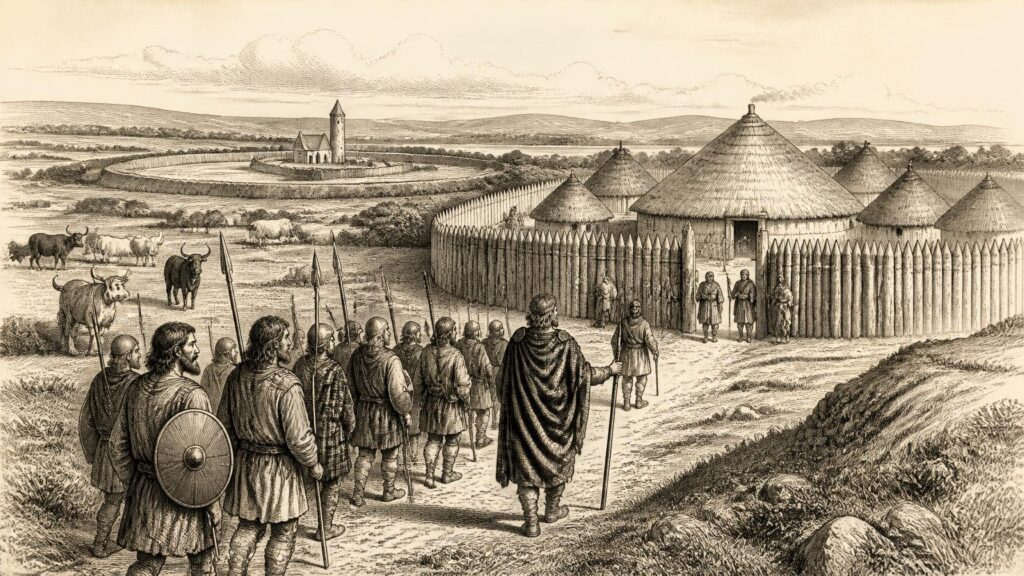
The uncertainty matters because place shaped early Irish politics. A king travelled with retainers, received dues and hospitality, judged disputes, made alliances and demonstrated authority in person. If the fighting occurred away from Brega, as one interpretation of the Tigernach wording suggests, Cenn Fáelad may have been caught during such a royal circuit; that remains an informed possibility, not a proven fact. Nor do the annals explain the immediate cause of the conflict. They do not describe troop numbers, weapons, negotiations or the experience of non-combatants. Their economy of language is itself revealing: for their compilers, the death of a king and the identity of the victor were the facts worth preserving.
A Cousin Replaces a Cousin
Both men belonged to Síl nÁedo Sláine, a leading dynasty of the southern Uí Néill, whose strength lay in Brega, the fertile and politically important region around the lower Boyne and Blackwater. Cenn Fáelad was the son of Blathmac; Fínnechta’s father, Dúnchad, was Blathmac’s brother. This was therefore a contest inside one powerful kindred. Its background reached back to the great plague of 664–665, which had carried off Blathmac and his brother Diarmait, joint rulers of Tara. Blathmac’s sons Sechnassach and then Cenn Fáelad had succeeded in turn, but neither established a lasting independent line.
Fínnechta’s victory did not abolish this family network; it rearranged it. His accession shows that seniority alone could not settle succession. Kingship among the Uí Néill depended upon descent, but it also required military success, followers, client rulers and recognition from ecclesiastical as well as secular communities. The modern phrase ‘high king of Ireland’ can be useful shorthand for the ruler associated with Tara, but it can mislead if it suggests a centralised realm. Ireland in 675 consisted of many kingdoms and lordships, connected by tribute, fosterage, marriage, church ties, raiding and negotiated overlordship. A Tara king possessed an exceptional claim to pre-eminence, not automatic day-to-day command everywhere on the island.
Even the sources preserve traces of political contest after the fighting had ended. Fínnechta is accepted in king-lists as a king of Tara, and his twenty-year reign became the standard retrospective reckoning. Yet the late seventh-century regnal poem Baile Chuinn Chétchathaig, probably composed during his reign, does not include Cenn Fáelad or his brother Sechnassach among its sequence of rulers. That omission should not be treated as neutral evidence that they never ruled. It more plausibly demonstrates how royal memory could be shaped by a victorious dynasty. The poem is important evidence for the political culture created under Fínnechta, but it cannot securely be dated to 675 itself.
Brega, Tara and the Price of Power
Brega gave the struggle a material foundation. Its productive lowlands, routes along the Boyne and proximity to Tara made it a prize far larger than a ceremonial hill. Control over people and land brought food-renders, cattle, labour, military service and prestige. Cattle were central stores of wealth and units in compensation and tribute, while grain, dairy produce and livestock sustained households, royal entourages and religious establishments. This was not an economy organised around towns: Ireland had no urban centres comparable to those of Roman Britain or continental Europe. Authority was exercised through dispersed settlements, estates, seasonal movements and personal obligations.
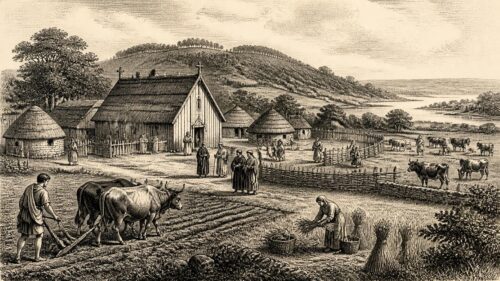
Most families lived and worked in small rural communities. Archaeology identifies ringforts—earthen raths and stone cashels—as a characteristic form of early medieval farmstead enclosure. Within and around them were houses, storage, craft work, food preparation and the practical management of animals. Fields supported a mixed regime of pasture and tillage. Such evidence cannot tell us what happened in one particular farmyard in 675, but it provides the setting within which a royal succession mattered. Mobilising for battle drew on the resources of local communities; a change of ruler could alter demands for food, cattle, labour, protection and allegiance.
There is no sound evidence for a general famine, epidemic, climatic disaster or major commercial transformation in Ireland during this particular calendar year. It would be wrong to manufacture one merely to give the year a fuller appearance. The available record instead points to a political crisis concentrated among elites. Nonetheless, elite fighting was never sealed off from ordinary life. Retinues needed provisioning, defeated supporters faced insecurity, and local kings had to decide whether and when to recognise the winner. The silence of the annals about these consequences is not proof that they were absent.
Churches in a Changing Political World
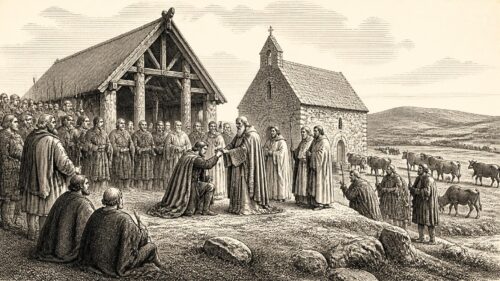
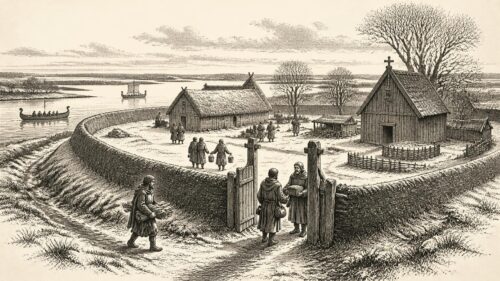
The battle and accession are not accompanied by a securely dated foundation, synod or ecclesiastical reform in 675. The Irish church nevertheless formed an essential part of the year’s world. Monastic and ecclesiastical settlements were centres of worship, literacy, teaching, craft production, landholding and exchange, linked to ruling families through patronage and kinship. Their enclosures, churches, houses, workshops, cultivated land and herds made them institutions with both spiritual and economic weight. Clerics also helped to maintain the learned culture from which annalistic record-keeping emerged.
That setting requires chronological care. Later annalistic entries place Fínnechta in conflict with northern Uí Néill power and record his destruction of Ailech Frigrenn in 676; that was not an event of 675, even if it followed naturally from his new position. Likewise, later stories associate him with churchmen, generosity, legal concessions and the young Adomnán of Iona. Such narratives illuminate the reputation Fínnechta acquired, but they should not be read back as reports of decisions made in his accession year. A responsible view of 675 distinguishes the firmly dated battle from the longer political and ecclesiastical relationships that later clustered around the king.
Learning, Memory and Limits
Seventh-century Ireland possessed a vigorous culture of Latin and vernacular learning, but 675 should not be burdened with achievements that belong to other dates or people. In particular, Cenn Fáelad mac Aililla, the celebrated learned man associated in later tradition with legal, poetic and ecclesiastical learning, was a different individual from Cenn Fáelad mac Blathmaic, the slain king. The scholar’s death is placed several years later. The shared name is a useful warning: Irish annals preserve dense networks of repeated personal names, and an attractive story can easily attach itself to the wrong man.
The sources for 675 were themselves written down and recopied long after the event, drawing on chronicle traditions whose chronological systems do not always align perfectly. The Annals of Ulster, for example, label their relevant entry U675 while their calendrical apparatus corresponds it with AD 674; other annalistic traditions place the battle and accession in 675. Modern scholarly synchronisation and biographical reference works therefore support 675 CE as the conventional date, while also warning against claims to a particular month or day. The year can be known, but not with modern diary-like precision.
A New Claim to Tara
By the close of 675, Fínnechta Fledach had displaced a first cousin, taken the kingship associated with Tara and become the figure through whom the future of Síl nÁedo Sláine would be contested. His later sobriquet, usually understood as ‘of the feasts’ or ‘the bountiful’, belongs to the reputation of a ruler whose reign would last until 695; it should not soften the fact that it began in bloodshed. The battle of Aircheltair—or at Tech Uí Máine in Dál Céltra, if that identification is accepted—was a moment when dynastic eligibility became effective only through victory.
For Ireland more widely, 675 was not a year of national unification, nor one in which every region suddenly changed course. Munster, Leinster, Ulaid, Connacht, the northern Uí Néill and numerous lesser peoples retained their own rulers and interests. But the turnover at Tara altered the balance among the strongest kindreds of the midlands and set the conditions for confrontations that followed. In the restrained language of the annals, a king fell and another began to reign. Behind that formula lay the practical realities of kinship, land, cattle, armed followings, religious patronage and remembered legitimacy that structured early medieval Irish life.
Primary Sources
- The Annals of Ulster, Year U675
- The Annals of Tigernach
- Chronicon Scotorum, Annal CS675
- Fragmentary Annals of Ireland, Annals 61–67
- Annals of Inisfallen, Part 3
- Annals of the Four Masters
- Chronological Synchronisation of the Irish Annals
- Fínshnechtae Fledach
- Cenn Fáelad mac Blaímaic: (d. 675), high-king of Ireland
- Blathmac
- Cenn-Fáelad
- Exploring the Irish Annals
- Baile Chuind Chétchathaig: An Edition
- Texts: Baile Chuind Chétchathaig
- Ringforts
- The Rural Settlement Pattern
- Early Christian Monasteries
- Patrician and Early Christian Architecture
- Churches and Ecclesiastical Enclosures / Shéipéil agus Ráthanna
- Christian Ireland 5th–8th Centuries
- Irish Texts at CELT
- The Annals of Tigernach: CELT Project Description
- Chronicon Scotorum: CELT Project Description
- Annals of Inisfallen