Ráith Mór and Connacht681 CE
In 681, Irish annals record the killing of Cenn Fáelad, king of Connacht; a battle at Ráith Mór in Mag Line against Britons, where Cathasach, king of the Cruithin, died; and the death of Suibne, superior of Corcach. These brief, variant records demonstrate fragile regional kingship, conflict involving cross-channel contacts, and the public importance of ecclesiastical leaders. They do not establish a single coordinated campaign or detailed causes. Ireland remained divided among interconnected rural kingdoms and church communities, sustained by farming, livestock, patronage and kinship amid recurring local insecurity.
Dateline
In 681 CE, Ireland’s surviving annalistic record preserves three securely associated notices: the killing of Cenn Fáelad, described as king of Connacht; a battle at Ráith Mór in Mag Line against Britons, in which Cathasach, king of the Cruithin, was killed; and the death of Suibne, superior of Corcach. These are short entries, but they reveal a political world in which royal authority remained precarious, conflict crossed the narrow seas, and ecclesiastical communities were led by figures important enough to be entered beside kings and battles. The evidence must be handled carefully. The Annals of Ulster place these items under an annal headed AD 681, while other annal compilations preserve related notices with slightly different year-numbering, names and detail.
Three Notices, One Uneasy Year
The most striking political notice is the death of Cenn Fáelad, called king of Connacht. The annal gives no place, assailant, motive or succession settlement. It simply records his killing. That silence matters. It prevents a responsible reconstruction of a dramatic assassination, palace attack or province-wide war. Yet the death of a king was never merely personal. A kingship in seventh-century Ireland rested on kinship, land, clientship, hostages, tribute and the ability to command fighting men. The removal of its holder could unsettle alliances among leading kindreds and invite rivals to press their claims.
Connacht was not a unified state in the modern sense, nor did its king govern through towns, paid officials or a permanent army. It was a large regional kingship made up of competing populations and dynastic interests, including branches of the Connachta and their subject or allied communities. Royal titles in the annals express real prestige, but they do not imply uncontested control of every district. The death recorded in 681 is therefore best understood as a disruption at the top of a layered political order rather than evidence for the collapse of Connacht itself.
The sources complicate even the king’s identification. The Annals of Ulster name him Cenn Fáelad son of Colgú, whereas the Annals of Inisfallen give a similar name with a different patronymic. Such variation is common in texts copied and compiled long after the events they describe. The secure point is that an annalistic tradition associated a king named Cenn Fáelad with Connacht and placed his violent death in this chronological neighbourhood. It is less secure to attach a detailed genealogy, identify a single killer, or treat later explanations as contemporary testimony.
War at Ráith Mór
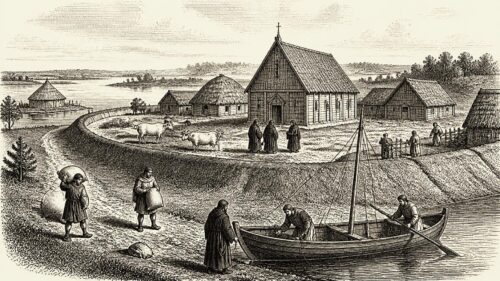
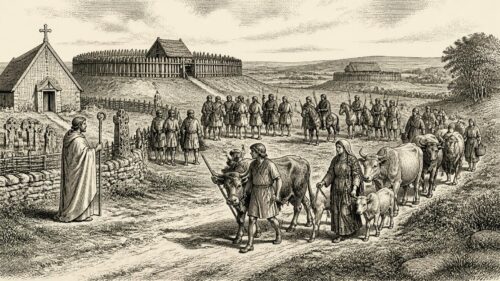
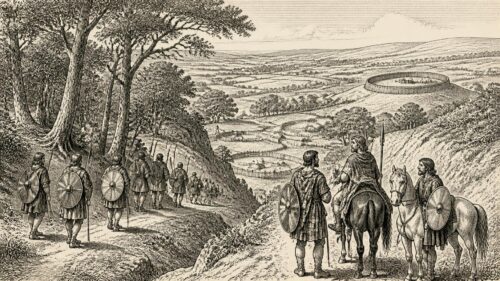
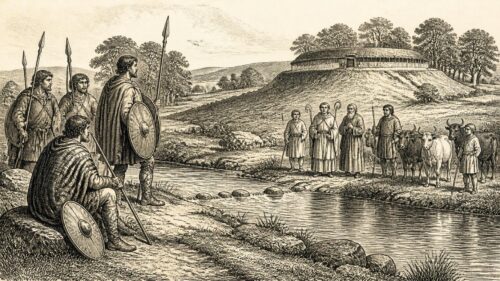
The battle at Ráith Mór, in Mag Line, is the year’s fullest military entry. It was fought “against the Britons”, and Cathasach son of Máel Dúin, king of the Cruithin, fell there, along with Ultán son of Dícuill. The annal also mentions the killing of a man named Muirmen while captive, though the wording is uncertain. This is a valuable reminder that northern Irish politics did not end at the coastline. The sea channel between north-east Ireland and western Britain was a route for ecclesiastics, migrants, raiders, warriors and royal diplomacy as well as for goods.
Mag Line lay in the north-east, a region where the Cruithin and the powerful Dál nAraide were central political actors. In early Irish usage, “Cruithin” could refer to a people or political grouping rather than a fixed ethnic category comparable to a modern nation. Nor does the annal specify which Britons fought at Ráith Mór, where they came from, or whether they arrived as a raiding force, allies of an Irish faction, or an organised expedition. The battle should not be inflated into a national war between Ireland and Britain. Its scale is unknown. What can safely be said is that overseas opponents were present in a conflict serious enough to kill a king.
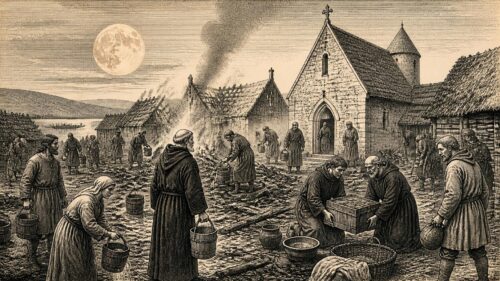
For communities near the battlefield, warfare meant more than the deaths named in the chronicle. Fighting could bring the seizure of cattle, grain, weapons and people; the destruction of crops or dwellings; and the interruption of travel along local routes. Captivity was a recognised reality in early medieval Ireland, and the notice concerning Muirmen hints at the vulnerability of prisoners. Even so, the sources do not say that Mag Line was devastated in 681. The human consequences are historically plausible consequences of armed conflict, not separately documented events for this particular campaign.
Kingship Without a Single Kingdom
The events of 681 belong to an Ireland divided among many small kingdoms, known conventionally as túatha, whose rulers were linked through wider dynasties and shifting overlordships. Kingship was graded. A local ruler might be subject to a provincial king, while the most prominent rulers of northern and southern dynasties competed for a broader claim to the kingship of Tara. Such claims created a political language of island-wide status, but they did not create a central Irish kingdom with uniform administration.
This arrangement helps explain why the annals move so abruptly from Connacht to Mag Line and then to Corcach. Their world was made of connected regions rather than a single political centre. A killing in the west and a battle in the north-east could both deserve record because elite families, churches and learned communities maintained relationships across long distances. Roads, river corridors and sea-routes carried news as well as people. Monasteries in particular participated in these communications, preserving genealogies, memorialising leaders and giving events a place in inherited historical time.
It is tempting to connect every death and battle to the better-known struggles of leading dynasties. The evidence does not allow that. No surviving entry explicitly says that Cenn Fáelad’s killing caused the battle at Ráith Mór, or that either event was directed by a claimant to Tara. Their juxtaposition within a year is not proof of a common campaign. The proper picture is one of several simultaneous political arenas, in which rulers faced local opposition and external threats while seeking recognition from wider networks.
Corcach and Ecclesiastical Authority
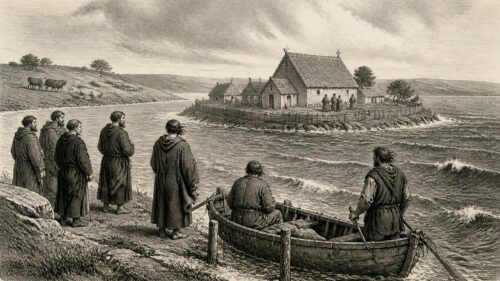
The death of Suibne son of Máel Uma, called superior of Corcach, gives the year a different kind of significance. “Superior” indicates the head of an ecclesiastical community, although it does not necessarily correspond neatly to the later image of a solitary abbot governing a large, enclosed monastery. Irish religious establishments could include churches, burial places, cultivated land, dependent households and communities of clerics, tenants and workers. Their leaders commanded spiritual respect but also managed land, food-renders and relationships with secular patrons.
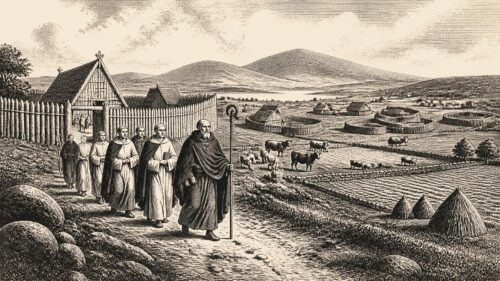
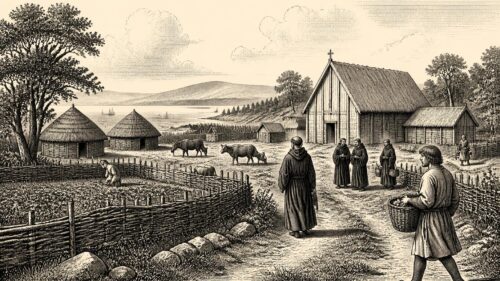
Corcach should not be assumed to be identical with a later urban Cork. Seventh-century Ireland had no towns in the later medieval sense. Settlement was overwhelmingly rural: dispersed farmsteads, enclosed residences, crannógs, ecclesiastical sites and seasonal grazing landscapes. Religious centres were nevertheless focal places. They offered worship, burial, literacy and commemoration; they also gathered labour and agricultural produce. Suibne’s recorded death shows that the leadership of such a centre was part of the political and social history worth preserving in the annals.
The annals do not describe Suibne’s learning, buildings or community, and it would be unsafe to assign a manuscript or a church foundation to him. Still, his notice belongs to a period when Irish ecclesiastical culture was deeply engaged with Latin learning, biblical study, computus, canon law and the cultivation of vernacular scholarship. Clerical communities were among the few institutions with the continuity and literacy needed to shape collective memory. Their chronicles were selective: ordinary cultivators, craftspeople, servants and enslaved people rarely appear by name, even though their labour sustained both royal households and churches.
Work, Food and Landscape
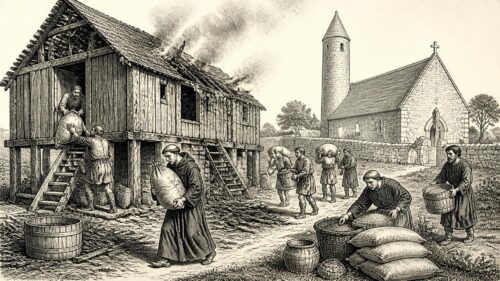
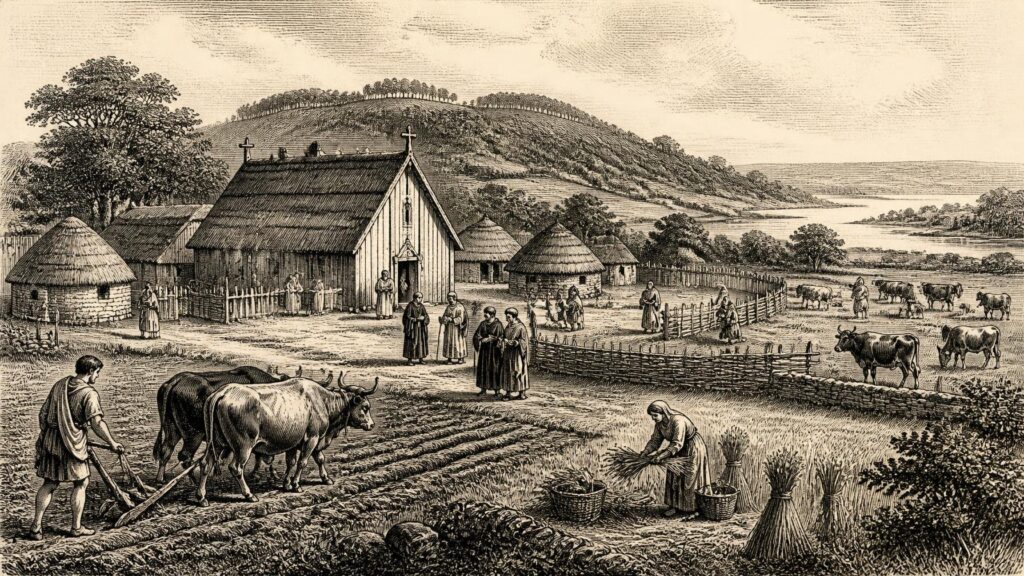
For most people in 681, daily life was ordered by the mixed farming economy rather than by the named deaths in the annals. Cattle were a principal store of wealth and a measure of status, central to tribute, fostering, marriage arrangements and compensation. They supplied milk, butter, hides and traction, while also being mobile property that could be transferred or raided. But Ireland was not simply a cattle landscape. Archaeological and legal evidence indicates the cultivation of cereals, especially oats and barley, alongside dairying, pig-keeping and the use of woodland and wetland resources.
Farm households worked within a strongly unequal society. Free farmers, clients, dependants, unfree people and slaves had different claims on land, livestock and legal protection. A ruler’s standing depended partly on his ability to reward followers and distribute resources; a church’s standing likewise depended on patrons and productive land. This material foundation helps explain why political violence could be consequential even where chronicles are brief. A dead king, a defeated warband or a disrupted ecclesiastical household affected obligations extending beyond the people named.
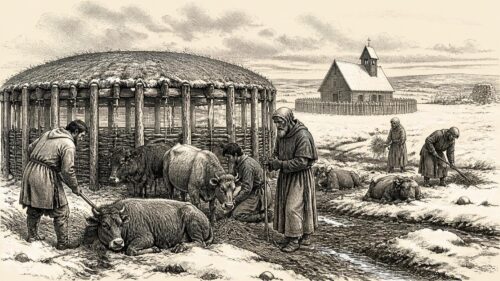
No reliable Irish annal for 681 records a major famine, epidemic, extraordinary weather event or environmental disaster. It would be wrong to supply one merely because later years preserve such reports. The year’s surviving evidence instead points to ordinary but demanding agricultural work conducted amid local insecurity. Summer and autumn brought the care of livestock and harvesting; winter required stored grain, preserved dairy produce, fuel and fodder. The battle at Ráith Mór and the killing of a Connacht king occurred against that seasonal rhythm, not outside it.
What 681 Reveals
681 CE is not a year for a sweeping story of national transformation. Its importance lies in the clarity with which three terse notices expose the structures of early medieval Ireland: kings could be killed; northern conflict could involve Britons from across the sea; and ecclesiastical superiors were figures of public consequence. The annals preserve the names of Cenn Fáelad, Cathasach and Suibne, but leave many questions unanswered. That incompleteness is itself part of the history. Ireland’s seventh-century past survives through records designed to remember exceptional deaths and conflicts, not to provide a continuous narrative.
Read cautiously, those records show an island of rural communities bound into wider political and religious networks. Connacht’s king, the Cruithin ruler at Ráith Mór and the superior of Corcach occupied different positions in that world, yet all depended on relationships of kinship, protection, production and belief. Their entries make 681 a year of demonstrable instability at the level of leadership, while the wider population continued the work of maintaining households, fields, herds and churches across a divided but interconnected Ireland.
Primary Sources
- The Annals of Ulster: Year U682 (AD 681)
- Annals of Tigernach
- The Annals of Tigernach
- Annals of Inisfallen: Part 24
- CELT Project: Annals of Inisfallen
- Fragmentary Annals of Ireland
- Annals of the Four Masters: Part 51
- CELT Project: Chronicon Scotorum
- Exploring the Irish Annals
- The Annals Attributed to Tigernach
- Agriculture, Settlement and Society in Early Medieval Ireland
- Early Medieval Ireland: Investigating Social, Economic and Settlement Change, AD 400–1100
- The Economy of Early Medieval Ireland
- Early Medieval Ireland: Archaeological Excavations, 1930–2009
- Early Medieval Dwellings and Settlements in Ireland, AD 400–1100, Vol. 1: Text
- Religion and Society in Ireland
- The Church in Irish Society, 400–800
- Ireland in the Middle Ages
- Legal Position and Living Conditions of Peasants and Commoners in Early Medieval Ireland, c.680–c.1170
- The Organization of Exchange in Early Christian Ireland
- Cenn-Fáelad
- The Annals of Tigernach: National Library of Ireland Catalogue