Brega Succession674 CE
In 674, Cenn Fáelad of Síl nÁedo Sláine was killed in battle by his kinsman Fínnechta Fledach, who succeeded to the contested kingship of Tara. Annalistic dates vary slightly, but the succession crisis belongs closely to this year. The conflict reflected rival dynastic claims within Brega rather than a unified national war. The killing of Congal Cennfhota in Ulaid also affected political and marriage alliances linking north-east Ireland and the midlands. Beneath elite struggles lay an agrarian society sustained by cattle, grain and rural settlements, while churches preserved the brief records on which this history depends.
Dateline
In 674 CE, the annals place Ireland’s most consequential recorded development in a struggle within the Síl nÁedo Sláine, an important branch of the Southern Uí Néill. Cenn Fáelad, son of Blathmac and styled king of Tara in later historical reckoning, was killed in battle; his kinsman Fínnechta Fledach emerged as victor and began to rule. The terse report offers neither battlefield narrative nor a reliable location. Yet it marks a real change in the leadership of the midlands, where claims to the kingship of Tara depended less on a unitary national state than on kinship, military following, tribute, alliances and recognition among other rulers.
A Date with Difficult Edges
The year must be handled with care. The Annals of Ulster explicitly head the entry “AD 674” and record both Cenn Fáelad’s defeat and Fínnechta’s accession. The Annals of Inisfallen also place the battle in 674. Other annalistic compilations arrange the same sequence differently: the much later Annals of the Four Masters put Cenn Fáelad’s death in 673 while assigning Fínnechta’s first year to 674. Such differences arise from the complicated transmission and synchronisation of Irish annalistic chronologies, not necessarily from disagreement that a succession crisis occurred. It is therefore responsible to connect the battle and accession closely with 674, while avoiding an invented day, season or precise battlefield.
The Fall of Cenn Fáelad
Cenn Fáelad belonged to a family that had dominated Brega and held the paramount kingship of Tara intermittently during the middle decades of the seventh century. His father Blathmac, and Blathmac’s brother Diarmait Ruanaid, had exercised pre-eminence before dying amid the great mortality of 665. Cenn Fáelad followed his brother Sechnassach, who died in 671. Thus the battle recorded in 674 ended the short succession of Blathmac’s sons, not a settled and hereditary monarchy.
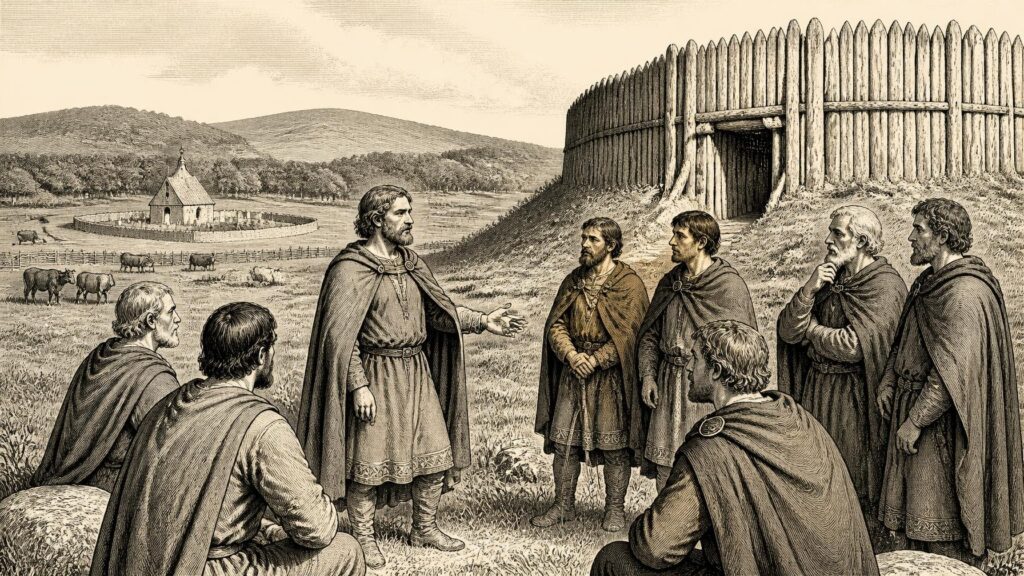
The Annals of Ulster call the encounter simply “the battle of Cenn Faelad”, saying that Cenn Fáelad fell and Fínnechta son of Dúnchad was victorious. Fínnechta too came from Síl nÁedo Sláine: he was a grandson of Áed Sláine and a cousin within the wider ruling kindred. The wording gives no licence to embellish the fighting into a grand national battle. What it does show is that warfare between close relatives could decide access to the most prestigious secular position in the Irish midlands. A king’s power rested upon people who would follow him, households able to provision them, and subordinate rulers willing—or compelled—to acknowledge him.
A later annalistic tradition names the site as Aircheltair, at Tech Ua Maine. That localisation may preserve genuine tradition, but it is not supplied by the earliest surviving versions of the core notice. Nor should the surviving record be read as proof that all Ireland had fought on either side. The political geography of 674 was a mosaic of overkingships and smaller peoples. A victory in Brega or its approaches could be highly significant without making its winner an uncontested ruler from Ulster to Munster.
Fínnechta’s Narrow Inheritance
Fínnechta’s accession was important precisely because the prize was difficult to hold. The title conventionally translated as king of Tara denotes a claim to leading rank among the Uí Néill and their neighbours; it should not be equated with the institutions of a later centralised kingdom. Tara itself was a ceremonial and ideological centre in the Boyne valley rather than an administrative capital. Its authority was enacted through assemblies, hostage-taking, gift exchange, judgment, ecclesiastical patronage and the capacity to lead a hosting.
The new ruler’s nickname, Fledach, “the Festive”, is preserved in the annals, but it should not be turned into a secure description of his personality. It may point to remembered generosity, conspicuous feasting, or later literary characterisation. What is firmer is the political situation. Fínnechta succeeded after killing a kinsman and inherited a dynasty with rival branches. His position depended on Brega, the rich plain and route network around the Boyne, but also on relations with Leinster, the northern Uí Néill, Connacht, Munster and the rulers of Ulaid.
The deaths of named rulers clustered around this period underline the instability. Annalistic chronology conventionally associates 674 with the killing of Congal Cennfhota, king of Ulaid, by Bécc Bairrche, though the surviving annal headings vary by a year. This was not a remote northern detail. Congal’s daughter Conchend had previously been married to Fínnechta, joining the houses of Dál Fiatach and Síl nÁedo Sláine. Bécc’s killing of his own father-in-law therefore altered a network of marriage and dynastic obligation that reached from eastern Ulster into the midlands.
Ulaid and the Northern Shore
Congal’s death did not automatically make Bécc Bairrche overking of Ulaid. Modern historical assessment suggests that Fergus son of Áedán, of the rival Uí Echach Cobo, initially took the provincial kingship, while Bécc became the leading figure among the Dál Fiatach. That distinction matters. “Ulaid” was itself a contested political sphere, containing several powerful kindreds rather than a single obedient territory. A killing within one royal family could redistribute influence without immediately resolving the wider contest.
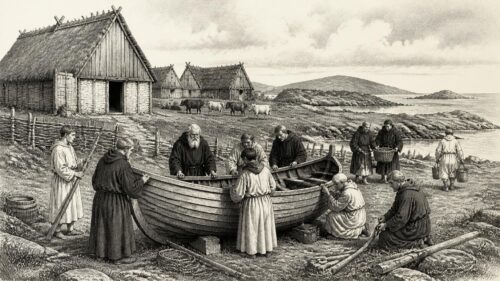
For people living along the coasts and inland loughs of the north-east, high politics had practical consequences. Kings and their rivals required food-renders, cattle, labour and fighting men. Kin groups made alliances through fostering and marriage; churches and ecclesiastical families could preserve memories, mediate claims and benefit from royal protection. The records of 674 do not tell us how any particular household experienced these changes. They do, however, reveal that the political links joining Brega and Ulaid were personal as well as military.
Life Beyond the Annals
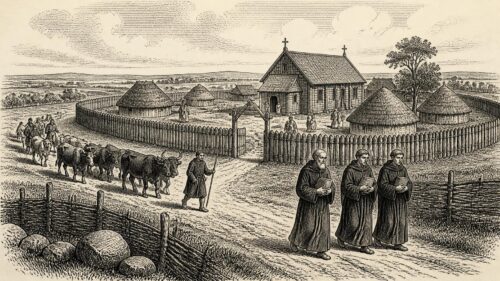
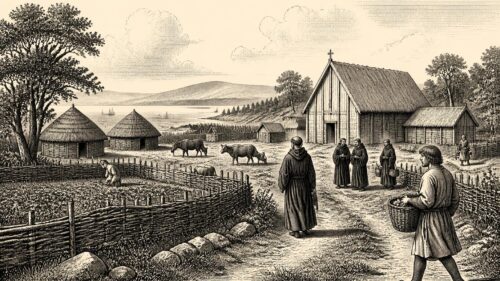
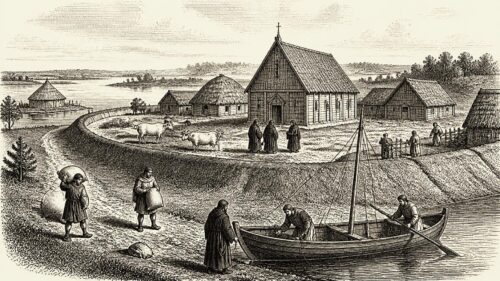
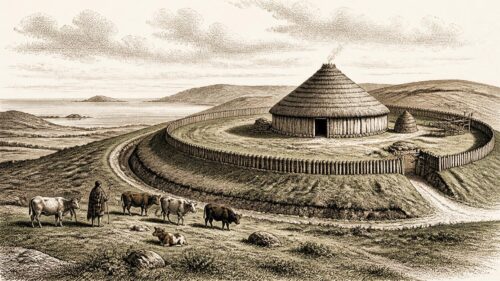
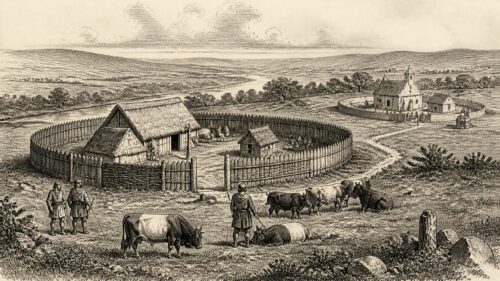
The annals chiefly remember kings, clerics, battles and unusual signs. They say little about most inhabitants of Ireland in 674. Archaeology supplies the necessary wider setting. Much of the population lived in dispersed rural communities, commonly in ringforts or raths: circular enclosed farmsteads containing timber, wattle-and-daub or other perishable buildings, working spaces and storage. In stonier western districts, comparable enclosed settlements could take the form of cashels. These were homes, productive places and visible statements of a household’s standing, not simply little castles.
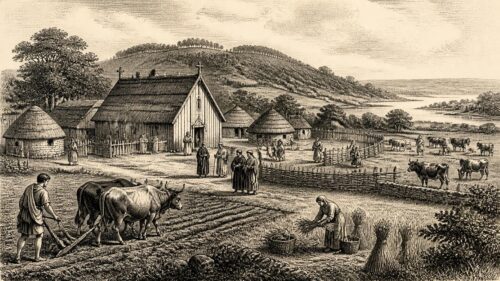
Cattle were central to wealth, food and social obligation. They could be transferred in tribute, compensation and gifts, while dairying, grazing and seasonal movement shaped ordinary routines. Cereals were also essential: evidence for corn-drying kilns, querns and mills confirms the labour devoted to growing, preserving and grinding grain. A king’s ability to assemble followers depended on this agricultural world. Feasts, campaigns and royal progresses were sustained by the surpluses of farmers, herders, craftspeople and dependants whose names rarely reached the written record.
Neither battle report records destruction of crops, famine or epidemic in 674 itself. The devastating mortality of the 660s was recent memory, but it is not responsible historical practice to assume that every community remained equally afflicted nine years later. Equally, silence is not evidence of an easy year. The correct picture is one of an agrarian society exposed to weather, animal disease, raiding and political demands, with the surviving written notices too selective to measure prosperity or hardship across the island.
Churches, Learning and Record-Keeping
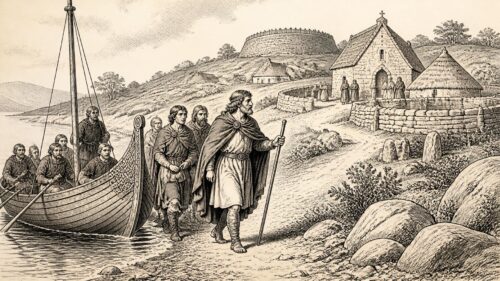
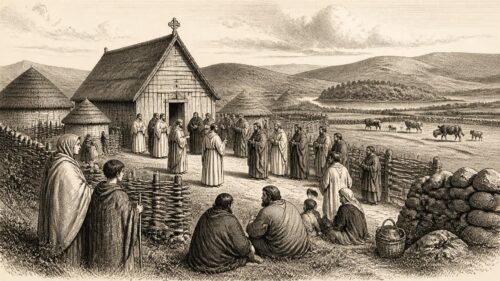
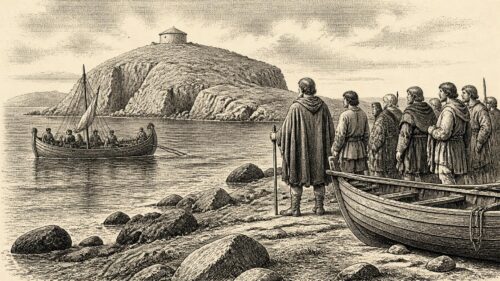
Christian institutions were embedded in this society. Monasteries, churches and their affiliated settlements were centres of worship, education, landholding and exchange, linked by travel across the Irish Sea and beyond. In the years immediately before 674, the annals note the movements of Fáilbe, abbot of Iona, and the foundation of a church by Máel Ruba at Apor Crosán in what is now north-west Scotland. Those are not events of 674, but they help define the connected ecclesiastical world in which Irish rulers operated.
Fínnechta’s accession should likewise be seen beside, rather than confused with, religious authority. Kings sought prestige through alliances with major churches; churchmen recorded royal deaths and defeats in chronicles that later became our principal evidence. The annalists did not write neutral modern history. Their compressed entries selected happenings that mattered to particular learned communities: succession, violence, death, celestial order and the standing of churches. Their very brevity is a warning against filling the gaps with imagined speeches, ceremonies or national programmes.
Sky Signs and Historical Caution
A notice associated with this annalistic sequence describes a thin, trembling, rainbow-shaped cloud extending east to west through a clear night sky, followed by a moon coloured like blood before Easter. The report is valuable as evidence that unusual phenomena were observed and recorded, but it cannot securely be diagnosed from the text alone as an aurora, eclipse, halo or other event. Nor can it responsibly be presented as a supernatural prediction of Cenn Fáelad’s fall. Medieval writers could connect natural signs and political disorder; historians should distinguish their interpretative world from what the observation itself proves.
For Ireland, 674 is therefore best understood as a year of dynastic transition rather than a fully documented turning point in every province. Cenn Fáelad’s death and Fínnechta’s accession shifted the balance within Síl nÁedo Sláine and at Tara. The closely connected upheaval in Ulaid showed that marriage alliances and violence crossed regional boundaries. Beneath these notices lay the productive, vulnerable rural society that made kingship possible, and a network of churches whose scholars preserved a few sharp fragments from a much larger lived world.
Primary Sources
- Part 245 of The Annals of Ulster
- Part 244 of The Annals of Ulster
- TEI Header for The Annals of Ulster
- The Annals of Tigernach
- Part 10 of The Annals of Tigernach
- Annals of the Four Masters
- Part 3 of Fragmentary Annals of Ireland
- Part 3 of Annals of Inisfallen
- Annals of Inisfallen
- Chronological Synchronisation of the Irish Annals
- Bécc Bairrche
- Blathmac
- King of Tara
- Ireland in the Seventh Century: A Tour
- The Church and the World in Early Christian Ireland
- Farming and Archaeology: The Irish Historic Landscape
- Ringforts / Ráthanna
- Ordinary People in Early Christian Ireland
- Cashelore
- Exploring the Irish Annals