
Irish Crafts
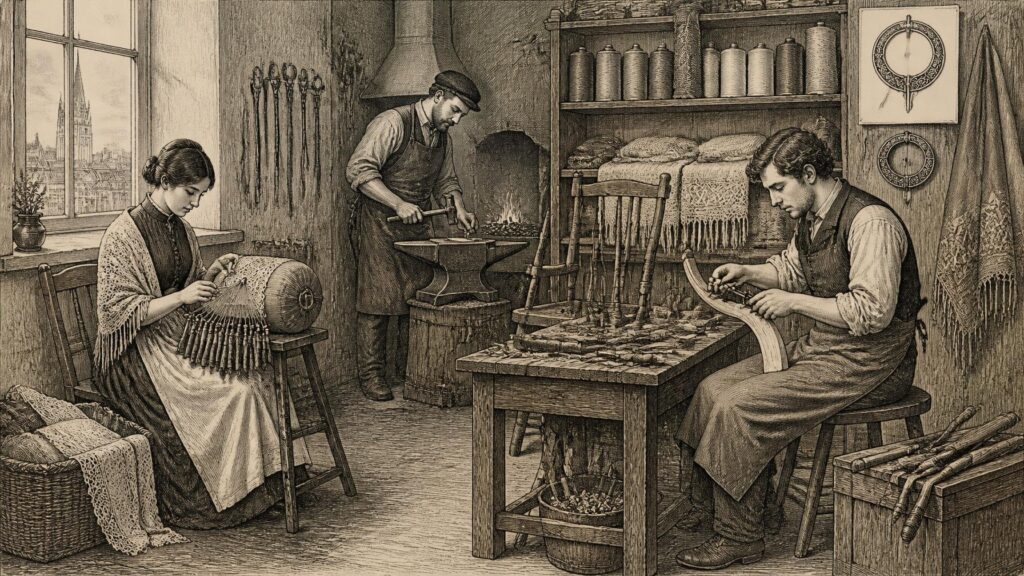
AI generated historical illustration, not a contemporary photograph.
At a Glance
Irish history can be read in objects made by hand: a hammered gold collar, a bronze brooch, an embroidered cope, a coopered vessel, a woven cloth, a carved chair or a printed book. “Crafts” is therefore not a marginal subject in Ireland’s past, but a way of approaching labour, skill, patronage, trade, belief and identity across many centuries. The surviving record is unequal. Precious metals and church treasures endure more readily than wood, fibre, leather and the work of ordinary households; urban documents preserve the rules of incorporated trades more readily than the knowledge of rural makers. Yet archaeology, museum collections, legal texts and civic archives together show that making was fundamental to social life on the island.
Material Beginnings
The earliest evidence for craft in Ireland is necessarily material rather than biographical. The names, voices and intentions of prehistoric makers are almost wholly lost, while their surviving work is selective: objects of stone, ceramic and metal tend to outlast textiles, timber, skin and foodstuffs. It would be misleading to describe all prehistoric objects as “art” in a modern sense, or to assume that every finely made item was simply decorative. A carefully shaped stone implement, a clay vessel, a timber structure or an ornament could combine practical, ceremonial and social purposes. Their manufacture nevertheless required knowledge of materials, repeated practice and decisions about form.
Irish archaeological collections demonstrate a long history of technical accomplishment in stone carving, pottery and metalworking. Gold ornaments from later prehistory are especially conspicuous because gold resists corrosion and because spectacular pieces entered collections early. They should not, however, be allowed to stand for the whole economy. The making of everyday things—wooden containers, woven fabrics, leather goods, tools and buildings—was at least as important to ordinary life, but survives more patchily. This imbalance shapes the historical picture. The museum visitor sees elite display more easily than household repair, seasonal work or the routine processing of local materials.
The elaborate goldwork associated with later Bronze Age Ireland nonetheless offers strong evidence of specialised skill. Scholars have identified remarkable technical and decorative sophistication in ornaments such as gorgets, lock-rings and discs. The workmanship implies makers who understood how to form, join, decorate and finish thin gold sheet and wire. It also implies access to valuable raw material and patrons or communities able to commission, exchange, inherit or deposit such objects. That does not prove a modern-style profession or a single national “school” of craftspeople. It does show that skilled production occupied an important place in prehistoric social relations.
Interpretation should remain cautious. Gold objects may have circulated far beyond the place where they were made, and styles could be shared through travel, exchange and imitation. An ornament found in Ireland is not automatically proof that every stage of its manufacture occurred there. Equally, the recurring tendency to explain prehistoric workmanship through lost mystical wisdom belongs more to later romance than to demonstrable history. Archaeology can identify techniques, contexts and distributions; it cannot reliably recover a maker’s individual story where the evidence is silent.
Skilled Society
For early medieval Ireland, the evidence broadens. Archaeological excavations reveal traces of ironworking, copper-alloy working, bone and antler working, glass-working, leather production, textile activity and woodworking. Settlement evidence matters because it restores craft from the display case to the lived landscape. Hearths, furnaces, slag, crucibles, moulds, offcuts, tools and unfinished objects can indicate where production occurred and what stages were carried out. Such remains also remind us that a finished reliquary or brooch was the culmination of a chain involving extraction, fuel, transport, preparation, skilled manufacture, use, repair and eventual loss or deposition.
Early Irish legal and literary material gives another perspective, although it must be handled critically. The law text known as Uraicecht Becc, as discussed by modern historians and archaeologists, assigns notable standing to crafts such as carpentry, metalworking and smithing. This does not provide a straightforward census of occupations, nor does it describe every community in uniform detail. Legal texts are normative: they state ideals, categories and rankings. Still, they demonstrate that skilled makers could be thought of as socially consequential people whose work had recognised value. The blacksmith in particular acquired a powerful place in both social thought and later imaginative tradition.
That prestige was not shared evenly. Craft was organised through distinctions of rank, gender, wealth and access to resources. The archaeological record suggests both small-scale work at many settlements and more specialised activity at selected secular or ecclesiastical sites. Certain goods demanded expensive materials or specialist knowledge, while other making was dispersed through homes and farms. Spinning, weaving, dairying, food preservation, woodworking and repair were integral to domestic existence, even when documentary sources fail to identify their makers. The language of “craftsmanship” can sometimes conceal this division by celebrating exceptional objects while treating necessary labour as invisible.
Nor should early Irish society be imagined as isolated. Metal, glass, pigments, ecclesiastical forms and ornamental ideas connected Ireland to Britain and continental Europe. Imported materials and external stylistic influences do not diminish local accomplishment; rather, they reveal participation in wider networks. A craft tradition is not a sealed inheritance handed down unchanged from one generation to the next. It is a series of practical negotiations between available resources, learned techniques, demand, fashion and belief.
Monastic Workshops
The conversion to Christianity and the growth of monasteries created influential settings for skilled production. Monastic communities required books, liturgical vessels, buildings, clothing, containers and fittings. They also attracted patronage, land, labour and intellectual exchange. Ireland’s early medieval manuscripts, metalwork and carved stone are often grouped under the label Insular art. The term is useful when describing shared artistic currents around Ireland and Britain, but it should not encourage the belief that all such works belong to a single uncomplicated “Celtic” style. Their makers worked within particular religious, political and regional circumstances.
Illuminated manuscripts are among the most celebrated survivals. The Book of Kells, probably produced around the turn of the ninth century in an Irish Sea monastic milieu, is valued for its dense ornament, colour and astonishing control of line. Its pages are evidence not only of artistic imagination but of disciplined processes: preparing vellum, ruling pages, writing text, planning images, grinding pigments and correcting errors. The manuscript’s interlace and intricate patterning have often been compared with metalwork. Whether or not one treats that resemblance as direct borrowing, the comparison highlights a shared culture of precision, visual rhythm and close observation.
Metalwork makes the relation between devotion and skill even more tangible. Chalices, patens, shrines, croziers, book covers and brooches combined demanding techniques with public meanings. The Ardagh Chalice, the Tara Brooch and the Derrynaflan Hoard are rightly famous, but fame can create distortion. These treasures were exceptional objects connected with powerful patrons and religious institutions. They should not be treated as the normal possessions of early medieval households. Their survival tells historians much about high-status craftsmanship and religious material culture; it tells less directly about the ordinary utensils, textiles and tools on which most people depended.
Folklore later surrounded many ancient and medieval objects. The familiar name “Tara Brooch”, for example, is a nineteenth-century label rather than evidence that the brooch was made at or belonged to the royal site of Tara. Such stories are historically interesting in their own right because they show how later audiences claimed old objects for national memory. They must be distinguished from archaeological provenance and technical analysis. Respecting folklore does not require treating it as proof.
Urban Workshops
The growth of towns transformed the conditions in which many crafts were organised. Viking-age and later medieval towns provided markets, imported materials, concentrated consumers and opportunities for specialised production. Excavations in places including Dublin, Waterford and Cork have recovered evidence for urban crafts and trade. In later medieval Ireland, finds from towns include pottery, metalwork, building materials and objects associated with everyday commerce. Towns did not replace rural making, but they created dense environments in which particular trades could cluster and in which goods could be bought, sold, repaired and regulated.
Dublin’s guild system is especially well documented. A charter of 1192 licensed the city’s guilds, and the surviving civic record shows that guilds became central to commercial and political life. These associations were more than trade clubs. They regulated access to particular occupations, supervised apprenticeships, defended members’ interests, participated in religious and civic ceremony, and helped structure municipal representation. The system gave recognised craftsmen and merchants influence, but it also created barriers. Admission by apprenticeship, birth or freedom favoured established households and controlled who could lawfully practise within the city.
Guilds should therefore not be romanticised as simple communities of mutual support. They could provide welfare, training and collective identity, but they also preserved privilege. Dublin’s civic franchise was far from democratic in the modern sense, and guild membership carried political consequences. Formal exclusions and unequal access mattered. The documentary record indicates that people described as belonging to “the Irish nation” were formally excluded in certain contexts, even though individuals with Irish surnames could acquire freedom. Craft institutions reveal both solidarity and hierarchy: they made livelihoods possible for some while policing competition and belonging.
The guild system also makes clear that craft history is civic history. Halls, streets, markets, parish churches and municipal offices formed the setting in which skilled labour gained public recognition. Weavers, tailors, tanners, smiths, bakers, carpenters, masons and other makers were not an ornamental fringe to urban life. Their work sustained food supply, clothing, housing, transport, worship and trade. The later abolition of most Dublin guilds in 1841 was consequently not merely an administrative reform; it marked the ending of a long-established framework through which occupational identity and urban authority had been organised.
Household Making
Most craft history is not contained in guild records. Across rural Ireland, homes and small communities depended on practical making that was seasonal, local and often undertaken alongside farming. Spinning and weaving wool, preparing flax, sewing and mending clothing, making baskets, shaping handles, repairing tools, curing leather, producing food vessels and maintaining buildings were forms of skilled work. The boundary between “craft” and domestic labour is historically unstable. It often reflects later ideas about artistic authorship and saleable objects rather than the way families understood their own indispensable work.
Textile production is a particularly important example. Wool and linen connected field, animal, household, workshop and market. Spinning and weaving required intimate knowledge of fibre, twist, tension, dye and pattern, while sewing and embroidery demanded patience and learned dexterity. Yet textiles decay readily, and their makers are frequently unnamed. Written records may identify an estate, a merchant or a manufacturer while leaving women’s household labour unrecorded. This silence should not be mistaken for absence. The work was real even where the documentary trail is thin.
Furniture and furnishing offer another route into this world. Surviving Irish country furniture reflects changing social and economic conditions during the nineteenth and twentieth centuries, but it must be read with care. Museum reconstructions of kitchens and farmhouses can make the past appear settled and uniform. In reality, objects were acquired gradually, reused, adapted and repaired. A dresser, settle bed, meal bin, stool, table or cooking implement belonged to patterns of household economy. Their usefulness depended on makers, users and repairers whose contributions are often inseparable.
Craft knowledge also travelled through families, neighbourhoods and informal teaching. This does not mean it was timeless. A technique could be altered by the arrival of imported goods, changing fashion, new tools, emigration, poverty or access to wage labour. “Traditional” should not be used to freeze rural makers in an imagined past. It is better understood as a later descriptive term for practices that were constantly being selected, adjusted and sometimes revived.
Famine Industries
The nineteenth century brought severe disruption and new forms of organised craft production. Industrialisation did not proceed evenly across Ireland, and the Great Famine exposed the fragility of rural livelihoods with devastating force. In this setting, lace schools, charitable enterprises and local industries were frequently promoted as ways to provide income, particularly for women. Their history cannot be told merely as a story of graceful handiwork. Lace was connected to philanthropy, fashion, export markets, religious institutions, gendered labour and the unequal distribution of economic power.
Clones lace is one documented example. In County Monaghan, crochet lace became embedded in the community’s social history in the decades after the Great Hunger, later declining and being revived by local efforts in the late twentieth century. Its history demonstrates both resourcefulness and constraint. Needlework could offer earnings where alternatives were scarce, but it was rarely a remedy for structural poverty. The fact that a craft was promoted as respectable women’s work does not mean the labour was easy, well paid or freely chosen.
The National Museum of Ireland’s lace collection preserves Irish lace and designs from the mid nineteenth to the mid twentieth century, including examples bought directly from schools, co-operatives and industrial exhibitions. These acquisition histories are valuable evidence. They show how institutions classified, displayed and promoted craft. At the same time, museum collections are shaped by selection: a sample retained for exhibition may not reveal the hours required to produce it, the rate paid to its maker or whether an item was sold, worn, exported or treasured at home.
Other crafts were affected by tourist demand and changing markets. Killarney woodwork, for example, developed distinctive inlaid souvenirs using local scenes and motifs. Such work could be dismissed as commercial novelty, but that judgement repeats an artificial divide between “authentic” craft and objects made for visitors. Tourist goods were still designed, made and sold by skilled people. Their imagery tells historians about what buyers expected Ireland to look like, while their manufacture reveals local adaptation to an expanding economy of travel and consumption.
Revival Politics
By the late nineteenth century, craft acquired a new political and cultural charge. The Irish Arts and Crafts movement drew on international design reform, particularly the critique of poor-quality industrial production associated with William Morris and his circle. In Ireland, however, the movement also intersected with cultural nationalism, the Gaelic Revival, arguments about education and the desire to create work. It did not simply recover an ancient national style. Instead, designers, artists, teachers and patrons selected medieval manuscripts, metalwork, high crosses, vernacular forms and natural motifs as materials from which to construct modern work.
This process was creative but selective. Early Irish ornament could be treated as proof of a glorious national past, even though the original objects arose from very different religious and political worlds. Revival makers transformed these forms for jewellery, stained glass, embroidery, furniture, printing and ecclesiastical commissions. Such adaptation was not necessarily false; traditions survive partly through reinterpretation. But the distinction matters. A twentieth-century object inspired by a medieval brooch is not a direct continuation of the medieval workshop that made the brooch. It is an argument about inheritance, made in a later age.
The Dun Emer Guild and later Cuala Industries exemplified this blend of craft, cultural ambition and economic purpose. Their work included hand-bound books, textiles and other designed objects, and Evelyn Gleeson expressed a wish to find work for Irish hands in making beautiful things. The phrase is revealing. It joined aesthetic judgement to employment, but it also reflected the era’s assumptions about national improvement, gender and suitable work. The women associated with such ventures were not peripheral assistants to a male cultural revival; they were organisers, designers, printers, embroiderers and business figures in their own right.
Stained glass and metalwork became particularly significant media. Artists looked to early Christian and medieval sources while responding to contemporary commissions and international styles. The revival’s achievements should not obscure its limitations: access to training, exhibition and patronage was unequal, and its rhetoric could idealise rural labour or national authenticity. Yet it widened the status accorded to decorative and applied arts. It also helped establish the notion that design, making and cultural identity were connected fields rather than separate pursuits.
Modern Legacies
The twentieth century did not produce a clean break between craft and industry. Irish makers continued to work in textiles, ceramics, metal, glass, wood, print and other materials while factories, schools, museums, exhibitions and state agencies changed the terms on which objects were designed and marketed. The National Museum’s Art and Industrial Division, established in 1877 within the Dublin Museum of Science and Art, had a remit that included commissioning, collecting and displaying Irish design. Its existence demonstrates that public institutions regarded craft not only as heritage but as a field of education and economic development.
Modern collections invite a wider definition of craft. A clock, a piece of furniture, a lace sample, a printed book or a hand-wrought silver object may sit between art, design, manufacture and utility. These categories have shifted over time. It is often more useful to ask who made an object, with what materials, for whom, under what working conditions and through what channels of exchange. Such questions avoid the habit of treating craftsmanship as a vague virtue detached from labour.
Contemporary interest in handmade work can bring older traditions renewed visibility, but historical continuity should not be overstated. A present-day craft practitioner may draw deeply on Irish materials or motifs without reproducing an unbroken practice from the distant past. The value of that work does not depend on an invented purity. Ireland’s craft history is compelling precisely because it includes adaptation: makers responding to imported influences, religious change, urbanisation, colonial rule, famine, nationalism, emigration, tourism and modern design education.
Historical Limits
The history of Irish crafts is thus a history with gaps. We know more about surviving treasures than perishable goods; more about corporations than unincorporated workers; more about patrons than apprentices; and more about works collected by museums than those worn out through use. Archaeology has corrected some of these imbalances by identifying workshops and production debris, while social history has drawn attention to women’s labour, household production and the economics of supposedly decorative work. Even so, many makers remain unnamed.
That anonymity should encourage humility rather than legend. Folklore, later nationalist narratives and commercial labels have all contributed to the public imagination of Irish craft. They can reveal how communities remembered or marketed the past, but they are not interchangeable with excavated evidence, datable objects or contemporary records. A careful account distinguishes what can be documented from what is plausible and from what belongs to story. The distinction does not lessen the richness of the subject; it makes the achievement of its makers more legible.
Across the centuries, crafts in Ireland were neither a single tradition nor a decorative afterthought. They were systems of knowledge embedded in homes, monasteries, towns, workshops and markets. They could confer prestige, sustain devotion, provide income, express political aspiration and make daily life possible. The finest surviving objects retain their power, but the larger historical lesson lies in the countless acts of skilled making that rarely entered a treasury or an archive. Crafted Ireland was made not only by famous treasures, but by hands whose work survived in use, memory and, sometimes, only in the traces they left behind.
I was struck by the article’s insistence that surviving objects privilege elite metalwork and ecclesiastical treasures, whereas domestic labour, especially textile work often undertaken by women, is harder to recover. This creates a tension between the crafts most visible in museums and those most central to everyday survival. The discussion of lace after the Great Famine deepens this issue: respectable income-producing work could demonstrate skill and resilience while also reflecting restricted choices and structural poverty. How should museums, historians and local communities interpret Irish craft so that exceptional treasures, household making, gendered labour and commercial tourist production receive balanced attention?