Young Ireland
At a Glance
Origins Circle
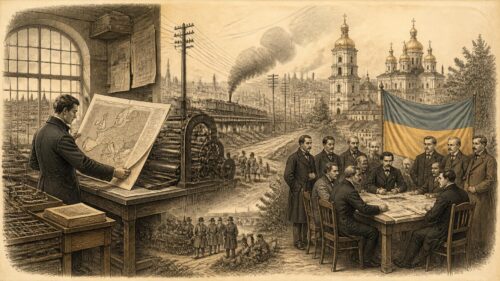
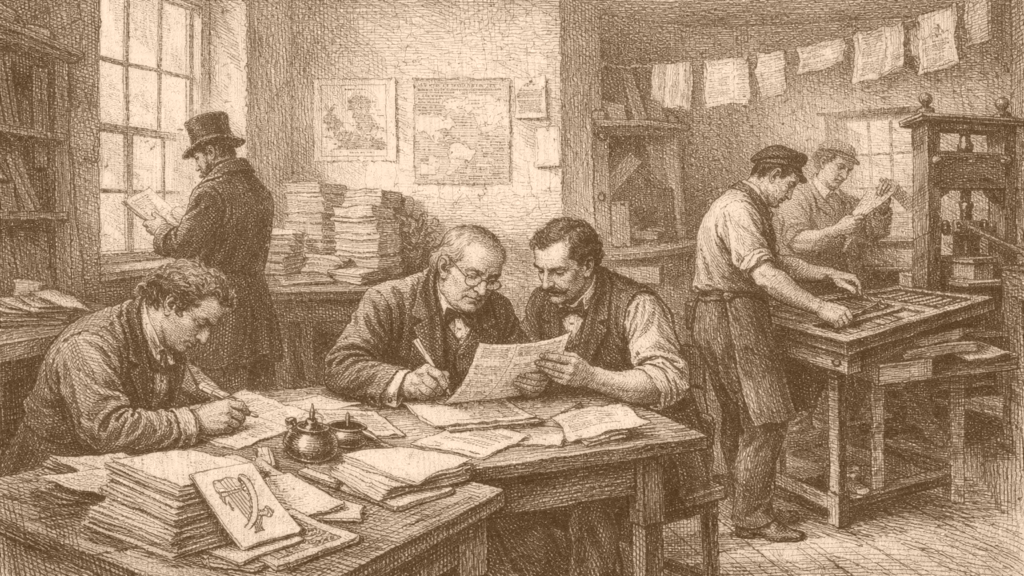
Young Ireland formed around the Nation newspaper. Thomas Davis, Charles Gavan Duffy, and John Blake Dillon founded the paper in 1842, and the movement soon gathered writers and agitators around it. James Quinn’s account stresses the centrality of history, education, and print to their project, while later summaries show that their influence extended beyond one newspaper office into wider nationalist culture.
The evidence does not support imagining Young Ireland as socially uniform. Its leading names included barrister-educated figures such as Davis and Dillon, the journalist Mitchel, and William Smith O’Brien, an MP. The broader record also points to a movement shaped by middle-class intellectuals. That pattern suggests a politics of educated leadership, even while its message reached far beyond elite readers through song, essay, and newspaper distribution.
Printed Nation
Print was the movement’s chief weapon. The Nation became, in later description, the most popular and influential nationalist paper of the century, and Young Irelanders used it to teach readers how to think about Ireland’s past. Their publishing programme aimed to create a national literature in history, poetry, and fiction. Cheap historical narratives and ballads made that project accessible to a wide readership and gave nationalism a memorable public voice.
Historical writing was not, for them, detached scholarship. One review explains that they preferred patriotic and inspirational narrative over dry documentary evidence, and that they treated ballad history as a powerful form of public education. Davis, in particular, saw song as a way to teach duty and stir feeling. The movement’s written culture therefore worked as political schooling, blending memory, emotion, and national purpose.
Historic Vision
Young Ireland’s historical imagination was built around conquest, resistance, and endurance. They argued that Irish history had been written by conquerors and so had to be rewritten by nationalists. Their preferred stories highlighted dramatic episodes, heroic figures, and the continuity of struggle. Thomas Davis’s thought, as later summarized, linked language, culture, and independence, while Quinn’s account places this method at the heart of Young Ireland’s political education.
This vision was broad enough to include both domestic heroes and exiled fighters. The ballads and histories praised warrior-leaders such as Hugh O’Neill and Owen Roe O’Neill, and they also celebrated the Wild Geese and the Irish Brigade abroad. Such choices were interpretive, not neutral, because they privileged martial courage and sacrifice as markers of national worth. The result was a past arranged to encourage present action.
Political Divide
The movement’s history was marked by disagreement long before 1848. Davis and his associates increasingly clashed with O’Connell’s circle over non-sectarian education and the proper limits of Repeal politics. The evidence shows an open breach over the Colleges Bill and growing dissatisfaction with sectarian habits in nationalist life. Young Ireland therefore emerged not simply from shared identity, but from arguments about how a modern Irish nation should be built.
During the Famine, some members moved toward sharper social criticism while others remained more cautious. Mitchel, later portrayed as the dominant personality after Davis’s death, pushed furthest left and embraced agrarian revolution, while James Fintan Lalor’s ideas also influenced the radical wing. That divergence matters: Young Ireland was never ideologically seamless, and its most dramatic turn toward rebellion came only after internal strains had widened.
Failed Rebellion
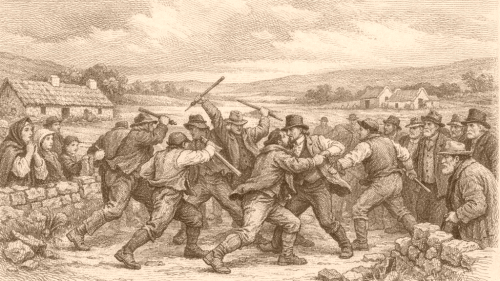
The 1848 rising revealed the gap between nationalist aspiration and practical capability. Contemporary retrospective description presents the Young Irelanders as, for the most part, middle-class intellectuals who lacked military experience, aside from courage. William Smith O’Brien’s decision to take the field was presented as a matter of honour and duty rather than military calculation. The resulting confrontation at Ballingarry ended in confusion and defeat, not the triumph its leaders had hoped for.
Yet the failure of the rising did not end their importance. Later accounts emphasize that some leaders were transported, others escaped, and the dispersal of the movement helped recast exile, Famine, and national grievance as political themes. That legacy mattered more than the battlefield result. Young Ireland’s significance lay in the language it left behind: a politics of memory, instruction, and inherited unfinished business.
Lasting Legacy
The longer afterlife of Young Ireland shows how deeply its rhetoric entered nationalist tradition. Later figures such as Arthur Griffith and Patrick Pearse explicitly drew on Davis and Mitchel, while Pearse placed Young Ireland among the chief evangelists of Irish nationalism. This does not mean the movement directly caused later rebellions; rather, its writings furnished later generations with a usable past and a vocabulary of sacrifice, continuity, and duty.
So who were the Young Irelanders? The safest answer is interpretive: they were a politically engaged intellectual network, rooted in journalism and historical imagination, whose leading members came from educated, usually middle-class backgrounds. Their cohesion was real but limited, their unity repeatedly tested by Famine politics and strategy, and their most enduring achievement was not rebellion itself but the remaking of how national history could be told.