Mary Spring
At a Glance
Family Origins
Mary Spring Rice was born in 1880 as the second child and only daughter of Thomas Spring Rice, 2nd Baron Monteagle of Brandon, and Elizabeth Butcher. The family seat was Mount Trenchard at Foynes in County Limerick, and the records place her childhood there. One later account adds that she learned fluent Irish at Mount Trenchard, making language part of the setting in which her early life is described.
The surviving notices also connect her to an extended Spring Rice family archive. The National Library of Ireland describes a body of Spring Rice papers that includes personal and domestic material, while UCD records note a substantial deposit of letters written to her cousin Dorothea Knox. Those letters are dated to 1921 and 1922 and are identified as discussing activism, Irish language issues, and the Treaty.
Language Work
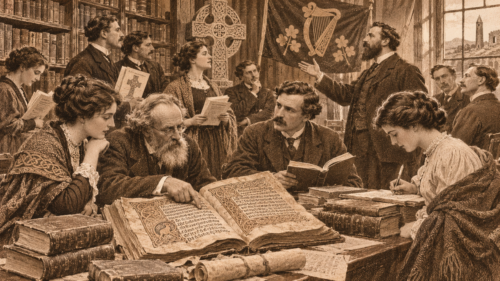
Several accounts show Spring Rice moving from family background into cultural activity. She is described as a fluent Irish speaker and as an active member of the Gaelic League. Another summary says she joined the Gaelic League in Dublin and London, organised festivals on the Shannon, and hired a native speaker from Kerry to teach classes in a local national school. These details together present sustained Irish-language involvement rather than a single gesture.
Her educational and community work is also visible in the notices on Coláiste Uí Chomhraí at Carrigaholt. One account says she served on its board, while another identifies the school as an Irish summer school established in 1912. The same biography adds that she was involved in local community endeavours. The evidence here is descriptive, not exhaustive, but it firmly links her to Irish-language institutions.
Nationalist Networks
The records place Spring Rice in a wider nationalist and associational milieu. One account says she was active in nationalist and trade union causes, joined the United Irishwomen, and joined the Limerick branch of the Irish Countrywomen’s Association. Another biography gives the date of her early membership of the United Irishwomen and identifies her as being on the executive of the Limerick branch in 1911. The evidence shows repeated organisational involvement over time.
She also appears in social and political circles that included Erskine Childers and Roger Casement. One account says she was introduced to Childers at an agricultural fair in Westminster Hall, where she was selling Limerick lace. Another says that in May 1914 she was on the Anglo-Irish committee in London to help the Irish Volunteers, alongside Alice Stopford Green, Childers, Casement, and her cousins Conor and Hugh O’Brien. The notices agree on her presence in that network.
Gun Planning
The clearest surviving evidence for her role in the Howth gun-running comes from the May 1914 letters to Michael Joseph O’Rahilly. One account says these letters detail the early planning of a consignment of 1,500 rifles and 45,000 rounds of ammunition bought at Hamburg. Another states that Spring Rice played a major role and is credited with conceiving the idea of using private yachts for the expedition. Together, these passages show planning rather than hindsight.
The same material says she offered her fishing boat, the Santa Cruz, though it was judged unsuitable because it was in poor condition. The later account on the voyage confirms that the organisers chose the Asgard and the Kelpie instead. This is a direct comparison between planning and outcome within the record itself, and it places Spring Rice among the organisers rather than among the passengers alone.
Voyage Diary
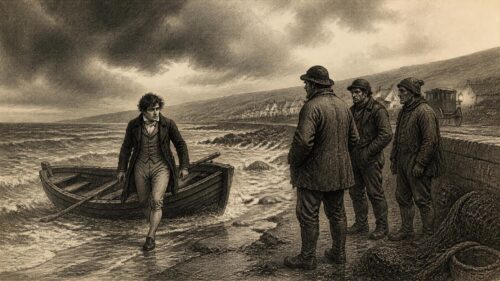
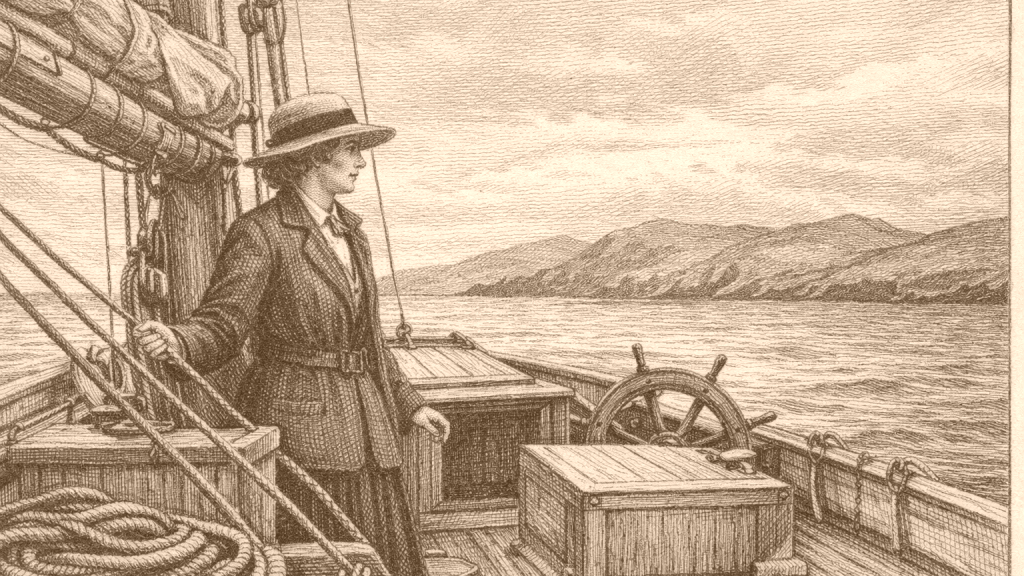
Spring Rice’s diary records the voyage in close detail. On 1 July 1914 she describes the journey to Conway, apprehension that the plan might fail, and the confusion aboard the yacht. She notes the conditions, the crowded working spaces, and the thunderstorm. The following day she writes of mist, hesitation, delayed departure, and the effort to get the vessel ready. The diary is immediate and practical in tone.
The later entries show the eventual departure and the journey’s pace. She records bringing Gordon Shephard aboard, the final clearing of the bar, and the sense that the expedition had really begun. She also remarks on headwind, light airs, and beating about the bay. A separate contemporary account describes the Howth landing and notes a white-painted yawl steered by a lady, which matches the diary’s setting without adding detail beyond it.
Later Years
After 1914, the surviving letters show Spring Rice still engaged in nationalist politics. One UCD description says that throughout the War of Independence and the Civil War she remained involved in the nationalist movement. In the letters written in 1921 and 1922 she discusses her activism, Irish-language issues, and the Treaty, and she comments on pro- and anti-Treaty positions. The record preserves her own uncertainty about her stance.
Those same letters also show specific moments of reflection during the Civil War period. She writes of dining with Erskine Childers and Molly Childers, of arguments that might have persuaded her toward an anti-Treaty view, and of her belief that independence with less bloodshed was preferable. Later she says the civil war was poisoning everything, and in another letter she responds to reports from prisoners with shock and doubt. The sequence captures her changing responses, not a settled conclusion.