Gerald Griffin
At a Glance
Early Life
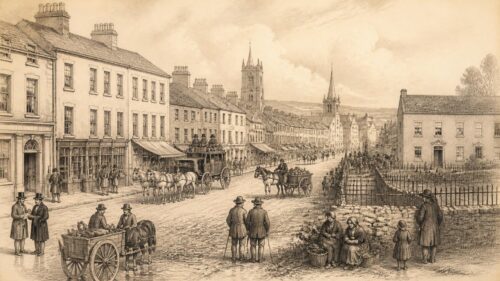
Gerald Griffin was born in Limerick on 12 December 1803. The chronology describes him as the twelfth of fifteen surviving children, born into a middle-class Catholic farming household. His father, Patrick Griffin, is identified as a brewery farmer, while his mother, Ellen Griffin, came from the ancient Gaelic family of the O'Briens. The same entry notes that she was cultivated and strongly interested in literature.
Around 1810, when he was seven or eight, the family moved about twenty-eight miles west of Limerick to a house called Fairy Lawn. The chronology describes his childhood there as close-knit and idyllic. It also says he received a good classical education, though one often irregular and haphazard, and links that uneven schooling to his father’s declining fortunes and to the character of Catholic education at the time.
Shannon Setting
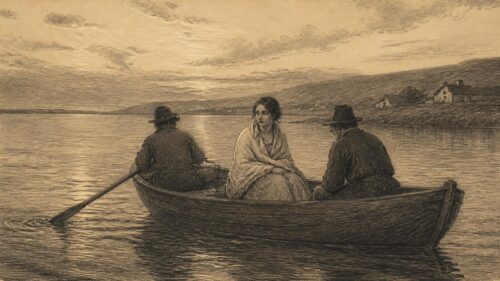
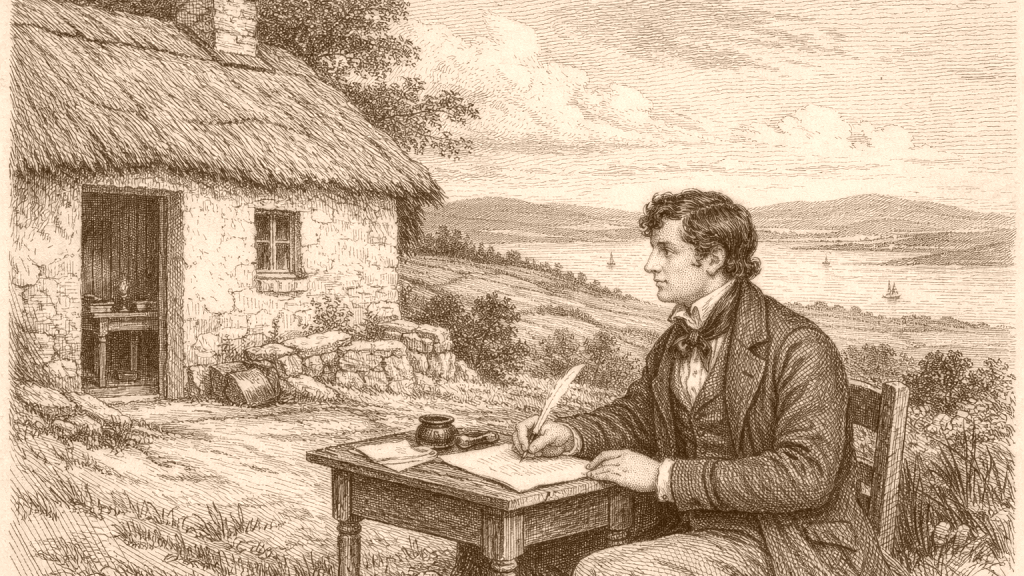
The setting of Fairy Lawn is described as a hill above the Shannon estuary, with countryside where the river reaches the sea. The chronology says Griffin was deeply influenced by those surroundings. It adds that the place probably gave his poetic imagination its first impressions of natural beauty, impressions that he later conveyed often in his fiction. This is presented as a probable origin, not as a certain causal explanation.
The same chronology places the family’s westward move within a settled rural landscape rather than an urban one. Its language emphasizes the house, the hill, the estuary, and the countryside as a cluster of impressions. Taken together, these details show how the source links Griffin’s early environment with observation of place. The source does not provide a fuller description of his childhood activities beyond this setting.
Family Departure
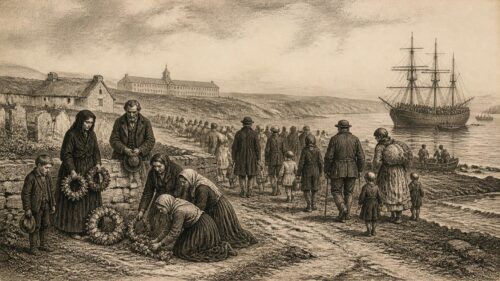
In 1820 Patrick Griffin decided to emigrate with most of the family to Pennsylvania after failed business ventures. Gerald Griffin remained in Ireland, as did his older brother, Dr William Griffin, with whom he went to live in Adare, County Limerick. The chronology states that he never saw his parents again, and it says that the separation clearly had a devastating effect on his sensitive and vulnerable nature.
This stage of the chronology records a sharp change in Griffin’s domestic circumstances. The family circle was split between Ireland and Pennsylvania, while Griffin’s immediate home shifted to his brother’s household. The source is explicit about the fact of the separation and about his remaining in Ireland, but it does not give more detail here about daily life in Adare or about his later private relations with the emigrated family.
London Ambitions
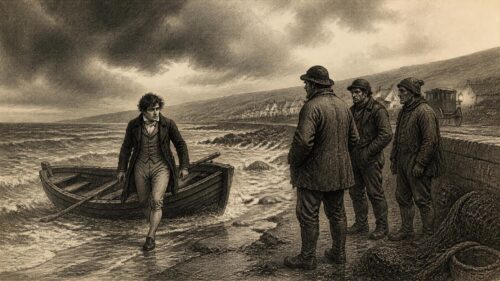
By 1823 Griffin had considered following his brother into medicine, but had abandoned that plan. A meeting with John Banim influenced his choice of a literary career. In the same year he completed a full-length tragedy, Aguire, now lost. William Griffin was sufficiently impressed to let him try for a literary career in London, and Gerald left Adare. A London actor then rejected the tragedy.
The chronology presents the London venture as an early setback. It says the tragedy was submitted to the judgment of an actor, probably Macready, and rejected. The wording records ambition, encouragement, and failure in close sequence, but it gives no surviving text of Aguire and no detailed account of the review itself. What remains is the factual outline of departure, submission, and rejection.
Journal Writing
In January to May 1824 Griffin had already completed Gisippus, and he gave four acts to Banim for suggestions. During the same period he was linked with Valentine Llanos in a project to translate Spanish works into English, apparently in hope of making money. The chronology then describes the first six months of that year as his bleakest London period, marked by poverty, poor health, and depression.
The chronology also notes that his friendship with Banim deteriorated, despite Banim’s attempts to help with suggestions, introductions, and financial aid. Griffin declined those invitations and disappeared from view for a while. In June 1824 he returned and began earning a living by writing under many pseudonyms for London journals, including the Literary Gazette and the News of Literature and Fashion. Those are the forms of activity directly recorded here.
Printed Voice
One published Griffin text in CELT, O Brazil, the Isle of the Blest, shows a different kind of literary presence. The poem imagines a distant island seen from the western horizon and follows a wanderer who leaves home in pursuit of it. It speaks in a moralizing tone, warning against a phantom of pleasure and urging return to duty, home, and peace. These are observable features of the poem’s printed text.
The poem’s closing movement reinforces that moral frame by contrasting the lure of the vision with the safety of return. The text repeatedly marks distance, departure, and loss, then turns back to prudence and home. Within the surviving materials here, that poem stands beside the chronology as direct evidence of Griffin’s literary output. CELT’s own pages also describe a large scholarly text corpus, which includes published works and related resources.