
Nationalist Archives
At a Glance
Archive Guides
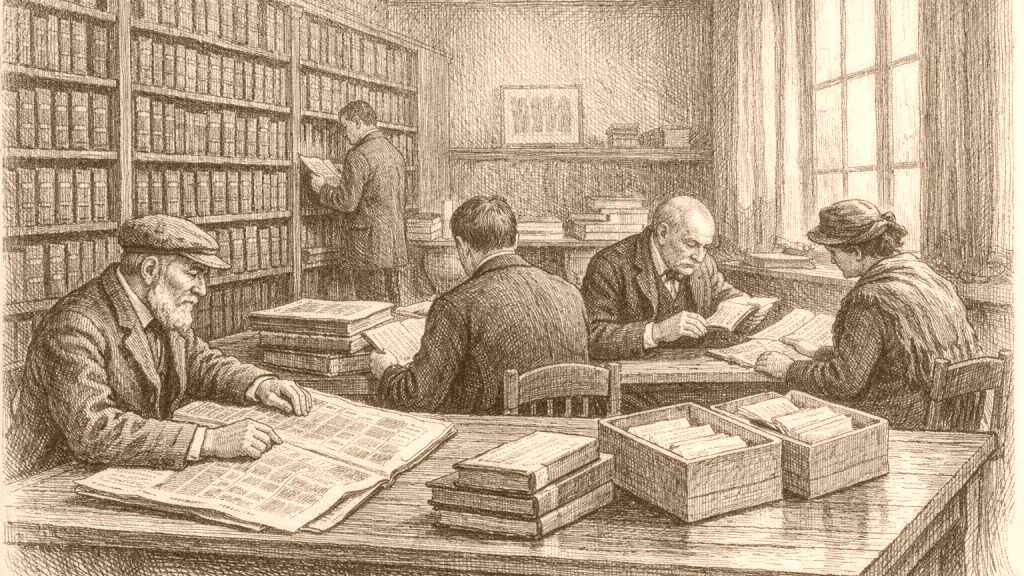
The library guides present nationalist material as part of wider Irish history research rather than as a single closed corpus. One guide lists major institutional collections, including Trinity College Library, the Digital Repository of Ireland, Military Archives Online Collections, the National Library of Ireland, the Public Record Office of Northern Ireland, and the Virtual Record Treasury of Ireland. It also points to government and legal documents, Irish parliamentary debates, and collections of reprinted primary sources, showing a broad map of access points rather than a single route. [2]
The same guide also directs readers to specific subject clusters linked with Irish political history. Its list includes the Irish Republican Digital Archive, Irish newspaper runs, and collections such as the Bureau of Military History, the Military Service Pensions Collection, and papers relating to Roger Casement. The guide also highlights newspaper titles including Irish Citizen, Irish Volunteer, Nationality, Sinn féin, and later Sinn féin issues, which places these publications beside other state, legal, and archival resources. [2] [4]
Republican Collections
The Irish Republican Digital Archive describes itself as an independent digital archive with thousands of documents spanning more than two centuries of Irish republican history. Its holdings include newspapers, magazines, statements, pamphlets, posters, election literature, books, memorial material, and other ephemera. The site also explains that users can search by person, organisation, publication, event, location, or other term, making the archive both broad in format and flexible in use. [4]
The archive further organizes material chronologically and by explanatory tools. It says that the chronological collections run from the United Irishmen and nineteenth-century republicanism through the revolutionary period, the Civil War and aftermath, the IRA campaigns of the twentieth century, the Troubles, and later republican organisations. It also offers glossaries for organisations and terminology, which are presented as aids for reading material written with assumed knowledge of political circumstances and abbreviations. [4]
Periodical Runs
The listed newspaper resources show how nationalist politics can be approached through serial print. The University of Washington guide names Irish Citizen, Irish Volunteer, Nationality, and Sinn féin as separate periodical resources, while the Ulster University guide points to Irish political and radical newspapers of the twentieth century. Read together, these listings show a strong emphasis on newspapers and magazines as searchable research material, not merely as incidental supplements to other records. [1] [2]
The same guides also show that access is often structured through database interfaces and finding aids. One page says the archive includes individual issues alongside substantial runs of republican publications and that a finding aid identifies gaps in individual runs. Another states that Irish Times issues, RTÉ Archives, and An t-Óglách Magazine are available alongside collections of reprinted sources. The evidence points to layered access, where periodicals are grouped with other digitized and reprinted formats. [2] [4]
Legal Records
The guides also locate nationalist research within official and legal records. Ulster University lists British and Irish History Calendars of State Papers, British Cabinet papers for 1880 to 1916, reports by Prime Ministers to the Crown, proceedings in parliament, and Oireachtas acts. The University of Washington guide similarly links Irish history research to British Parliamentary Publications, Documents on Irish Foreign Policy, and Irish Parliamentary Debates, showing that nationalist topics are connected to state documentation as well as to movement publications. [1] [2]
These listings also include collections that support local and institutional history. Ulster University names the Historical Manuscripts Commission, Sir William Clarke Manuscripts, Tanner Manuscripts, and Thomason Tracts, while also noting that original sources such as manuscripts are held in Special Collections. The same guide states that the section it describes concentrates on sources held in book form or on microform, which distinguishes these access formats from original archival holdings. [1]
Manuscript Material
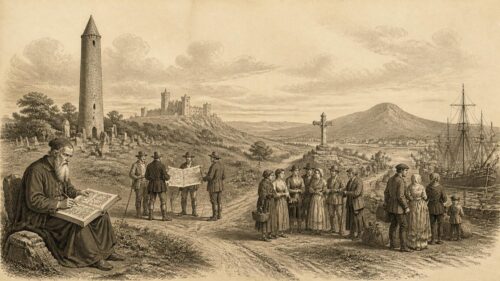
The Annals of Tigernach provide a concrete example of how manuscript evidence is described in a digital edition. The text page identifies manuscript sources in the Bodleian Library, including Rawlinson B 502 and Rawlinson B 488, with dates, physical description, provenance, and the arrangement of contents. It also notes that the edition is based on an unpublished translation and that the text is available for academic research and teaching only, which makes the conditions of access part of the source description. [3]
The same edition also shows the relationship between fragments and editorial work. It describes Rawlinson B 488 as containing three fragments of the Annals, and it lists a sequence of editions, reprints, and later scholarly notes. This is not a narrative of nationalist politics, but it is a direct example of how an Irish historical text is mediated through manuscript description, editorial history, and bibliographic reference within a digital resource. [3]
Research Access
Taken together, the guides and archives present nationalist material as a field of access points, formats, and catalogues. CELT describes itself as a free digital humanities resource with a searchable textbase of more than sixteen million words in 1,354 documents, while the Irish Manuscripts Commission presents digital resources such as searchable editions, a database of expenditure, and Analecta Hibernica. These institutional statements emphasize searching, downloading, and public awareness rather than thematic synthesis. [5] [6]
The clearest visible pattern across these sources is unevenness in what each portal foregrounds. Some pages stress newspapers and magazines, others emphasize manuscripts, and others direct users to debates, papers, or specialised databases. The evidence does not present one unified nationalist archive; instead, it shows several institutions offering overlapping routes into republican and related Irish materials, each with its own scope, terminology, and degree of detail. [1] [2] [4] [5] [6]
Source References
Hover over a number to see the source. Select it to open the source.

- [1] Primary Sources - History - Library Guides at Ulster University
- [2] Primary Sources: Ireland - History : Britain & Ireland - Library Guides at University of Washington Libraries
- [3] The Annals of Tigernach
- [4] Start Here - The Irish Republican Digital Archive
- [5] Irish Manuscripts
- [6] CELT: The online resource for Irish history, literature and politics
How do the listed digital and library collections organize access to Irish nationalist and republican materials across different formats and periods?