
Beef Passage
At a Glance
Trade Access
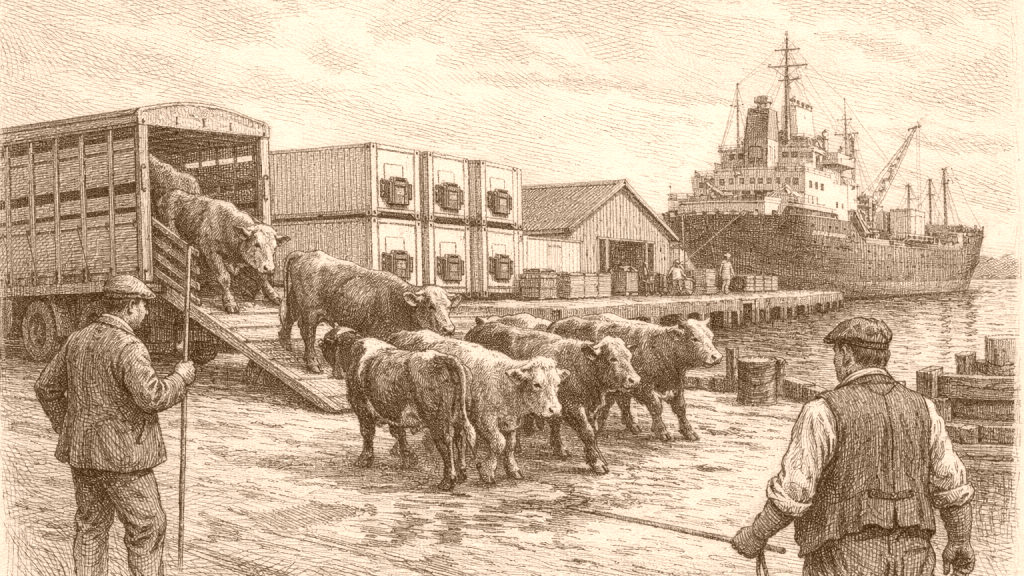
In June 2018, six meat processing plants in Ireland were approved by Chinese authorities to begin exporting frozen products to the Chinese market. The approval list included three beef plants in Tipperary, Meath, and Cork, together with three pork plants in Tipperary, Laois, and Cavan. The same notice says that the total number of Irish meat producers approved for beef and pork exports to China then rose to thirteen. That marks the clearest documented opening in this sequence. [5]
A different account of the same period says that Ireland was the first beef-producing country in the European Union to regain access to the Chinese market after the BSE outbreak of the 1990s. It also links that reopening to concerns about Brexit, although it does not explain the wider politics in detail. What is directly visible in the record is the contrast between regained access and the renewed use of China as a destination for Irish beef and pork exports. [5]
Plant Approvals
The June notice refers back to earlier approvals as well. On 13 April, three beef processing plants in Donegal, Wexford, and Monaghan were approved and accredited. The same document notes that four earlier approved meat plants were already selling pork to Chinese consumers before 2018, and it names their locations as Waterford, Tipperary, Offaly, and Cork. This creates a sequence of approvals rather than a single opening. [5]
By 2019, a government speech described the reintroduction of Irish beef into the Chinese market and said that six beef plants had been approved to export there. The speech presents this as a positive development within growing agricultural and agri-food cooperation, but it does not add technical details about how the approvals were obtained. The observable point is that official Irish and Chinese references both describe a workable export channel for beef by that stage. [4] [5]
Early Shipments
Later commentary gives numbers for the first phase of trade. It says that in 2019, Ireland exported 10,287 tonnes of beef to mainland China, and that up to the ban in May 2020 it had exported 6,500 tonnes. It also says that Ireland exported a small amount of beef in 2018, and that an Irish processor, ABP, was already established in the market before suspension. Those figures show that exports were real, but still limited. [7]
The same commentary contrasts China with other beef markets by describing it as unusually large and fast-growing. It states that China imported just over 70,000 tonnes of beef in 2012 and reached 2.4 million tonnes by the end of November 2022, with imports making up more than one-fifth of internationally traded beef. These figures are not Irish figures, but they frame why a relatively small exporter could still view the market as significant. [7]
Suspension Return
The export channel did not remain continuous. One account says the May 2020 suspension was expected to be temporary, but instead lasted until at least early 2023. It also states that the interruption followed a BSE case and that the market condition required Ireland to notify Chinese authorities of any such incident, including atypical cases. Here the documentary record is clear about the rule and the outcome, even if it does not explain every administrative step. [7]
A 2025 industry report says that Irish beef has been stop-start in China because of isolated atypical BSE cases. It adds that exports were suspended after a case was found in October the previous year, and that clearance had not yet been given to resume. The report also notes that Hong Kong continued to take Irish beef while mainland China remained suspended. That comparison is direct and does not require any broader explanation. [6]
Market Scale
The 2023 commentary also says that Irish factories were building business in 2020 and that the infrastructure had been in place for several years. It further notes that most large Irish beef factories were approved for export to China, unlike the United States, where only a handful had approval. The document does not claim that this guaranteed sales, only that approval and factory capacity were already broadly aligned on the Irish side. [7]
The same source gives a practical target for renewed trade, saying that a 30,000-tonne level remained attainable if conditions continued in 2023. Another later account says that Chinese demand remained attractive even though Irish beef had delivered little so far, and that the market still offered promise. Those statements are assessments rather than hard outcomes, but they show how the trade was still being discussed after suspension. [6] [7]
Official Framing
Official and institutional sources place the trade relationship within a broader Irish and Chinese connection. A 2019 ministerial speech says trade between the two countries was valued at over €15 billion and that Irish food exports to China had reached €974 million in 2017, with beef among the sectors mentioned. It also identifies direct flights to Beijing, Shenzhen, and Hong Kong as routes that would support wider links. The speech frames beef within a larger commercial relationship. [4]
The documentary setting for these records is also clear. CELT is described as a searchable online textbase of Irish literary and historical documents, while the Fenian Archive page identifies the annals it indexes and links them to CELT editions. That context does not change the trade history itself, but it explains where the annalistic material is being accessed from and how such texts are presented for reading. [1] [2] [3]
Source References
Hover over a number to see the source. Select it to open the source.

- [1] Irish annals — Fenian Archive
- [2] CELT - Corpus of Electronic Texts | University College Cork
- [3] FAQ | University College Cork
- [4] Speech by Minister Heather Humphreys - DETE
- [5] Meat Plants in Ireland Gain Access to Chinese Market
- [6] China promised much but delivered little for Irish beef - 31 October 2025 Premium
- [7] China can be the real deal for Irish beef exports - 05 January 2023 Free



How did Irish beef access to the Chinese market develop from initial approval to later suspension and reopening efforts?