
Minimum Wages
At a Glance
Legal Framework
The National Minimum Wage Act 2000 created a formal statutory scheme rather than a single wage figure alone. Its contents show parts on interpretation, non-application, and the voiding of agreements that pay less than the national minimum hourly rate. The Act also set out working hours, pay reference periods, records, and dispute procedures, indicating a system built for calculation, enforcement, and challenge rather than a simple declaration of pay. [2] [2]
The same Act also provided for entitlement, sub-minimum rates, and procedures for enforcement. Its table of contents includes minimum hourly entitlement, lower rates during the first two years after entering employment or after attaining age eighteen, trainee rates, and pro-rata entitlement for less than a full hour. It further provides for inspectors, offences, penalties, and civil proceedings, showing that minimum wage rules were tied to monitoring and legal remedy. [2] [2]
Rate Order
By 2020 the minimum wage was being set through an order made under the Act. The order states that the Minister, after receiving a recommendation from the Low Pay Commission, declared the national minimum hourly rate of pay to be €10.10. It also identifies 1 February 2020 as the commencement date, making the wage figure and its effective date explicit in the instrument itself. [6] [3]
The same order gives separate allowances for board and lodgings. It specifies board only at €0.90 per hour worked, lodgings only at €23.86 per week, or €3.42 per day. The explanatory note repeats those amounts and the date, so the order presents the wage rate together with allowable in-kind adjustments rather than leaving those matters implicit. [6] [3]
Agricultural Setting
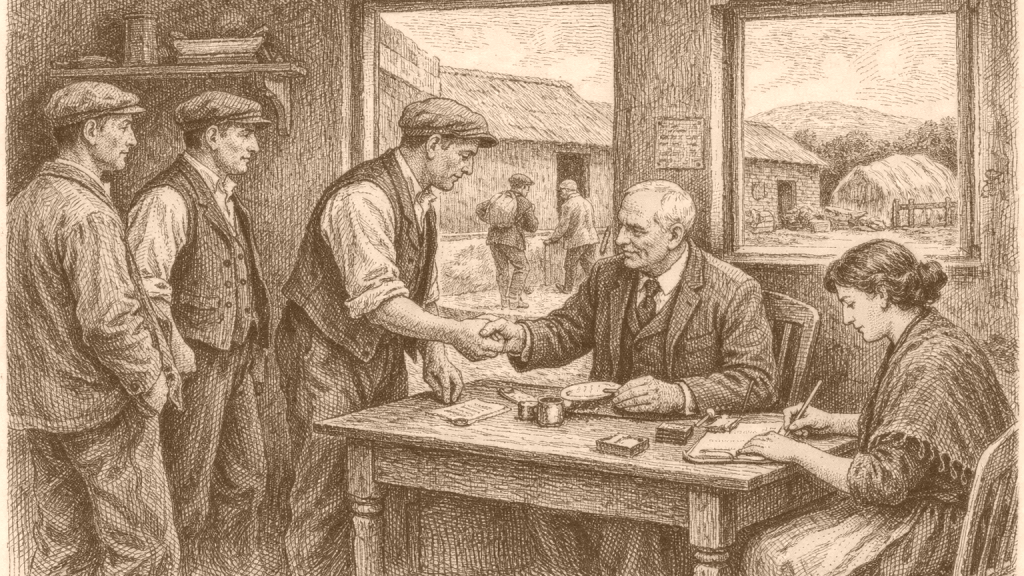
For agriculture in the years around the First World War, the evidence points to state wage setting rather than a national minimum wage law in the later sense. One account says the government introduced compulsory tillage and minimum wage setting for agriculture, and that local minimum wages were set so agriculture would retain a workforce. The same passage links these measures to wartime inflation and to competition from better-paying arms and ammunition jobs. [9] [5]
The agricultural account also places wage demands within wider labour organisation. It notes that from March 1917 there was a flurry of wage demands, with new organisations established and old ones revived, and that the ITGWU spread into rural areas by absorbing local organisations. The passage does not give a single national wage figure for agriculture; instead it shows multiple local and organisational pressures around pay. [9] [5]
Munitions Work
A wartime munitions account gives a clearer example of sector-specific minimum pay. It says women in government-controlled employment were forced by union activity to adhere to a minimum wage of £1 per week. The same passage places this within the Munitions of War Act context, where strikes, lockouts, and stoppages were banned and notice of disputes was required. The minimum wage there belonged to a controlled industrial setting, not a general economy-wide rule. [7] [4]
The same article shows later changes in earnings within that workplace. It says a special arbitration tribunal in April 1918 raised rates and war bonuses for shell workers and for canteen, cloakroom, and cleaning staff, and that by November 1918 the women were earning £1-4-0 per week, with some earning more. These figures show movement in pay inside one war industry over a short period. [7] [4]
Court System
The Act’s dispute machinery connects minimum wage entitlement to Ireland’s labour institutions. It provides for rights commissioners, appeals, Labour Court determinations, referral on questions of law, and enforcement of Labour Court decisions. The later Labour Court history says the Court was established under the Industrial Relations Act 1946 and highlights its central role in settling industrial disputes, which helps place minimum wage disputes within a broader institutional landscape. [2,10] [2] [6]
The statutory text also links minimum wage rules to inspectors and offences. It lists inspectors and their powers, investigation of allegations, an offence to refuse or fail to pay the minimum hourly rate, and penalties and proceedings. In this material, enforcement is not peripheral: it is one of the main parts of the Act, alongside entitlement and calculation. [2] [2]
Historical Contrast
Taken together, these excerpts show a shift in form. The wartime material presents minimum wages as sectoral measures attached to agriculture or munitions, with local or government-controlled rates and accompanying restrictions. The 2000 Act, by contrast, creates a general statutory structure with entitlement, calculation, enforcement, and later amendment. The evidence supports comparison of these legal forms, but it does not by itself explain why the shift occurred. [6,7,9,2] [2] [3] [4] [5]
The available material also shows that later legislation did not stand still. The Irish Statute Book entry records amendments and inserted provisions, including later sections 10A, 10B, 10C, 10CA, and changes to the rate-prescribing section 10D. That record shows continuing legal adjustment after 2000, while the 2020 order gives one snapshot of the rate and allowances at a particular moment. [1,6] [1] [3]
Source References
Hover over a number to see the source. Select it to open the source.


How did Irish minimum wage rules move from sector-specific wartime and statutory arrangements to a national legal framework by 2020?