
OConnell Commemorations
At a Glance
Library Commemoration
The National Library of Ireland presents Daniel OConnell through a commemorative framework tied to the 250th anniversary of his birth. Its notice names him as a major political figure and states that a commemorative programme was launched to mark that anniversary. The same notice also says the library invites the public to rediscover his life and legacy through its collections, linking commemoration to access rather than to a single display item. [2]
The Irish-language version repeats the same commemorative framing and confirms that the programme is connected to the 250th anniversary of OConnell’s birth. It also describes his campaigns for Catholic Emancipation and repeal of the Union, while identifying the library as a place where his life and work can be explored. The parallel wording in both language versions shows a consistent institutional presentation across the two notices. [3]
Archive Holdings
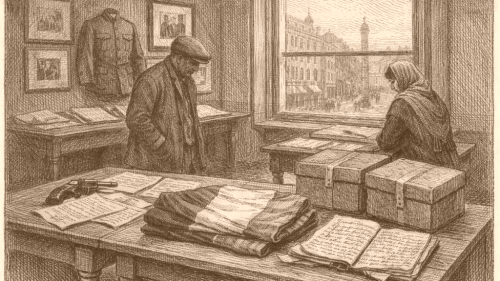
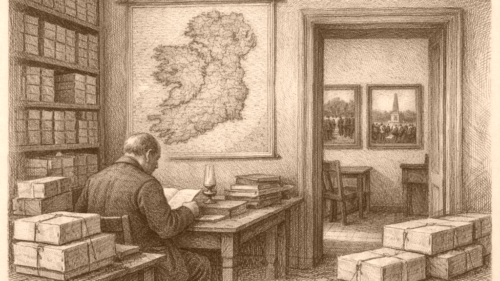
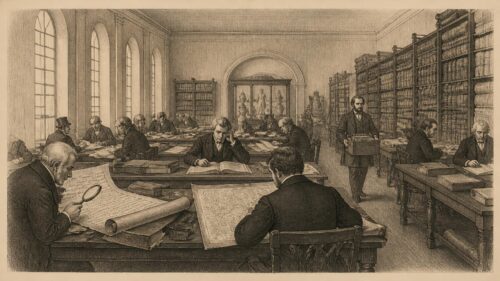
The Irish Archives Resource describes a Daniel OConnell collection held in UCC Library Archives Service. Its entry gives creation dates of 1816 and 1968, an archival reference, and a medium of four items. The description shows that the collection is organised around a small number of documents rather than a large run of papers, and it identifies the records as being held and accessible through UCC special collections procedures. [1]
The same entry specifies the contents more closely. One item is a 1816 letter from Daniel OConnell to his son Maurice, written from Cork and asking after the health of another son, Morgan. The later material consists of correspondence from 1968 about the provenance of that earlier letter, including discussion of where other OConnell correspondence might be located. The collection is therefore described as both personal and documentary. [1]
Museum Objects
The National Museum of Ireland lists Daniel OConnells Repeal Cap, dated 1843, in its Historical collection. The description places that object within a set of materials related to the Volunteer movement of the 1780s, the Repeal movement, the Fenians, the Land War, and later political developments. This is a direct example of commemoration through preserved object biography rather than through a textual notice alone. [4]
The Irish-language museum page gives the same information in parallel form. It again names Daniel OConnells Repeal Cap, 1843, and states that the collection includes medals, documents, diaries, military equipment, and personal memorabilia. The wording also notes overlap with the Easter Week and Arms collections, which situates the item in a wider national collecting structure rather than as an isolated relic. [5]
Visual Memory
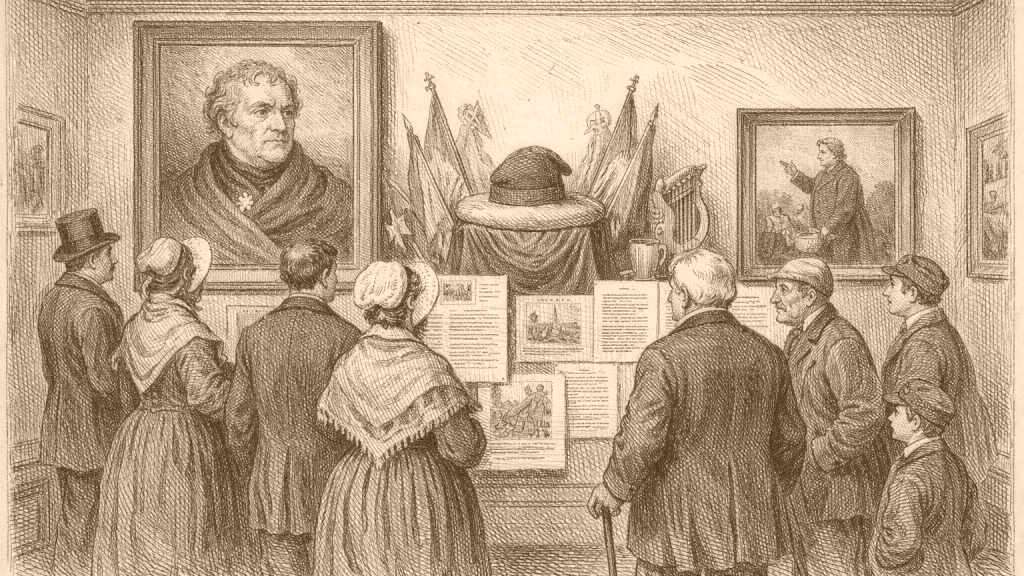
The NLI notice says its collections include visual materials that trace the evolution of OConnells public image, from early portraits associated with his legal career to later images emphasising political prominence. It also says the holdings include supportive illustrations and satirical cartoons. This is important for commemoration because it shows that representation was not confined to letters or official records but also included public imagery preserved by the library. [2]
The same notice lists historical newspaper coverage from The Nation, including reports on the Monster Meetings of 1843. In that description, the coverage documents peaceful demands for repeal of the Act of Union. The library therefore presents commemoration through several forms of record at once: newspapers, portraits, printed images, and family papers all contribute to how OConnell is remembered in its holdings. [2]
Public Access
The NLI explicitly states that its Daniel OConnell holdings are freely accessible and that readers can visit its rooms or use the online catalogue. It also says many items have been digitised. This makes the commemorative programme visible not only as an announcement but as an invitation to consult the material directly, in person or online, within the limits described by the library. [2]
The archives entry, by contrast, places access through a formal request system. It says material is available by request with Special Collections and Archives at UCC Library and that at least one week is needed for preparation. The museum page offers a different kind of access again, presenting the Repeal Cap as part of an online collection list. These differences are visible in the institution descriptions themselves. [1] [4]
Commemorative Scope
Taken together, the records show commemoration of Daniel OConnell through three kinds of institutional holding: library collections, archival correspondence, and museum objects. The NLI focuses on breadth and public programme; the archives entry focuses on a small documentary cluster; the museum records a named object from 1843. The wording in each institution differs, but all three treat OConnell as a figure whose material legacy is preserved for consultation. [2] [1] [4]
The evidence does not provide a complete survey of all OConnell commemorations, and it does not describe ceremonies, exhibitions, or public events beyond the references quoted here. What it does show is that Irish institutions mark his memory through curated records and access systems. In these excerpts, commemoration is visible as a practice of preservation, description, and public invitation across more than one repository. [2] [1] [4]
Source References
Hover over a number to see the source. Select it to open the source.

- [1] Daniel O’Connell Collection - Irish Archives Resource
- [2] Marking 250 Years Since the Birth of Daniel O’Connell | National Library of Ireland
- [3] Ag comóradh 250 Bliain ó Rugadh Dónall Ó Conaill | National Library of Ireland
- [4] Historical | National Museum of Ireland
- [5] Stairiúil | Ard-Mhúsaem na hÉireann
How are Daniel OConnell commemorations represented across Irish archival, library, and museum collections?