
Irish Eurovision
At a Glance
First Entry
RTÉ’s archive description places Ireland’s first Eurovision Song Contest entry in 1965, when Butch Moore represented the country with Walking the Streets in the Rain and finished sixth. It also states that Ireland has been represented every year except 1983 and 2002. The same list shows a long run of entries through the later twentieth century, with repeated appearances by different performers and songs. That evidence establishes continuity in participation rather than a single isolated appearance. [3]
The RTÉ archive entry also identifies the sequence of Irish performers from the 1960s onward, including Dickie Rock, Sean Dunphy, Muriel Day, and Dana. The list records placements beside each act, which makes comparison possible across years without adding outside commentary. A separate RTÉ page summarises the national record more broadly, stating that Ireland holds seven Eurovision wins and that its history at the contest begins with Butch Moore in 1965. The evidence is factual and cumulative. [3] [4]
Colour Broadcast
A 1970s RTÉ archive item links Eurovision with the broadcaster’s technical transition to colour. It says that the 1970 contest in Dublin was one of the first home-produced colour television programmes broadcast by RTÉ, and that Bernadette Ní Ghallchóir presented the show from the Gaiety Theatre. The same page says RTÉ invested heavily in colour television in the late 1960s and early 1970s, and that the first colour transmission was broadcast in 1968. Those statements describe a media transition, not its wider causes. [6]
The same archive page adds that colour transmission came in stages, beginning with sports and other events taken from the Eurovision network, then moving to colour playback for home-produced films and video, and finally to full-colour studios and outside broadcasting units. Within that framework, the 1971 contest entry by Angela Farrell is noted as coming eleventh with One Day Love. The page places the performance beside Monaco’s winning entry, allowing direct comparison of result and winner without extra interpretation. [6]
Winning Streak
RTÉ’s archive summary states that Ireland has the contest record for most wins, with seven titles, and that it is the only country to have won three years in a row. The same page names the winning Irish acts: Dana, Johnny Logan twice, Linda Martin, Niamh Kavanagh, Paul Harrington and Charlie McGettigan, and Eimear Quinn. Because the page is a summary, it gives the sequence but not the detailed circumstances of each victory. The evidence is sufficient for a basic record of achievement. [4]
Another RTÉ page on the 1995 contest provides a more specific comparison. It says Ireland hosted for the third year in a row, that the country was the first ever to stage the contest on three consecutive occasions, and that it remained the only country to win in three successive years. The page also records that the 1995 competition was won by Norway, while Ireland’s Eddie Friel finished fourteenth with Dreamin. These are discrete observations from the archive entry. [5]
Hosting Years
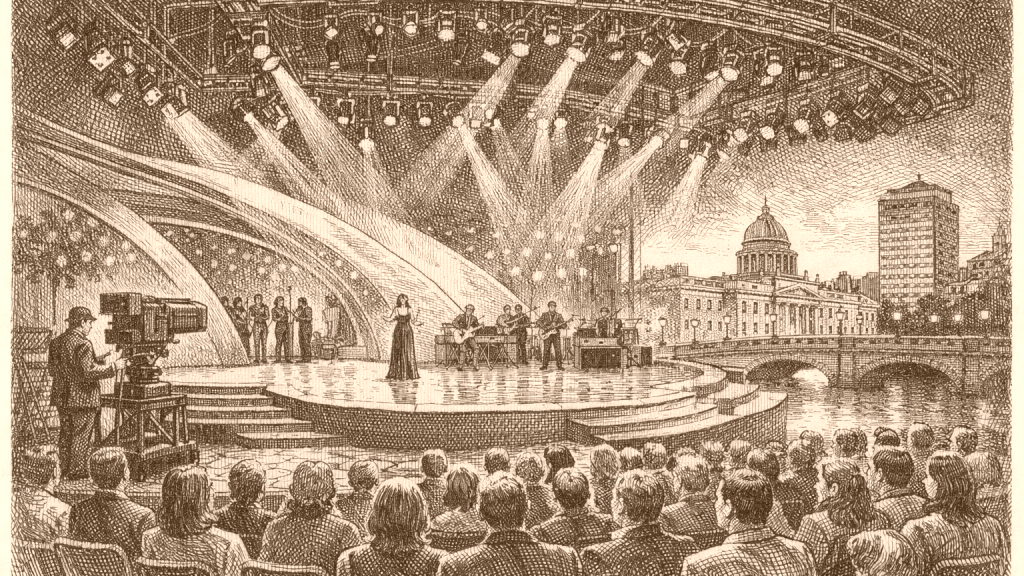
The archive record shows that winning brought the practical result of hosting, and that RTÉ carried that burden seven times. It identifies Dublin hosting in 1971 after Dana’s victory, and again in 1981 after Johnny Logan’s win in the previous year. Another archive page says the 1981 production preparations at the RDS were underway just days before the contest, and that Doireann Ní Bhriain presented the show while Larry Gogan served as commentator. These details are procedural and local, not explanatory. [4] [7]
A further RTÉ archive item on the Point Theatre says Ireland hosted the competition for the third year in a row in 1995. It also notes that Mary Kennedy introduced the contest from Dublin and that the 40th anniversary of Eurovision coincided with what the page calls Ireland’s own piece of history. The same item states that Ireland was the first country ever to stage the contest on three consecutive occasions. The wording is direct, though its wider significance is not elaborated in the source. [5]
Recent Results
The RTÉ contestants list continues through the 2000s and 2010s, preserving a clear chronology of Irish entries and placements. It records non-participation in 2002 and again in 1983, and then shows later results that include qualification failures, lower placements, and occasional top-ten finishes. The list also includes 2020, when the contest did not take place because of the Coronavirus pandemic. The entry format is plainly documentary, so the comparison is limited to recorded outcomes. [3]
The same archive page shows the persistence of Irish representation into the twenty-first century, with acts such as Jedward, Ryan Dolan, and Ryan O’Shaughnessy appearing on the list. It records that some entries did not qualify, while Bambie Thug finished sixth in 2024 and EMMY did not qualify in 2025. These observations do not establish a trend beyond the page itself, but they do show the contrast between earlier winning decades and more mixed recent results. [3]
Archive Record
The CELT list is not a Eurovision source in content, but it is useful as an archive guide. It groups Irish texts under historical, legal and genealogical material and names the Annals of Ulster, the Annals of Tigernach, the Annals of Inisfallen, and the Annals of the Kingdom of Ireland among many editions. That listing shows the scale and variety of the corpus in which Irish history is organised for readers. It is a separate context from the RTÉ material, not a parallel account of Eurovision itself. [1]
The Annals of Ulster edition page adds a second kind of archival description. It specifies manuscript sources, lacunae, and editorial handling in a digital edition, including the use of translations for different chronological ranges and the presence of gaps in the manuscripts. This does not relate to Eurovision events, but it demonstrates how historical material can be presented through layered editorial notes. In contrast, the RTÉ pages compress Eurovision history into short item summaries and entry lists. [2] [3] [4]
Source References
Hover over a number to see the source. Select it to open the source.

- [1] List of Irish Texts at CELT
- [2] The Annals of Ulster
- [3] RTÉ Archives | Entertainment | Ireland's Eurovision Contestants
- [4] RTÉ Archives | Entertainment | Eurovision Song Contest
- [5] RTÉ Archives | Entertainment | Once Again Ireland Hosts the Eurovision
- [6] RTÉ Archives | Entertainment | Eurovision In Ireland And In Colour
- [7] RTÉ Archives | Entertainment | Behind The Scenes At Eurovision
How did Ireland’s documented Eurovision participation and hosting pattern change from 1965 to 2025?