
Killarney Heatwave
At a Glance
Heatwave Context
Met Éireann’s July 2021 statement describes a month that began with rain and showers, then turned mostly dry from 13 July. It says a hot tropical air mass arrived between 17 and 25 July as high pressure blocked Atlantic fronts, creating heatwave conditions in many places. The same statement also notes intense thunderstorm activity in parts of the country later in the month, so the pattern was not uniformly hot or dry throughout. [8] [5]
The annual review for 2021 reinforces that July was unusually warm and dry nationwide, with widespread heatwaves and long dry spells. It states that Met Éireann issued its first ever High Temperature warning, and that at least ten stations reached heatwave conditions. The same review adds that Kerry’s Valentia Observatory recorded tropical nights, showing that the heatwave affected the southwest as well as inland stations. [9] [6]
Kerry Setting
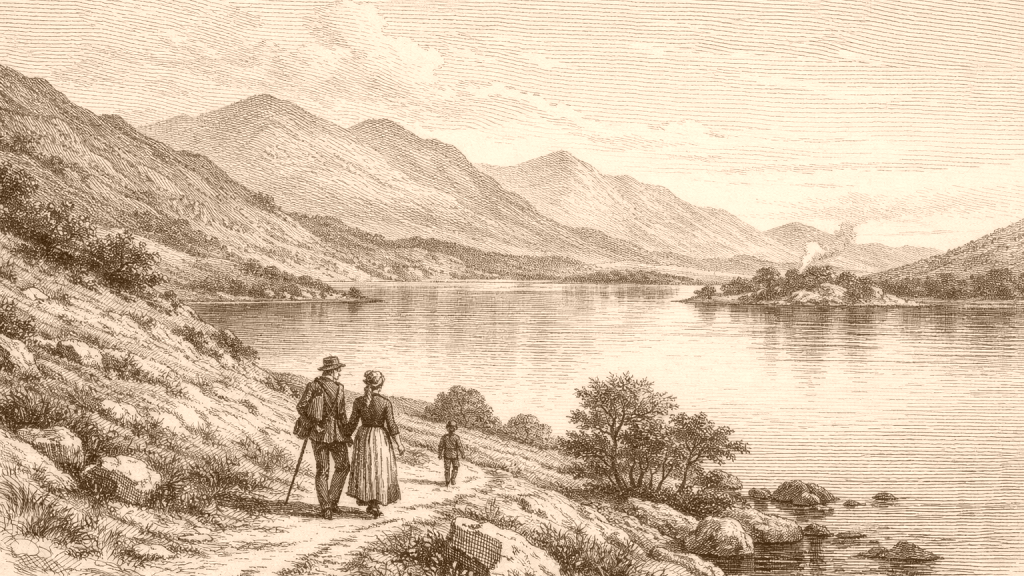
Killarney’s landscape sources present the district as a lake country shaped by mountains, wooded shores, and broad water surfaces. One guide describes Inisfallen as a fertile, wooded island on the lake, while another describes the wider Killarney scene as a system of two connected lakes with high southern shores and gentler ground to north, east, and west. These passages do not mention wildfire, but they show the kind of terrain in which summer heat would be experienced. [6][7] [3] [4]
The same descriptions emphasise vegetation: oak, ash, alder, holly, arbutus, yew, and strawberry trees appear in the Killarney accounts, while Inisfallen is said to be richly clothed with wood. That matters because the surviving passages connect Killarney to dense, scenic growth rather than open moorland. No excerpt here states that a wildfire occurred, and none gives a precise July 2021 local fire report, so any such detail would go beyond the text available here. [6][7] [3] [4]
Local Comparison
The modern Killarney weather archive provides a useful local comparison, though the retrieved excerpts only show later years. For July 2025 it lists an average temperature of 15.0°C with 85.4 mm of rain, and for July 2026 an average of 17.5°C with 17.1 mm of rain. Those figures cannot be transferred to 2021, but they do show that July conditions in Killarney can vary sharply from one year to another. [5] [2]
The same archive also gives yearly totals that place those Julys within broader recent patterns of rainfall and temperature. For 2025 it reports an annual average temperature of 10.5°C and rainfall of 1,488.8 mm, while 2026 is listed with 11.3°C and 1,290.1 mm. These are not evidence for July 2021 itself, but they show the archive’s format and confirm that later Killarney summers could still be wet or relatively dry by month. [5] [2]
Weather Detail
Met Éireann’s July 2021 statement supplies the clearest national temperature detail. It records a maximum of 30.8°C at Mount Dillon on 21 July, and says that heatwaves were reported at fourteen stations between 16 and 25 July. It also says Valentia Observatory recorded two tropical nights and its highest July maximum since 1976, which places Kerry within the broader heatwave pattern rather than outside it. [8] [5]
The annual review adds another layer by describing July 2021 as warm, dry, and sunny nationwide, with above-average temperatures and below-average rainfall at most stations. It also says the hot conditions were linked to blocking high pressure and a tropical continental air mass. That explanation appears only in the weather review, not in the Killarney guide material, so the climate evidence and the landscape evidence remain separate kinds of testimony. [9][6][7] [6] [3] [4]
Source Limits
The available excerpts support a comparison between a nationally significant July heatwave and Killarney’s setting, but they do not give a direct local wildfire account for July 2021. They also do not provide a July 2021 Killarney monthly archive figure in the retrieved weather pages. What they do provide is enough to show that Kerry experienced tropical nights during the heatwave and that Killarney sat within a wooded lake landscape. [8][9][5][6][7] [5] [6] [2] [3] [4]
Taken together, the passages indicate a summer of exceptional heat in Ireland, with Kerry included in the record of tropical nights, and a Killarney setting characterised by lakes, hills, and woodland. They do not establish the scale, timing, or cause of any wildfire in Killarney, so that element must remain unasserted here. The strongest evidence concerns weather and place, not a specific fire event. [8][9][6][7] [5] [6] [3] [4]
Historical Frame
A wider historical frame can be seen in older Killarney descriptions, which present the district as a celebrated scenic landscape already known for its lakes and wooded islands. Those texts are not weather records, but they help define the locality to which later climate statements refer. In this sense, the 2021 heatwave belongs to a long-observed landscape whose basic features were already being described in nineteenth-century guide literature. [6][7][3] [3] [4] [1]
The point of comparison is therefore straightforward: a modern heatwave record from Met Éireann, a local weather archive with later July values, and older descriptive texts about Killarney’s lakes and wooded scenery. None of these passages alone tells the whole story. Read together, they show why July heat in Killarney is best understood as a meeting of climate data and place description, while a specific wildfire episode remains undocumented here. [8][9][5][6][7] [5] [6] [2] [3] [4]
Source References
Hover over a number to see the source. Select it to open the source.

- [1] Part 26 of Narrative of a residence in Ireland during the Summer of 1814, and that of 1815
- [2] Weather History in Killarney, Ireland
- [3] Part 20 of Guide to Killarney and Glengariff
- [4] Part 2 of A Description of Killarney
- [5] Climate Statement for July 2021 - Met Éireann - The Irish Meteorological Service
- [6] Weather & Climate Review 2021 - Met Éireann - The Irish Meteorological Service





How did the July 2021 heatwave compare with Killarney’s local weather context and the broader Irish climate conditions recorded that month?