
Industry Traces
At a Glance
Digital Access
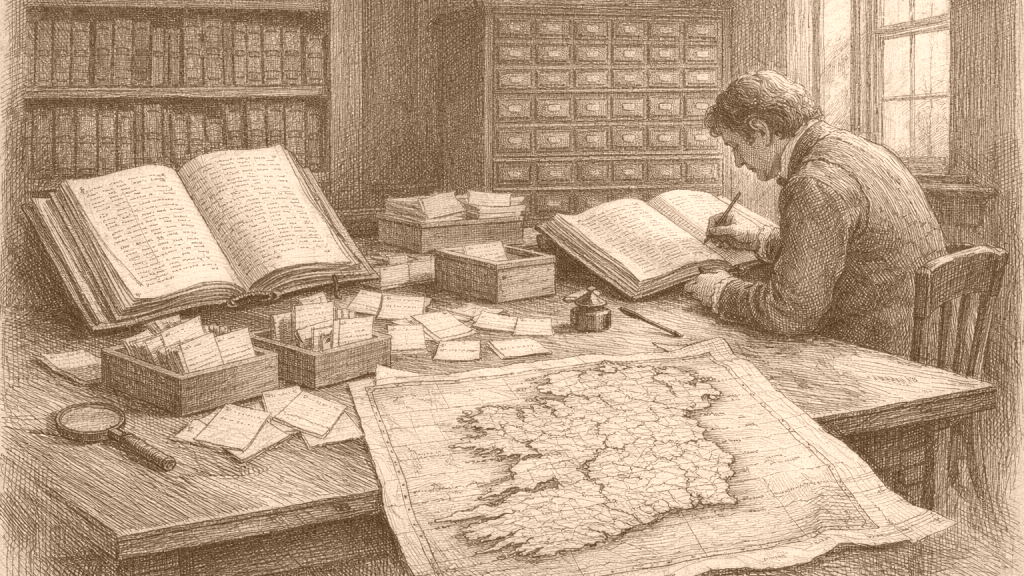
Irish annals are presented through a searchable archive that offers English translations of eight medieval annals and directs readers to the CELT text base for the reading texts. The archive names the Annals of Ulster, Tigernach, Inisfallen, the Four Masters, Loch Cé, Connacht, Mac Carthaigh's Book, and the Fragmentary Annals of Ireland. Its interface also notes that the older and newer CELT sites are linked side by side. [1]
The same archive explains how users move from a search hit to the relevant annalistic item. It says the search opens the annal volume only, that the reader must scroll to the year and item shown in the hit, and that year boxes are optional. It also states that quoted phrases are kept together and that the snippet comes from the site’s own table, with a maximum of fifty hits. [1]
Annals Records
The Annals of Ulster page identifies the text as a digital edition compiled by named editors and hosted by the Corpus of Electronic Texts. It describes the edition as restricted for academic research and teaching, and it records that the electronic text extends the published translation used for entries up to AD 1131 and then continues with later editorial work. These details concern the modern edition, not the original annalistic composition. [6]
That page also lists manuscript witnesses and lacunae. It names Trinity College Dublin MS 1282 and Bodleian Rawlinson B 489, gives the scribal hands associated with those manuscripts, and notes gaps in the text for specific ranges such as 1102 to 1108 and 1115.4 to 1162.3. It further says that one manuscript is a fair copy of the other and that some lost text is supplied from the second manuscript. [6]
Text Listings
CELT’s Irish texts listing places the annals within a wider catalogue of historical, legal, and genealogical material. It names editions of the Annals of Ulster, Tigernach, Inisfallen, the Four Masters, Loch Cé, Connacht, Mac Carthaigh's Book, and other annalistic or related works. The list shows that annal texts sit alongside poetry, legal texts, chronicles, and other genres rather than forming a separate standalone collection. [2]
The translated-texts page at University College Cork repeats that arrangement in a different format. It lists translated annals from Irish into English and gives publication details for the major editions, including the Annals of Ulster, Tigernach, Inisfallen, the Four Masters, Loch Cé, Connacht, and the fragmentary annals. It also includes other translated Irish texts such as the Annals of Clonmacnoise, the History of Ireland, and the Book of Rights. [3]
Research Guide
A university library guide describes Ireland-focused primary sources as materials created in Ireland, north and south, while also warning that British collections may include relevant Irish items. In its list of major institutional collections, it names Trinity College Dublin, the Digital Repository of Ireland, the Military Archives, the National Library of Ireland, PRONI, UCD Digital Library, and the Virtual Record Treasury of Ireland. The page presents these as research gateways rather than as narrative sources. [4]
The same guide also places CELT among books, magazines, newspapers, and television resources. Beside that, it lists Irish Times, RTÉ Archives, and several newspaper or magazine collections, as well as reprinted-source series such as Analecta Hibernica and Archivium Hibernicum. The guide therefore gathers different kinds of documentary access in one place, but it does not compress them into a single subject heading for industry. [4]
Search Results
Irish History Online returns a large set of results for the keyword Industry, reporting 656 text results. The sample shown on the results page includes journal articles, theses, monographs, and collective volumes. Among the visible titles are works on electricity, co-operation, transport, industrial conflict, and linen manufacture, which indicates that the keyword spans several branches of historical scholarship rather than one single field. [5]
The same results page also shows that industrial topics appear in a broad chronological spread. Visible entries range from the seventeenth century to the twentieth century, including an Anglo-Irish industrial enterprise, a history of railways in Ireland, and studies of electrification and town gas. Because the page is only a keyword listing, it reveals breadth in titles and formats, not a full subject classification. [5]
Source Limits
Taken together, these pages show distinct levels of description. One set identifies annal collections and their manuscript bases; another groups translated texts within a broad editorial catalogue; another directs users to repositories and newspaper collections; and a separate database lists industry as a keyword with many kinds of publications. The materials overlap in topic, but each site frames access differently and preserves its own boundaries of description. [1] [2] [3] [4] [5] [6]
The evidence does not provide a single narrative of industrial development. What it does provide is a map of access: one archive for annals search, one edition for the Annals of Ulster, one text catalogue at CELT, one university guide to Irish primary sources, and one index of industry-related scholarship. Any further synthesis would require moving beyond these pages and into the texts they point toward. [1] [2] [3] [4] [5] [6]
Source References
Hover over a number to see the source. Select it to open the source.


How do modern digital gateways organize access to Irish annals and industry-related historical research materials?