Niall of the Nine Hostages
The sources link him to Eochaid Mugmedón, place him in the sovereignty of Ireland for a period of twenty seven years, and connect his story with raids, hostage taking, and conflict in Ireland and beyond the island. The same materials also preserve a death tale in which he is slain by Eochaid son of Enna Censelach. The literary and annalistic tradition presents Niall as the son of Eochaid Mugmedón. In the annal references preserved in the UCC material, the first year of Niall’s sovereignty is given as 379 and his death as 405, while the same tradition states that he had been in the sovereignty for twenty seven years when he was slain.
Dateline
The sources link him to Eochaid Mugmedón, place him in the sovereignty of Ireland for a period of twenty seven years, and connect his story with raids, hostage taking, and conflict in Ireland and beyond the island. The same materials also preserve a death tale in which he is slain by Eochaid son of Enna Censelach.
Dynastic Memory
The literary and annalistic tradition presents Niall as the son of Eochaid Mugmedón. In the annal references preserved in the UCC material, the first year of Niall’s sovereignty is given as 379 and his death as 405, while the same tradition states that he had been in the sovereignty for twenty seven years when he was slain. These dates belong to the annalistic framework of the surviving texts rather than to secure contemporary record.
Hostage Tradition
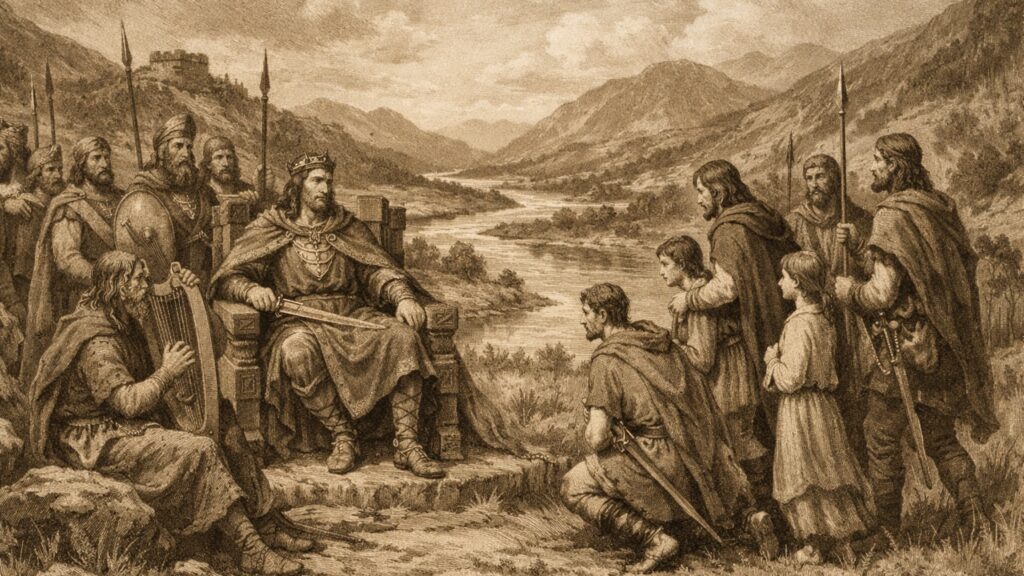
The best known explanation of Niall’s epithet is that he took hostages from a wide range of peoples. One tradition preserved in the materials says that he received five hostages from the provinces of Ireland and four from Alba. Another version says that he had hostages from Ireland together with hostages from Scotland, the Saxons, the Britons, and the Franks. The figure of the nine hostages therefore belongs to the story world of the texts, and the surviving versions do not agree in every detail. What remains constant is the idea that his power was marked by the taking of hostages from multiple regions.
Raids Abroad
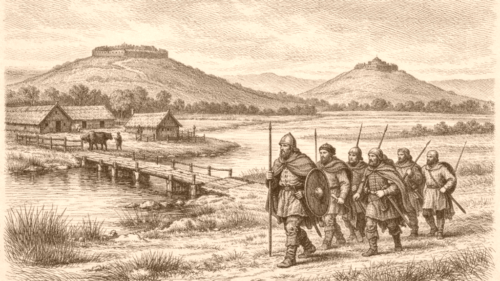
The saga material associates Niall with expeditions beyond Ireland. The background notes to the UCC texts state that the tale of his expedition to Alba may preserve a recollection of Irish incursions into Britain at the end of the fourth century and the beginning of the fifth. In the death tale, Niall is said to have gone as far as Letha and Italy in search of kingship. The same tale also places him near the Alps, where he encounters a lone warrior who speaks of hostages due from the Romans. These episodes are part of a legendary narrative pattern and should be read as traditional storytelling rather than documentary prose history.
Leinster Conflict
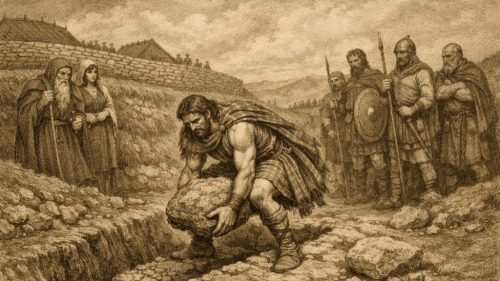
One of the clearest surviving narratives about Niall concerns his dealings with Leinster. In the Irish version, Echu son of Enna first comes from the house of Niall and is refused food by Niall’s poet, Laidcenn son of Bairchid. He later destroys the poet’s stronghold and kills Laidcenn’s only son. The poet then spends a year satirising and cursing the men of Leinster. Niall comes south on a hosting, demands that Echu be given to him as hostage, and has Echu brought before him at Ath Fadat in Fothairt Fea by the Slaney. The text then describes an attack in which Echu breaks his chain, seizes the iron bolt, and strikes down nine champions who move against him. Niall’s return to Leinster, and the killing of the poet Laidcenn by a stone thrown at him, belong to the same narrative cycle.
Death Account
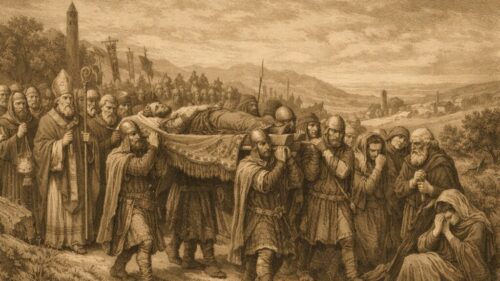
The death tale says that after raiding Leinster Niall went home, and that Echu was exiled from Ireland while Niall reigned. It then places Niall’s death at Muir nIcht, identified in the background material as the sea between France and England. The English translation says that Echu son of Enna shot Niall with an arrow from a Saxon camp among the bards of the Pict-folk at Carn Fiell. The saga also preserves variants in which the killing is linked with the house of Erc son of Echu Munremar, king of Alba, or with other surrounding details. The annalistic summary and the saga account do not offer the same narrative form, but both place Niall’s end outside Ireland.
Later Reception
Later writers drew on these traditions when discussing the early kings of Ireland. Geoffrey Keating’s History of Ireland repeats the explanation of Niall’s epithet through the nine hostages. The nineteenth-century Dictionary of National Biography also summarises Niall as king of Ireland, notes his wars in Ireland and Britain, and observes that he is closely associated with the ancestry of the O’Neills. The medieval tales and later summaries together show how Niall was remembered: not through secure contemporary biography, but through a powerful body of historical legend, dynastic genealogy, and learned retelling.
Source References
Hover over a number to see the source. Select it to open the source.