Diarmait Cerbaill
The text preserved by the CELT project under the title Orgguin trí mac Diarmata Mic Cerbaill centres on the killing of Diarmait’s three sons. It names Diarmait as their father and presents him as a king of Ireland within the literary setting of the tale. The narrative follows the deaths of the sons and the events that follow from them, rather than offering a detached historical account. The story opens with the sons of Diarmait mac Fergusa Cerrbeoil travelling again into the land of Laigin on a raid. There they come upon Maelodrán ua Díma Chrón beside a mill owned by Mic Dímmae.
Dateline
The text preserved by the CELT project under the title Orgguin trí mac Diarmata Mic Cerbaill centres on the killing of Diarmait’s three sons. It names Diarmait as their father and presents him as a king of Ireland within the literary setting of the tale. The narrative follows the deaths of the sons and the events that follow from them, rather than offering a detached historical account.
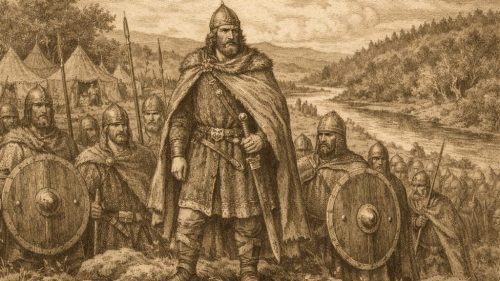
The story opens with the sons of Diarmait mac Fergusa Cerrbeoil travelling again into the land of Laigin on a raid. There they come upon Maelodrán ua Díma Chrón beside a mill owned by Mic Dímmae. The tale follows the encounter in detail, first with the sons’ attempt to seize him, then with the reversal in which Maelodrán uses the mill and the surrounding crowd to his own advantage. The episode ends with the death of three royal sons, a fact made explicit in the closing verses of the tale and reinforced by the narrative’s title.
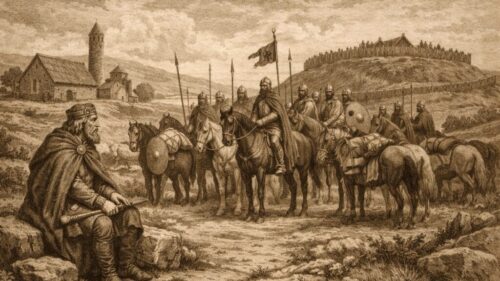
Within the same tradition, Diarmait later seeks revenge for the loss of his son at Laigin. The tale states that he was with the people of Ériu at Loch Gabar and that he promised safety to the Laigin if Maelodrán were handed over to him in surety. The Laigin refuse to surrender him unless he is killed. Diarmait then goes out alone and meets Maelodrán at the door of the house, where the two exchange words and Maelodrán identifies himself to him. The narrative continues with the handing over of Maelodrán and the later reconciliation of the king and the man who had been protected among the Laigin.
Royal Setting
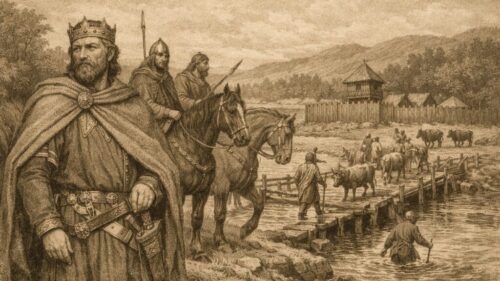
Diarmait is associated with rulership in the story’s poetry and prose, and one closing verse refers to him as ríg Hérenn, king of Ireland. That designation belongs to the literary setting of the tale. It is one of the ways the tradition names him in the text.
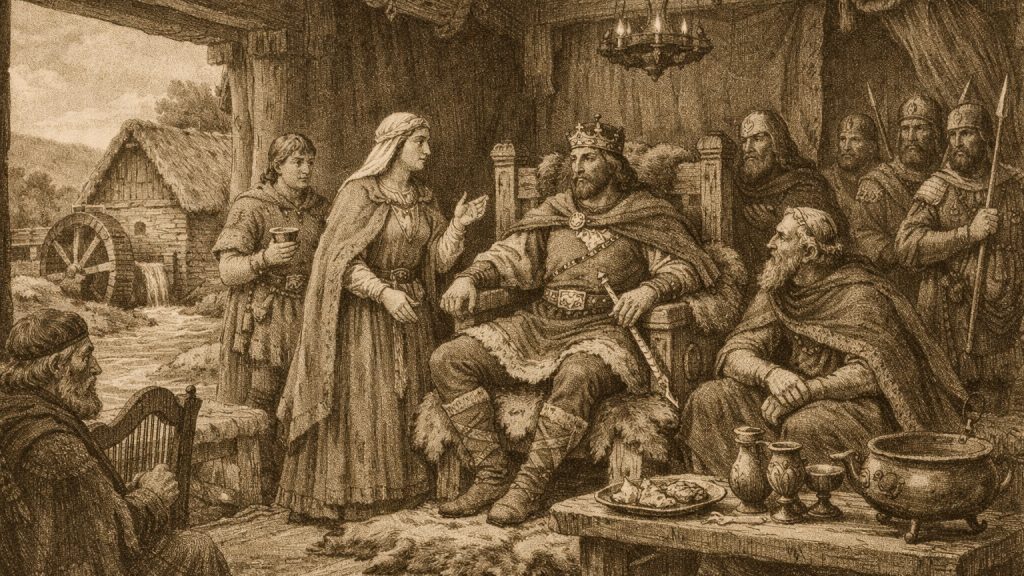
Mugain ingen Chonchraid, identified in the tale as the mother of Diarmait’s children, appears as an active presence in the household. When Maelodrán is brought into the king’s dwelling, she hears the exchange and praises the captive’s boldness. She remarks that he has done a worthy deed in saving himself and says that his life is better preserved than taken. Her intervention leads to the practical outcome that Maelodrán is concealed and then protected rather than immediately slain. In the tale, she therefore becomes a crucial voice in the movement from retaliation towards settlement.
Family Honour
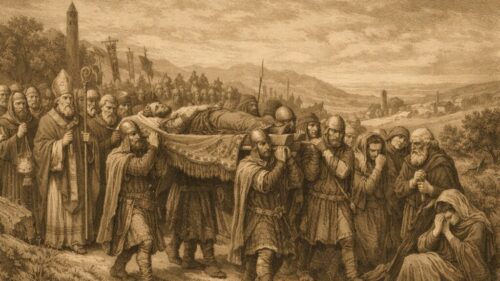
The poem attached to the story stresses the violence done to Diarmait’s family and the deaths that follow in the mill. It belongs to the literary tradition of the narrative and closes the account with verse rather than prose. The poem names Diarmait’s three sons and places their killing at the centre of the story. It also recalls the mill and the manner in which the sons were slain there. The tale’s final verse keeps attention on the dead sons, their father, and the loss that drives the narrative.
The background material connected with the CELT edition places the tale among early Irish texts and lists manuscript witnesses in the Bodleian Library and the Royal Irish Academy. It also points to related scholarly editions and to other works on names, place-names, and kingship.
Primary Sources
Source References
Hover over a number to see the source. Select it to open the source.