
Housing Act
At a Glance
Legal Framework
The Housing Act of 1925 states its purpose plainly: to facilitate the provision of dwelling houses, to authorize grants for those providing them, to amend earlier housing legislation, and to increase supply. Its arrangement of sections shows a detailed administrative scheme rather than a single measure. The act defines local authorities, public utility societies, the minister, houses, reconstruction, and erection, distinguishing new building from rebuilding in the legal language of provision. [1]
The same act also sets out who may receive grants and under what ceiling. The minister may, with finance consent, make grants to persons, public utility societies, and local authorities for houses meeting the statutory rules. The act fixes the aggregate amount at £300,000 and excludes several categories, including houses already aided under the 1924 building facilities legislation and some houses tied to compensation for property destruction. [1]
Urban Conditions
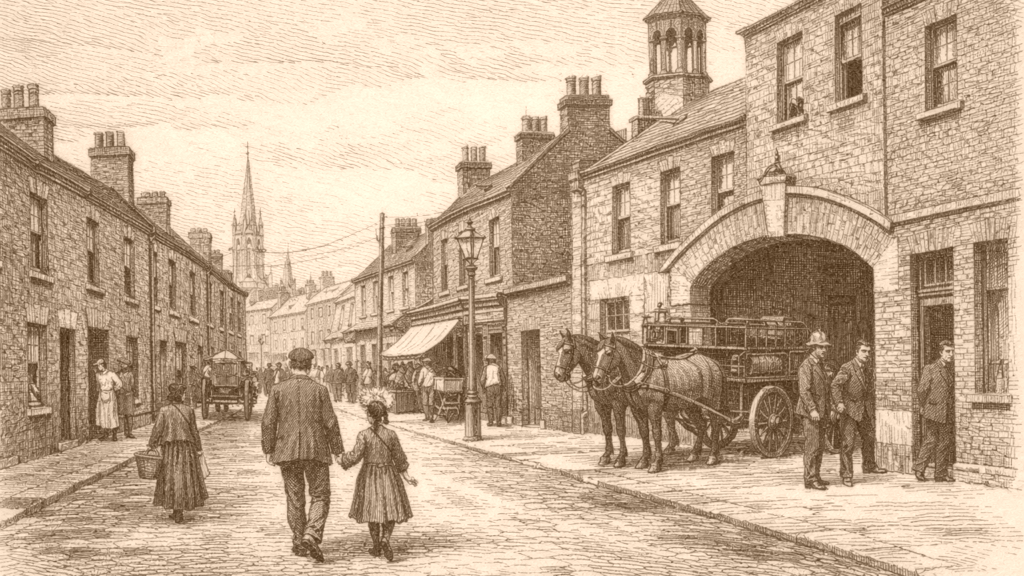
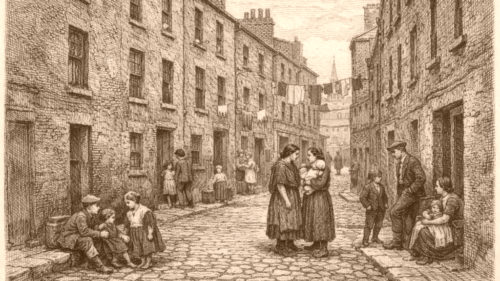
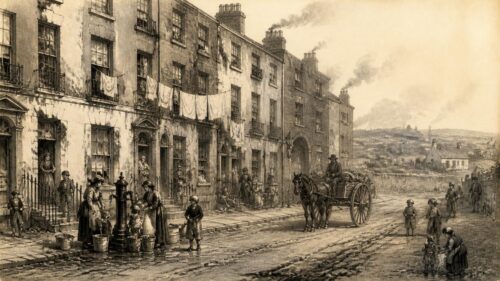
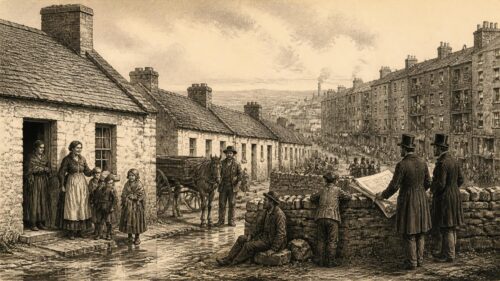
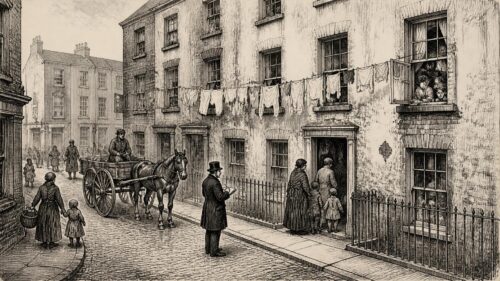
A later account of Pearse Street shows the density and mixed use of an inner-city Dublin thoroughfare. The street linked the city centre with docks and the inland waterway network, and by 1926 it contained solicitors, coal merchants, a fire station, a cinema, a train station, schools, pubs, and residential properties including tenements. The record presents housing not as an isolated sector, but as part of a crowded urban environment with overlapping commercial and domestic functions. [4]
The same street also places municipal services within that setting. The Central Fire Brigade Station stood at no. 14, while household and occupational details ranged from police officers to theatre workers, shop assistants, and people working on their own account. This does not by itself prove a housing shortage, but it does show the close proximity of homes, workplaces, and public institutions in a built-up city street. [4]
Fire Risk
Fire hazards form another part of the housing record. A UCC research item on early-twentieth-century Dublin identifies fire hazards and housing as a linked topic, and the Pearse Street material makes that linkage visible through the presence of a fire brigade station on a street containing tenements and varied business premises. The evidence does not describe a single fire event here, but it does connect urban housing with concerns about risk and response. [2] [4]
The National Archives’ Pearse Street account further suggests how ordinary urban life and emergency services coexisted in the same space. The street contained businesses, residences, and a fire station within a short stretch, and the census forms captured a wide range of occupations and dwelling arrangements. This is indirect evidence of a city where housing had to be understood alongside safety, infrastructure, and daily movement. [4]
Public Works
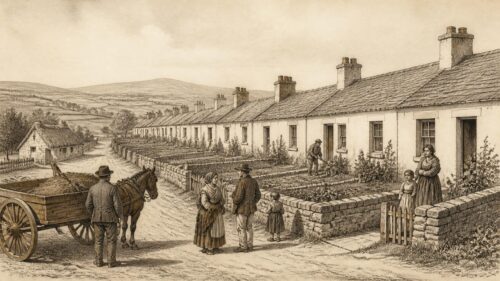
The Office of Public Works archive description shows how housing sits inside a broader state record of roads, bridges, civil buildings, and working papers. Among its series are labourers’ dwellings, property compensation claims, and architectural and engineering drawings. The catalogue does not tell a single housing story, but it demonstrates the administrative breadth through which the state preserved records relevant to building, repairs, and property management. [5]
The same archive also records that some material concerns destruction of property and that a series on damage compensation exists for the early 1920s. That does not, on its own, establish the causes of housing scarcity, but it does show a documentary environment in which building, loss, and compensation were all managed within state files. Such records help explain why housing policy would be tied to reconstruction and public administration. [5] [1]
Late Crisis
A review of unfinished housing estates describes a much later phase of the crisis. It says that the Celtic Tiger years brought intense construction, that recession in 2008 caused a collapse of the property market and construction industry, and that the result was just over 2,000 unfinished housing developments across the country. The source gives a clear numerical measure of the post-2008 problem. [3]
That review also states that, since 2008, the Irish government and local authorities have developed strategies and plans to finalise unfinished estates, including plans to use empty housing for social housing purposes. The source criticises this imposed tenure mix and says it needs urgent review, but the present evidence should be read as the review’s own argument rather than as a settled conclusion about policy outcomes. [3]
Historical Pattern
Taken together, the excerpts show a long pattern of Irish housing pressures appearing in different forms. The 1925 act framed housing as a matter for grants, local authorities, and regulation; the Dublin street material shows dense urban occupation, tenements, and fire services; the OPW records show state files that include dwellings and compensation; and the later review describes unfinished estates after the property collapse. The evidence is discontinuous, but it is consistent in linking housing to public action. [1] [4] [5] [3]
What cannot be said from these excerpts is equally important. They do not provide a single continuous chronology of the housing crisis, nor do they quantify need in the early twentieth century. They do, however, preserve direct evidence of legislative response, urban crowding, archival administration, and later unfinished developments. The historical picture is therefore partial, but it is still enough to show recurring pressure on housing across three centuries. [1] [4] [5] [3]
Source References
Hover over a number to see the source. Select it to open the source.

- [1] Housing Act, 1925
- [2] Fire hazards and housing in early-twentieth century Dublin - Discover Research at University College Cork
- [3] Imposing tenure mix on residential neighbourhoods: A review of actions to address unfinished housing estates in the Republic of Ireland - Discover Research at University College Cork
- [4] Pearse Street, Dublin: a whistle-stop tour via the 1926 census - National Archives
- [5] Office of Public Works Collections | The National Archives of Ireland
How did Irish public policy and urban conditions, from the early twentieth century to the post-2008 period, shape the documented housing crisis visible in the sources?