

Shelter Bargains
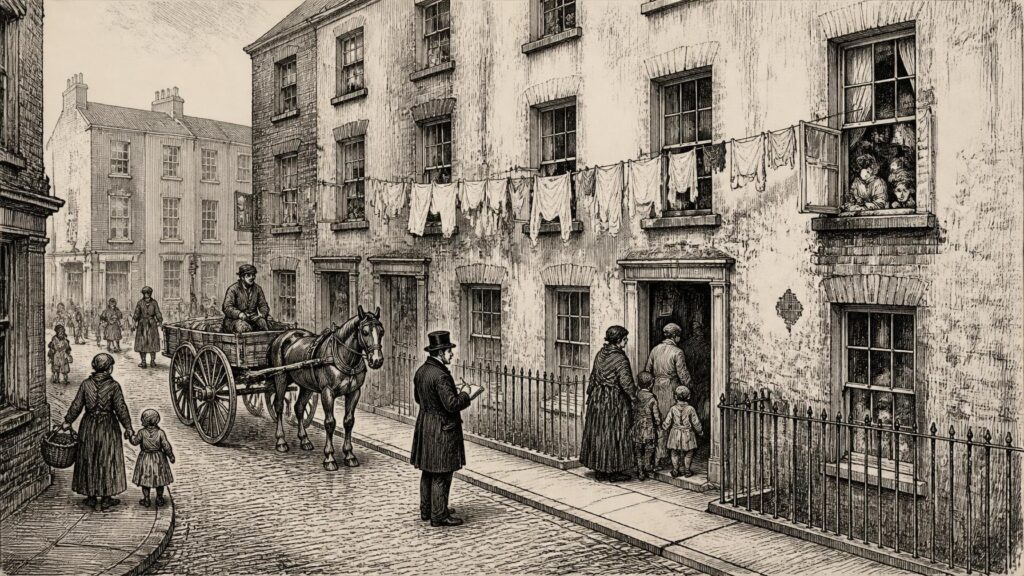
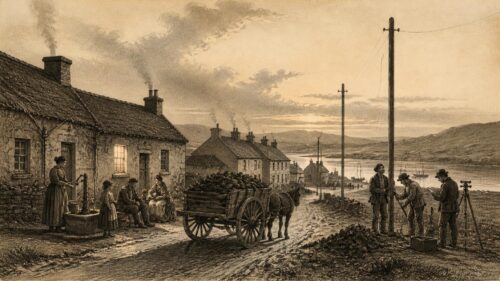
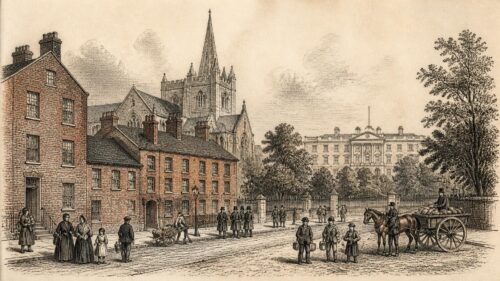
AI generated historical illustration, not a contemporary photograph.
At a Glance
Ireland’s recurring rental crises have never been only arguments about what a tenant can pay or what an owner may charge. They have concerned crowded rooms and public health, land and urban speculation, the duty of local authorities, the constitutional standing of property, and the uneasy boundary between a dwelling as a home and as an investment. From the tenement streets of nineteenth-century Dublin to the national rent rules introduced in 2026, housing policy has repeatedly attempted to reconcile needs that are real, competing and rarely settled for long.
Colonial Foundations
The modern Irish rental question was shaped under the Union, when the legal framework governing property and tenancy was made within the United Kingdom. It is important, however, not to collapse all forms of tenancy into one story. Rural occupiers, urban lodgers, tenants of furnished rooms, artisan households and commercial tenants faced differing conditions. The famous conflict between landlord and tenant in nineteenth-century Ireland is often recalled through agrarian struggle, estates and eviction. Yet the growing towns and cities created a connected, though distinct, problem: how ordinary households could obtain a secure, sanitary and affordable place to live.
The Landlord and Tenant Law Amendment Act (Ireland) 1860, commonly called Deasy’s Act, was a notable legal landmark. Its importance lay less in creating a wholly new social order than in stating and consolidating a contractual approach to landlord and tenant relations. In broad terms, it strengthened the legal means by which a landlord could recover possession for breach of contract. The law did not make a tenant powerless in every circumstance, nor did every landlord deploy it harshly. But it rested upon an assumption that the letting of a home was fundamentally a private agreement between parties with formally recognisable rights. That assumption sat uneasily beside extreme inequalities of wealth, information and bargaining power.
In urban Ireland, a shortage of decent dwellings made those inequalities acute. A household seeking rooms in a crowded city did not bargain from the same position as an owner holding scarce accommodation. The question was not simply the nominal rent. It was whether a room was dry, whether water and sanitation were available, whether a landlord maintained the building, whether subletting multiplied occupancy, and whether a family could remain after a wage loss, illness or bereavement. Rent therefore stood at the centre of a larger system of insecurity.
The language of crisis should nonetheless be used carefully. Contemporary reformers sometimes portrayed tenants as passive victims and landlords as a single predatory class. The documentary record supports neither universal claim. Some owners lived among their tenants and maintained property; some tenants exercised agency through family networks, lodging arrangements and collective pressure. What the evidence does establish is that legal formalism could coexist with profound material inequality. The rental market did not reliably produce healthy homes for those with the lowest incomes, particularly in Dublin’s inner city.
Urban Misery
Dublin’s tenements became the most enduring symbol of Irish urban housing failure. The city’s decline after the Act of Union, the conversion of former Georgian houses into multiple dwellings, limited industrial employment and persistent poverty created a housing pattern unlike the newer working-class districts found in many British cities. Large houses designed for a single prosperous household were subdivided, often repeatedly. Their original fabric was ill suited to dense occupation; maintenance lagged; and landlords, middlemen, tenants and subtenants could all occupy different positions within the chain of payment and control.
The 1911 census gives this history a sobering numerical form. University research drawing on the census records notes that Dublin contained more than 5,000 one-room tenements occupied by five or more people. Hundreds of those rooms held eight or more people. Such figures do not tell every family story, and they do not mean that every one-room household endured the identical conditions. Yet they demonstrate severe overcrowding on a scale that cannot be dismissed as anecdote. A room was at once bedroom, kitchen, living space and, for some, a place of work or lodging. Privacy was scarce and infection travelled easily.
Housing conditions were tied to public health. Mortality, tuberculosis and infant welfare became central to the politics of accommodation, while sanitary inspection revealed the limits of relying upon private repair. The public discussion of Dublin’s slums was not generated by one event alone. It emerged from reports, medical evidence, journalism, charitable activity and the lived knowledge of residents. Still, the collapse of two tenement houses on Church Street in September 1913, killing seven people, crystallised outrage. The subsequent housing inquiry was a recognition that unsafe dwellings were not merely misfortunes within private contracts; they were a civic problem demanding public scrutiny.
Later memory has sometimes turned the tenement into a simplified national emblem: a uniformly miserable world, peopled by helpless families and indifferent owners. Oral history and literature rightly convey hardship, solidarity and resilience, but they are not substitutes for evidence. The historical record supports a more precise conclusion. Tenement life encompassed varied households and degrees of poverty, yet structural overcrowding, poor sanitation and insecure occupancy were widespread enough to demand a state response. The persistence of these conditions shows why an account of Irish housing cannot begin with post-independence building programmes. The crisis had already made a powerful case for public intervention.
War Controls
The First World War changed the legal terms of renting. Housing scarcity and rising prices were not confined to Ireland, and wartime government answered them with the Increase of Rent and Mortgage Interest (War Restrictions) Act 1915. As the official explanatory memorandum prepared for the 1960 rent legislation later recalled, the first controls restricted rents by reference to their 1914 level. The measure was understood as temporary. Like much emergency law, however, it outlived the immediate emergency because the scarcity and political tensions that justified it did not simply vanish in peacetime.
Rent restriction did more than cap a price. It also limited recovery of possession in defined circumstances. Its object was protective: a tenant should not be displaced or charged an exceptional rent merely because accommodation had become scarce. But the policy also introduced a lasting difficulty. A rent fixed to an old baseline may protect a sitting tenant, while leaving insufficient income for repair, improvement or new construction. That difficulty should not be treated as a mechanical law. Landlords’ costs, property condition, tax, finance and demand all matter. Nonetheless, the problem of maintaining old housing with a frozen or tightly limited rental stream became a major feature of Irish debate.
Controls continued in changing forms after the establishment of the Free State. The framework was complicated by the inheritance of British legislation, subsequent Irish enactments and the different treatment of particular types of dwelling. The Second World War created another emergency and, in 1944, controls were extended through an Emergency Powers Order to dwellings beyond the older pre-1919 group. The Rent Restrictions Act 1946 consolidated the position. This was not a single uninterrupted freeze affecting every rented home in the same way. Eligibility depended upon matters such as the age of the building, whether it was furnished, the date of the tenancy and its rateable valuation.
The significance of this period is easily misunderstood. Wartime rent restrictions were not a complete housing policy. They moderated a consequence of shortage, but did not create enough homes, eliminate unsafe buildings or resolve the distribution of housing finance. They did, however, establish an important principle in Irish public life: the rent paid for a home could be regulated in the common interest. That principle would survive, although the legal mechanisms and political arguments around it would alter dramatically.
State Building
Independence brought a new institutional setting but no instant escape from housing scarcity. The Irish state inherited overcrowding, poor urban stock and constrained public resources. It also inherited local government bodies whose work had long included sanitary and housing responsibilities. The Department of Housing, Local Government and Heritage traces part of its administrative lineage to the nineteenth-century Poor Law system and the expanding responsibilities of local government. By the early Free State, the question was not whether public bodies had any role in housing; it was how far they could build, borrow, subsidise and manage.
Local authority housing became a central answer. New estates and cottages offered a material alternative to unregulated, deteriorating private accommodation. Slum clearance, rehousing and suburban development altered the geography of Irish cities, particularly Dublin. The result was not uncomplicated triumph. Clearance could uproot established communities; new estates were sometimes distant from employment and services; and authorities faced the conflicting pressures of construction cost, loan repayment and the needs of households with very low incomes. Yet municipal building represented a profound shift in practice. Government was no longer merely inspecting unhealthy housing or restraining rents. It was becoming landlord, builder and planner.
Evidence from the 1920s shows both ambition and constraint. State loans supported local authority building, but surveys found that the output remained insufficient to clear slums and meet need in towns and cities. A historical study held by University College Dublin records an official 1929 assessment that around 40,000 additional dwellings were required in urban local-authority areas. The same research warns against assuming that every new council house went to the very poorest households. Revenue concerns and the obligation to meet loan charges could encourage authorities to select tenants considered better able to pay. Housing policy was therefore shaped not simply by ideals of reform but by municipal finance.
The long transition away from inner-city tenements was similarly incomplete. UCD material on industrial Dublin records that unsuitable or hazardous urban housing remained widespread between 1913 and 1938, despite slum clearance. It also notes that many tenements still housed a substantial section of Dublin Corporation’s population in 1950. Such continuity is historically important. It cautions against a neat narrative in which independence solved the inherited housing crisis. Building programmes transformed lives and landscapes, but the old city and its poorest residents were not remade at the same pace.
Public provision nonetheless changed the balance of tenure. The state’s active role made it possible for lower-income households to obtain homes outside the most precarious portion of the private market. In later decades, a strong cultural and political preference for owner occupation would become equally influential. But the period of municipal construction established a durable lesson: when private supply does not provide adequate accommodation at affordable cost, government can choose to provide, finance or commission homes directly. Whether it chooses to do so at sufficient scale is a political and fiscal decision, not an historical inevitability.
Ownership Ascendant
From the mid twentieth century, Irish housing policy increasingly favoured owner occupation, while the private rented sector contracted. This pattern had several causes: building subsidies, credit arrangements, rising expectations of home ownership, local authority sales and the poor return offered by older controlled lettings. It would be too simple to say that policy deliberately abolished renting. Renting remained essential for students, migrants, mobile workers, older people and households unable or unwilling to purchase. Yet it often became a residual tenure: smaller, less politically central and associated with older or poorer-quality stock.
The Rent Restrictions Act 1960 sought to rationalise a complicated legacy. Its explanatory memorandum described the 1915 controls, the interwar changes, the 1944 extension and the 1946 consolidation. The new Act maintained permanent control for specified dwellings while relaxing its scope and raising controlled rents. It was an effort to make a patchwork system workable rather than a decision to abandon tenant protection. But its very complexity showed the difficulty of governing rents by inherited categories. A house built before a particular year, an unfurnished tenancy, a valuation threshold or the timing of a letting could determine whether a household belonged to a regulated or unregulated world.
The Economic and Social Research Institute, writing in 1979, described the controlled and uncontrolled private rented sectors as so different that they were better treated as separate sectors. The distinction reached beyond rent. It affected security of tenure, property condition and the practical relationship between landlord and tenant. This observation matters because discussions of “the rental market” often assume one market with one price signal. Historically, Ireland had overlapping rental systems, shaped by law, age of stock and tenure history.
The shrinkage of private renting had consequences. A reduced sector can be more vulnerable to shocks because it has less capacity to absorb people who cannot buy, who leave the family home, whose relationships end or who move for work. At the same time, older controlled properties could become neglected if rents were inadequate and enforcement weak. There was no costless choice between rigid price control and unrestrained market rents. The policy challenge was to balance affordable occupation, decent standards, investment in repair and sufficient new supply.
Historical interpretation should avoid presenting owner occupation as a mistake in itself. Secure ownership has given many Irish households stability and wealth over generations. The difficulty arose when political attention treated ownership as the normal destination and renting as a temporary exception. A rental sector perceived as transitional was less likely to receive the long-term institutional support required for professional management, secure tenure, affordable supply and effective enforcement. The vulnerabilities apparent in later crises had deep roots in this hierarchy of tenures.
Constitutional Limits
The old system of rent control encountered a decisive constitutional challenge in 1981. Landlords challenged parts of the Rent Restrictions Act 1960, including provisions on lawful rents and recovery of possession. In Blake and others v Attorney General, the Supreme Court upheld the finding that these provisions were repugnant to the Constitution. The Oireachtas explanatory memorandum for the Housing (Private Rented Dwellings) Bill 1981 described the court’s conclusion in stark terms: controls over rent and possession, without compensation, amounted to an unjust attack on landlords’ property rights.
The judgment did not mean that Irish law could never regulate rents or protect tenants. It did mean that regulation had to operate within constitutional limits, particularly the constitutional protection of property and the State’s power to delimit property rights according to the principles of social justice and the exigencies of the common good. Those phrases have often been invoked as if they automatically answer policy questions. They do not. They establish a field of argument in which proportionality, public purpose, burden and fairness matter.
The 1981 moment marks a turning point in the history of Irish rental policy. First-generation rent control, associated with long-standing ceilings tied to historical rents, had become legally and practically untenable. The question thereafter was how to protect occupiers without recreating a regime seen as confiscatory or so rigid that it discouraged maintenance. The replacement approach placed greater emphasis on registration, standards, court or tribunal mechanisms, and contractual arrangements. It was a different settlement, not the end of the housing problem.
There is a tendency in modern argument to deploy the 1981 decision as a conversational weapon. One side claims that it proves rent regulation impossible; another suggests that it was merely an obstacle manufactured by vested interest. Neither reading is satisfactory. The documentary evidence supports a narrower conclusion. The particular statutory scheme was struck down in its particular legal context. Later governments were still able to legislate extensively for security of tenure, rent review procedures, registration and rent stabilisation. Constitutional law constrained policy design; it did not abolish public responsibility for housing.
Market Return
The private rented sector regained importance from the 1990s onward. Economic growth, population change, inward migration, delayed home purchase and the expansion of higher education increased demand for rented accommodation. Construction rose sharply during the property boom, but its composition did not guarantee an enduring supply of affordable, secure rentals. When the financial crisis followed, the housing system faced a different but related set of pressures: distressed mortgages, halted building, constrained credit, unemployment and an eventual shortage of available homes in high-demand areas.
The Residential Tenancies Act 2004 was a major institutional response before the full consequences of the later crisis emerged. It established a modern statutory framework for much of the private rented sector, including registration and a dispute-resolution structure, while giving tenants forms of statutory security through Part 4 tenancies. The Act did not create universal permanence, and it included exclusions and grounds for termination. Its importance lay in moving the sector away from a model in which disputes were principally matters of ordinary private law and toward a specialised regulatory system.
The emergence of the Residential Tenancies Board gave the state a more substantial informational and enforcement role. Registration made it easier to observe a sector that had often been poorly documented. Dispute resolution recognised that a tenant facing an unlawful rent demand, poor standards or an improper notice may not be in a realistic position to vindicate rights through costly ordinary litigation. This was not a return to the rent freezes of the old regime. It was the construction of a regulatory infrastructure appropriate to a larger and more varied rental sector.
Census evidence illustrates the significance of that sector. In 2022, the Central Statistics Office recorded 330,632 households renting from private landlords, a rise of 7 per cent since 2016. The same census found that owner occupation had fallen to 66 per cent of households, down from almost 70 per cent in 2011. These figures should not be used to imply that every renter faces crisis or that every owner is secure. They do show that renting has become a normal and consequential tenure for a large section of the population, rather than a marginal stage before ownership.
With that renewed importance came renewed vulnerability. High rents can transfer a large share of household income to accommodation, restrict the ability to save, delay household formation and make a notice to quit profoundly destabilising. Limited supply also means that a tenant may have legal rights yet be unable to find a realistic alternative home. The rental crisis, in this sense, is not only an issue of price. It is a crisis of availability, security, standards and power in a market where moving is often expensive and involuntary.
Modern Regulation
Rent Pressure Zones, introduced in late 2016, were Ireland’s principal modern attempt to restrain rapid rental inflation. The Planning and Development (Housing) and Residential Tenancies Act 2016 initially capped rent increases in designated areas, generally by reference to a maximum annual increase of 4 per cent. Designation depended on evidence of high and rising rents. The initial areas included Dublin’s four local-authority areas and Cork City, with other areas added later. The policy was deliberately more flexible than the older system: it concerned the rate of increase rather than fixing every rent at a historic nominal level, and it contained exemptions for some new or substantially altered accommodation.
The results are not a matter for folklore. ESRI research found that the policy moderated rental inflation in designated areas, estimating reductions in rent growth of between two and five percentage points using different methods. That is evidence of effect, not proof that the regime solved affordability. A slowing of increases does not make a rent affordable when the starting level is already high. Nor does it supply a dwelling where none is vacant. Still, the research challenges the assertion that regulation necessarily has no influence on rents.
The counterargument also has evidence behind it. Research published by the ESRI in 2025 found signs of rental-market exit after controls were tightened in 2021, including more properties listed for sale and fewer rental listings or registrations near the relevant policy boundaries. The study does not establish that every landlord departure was caused by rent rules, nor does it show that tenant protections are dispensable. It does demonstrate why policy assessment must examine supply as well as prices. A rule that protects a continuing tenant may have different effects on a potential tenant searching for a home.
In June 2025, Rent Pressure Zone rules were extended nationwide. On 1 March 2026, the framework changed again: Rent Pressure Zones were replaced by a national system of rent control for private and student-specific accommodation. The current regime also introduced rolling six-year tenancies of minimum duration for new tenancies, with different termination rules for smaller and larger landlords. Existing tenancies were retained within their own protections. The changes illustrate a recurring Irish pattern: rental law is repeatedly adjusted as policymakers attempt to protect occupation while retaining or restoring investment.
Cost rental forms another strand of the contemporary response. Introduced in 2021, it aims to provide secure homes at rents linked to the cost of provision rather than the highest market price, generally at a stated discount to market levels. Historically, this matters because it revives an older insight in a new form. A society need not choose only between private market rent and traditional public housing. It can support non-profit, municipal, approved-housing-body and cost-based forms of supply. Their effectiveness depends not on the label alone but on land, finance, scale, management and long-term commitment.
Policy Lessons
History does not issue a ready-made housing programme. The Dublin tenement, the wartime rent ceiling, the council estate, the 1981 constitutional decision and the twenty-first-century Rent Pressure Zone arose from distinct economic and legal circumstances. It would be misleading to claim that any one period supplies an easy blueprint for another. In particular, an early twentieth-century control tied to a 1914 or 1941 rent baseline is not equivalent to a modern cap on annual increases, and neither is identical to a cost-rental system.
History can nevertheless clarify the choices. First, supply matters, but so does the kind of supply produced. A large number of homes that are unaffordable, insecure or badly located does not resolve the needs revealed by the rental crisis. Second, tenant protection matters, but the conditions of property maintenance and future provision cannot be ignored. Third, legal rights require institutions capable of enforcing them. Registration, accessible dispute resolution, inspection and reliable data are not bureaucratic extras; they determine whether law changes everyday conditions.
Fourth, public provision remains indispensable whenever private returns and social need diverge sharply. The history of municipal housing demonstrates that state action can shift the practical options available to households. Its limitations also show why provision must be adequately financed and connected to transport, employment, schools and services. Fifth, property rights and housing rights should not be treated as abstractions belonging to opposed camps. Homes are assets, but they are also places where people sleep, raise children, recover from illness and participate in community. Democratic policy must confront both facts.
The enduring lesson is that rental crises are produced over time. They emerge when population, wages, construction, finance, land values, law and political priorities cease to align with the need for secure homes. They also persist when debate reduces the problem to a single lever: more building, stricter controls, larger subsidies or stronger evictions law. Ireland’s history suggests that durable improvement requires a settlement broad enough to include supply, affordability, standards, security and public capacity. Such settlements are difficult, contested and provisional. They are nevertheless more realistic than the hope that an ungoverned market, or one isolated legal reform, will resolve a crisis rooted in the whole housing system.





The article’s account of Ireland’s rental history highlights a persistent tension: rent protections can shield tenants during scarcity, yet may affect maintenance, investment and the availability of homes. Its comparison with municipal building is especially revealing, because public provision offered an alternative to reliance on private landlords, although finance and allocation created their own constraints. The article also stresses that today’s institutions differ substantially from earlier periods. When assessing contemporary rent stabilisation, what lessons from the relationship between regulation and public building remain useful, and how should policymakers balance secure tenancies, property rights, housing standards and new supply in Ireland?