

Precarious Shelter
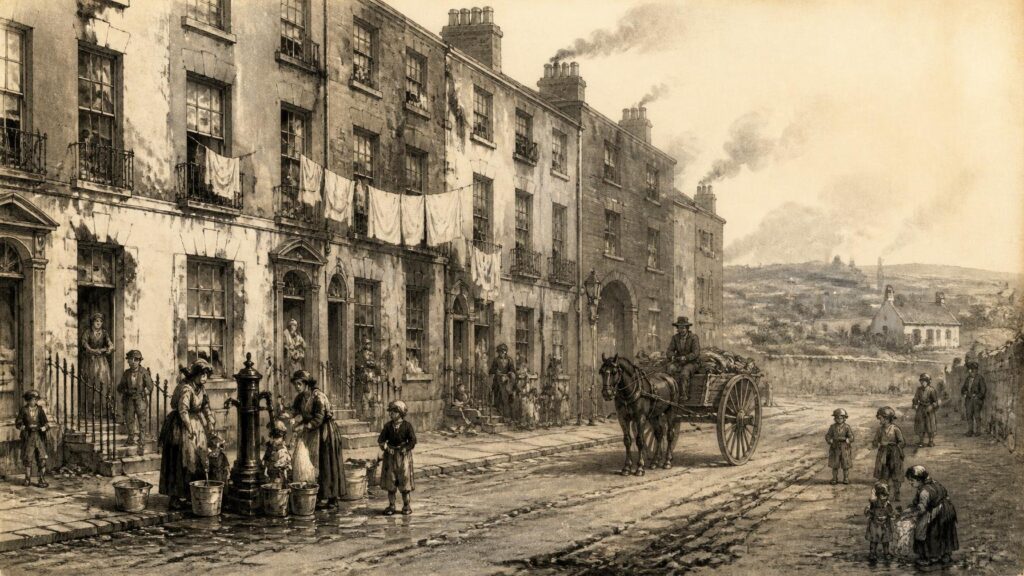
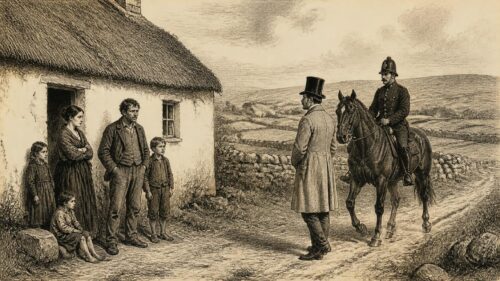
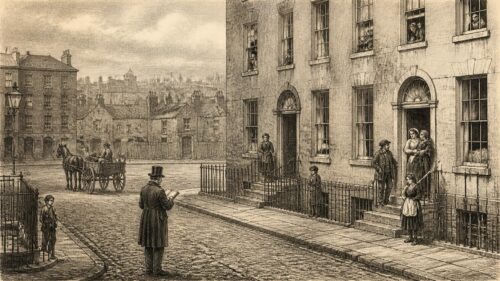
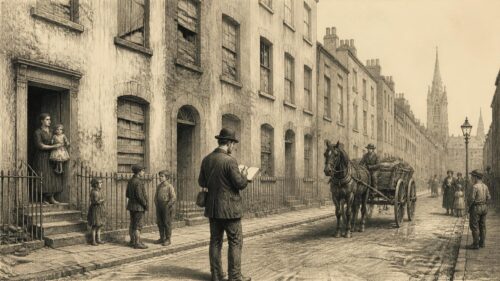
AI generated historical illustration, not a contemporary photograph.
At a Glance
In Ireland, the history of housing is inseparable from the history of power: who possessed land, who controlled rents, who could leave a home, and who was forced to accept whatever shelter could be found. Homelessness, likewise, has never meant simply sleeping outdoors. It has included the workhouse inmate, the lodger in an overcrowded room, the family doubled up with relatives, the person in a hostel, and those hidden from official notice in precarious accommodation. The Irish record is therefore a history not only of buildings but of insecurity, dignity, public responsibility and the uneven extension of citizenship.
Defining Home
“Housing” and “homelessness” are modern administrative words, but the conditions they describe are old. A home may be a dwelling, a legal tenancy, a place of family belonging, or a secure base from which work, schooling and health can be sustained. Those meanings do not always coincide. A person may have a roof while living in dangerous crowding, temporary lodgings or accommodation controlled by another household. Conversely, someone without a conventional tenancy may retain social ties and a place in a community. Historians need to keep these distinctions in view, particularly in Ireland, where informal lodgings, institutional accommodation, migration and emigration often concealed housing need from official records.
Documented evidence is strongest where censuses, inspectors, commissions, local-authority records and legislation survive. Such sources reveal numbers of rooms, household sizes, rents, building programmes and administrative decisions. They are less reliable guides to private experience. Family reminiscence, songs, memoirs and literary works preserve important emotional truths, but they should not automatically be treated as representative evidence. The familiar image of the Irish poor as permanently cabin-dwelling, and the equally familiar image of every Dublin tenement as identical misery, flatten a more varied reality. Extreme deprivation was real and repeatedly recorded; so too were gradations of security, mutual aid and aspiration.
The subject also demands an all-island perspective while recognising constitutional change. Before 1922, housing conditions in Ireland were shaped by the institutions of the United Kingdom. After partition, housing developed under separate administrations in the Irish Free State, later Ireland, and Northern Ireland. Dublin’s tenements have dominated popular memory, yet rural cottages, provincial towns, Belfast industrial districts and the lodging systems of ports and market towns are equally part of the larger story. This article concentrates principally on the territory of the present Republic while noting that housing questions long crossed political boundaries.
Rural Foundations
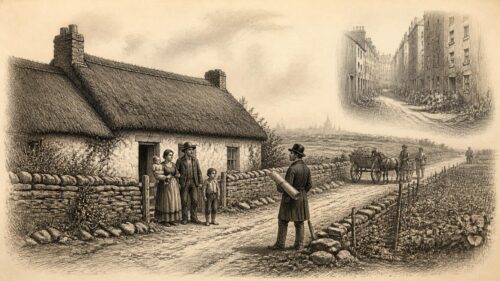
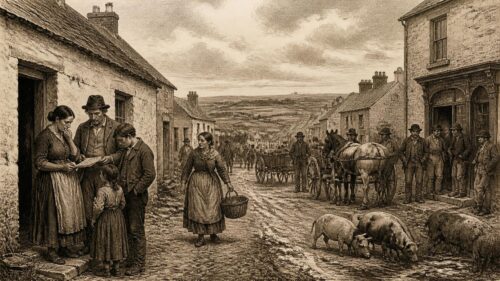
For much of the eighteenth and early nineteenth centuries, the housing of the rural poor was bound closely to agricultural employment, subdivision of holdings and insecure access to land. Cabins could be erected cheaply from local materials, altered by occupants and abandoned when households moved. Their very impermanence makes them difficult to recover in the archive. Valuation records, estate papers and travellers’ accounts nevertheless show that many labouring families lived in small, poorly built dwellings, often on marginal plots or by roadsides. A cottage could offer independence from a landlord’s demesne or a farm employer, but it might also be overcrowded, damp and vulnerable to eviction.
The relationship between landholding and shelter mattered greatly. A tenant farmer with a secure holding had a different prospect from a landless agricultural labourer paid by the day or season. The widespread reliance on conacre and other short-term arrangements made household formation precarious. Marriage, family size and the availability of small plots could affect whether a couple established an independent home. In this setting, housing was not a distinct market sector. It was embedded in the unequal rural economy and in local systems of patronage.
Accounts of pre-Famine Ireland must be handled carefully. They often use vivid language of mud cabins and destitution, and some were written by officials or commentators with political purposes. Yet the broad pattern is beyond serious doubt: many rural dwellings were slight, crowded and dependent on the fragile incomes of the poor. The category once used in census returns as “fourth-class” housing, broadly associated with the most rudimentary cabins, indicates the scale of substandard accommodation. It does not mean that every family in such a house experienced the same degree of hardship, but it records a material problem that neither custom nor local charity could solve.
Poor Law
The Irish Poor Law, introduced in 1838, created a system whose central institution was the workhouse. It was not designed as housing policy in the modern sense. Rather, it provided relief under deliberately deterrent conditions, based on the belief that assistance should be less desirable than independent labour. Workhouses were erected across Ireland in the early 1840s and organised through Poor Law unions and elected boards of guardians. They separated residents by age, sex and status, and they imposed institutional discipline on those who entered.
The Great Famine exposed both the scale of need and the cruelty of treating shelter as a test of desperation. Workhouses became overwhelmed by destitute people, including families whose homes, livelihoods and local support had collapsed. Admission could mean separation from kin; refusal could mean exposure, hunger or migration. The workhouse should not be imagined as the only housing crisis of the Famine years, since countless people were displaced without entering one. But it became a potent symbol of how relief could substitute institutional custody for a secure home.
After the Famine, many workhouses continued in altered forms. Their buildings later served as county homes, hospitals, welfare institutions and other public facilities. This institutional afterlife matters because it helped shape Irish attitudes towards homelessness. People without housing were frequently understood through categories of poverty, illness, old age, childhood, disability or perceived moral failure. Such categories could bring care, but they could also make the absence of a home appear to be an individual defect rather than a failure of supply, income or rights.
There is a persistent folklore that every workhouse resident had been rejected by family or was wholly without alternative. The surviving evidence gives a more complicated picture. Some entered because of acute destitution, bereavement or illness; some families used institutions in periods of crisis; others avoided them at great cost. What is certain is that the Poor Law made public assistance conditional on submission to an institution. It did not establish a general entitlement to adequate independent housing.
Urban Decline
Dublin’s nineteenth-century housing crisis emerged from a distinctive urban history. The city had been an important eighteenth-century capital, marked by grand streets and large Georgian houses. The Act of Union in 1800 abolished the Irish parliament, and many members of the political and social elite no longer required town houses near a legislature in Dublin. Their departure was not the sole cause of urban poverty, but it contributed to changes in property values and occupation. Large houses were subdivided, frequently passing through layers of owners, middlemen and tenants.
At the same time, Dublin did not develop industrially at the pace of several British cities. It contained major employers and skilled trades, but its economy did not generate sufficient secure, well-paid work for its growing labouring population. Rural migration, casual employment and weak municipal resources intensified pressure on low-cost rooms. In the inner city, families rented space rather than whole houses. A once-elite dwelling could contain numerous households, each with access to one room and shared yards, stairways and sanitary arrangements.
Other Irish towns experienced poor housing, but Dublin became the most notorious case. Belfast’s industrial expansion produced its own overcrowded working-class districts, while Cork, Limerick, Waterford and provincial towns had serious deficiencies. Dublin’s tenements acquired exceptional prominence because their density, the visibility of their decay and the city’s cultural centrality made them a powerful national symbol. The danger is that the symbol can obscure the rural poor, whose housing problems often took the form of isolated cottages, lodgings tied to employment, overcrowded farm homes or forced migration.
Tenement Lives
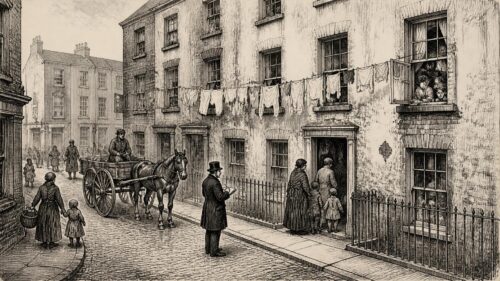
The tenement was not a single building type but a form of divided occupation. A large house might be partitioned into flats or rooms; a purpose-built block might also be called tenement housing. What united these arrangements was the letting of limited space to multiple households. The 1911 census and contemporary inquiries reveal the scale of Dublin’s overcrowding. More than 20,000 families were recorded in one-room accommodation in the city, while thousands more occupied two rooms. Such figures are stark because a “family” could include parents, children, relatives or lodgers.
Overcrowding had practical consequences. One room might serve simultaneously as kitchen, bedroom, workplace and sickroom. Water could be obtained from a shared tap; toilets were often communal, badly maintained or inadequate; refuse disposal was unreliable. Dampness, poor ventilation and structural neglect created conditions in which infectious disease spread readily. Contemporary observers repeatedly linked tenement life with high mortality, tuberculosis and infant deaths. Their language can be sensational, but the public-health crisis was real and is corroborated by medical and demographic research.
Yet tenement life cannot be reduced to a catalogue of filth. Tenements were homes, however constrained. Residents formed neighbourly networks, borrowed food, shared childcare, organised local politics and created social worlds in courts, streets and stairwells. They also experienced conflict, surveillance and stigma. Oral testimony and literature have preserved the humour and solidarity of these communities, but these qualities should not romanticise conditions that many inhabitants struggled to escape. Mutual support was often a response to poverty, not evidence that poverty was bearable.
Landlordism in the city was similarly varied. Some owners were negligent, some were exploitative, and others maintained properties to differing standards. The presence of a landlord who repaired a roof did not make a one-room dwelling suitable for a large family. Nor does the existence of decent tenancies cancel the evidence of slum conditions. Historical interpretation is strongest when it rejects both comforting extremes: that every property owner was a caricature of greed, or that only a few isolated houses were unfit.
Public Health
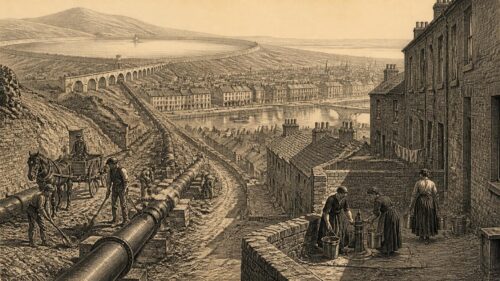
Housing became a public issue partly because disease made private neglect visible. Sanitary reformers inspected drains, privies, water supplies, yards and cellars, turning domestic conditions into subjects of reports and regulation. The Housing of the Working Classes Act 1890 consolidated earlier legislation and gave local authorities powers connected with unhealthy areas, improvement schemes and working-class dwellings. It also reflected a wider change in official thinking: the state could not ignore housing if bad housing endangered public health and urban order.
The law did not itself rebuild Dublin. Local authorities faced financial limits, legal complexities and the difficulty of rehousing people who could not afford improved accommodation. Clearance could remove an unhealthy building while displacing residents into other overcrowded rooms. This recurring contradiction runs through housing history. Demolition may be necessary where structures are unsafe, but it does not resolve a shortage unless replacement homes are accessible, affordable and located where households can sustain work and family life.
Private philanthropy attempted part of the response. The Dublin Artisans’ Dwellings Company, founded in the 1870s, built purpose-designed accommodation. The Iveagh Trust, established by Edward Cecil Guinness in 1890, developed dwellings, a hostel and public baths around St Patrick’s Cathedral. These initiatives mattered architecturally and socially. They demonstrated that better urban housing could be built and managed. But their reach was limited, and the rents of even improved dwellings could exclude casual labourers and the very poor. Philanthropy eased suffering without transferring the full obligation of housing provision from charity to public authority.
Rural Cottages
Rural housing followed a partly different route. The Labourers’ Acts, beginning in the 1880s, enabled local bodies to provide cottages and small plots for agricultural labourers. The measures were significant because they acknowledged that those who worked the land might require publicly supported homes of their own. Local authorities could acquire sites, borrow funds and build cottages, usually with an allotment attached. By the eve of the First World War, nearly 50,000 such houses had been built under the legislation and related schemes.
The labourer’s cottage was more than a building. It could reduce dependence on a farmer for accommodation, allow a household to grow food, and provide a measure of privacy unavailable in a crowded family home or tied cottage. It was also a political achievement, won through agitation by labourers, unions and local representatives as well as enacted from above. The cottage programme therefore complicates the idea that pre-independence Ireland did nothing for working-class housing.
Its limits were substantial. A cottage did not guarantee a living wage, permanent work or equality in a rural society still dominated by property. Allocation could be affected by local influence. The attached plot was valuable but could add labour to already precarious lives. Some cottages later required modernisation; others were isolated from services and employment. Still, the programme left a visible landscape across the country and established an important precedent: local government could directly intervene in the provision of decent dwellings.
Revolutionary Years
The years surrounding the First World War, the 1916 Rising, the War of Independence and the Civil War did not suspend the housing crisis. Wartime pressures impeded building, while Dublin’s inner-city slums remained dangerously overcrowded. The collapse of tenement houses, notably disasters in 1913, focused public anger and produced inquiry. Such events did not reveal a previously unknown problem; they made structural neglect impossible to ignore. The dead and injured gave urgency to conditions residents had endured for decades.
Nationalist rhetoric frequently imagined the coming Irish state as a moral departure from poverty and absentee governance. Housing was part of that expectation, though it competed with immense political, fiscal and security challenges. The new Free State inherited inadequate dwellings, limited resources and a local-government structure accustomed to constrained powers. It also inherited an urban working class whose needs could not be met simply by land reform. The transfer of agricultural land from landlord to tenant was transformative for many farming households, but it did not solve the plight of urban renters.
It is tempting to present independence as either total rupture or total continuity. Neither is satisfactory. Constitutional change created new possibilities for Irish policy, symbolism and public expenditure. At the same time, the physical fabric of poor housing, the costs of construction and the unequal distribution of income did not disappear in 1922. The slow pace of improvement in many urban districts demonstrates that political sovereignty alone could not provide homes.
State Building
Interwar governments increasingly used housing construction and slum clearance as instruments of social policy. Local authorities built estates and houses, while central government provided subsidies and regulated the framework of provision. In Dublin, the replacement of inner-city tenements with suburban estates reshaped the city. Families moved to places such as Marino, Cabra, Crumlin, Drimnagh and later Ballyfermot, gaining houses with gardens, indoor facilities or improved space by the standards of the period.
The gains were real. For many families, a local-authority house meant an end to one-room living, shared privies and unreliable landlords. Children had space to sleep and play; women often gained safer cooking and washing facilities; households could establish longer-term routines. It is important not to dismiss these changes because later generations identified shortcomings in estate design or services. The move from a collapsing inner-city room to a sound house was, for many, a profound improvement in health, privacy and self-respect.
But rehousing could also sever established networks. A suburban estate might initially lack shops, transport, schools, churches, paved roads or employment nearby. Residents who had lived close to casual work, relatives and familiar streets found themselves at a distance from both livelihood and support. The history of clearance is therefore not a simple ascent from slum to suburb. It contains both relief and dislocation. The most persuasive interpretation recognises residents as active makers of new communities, rather than passive recipients of official planning.
Persistent Tenements
Despite substantial construction, tenements did not vanish quickly. Reports in the 1940s and 1950s continued to document overcrowding and unhealthy conditions in Dublin. The survival of bad housing after decades of official attention indicates the depth of the shortage. New homes had to meet population needs, replace unfit structures and accommodate households displaced by clearance. Wartime restrictions, material shortages and limited finance further slowed progress.
By the middle decades of the twentieth century, the contrast between national ideals and inner-city realities was increasingly embarrassing. Ireland was represented as a society of home, family and moral order, but many citizens lacked the space and security associated with that image. The contradiction was not merely symbolic. Poor housing shaped illness, schooling, domestic labour and family relationships. A child’s chances could be affected by whether there was a quiet place to sleep, study or recover from sickness.
The eventual decline of the traditional tenement system resulted from a combination of clearance, new building, changing household patterns and economic development. Its material traces remain in converted houses, surviving flats and the urban memory of particular streets. Museums, archives and restoration projects have made this history more visible, but visibility can encourage nostalgia. A preserved room is an interpretative setting; it cannot reproduce the uncertainty of rent collection, overcrowding, bereavement or disease that defined many residents’ lives.
Council Homes
For much of the twentieth century, local-authority housing became a central pillar of Irish provision. Scholarly work from University College Dublin has shown that the sector was unusually important in the early decades of the state: by 1961, social housing accommodated 18.4 per cent of Irish households. Council houses and flats were not residual accommodation for a tiny group. They served a broad range of lower- and moderate-income households and helped expand the nation’s housing stock.
This achievement should be assessed in context. Ireland remained poorer than many western European states, and housing quality varied by place and period. Nevertheless, direct public building allowed families to secure homes at rents related to income rather than solely to market pressure. Councils acted as landlords, builders and planners. Their estates also generated political relationships, tenant associations and expectations that housing was a public service rather than a commodity alone.
Tenant-purchase schemes altered this landscape. Home ownership offered many former tenants security and an asset, but large-scale sales reduced the stock retained for future low-income renters. From the later twentieth century, council building declined in relative importance while private ownership, private renting and non-profit housing associations assumed larger roles. This was not simply an Irish development; it formed part of wider shifts in policy. In Ireland, however, it had particular consequences because public construction had previously been so central.
Changing Tenure
The late twentieth century brought a stronger political and cultural preference for owner occupation. Owning a home was associated with independence, family security and social advancement. Those aspirations were understandable in a society with long memories of landlord control and insecure renting. Yet a system strongly oriented towards ownership could leave renters exposed when rents rose or supply tightened. It could also encourage policymakers to treat social housing as a residual safety net rather than a mainstream form of tenure.
Housing need did not disappear during periods of economic growth. It changed form. Young adults remained longer in parental homes; separated adults sought smaller dwellings; migrants entered a rental market of uneven quality; and households with low or unstable incomes struggled to obtain secure leases. Vacant properties, dereliction and unsuitable accommodation could coexist with acute demand. The fact that houses existed did not mean they were available at a rent or price ordinary households could meet.
Interpretations of this period often divide too easily between “market” and “state”. In practice, Irish housing has long depended on mixed arrangements: public subsidies, tax measures, regulation, banks, private landlords, voluntary bodies, family transfers and local-authority allocations. The key historical question is not whether the state was present, but how its resources and rules distributed risk. When public building fell, the consequences were felt most sharply by people least able to compete in the market.
Hidden Homelessness
Homelessness became more visible in public debate during the 1980s, but it was not new. Earlier generations had slept in lodging houses, institutions, missions, workplaces, makeshift shelters or the homes of relatives. Many women and children experiencing housing insecurity were especially likely to be hidden from street counts. A person leaving violence, family breakdown or an unsafe tenancy might avoid rough sleeping by moving repeatedly between friends, relatives and temporary rooms. This did not make their position secure.
Voluntary organisations played a major role in exposing these experiences. Focus Point, later Focus Ireland, opened in Dublin in 1985 after research by Sister Stanislaus Kennedy into the needs of homeless women. Such work challenged the stereotype of homelessness as an exclusively male, street-based condition. It showed how lack of a home could be concealed by institutional admissions, temporary lodging or dependence on others. The language of “hidden homelessness” helped widen public understanding, though it also revealed how difficult reliable counting could be.
The Housing Act 1988 marked an important legal change. It defined a person as homeless where no accommodation was available that they could reasonably occupy or remain in, including certain people in institutions because they had no such accommodation, and where they could not provide it from their own resources. The definition did not solve homelessness, but it placed duties of assessment and powers of assistance within the work of housing authorities. It was a shift from treating homelessness chiefly as charity or emergency relief towards recognising it as a housing matter.
Legal Recognition
Legal definitions necessarily draw boundaries. They enable authorities to assess need and organise services, but they can also exclude people whose insecurity does not fit prescribed categories. A person living in a severely overcrowded household, for example, may not be recorded in the same way as someone in emergency accommodation. Administrative numbers are therefore indispensable but incomplete. They measure particular forms of need according to rules that have changed over time.
Following the 1988 Act, local authorities became more clearly involved in homelessness assessments and emergency responses. Later legislation required homelessness action plans and consultation structures. The institutional framework brought local government, health services and voluntary providers into closer relationship. It also created a pattern in which emergency accommodation could become a substantial part of the response. Emergency provision is necessary when people have nowhere safe to stay; historically, however, it has often been easier to fund a temporary bed than to provide a permanent home.
That distinction is central. A hostel, hotel room or other emergency placement may avert immediate danger, but it cannot automatically offer the security, privacy and control associated with home. Families need space for ordinary domestic life; individuals need stability from which to manage health, work, recovery and relationships. The historical lesson is not that emergency services are unimportant. It is that a system centred on emergency risks normalising the absence of settled housing.
Housing First
Housing First emerged as a significant policy response to long-term homelessness and rough sleeping. Its underlying principle is that people with complex needs should not have to prove “housing readiness” before receiving a permanent home. Instead, stable housing is provided alongside voluntary, continuing health and social supports. Ireland piloted Housing First in Dublin in 2011, and a national implementation plan followed for 2018 to 2021, with a further plan for 2022 to 2026.
In historical terms, the approach represents a notable reversal of older institutional assumptions. The workhouse and many later shelters placed accommodation within regimes of discipline, assessment or temporary refuge. Housing First begins with the premise that a home is the platform from which other difficulties can be addressed. It does not deny the importance of addiction, mental health, disability, trauma or imprisonment in some people’s experiences of homelessness. Rather, it refuses to make resolution of those issues a precondition for a tenancy.
The policy has limits as well as promise. It requires an adequate supply of ordinary, affordable dwellings and sustained support teams. It cannot compensate for a wider shortage of social and rental housing. Nonetheless, it has altered public language by insisting that the person who has slept rough is not merely a client of a shelter system but a tenant and resident with a claim to permanence. That conceptual shift belongs to the longer Irish history of moving, unevenly, from relief to rights.
Present Reckoning
The recent housing crisis has renewed public attention to rents, supply, evictions, vacant homes, social-housing waiting lists and emergency accommodation. These are contemporary matters, but they should not be treated as though they emerged from nowhere. Ireland’s past shows recurring mismatches between where homes were needed, what households could afford and what public institutions were willing or able to provide. It also shows that housing conditions influence health, educational opportunity, family life and participation in civic life.
Historical analogies must be used with care. A family in hotel accommodation today does not live the same experience as a tenement household in 1911, and a modern apartment shortage is not identical to a nineteenth-century cabin crisis. The legal context, welfare system, household structure and built environment are different. Yet there is a legitimate continuity in the underlying question: whether secure shelter is treated as a foundation of social membership or as a benefit distributed chiefly through purchasing power.
The record offers no simple golden age. Philanthropic schemes helped but could not reach everyone; municipal building transformed lives but sometimes displaced communities; home ownership created security for many but did not protect those outside it; emergency services saved lives but could not substitute for homes. What the evidence does support is a clear conclusion. Housing insecurity in Ireland has repeatedly been produced not by a lack of sympathy alone, but by structural decisions about land, finance, tenure, public investment and whose needs count as urgent.
Historical Lessons
The first lesson is that homelessness is broader than rough sleeping. Irish experience demonstrates the importance of counting insecure lodgings, institutional stays, concealed family homelessness and overcrowding as well as visible street homelessness. The second is that the quality of a dwelling matters. A roof over a family is not necessarily a home if it is unsafe, unaffordable, overcrowded or liable to disappear at short notice.
The third lesson concerns public capacity. Large improvements in Irish housing conditions were achieved when local and central government directly financed, built or enabled homes at scale. That does not prove that every future solution must repeat an earlier model unchanged. It does show that leaving provision entirely to private calculation has repeatedly failed those with low incomes or insecure work. The fourth lesson is that residents’ voices matter. Labourers, tenants, women experiencing hidden homelessness and estate communities have shaped policy when they organised, testified and refused to remain invisible.
Finally, historical memory should be humane without becoming sentimental. The tenement room, the labourer’s cottage, the workhouse ward and the council estate were all places where people made lives under pressure. They were not merely backdrops for national drama. To understand housing and homelessness in Ireland is to understand how ordinary people negotiated dependence and belonging. The enduring challenge is not simply to put bodies indoors, but to make secure homes possible for those whom earlier systems repeatedly left at the threshold.
One issue is the article’s insistence that homelessness cannot be measured by rooflessness. Workhouse residents, overcrowded lodgers, families staying with relatives and hostel users could be insecure, yet informal arrangements often escaped official records. This makes provision a history of visibility: those most dependent on unstable shelter may have been least legible to policy-makers. The comparison between Dublin tenements and rural labourers’ cottages suggests that improved dwellings could offer security without removing inequalities of income, power or access to work. How should historians and present-day housing policy balance statistical records with lived experience when defining housing need and evaluating solutions?