

Rent Reckoning
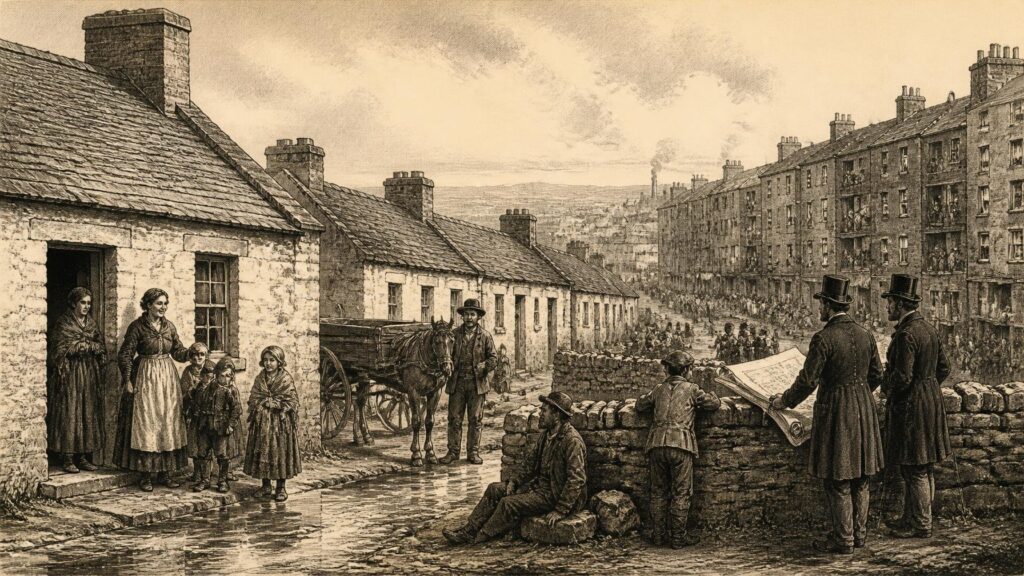
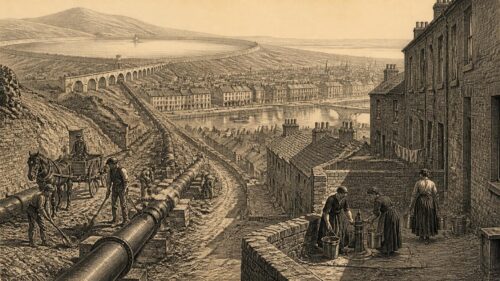
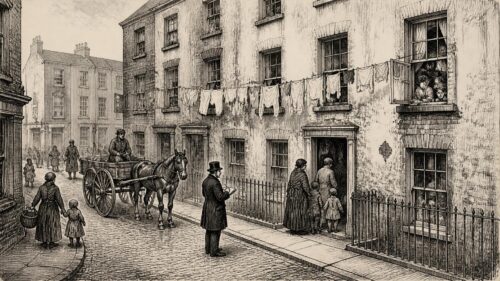
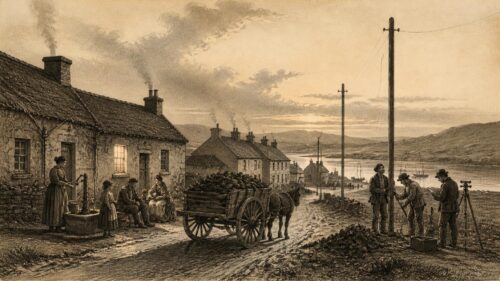
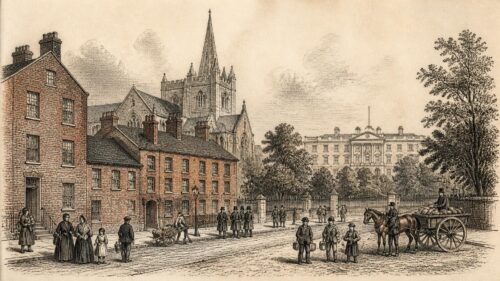
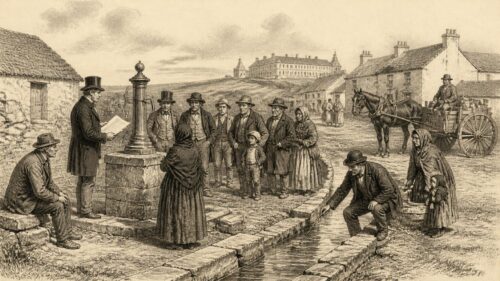
AI generated historical illustration, not a contemporary photograph.
At a Glance
Housing and rent reform in Ireland is not a single story of state intervention or market retreat. It is a long argument about land, ownership, health, class and citizenship, conducted in cottages, tenements, council chambers, courts and the Oireachtas. Its changing laws reveal a recurring difficulty: how can a society protect the home as a place of security while recognising property as an economic right? The answer has never remained fixed for long.
Housing Question
Irish housing history is often narrated through the recent language of crisis, shortages and unaffordable rents. Those matters are important, but they can obscure how old the underlying questions are. Long before the modern State, the condition of dwellings was tied to public health, agrarian power and the relationship between landlord and tenant. In rural districts, the insecurity of labourers’ cabins stood alongside the much larger political contest over agricultural tenancies. In towns and cities, overcrowded tenements, bad sanitation and insecure lettings made housing a visible social problem. Rent was not simply a private payment. It shaped whether a family could remain near work, school, kin and parish.
The nineteenth-century Irish land question supplies an essential, though incomplete, starting point. Tenant farmers’ agitation concerned landholding rather than urban residential rents in the later sense, yet it decisively altered public ideas about ownership and occupation. The successive Land Acts increasingly enabled tenants to acquire land, and that transformation made ownership a powerful ideal in independent Ireland. It helped create a political culture in which the secure home was frequently imagined as one owned by its occupier, rather than one protected by a strong and permanent rental system.
That inheritance should not be exaggerated. Agricultural landholding and urban renting were legally and socially different worlds. A rural tenant farmer was not a Dublin tenement tenant, and the land reforms did not solve urban overcrowding. Nevertheless, the association between independence, security and proprietorship became enduring. Later governments would support local-authority building while also encouraging households to purchase dwellings. Housing reform therefore developed through two linked but sometimes competing ambitions: to supply decent homes for people unable to obtain them privately, and to extend owner-occupation where possible.
The evidence also warns against a comforting national story in which reform steadily displaced hardship. New laws could produce real improvement, but unevenly. Local capacity, land availability, construction costs and the ability of households to meet rent or repayment obligations all mattered. Ireland’s history is consequently better understood as a sequence of partial settlements. Each addressed a pressing defect, while leaving another exposed.
Rural Foundations
The first large public-housing programmes in Ireland were notably rural. The Labourers Acts, beginning in the 1880s, allowed local authorities, assisted by central funds, to provide cottages and plots for agricultural labourers. This was a substantial intervention in the living conditions of people who had often occupied one-room cabins or other poor accommodation dependent on employment and local landowners. Historical scholarship records that tens of thousands of cottages were built under these measures before independence.
The cottages were modest, but their importance cannot be measured only in architectural terms. A labourer’s dwelling with a garden or plot could reduce dependence on a particular employer, improve family privacy and bring a degree of residential stability. The schemes showed that housing could be treated as a public responsibility, not merely as a charitable concern or an incidental consequence of landownership. They also established practical precedents: public borrowing, local-authority administration, inspection and the use of legislation to connect dwelling conditions to social welfare.
There is a tendency in retrospective accounts to present the labourers’ cottage as an uncomplicated rural idyll. That is folklore rather than sufficient history. Cottages did not abolish poverty, seasonal unemployment or emigration. Their distribution was uneven, and some were later altered, neglected or lost. Nor did the schemes produce a uniform rural experience. Yet the documentary record supports a more restrained conclusion: they represented an early and unusually extensive form of publicly supported housing in Ireland, predating major urban programmes.
The rural emphasis reflected the social geography of the country, but it also demonstrated a difficulty that would continue throughout the twentieth century. Housing policy could improve the physical home without resolving the economic conditions of those who lived in it. A sounder cottage did not guarantee a reliable wage; later, a new council house did not necessarily guarantee an affordable rent. Reformers repeatedly encountered this gap between construction and affordability.
Urban Misery
In the cities, the housing question appeared in harsher and more concentrated form. Dublin’s tenements became the best-known symbol, though poor urban housing was not confined to the capital. Houses built for other classes were subdivided, rooms were let to separate families, and sanitary provision frequently failed to match dense occupation. The danger was material as well as moralistic: overcrowding was associated with disease, infant mortality and the inability of municipal authorities to maintain healthy urban environments.
Housing legislation under the United Kingdom increasingly equipped local bodies to address working-class dwellings. The Housing of the Working Classes Acts enabled clearance and municipal building, although powers alone did not ensure rapid delivery. Acquisition of sites, finance and political will remained obstacles. Archival records held by local authorities, including plans for Limerick Corporation houses, show that municipal housing activity existed before independence. Its scale, however, did not yet match the depth of need.
Urban reform also raised an issue that remains central: clearance could displace people before adequate replacement housing was ready. Demolishing unfit dwellings was easier to defend than ensuring that the people removed could afford and access new homes nearby. The history of slum clearance therefore cannot be reduced to a straightforward progress story. Better-built houses were a major achievement, but rehousing involved choices about location, household size, rent levels and eligibility. Those choices distributed security unevenly.
Rent lay at the centre of the problem. The poorest households often paid a high proportion of small and irregular incomes for the least satisfactory rooms. Landlords’ returns could depend upon subdivision and dense occupation, while tenants had little bargaining power and few alternatives. Public health reform, municipal housing and landlord-and-tenant law thus overlapped. A dwelling was both shelter and an income-producing asset; reform had to contend with both facts.
Wartime Controls
Modern rent restriction in Ireland emerged from the exceptional circumstances of the First World War. Wartime pressure on accommodation and prices led to controls that limited increases for categories of rented dwellings. The principle was far-reaching: the State accepted that, in particular conditions, the ordinary operation of the rental market could be constrained to protect occupiers. What began as emergency policy endured, in amended forms, well beyond the emergency which had inspired it.
The prolonged life of rent control had consequences. It offered protection to tenants in covered dwellings, especially where rents would otherwise have risen sharply. It also created a dual system. Some properties and tenancies fell within the restrictions, while others did not; inherited statutory categories became increasingly remote from contemporary housing conditions. A house’s treatment could depend on its age, its historic rent or other legal features that had little obvious relation to present need.
By the middle decades of the twentieth century, rent restrictions had become a familiar element of the legal landscape. The Rent Restrictions Act 1960 consolidated the preceding legislation and set out a detailed framework for controlled dwellings, permitted increases and related matters. Its complexity itself tells a historical story. Legislators were attempting to preserve tenant protection while allowing specified allowances for repair and improvement. The legislation recognised that an absolute freeze could discourage maintenance, but it struggled to create a stable balance between affordable rent and viable upkeep.
Rent control’s defenders could point to the security it afforded long-standing tenants. Its critics could point to low returns, disinvestment and the shrinking availability of privately rented accommodation. Both claims contain elements that require careful qualification. Poor maintenance cannot be attributed solely to rent controls, since age, poverty, enforcement and landlord conduct also mattered. Equally, it would be implausible to deny that a regime allowing very low historic rents affected the incentive and capacity of some owners to repair or retain property for letting. The significant historical fact is not that one side was simply right; it is that the old system hardened into a structure increasingly regarded as unsuited to changing conditions.
State Building
Independence did not produce an immediate housing solution. The new State inherited shortages, financial limits and major administrative tasks. Its early measures included the so-called Million Pound Scheme, intended to support local-authority house building. Much of the housing produced in this period was sold or made available on purchase terms rather than held indefinitely for public renting. That choice was consistent with the wider attraction of owner-occupation, but it also limited the growth of a permanent public rental sector.
During the 1930s, housing provision expanded markedly. The State used grants, subsidies, local-authority construction and slum-clearance programmes. In Dublin, large estates replaced many dangerous tenements, and new suburban districts altered the physical and social map of the city. Across the country, the balance of public and private building varied, but housing became a more prominent instrument of employment policy, public health and electoral politics.
Scholarly accounts of this era properly resist simple celebration. The construction programme was important, and many families moved from grave overcrowding to houses with gardens, indoor facilities or more space. Yet the new estates were not always close to jobs and amenities, and residents sometimes faced transport costs or limited services. The affordability of rents and purchase instalments mattered as much as the quality of the fabric. A newly built house remained insecure if the household income could not sustain it.
The 1940s interrupted building with wartime scarcity, but the post-war period returned housing to the forefront. Official estimates identified a substantial need for new urban and rural dwellings. The Housing (Amendment) Act 1948 expanded assistance and revised the management of local-authority houses. The later Housing Act 1950 extended local-authority provision across social classes. These measures demonstrate that Irish housing policy was never exclusively directed towards the very poorest; it was also used to shape the broader social distribution of decent homes.
The Housing Act 1966 consolidated a large body of housing law. It clarified and assembled powers relating to housing authorities, finance, management and standards. Consolidation might sound technical, but it was historically meaningful. It reflected the maturity of a substantial state role in housing after decades of piecemeal schemes. The Act also included provisions concerning fitness for habitation in certain lettings, an acknowledgement that private tenancy could not be left entirely beyond public concern.
Ownership Ideal
By the 1960s, state housing policy increasingly operated alongside a powerful commitment to private home ownership. Grants, local-authority loans and other supports helped many households buy or build. This was not simply the outcome of individual preference. Research on the Irish housing system has shown how public policy, direct subsidy and credit arrangements supported the spread of ownership. The owner-occupied home became a central social aspiration and, for many, an important store of family wealth.
This development improved security for many successful purchasers, but it had long-term implications for renting. If policy assumes that the normal route to housing security is ownership, private renting can come to be treated as temporary, residual or suitable chiefly for people who have not yet bought. That assumption is poorly fitted to tenants who require stable, long-term homes: older people, families, migrants, students, workers with uncertain incomes and others whose circumstances do not fit a single housing pathway.
The gradual decline of the old private rented sector had several causes. Ageing stock, rent restrictions, redevelopment, household preferences and the expanding owner-occupied sector all played a part. It is inaccurate to say that policy alone destroyed private renting, just as it is inaccurate to say that tenants’ protections alone did so. What can be said securely is that the sector contracted greatly in the decades after the 1960s, while social housing and ownership carried more of the burden.
That arrangement appeared sustainable while public building and accessible ownership channels were sufficiently strong. It became more fragile when the private rental sector later expanded again, but without the institutional framework that long-term renting would require. The consequences became especially apparent from the late twentieth century onward.
Constitutional Break
The old rent-restriction system reached a decisive turning point in 1981. In Blake v Attorney General, the Supreme Court considered the constitutionality of key restrictions under the Rent Restrictions Act 1960. The case exposed the tension between the social purposes of rent control and constitutional protection for property. The Court’s decision invalidated the relevant rent-control provisions, finding that their continued operation had become an unjust attack on property rights in the circumstances then prevailing.
The judgment is sometimes recalled as though it established a general constitutional prohibition on regulating rent. That is too broad. The Constitution recognises property rights, but it also permits their regulation and delimitation according to social justice and the exigencies of the common good. The historical significance of Blake was narrower and more practical: a long-standing regime tied to historic rents and conditions could not simply persist without regard to the burden imposed on owners. It did not prevent later legislatures from creating other forms of tenancy regulation.
Following the decision, the old system was dismantled through the Housing (Private Rented Dwellings) Act 1982. The result was a sharp break. Ireland moved away from the inherited wartime model of first-generation rent control, in which nominal rents could remain heavily constrained for very long periods. The private rented sector was thereafter governed much more by market rent and general landlord-and-tenant law.
For tenants, deregulation did not create a settled or secure rental order. The experience of the 1980s and early 1990s revealed the limits of relying on general private-law rules where tenants had weak bargaining power. Campaigning by housing organisations, particularly Threshold, brought attention to poor conditions, brief notice periods and the absence of basic documentation. The subsequent reforms did not restore the old rent-control system. Instead, they began to build a new model based on minimum standards, procedural rights and regulated contractual relations.
Tenant Recovery
The Housing (Miscellaneous Provisions) Act 1992 was an important step in this reconstruction. It strengthened protections through such measures as rent books, registration arrangements, longer notice to quit and minimum standards. It also abolished distress, the old common-law remedy by which a landlord could seize a tenant’s goods for unpaid rent. That abolition was symbolically and materially significant: it removed a remedy rooted in a much older hierarchy of landlord power.
The 1992 reforms were not a complete answer. They did not create comprehensive long-term security of tenure, and enforcement remained essential. Still, they marked a change in the terms of debate. A tenant was increasingly understood not merely as a contracting occupier but as someone entitled to a habitable dwelling, intelligible records and lawful procedure. The quality of the home, as well as the amount of rent, had become a matter for public regulation.
The Residential Tenancies Act 2004 brought this process much further. Its stated purposes included a measure of security of tenure, clarification of landlords’ and tenants’ rights, accessible dispute resolution and the registration of tenancies. It established the Private Residential Tenancies Board, later known as the Residential Tenancies Board. The Act created the familiar Part 4 tenancy protections, limiting a landlord’s ability to terminate after a qualifying period except on specified grounds. It also provided for notice requirements, dispute resolution and a tenancy register.
In rent matters, the Act initially prohibited rents above market rent and regulated the frequency of reviews, rather than setting a general numerical cap. That design reflected the post-1982 preference for a market-based sector with legal safeguards around process and comparability. It sought to prevent arbitrary or excessively frequent changes without attempting to hold rents at a fixed historic level. The distinction matters. The new framework was not a return to the wartime regime, even though both systems arose from concern about tenants’ vulnerability.
Pressure Zones
Rapid rent growth after the financial crisis brought the limits of market-rent regulation into focus. Demand for rental homes increased while supply was constrained, especially in Dublin and other high-pressure areas. The Planning and Development (Housing) and Residential Tenancies Act 2016 introduced Rent Pressure Zones, a new form of rent stabilisation. The system initially applied to specified areas where rent increases and rent levels met statutory criteria drawn from the Residential Tenancies Board Rent Index.
The statutory design was data-led. An area could be designated where average rents had risen by more than seven per cent annually in at least four of the preceding six quarters and where the most recent average rent stood above the national standardised average. The original regime limited annual increases in designated areas, subject to important exemptions, including certain new-to-market properties and substantially refurbished dwellings. Its purpose was not to return every rent to an earlier level. It aimed to moderate the pace of increase in a heated market.
Rent Pressure Zones have often been described in public debate as “rent control”. In a broad everyday sense, that label is understandable, because the law constrains rent increases. Historically and legally, however, the term can mislead. The old rent-restriction regime fixed protections around historic categories and endured for generations; the newer model regulates increases through a current, property-linked formula and periodic legislative adjustment. Researchers commonly classify the latter as a later-generation rent-regulation system. The difference does not settle whether it is effective, but it does clarify what kind of policy it is.
The reform also illustrates an enduring lesson: rent rules cannot be considered separately from supply, standards, enforcement and tenure security. A cap may restrain an increase for a sitting tenant, but exemptions, change of tenancy, unlawful notices or a shortage of available homes can weaken its practical effect. Conversely, increasing supply without enforceable standards or secure tenure can leave many households exposed. Irish history offers no single lever capable of resolving all these issues.
Historical Balance
The long record of Irish housing and rent reform suggests several conclusions. First, public action has repeatedly been decisive. Rural cottages, municipal estates, housing grants, minimum standards, tenancy registration and rent regulation did not emerge from an unregulated market. They were created through legislation, administration and political pressure. Second, housing interventions work through particular institutions. A right written in an Act requires inspection, accessible adjudication, tenant knowledge and resources for enforcement.
Third, the history cautions against false choices. It is not necessary to choose between decent housing supply and tenants’ rights, or between public building and rental regulation. Earlier governments combined construction with management rules; later reforms combined standards, dispute resolution and registration. The exact balance changed, often imperfectly, but the components were never truly separable.
Fourth, ownership has brought real security to many households, yet it cannot stand as the sole model of a successful housing system. The recurring revival of private renting has made this plain. A durable rental sector requires homes that are safe, rents that are comprehensible and lawful, routes to challenge abuse, and tenures stable enough for ordinary family and working life. Those are not modern inventions. They are updated expressions of concerns visible in the labourers’ cottage, the tenement inquiry, the rent-restriction statute and the council estate.
Finally, historical memory should be used carefully. It is tempting to invoke a golden age in which the State simply built its way out of difficulty, or a lost age when rent control guaranteed permanent security. The evidence supports neither simplified picture. Earlier building campaigns achieved much, but faced affordability and location problems. Old rent restrictions protected tenants, but became legally and economically strained. The more useful inheritance is not nostalgia but experience: housing policy succeeds only when it acknowledges the home as both a social necessity and a site of economic power.
Ireland’s rent reckoning has therefore never been solely about the amount written on a receipt. It has concerned who can remain, who bears risk, who maintains the dwelling, who benefits from rising values and what obligations attach to ownership. Those questions have survived changes of government, law and tenure. Their persistence is itself the strongest historical evidence that housing reform is not a finished chapter, but a continuing public responsibility.
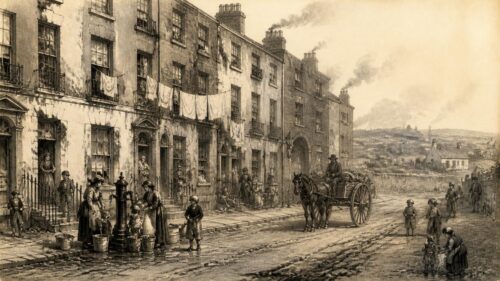
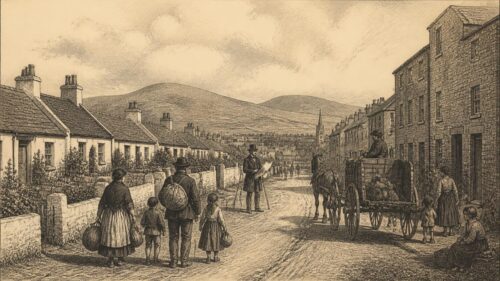
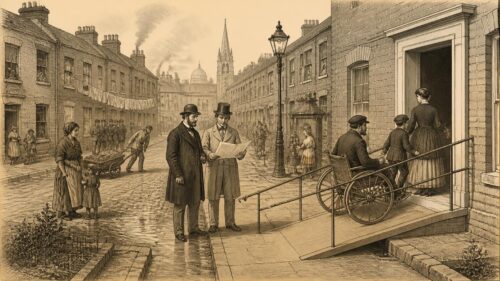


Ireland’s housing history shows that reform often relocated insecurity rather than removing it: labourers’ cottages, council estates, ownership supports and tenant protections improved many lives, yet affordability, access and maintenance remained problematic elsewhere. The shift from historic rent restriction to procedural rights suggests that regulation must respond to changing economic circumstances. Equally, the article questions whether ownership alone can secure a home, particularly for households needing stable, long-term rented accommodation. Ireland’s attempts to balance property rights, public health and social stability raise an enduring issue: how could a modern rental system protect tenants from insecurity while supporting affordable, well-maintained homes?