
Banshee Lore
At a Glance
Origins Meaning
In the antiquarian texts gathered here, the banshee is presented first as a figure of fairy belief rather than as a single fixed character. One account identifies her as a female fairy, a ben-side, and links her to fairy-hills and queenship. Another describes her as a spirit of death, attached in particular to certain families or septs. The overlap between fairy status and death warning is central in both treatments, even though each source frames the figure differently and for different purposes. [2] [3] [4]
The language of these passages also shows that the banshee was not treated as an abstract symbol alone. She is described as being associated with certain historic families, with music and song, and with the approach of death. One text states that only certain lineages or gifted persons are attended by her. Another calls her the spirit of doom. Read together, these descriptions place the banshee at the intersection of genealogy, artistry, and ominous warning. [3] [4]
Family Bonds
The family connection is made explicit in the sources. The banshee is said to attend families, and in one account she follows the old race even across the ocean to Canada. The same passage gives a narrative in which a lament is heard before two deaths occur within a household. The sequence does not prove a general law, but it does show how the tradition was represented: a family hears a warning cry, then interprets later death as fulfilment of the warning. [3]
The same source also presents other family-centered scenes. In one, an elderly woman near death hears music rather than an ordinary voice, and the music ends when she dies. In another, a father hears a cry from close to the window and later his daughter dies after the warning. These are narrative examples, not independent proof of belief in every locality, but they show how banshee lore could be rendered through domestic and aristocratic settings alike. [3]
Regional Forms
The banshee in one antiquarian account is also anchored in named places. Aine is linked to Knockainy in County Limerick; Clidna to Carrigcleena; Aebinn or Aibell to Craglea near Killaloe; and Grian to Pallas Grean. [2]
That same account notes that the writer does not attempt a complete catalogue of these sites, saying that listing all the fairy-hills and their presiding gods and goddesses would require a large volume. It also remarks that, in modern times, the word banshee has narrowed in meaning to a female spirit who attends a family and cries around the house before a death. This contrast between wider local mythology and narrower modern usage is explicit in the text itself. [2]
Night Cry
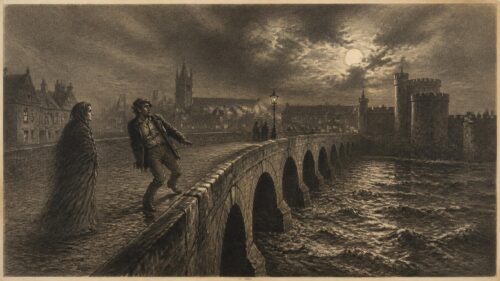
One description says the banshee is heard keening or crying at night round the house when someone is about to die. Another says a strange and mournful lamentation was heard outside the house, with no one seen nearby, and that the cry was heard again at the exact hour when the father and son were brought home dead after drowning. [2] [3]
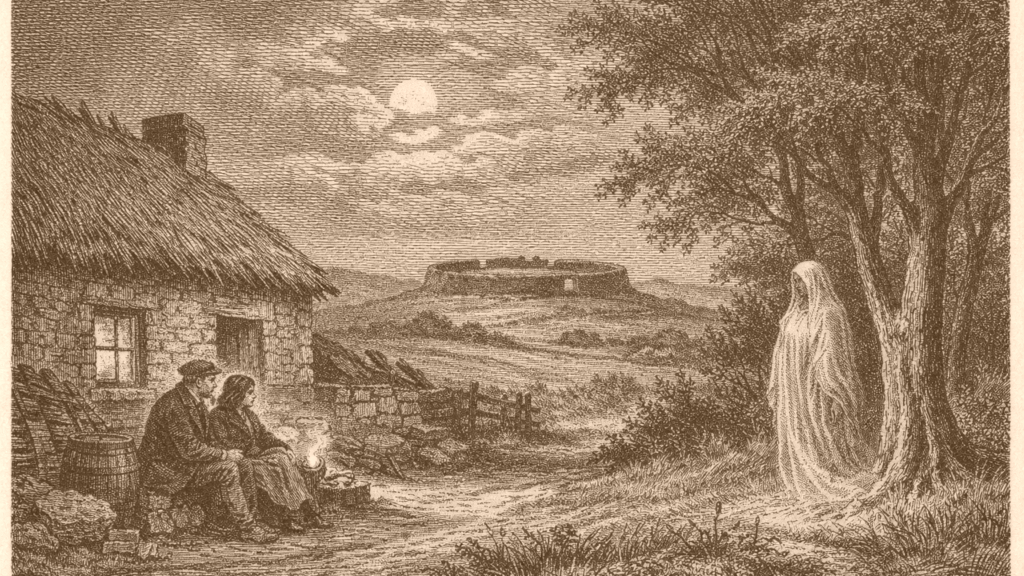
The texts do not present the banshee as purely terrifying. In one description she may appear as a shrouded woman lamenting under trees; in another, the sound can be low and soft, even musical, near the window of a dying person. These passages complicate any simple image of shrieking horror. They suggest that the tradition admitted more than one tonal register, from bitter cry to spiritual music, while still keeping the link to impending death. [3]
Seasonal Lore
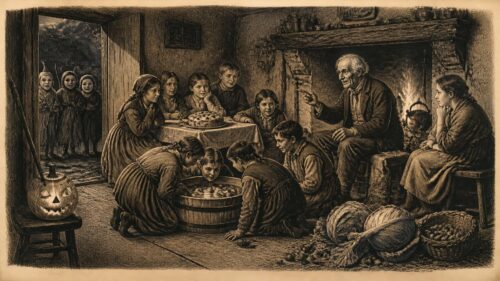
One account published in 1906 places the banshee within the wider cycle of Samain or Halloween belief. It says the fairy-hills were thrown open on Samain Eve, that mortals might glimpse inside if they ventured near, and that people commonly remained indoors because the otherworldly beings were abroad. The banshee is not the only figure in this seasonal world, but the passage places her among the broader fairy powers active at that threshold night. [2]
That same source adds that the superstition about fairies being abroad on Samain Night existed in Ireland and Scotland at the time of writing. This is not a claim about all communities or every period, but it is a direct observation from the author's own present tense. It shows that banshee lore was narrated as part of a living system of belief, not only as an antiquarian memory of the past. [2]
Recorded Memory
The later archive record shows that banshee lore remained a distinct topic in twentieth-century collection. A catalogue entry from 1993 identifies a recording specifically as being about the banshee within a set of interviews on funeral customs, graveyards, evil wishing, and fairy lore. The entry itself is brief, but it demonstrates that the subject was still being indexed as a discrete item in oral-history work, separate from surrounding practices and beliefs. [1] [5]
The UCCFEA sound recording catalogue is an online version of a digitised analogue archive. Its listing for an interview with Mrs Theresa Lynch includes an item titled “About the banshee” alongside items on funeral customs, graveyards around Cork city, evil wishing, fairy lore, keeping the corpse washing water under the bed, living conditions in houses in the 1940s, clothing and eating habits, and Harriers clubs and drag hunting. [5] [1]
Source References
Hover over a number to see the source. Select it to open the source.

How do antiquarian and folkloric texts describe the Irish banshee’s identity, functions, and regional variations?