

Sacred Silence
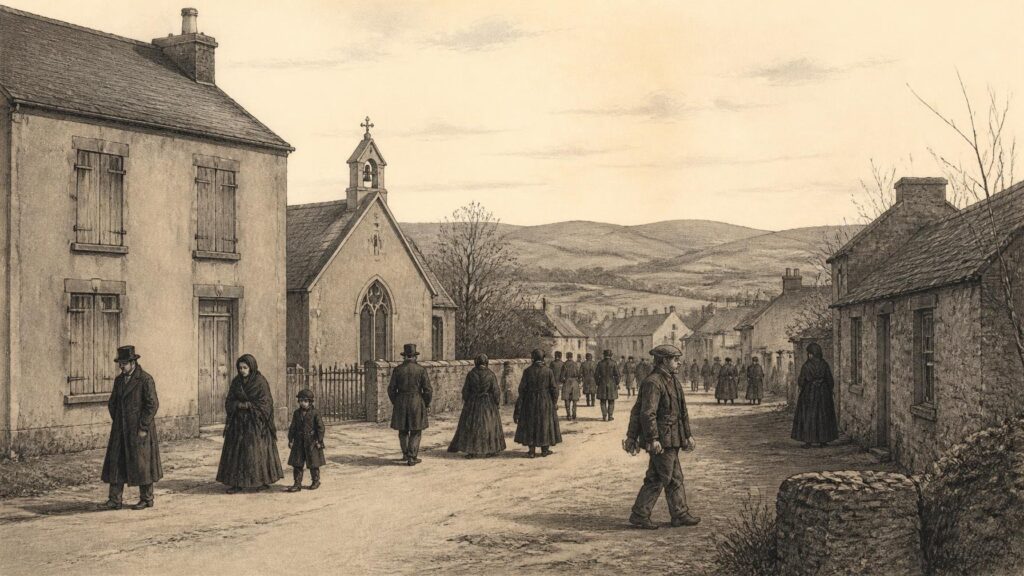
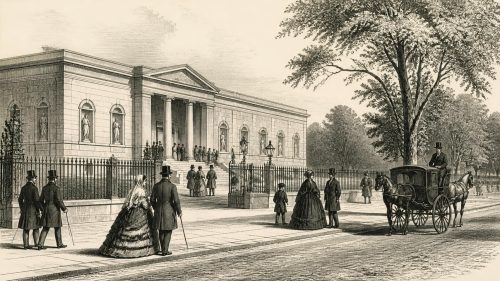
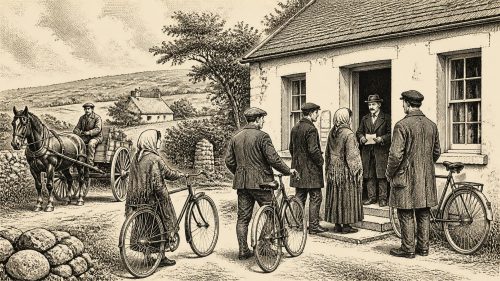
AI generated historical illustration, not a contemporary photograph.
At a Glance
For generations, Good Friday imposed a recognisable pause upon Irish public life: bells fell silent in many churches, meat disappeared from household meals, entertainments were restrained, and, for almost a century in the Republic, public houses could not legally sell drink. Yet the apparent stillness was never wholly uniform. It was created through overlapping Catholic, Protestant, legal, familial and local practices, and it altered as Ireland altered. The history of the day is therefore not simply one of religious obedience or later secular release. It is a record of how belief entered the street, the shop, the farm, the workplace and the statute book.
Christian Origins
Good Friday is the Christian commemoration of the crucifixion of Jesus Christ. Its place in Holy Week is ancient within western Christianity, but its specific appearance in Ireland must be understood through the island’s long and varied Christian history rather than through any claim of an unchanging national custom. Medieval Irish Christianity belonged to the Latin Church and shared its penitential calendar. Fasting, abstinence, prayer and liturgical remembrance formed the broad framework within which local observances developed. What was distinctive in Ireland was not that Good Friday was known, but the intensity with which it could become a social marker in later centuries.
The day’s religious meaning made it unusually suitable for public regulation. Unlike an ordinary Friday, it carried a solemn narrative of suffering, betrayal, death and redemption. Christian churches treated it not as a feast but as a day of mourning and devotion. Catholic practice centred upon the Passion, veneration of the cross and, in many places, the afternoon liturgy. Anglican and other Protestant traditions also marked the day through worship, scripture and prayer, though their devotional patterns, fasting rules and local customs differed. An Irish history of Good Friday must retain that plurality. The island’s religious communities did not experience the day in identical ways, nor did individual households within a single denomination.
It is tempting to project modern images of a quiet Irish Good Friday backwards indefinitely. Evidence does not warrant that. The surviving record is uneven: ecclesiastical directions tell us what clergy expected; law records what governments required; memoir, newspaper and folklore material show fragments of lived practice. Such evidence can demonstrate that the day mattered, but it rarely permits a single national reconstruction for every period. Its value lies in revealing how sacred meaning became embedded in ordinary time.
Seasonal Framework
Good Friday belonged to Lent, a season that ordered the year as much as it ordered devotion. In Ireland, as elsewhere in Catholic Europe, Lenten discipline historically involved fasting and abstinence. The practical burden varied by period, age, class, health and clerical guidance. Older people often remembered stricter observance than their children practised, and those recollections later entered folklore collections as testimony both to hardship and to moral seriousness. A calendar governed by Lent gave Good Friday exceptional weight because it stood near the end of a long period of restraint.
The annual rhythm also explains why food was so prominent in memory. Restrictions on meat, dairy produce or eggs had immediate consequences in homes whose meals depended heavily on locally produced food. The approaching Easter feast promised release from deprivation, and eggs in particular acquired ceremonial as well as culinary importance. The contrast between a sparse Friday and a celebratory Sunday made the passage emotionally visible. It was not merely doctrine translated into diet; it was a domestic experience of waiting, self-denial and anticipated abundance.
Modern accounts sometimes speak as if everyone fasted by the same rule. The historical reality was more complicated. Formal Catholic obligations changed over time, dispensations existed, and practice was affected by occupation and circumstance. A labourer, fisher, domestic servant or child could not necessarily observe a prescribed pattern in the same manner. Nor should a historian confuse religious instruction with universal compliance. Nevertheless, the recurrent association of Good Friday with plain food and curtailed consumption is securely documented in Irish folklore and popular memory. It was a day whose seriousness could be tasted.
The seasonal setting also joined religious observance to rural work. Good Friday occurred during a period of preparation in the agricultural year, when gardens, seed, animals and weather mattered intensely. This proximity encouraged beliefs that gave the day practical force beyond the church door. Some were pious extensions of sacred time; others were local customs or superstitions that ecclesiastical teaching did not create and may not have endorsed.
Household Discipline
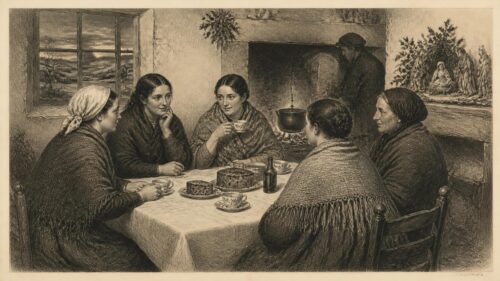
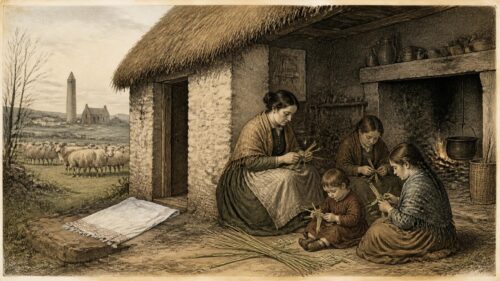
Within the home, Good Friday was often communicated less through theological explanation than through rules: what could be eaten, what work ought not be done, when children should be quiet, and whether ordinary recreation was suitable. Such rules turned a church festival into family discipline. They also created memories. People who later described the day frequently recalled the atmosphere of the kitchen, the absence of meat, the preparation for church, or the sense that certain noise and pleasure were improper.
The language of obligation should be used carefully. Irish households were never identical, and a custom observed in one parish could be unknown a few miles away. The National Folklore Collection’s Schools’ Collection, assembled during the late 1930s by schoolchildren recording local knowledge, preserves many accounts of fasting and Good Friday observance. It is invaluable evidence, but it is not a statistical survey. A child wrote down what an older informant, parent, neighbour or teacher considered worth preserving. The manuscripts reveal remembered custom, regional vocabulary and belief; they do not prove that every family acted alike or that a custom was immemorial.
Some recollections describe people delaying food until noon, taking little more than tea or simple bread, or regarding the day as a particularly strict fast. Such accounts accord with the wider Lenten framework. They also suggest why Good Friday could be remembered as demanding by children and older adults alike. Hunger was not only physical. It signified participation in a communal moral order, one reinforced by church, family and neighbourhood expectation.
Yet domestic observance could contain affection and humour as well as austerity. Adults might accommodate children; illness and work imposed exceptions; preparation for Easter generated anticipation. The household was not merely a miniature institution enforcing rules. It was the place where doctrine was negotiated in practice. This helps explain both the durability of Good Friday memory and the later speed with which some restrictions faded when religious authority, family patterns and leisure habits changed.
Folk Belief
Good Friday attracted a body of folklore that ranged from the devotional to the plainly magical. In the Schools’ Collection, contributors recorded assertions that seed sown or plants set on Good Friday would flourish. Other entries mention reluctance to drive nails, spill blood, look into mirrors or undertake certain kinds of work. Still others attach special properties to eggs laid that day. These are historical records of what people said, believed or remembered; they are not evidence that the claims were factually true, nor that they were official Christian teaching.
The distinction matters. Folklore is often flattened into a picturesque national inheritance, as if every recorded saying represented an ancient and shared Irish worldview. In fact, folklore evidence is local, transmitted and adaptive. A belief may have been strongly held in a particular townland, repeated as a family saying, or included by a pupil because it sounded memorable. Its significance lies in showing how people made the sacred calendar useful and intelligible. A holy day could be understood as a moment when ordinary causation was altered: crops might grow better, misfortune might follow forbidden acts, or objects and food might acquire protective force.
These beliefs also reveal the closeness of religious and agricultural life. To plant on Good Friday was not simply to perform a quaint rite. It connected labour, hope for a harvest and the drama of Holy Week. In a society where a failed crop could have serious consequences, auspicious timing was meaningful. The custom might coexist with practical horticultural knowledge; people did not necessarily choose between superstition and experience in the modern sense. Ritual could dignify work while work gave ritual a concrete setting.
Interpretation requires restraint. It would be unsafe to label every Good Friday custom a survival from pre-Christian religion. Such sweeping explanations were once fashionable, but a recorded custom may have multiple and much later origins. The evidence supports a more modest conclusion: Irish communities attached local beliefs to a Christian holy day, blending devotional seriousness with seasonal concerns. Where the origin of a practice cannot be established, uncertainty is more honest than romantic invention.
Prayerful Gatherings
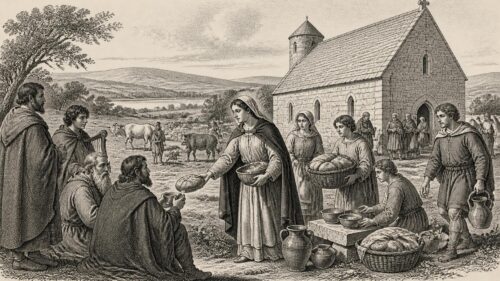
Public worship gave Good Friday its most obvious collective form. Churches and chapels drew people into a shared commemoration, especially for afternoon devotions associated with the hour of Christ’s death. In Catholic communities, the kissing or veneration of the cross, Stations of the Cross and Passion services made bodily gestures central to remembrance. The Schools’ Collection preserves references to people going to chapel at three o’clock and to acts of devotion undertaken on the day. Such material does not establish a single standard liturgy for all parishes, but it confirms the social importance of worship.
The gathering was public in a particular sense. It brought neighbours together, but it demanded quiet, modesty and an awareness of grief rather than celebration. Attendance could express personal faith, family expectation or local belonging. A person’s absence might be unremarkable, but in closely knit places the rhythms of worship were visible. Good Friday thereby made religion part of the social landscape: roads led to churches, shops adjusted their habits, and households planned their day around services.
Different churches observed the day in their own ways. The Church of Ireland’s Good Friday liturgy belonged to the Book of Common Prayer tradition, while Presbyterian, Methodist and other Protestant congregations developed their own patterns of preaching, hymnody and prayer. These distinctions matter because the phrase “Irish Good Friday” can easily conceal the island’s denominational complexity. Solemnity was widely recognisable, but it was not monopolised by one church, nor were all forms of public restraint equally meaningful to all communities.
The growth of broadcasting later extended religious observance beyond church walls. Radio and television could carry services, music and religious programming into homes, helping to create a wider sense that the day differed from ordinary time. Broadcast schedules, however, also demonstrate change. They were shaped by audience demand, commercial competition and evolving ideas of public service. The sacred public sphere was never separate from modern media; it was partly made through them.
Quiet Streets
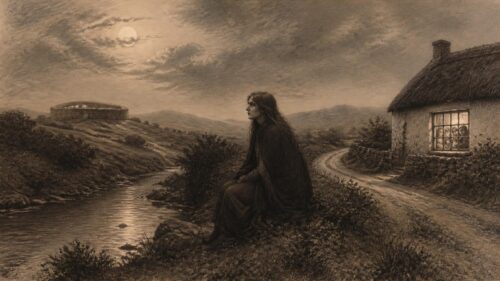
The remembered quietness of Good Friday is one of the strongest images attached to twentieth-century Ireland. Streets were said to empty, shops to close early, sporting fixtures to disappear and public houses to remain shut. The image contains truth, but it should not be mistaken for a complete description. Cities still required transport, hospitals, policing, domestic labour, hotels and other services. Rural people still tended animals, cooked, travelled and worked when necessity demanded. Silence was relative, not absolute.
What made the quiet distinctive was the convergence of several restraints. Religious observance discouraged amusement; fasting altered domestic routine; some businesses curtailed trading; and liquor law imposed a highly visible closure. The resulting public atmosphere could be experienced even by people who did not attend church. A locked pub door, an altered newspaper schedule or the absence of a match announced that the calendar had authority. Public life was not stopped, but it was marked.
Accounts of such quiet can carry nostalgia or criticism. For some, it represents neighbourly respect and a respite from commerce. For others, it suggests social pressure, limited choice and a public culture that granted one religious tradition disproportionate influence. Both responses are historical evidence in their own right, though neither is a complete explanation. The same quiet street could be felt as dignified by one resident and oppressive by another.
The historian’s task is not to decide whether silence was inherently virtuous. It is to identify how it was produced. Good Friday quietness came from voluntary devotion, inherited habit, economic practice, legal constraint and the expectations people placed on one another. Its gradual erosion therefore had several causes as well: declining religious observance in some groups, a more diverse population, expanded consumer culture, tourism, new leisure patterns and the deliberate repeal of particular laws.
Colonial Licensing
The law governing drink did not begin with the Irish Free State. Nineteenth-century Ireland was regulated through a complex body of British and Irish licensing legislation. Closing rules reflected concerns about drunkenness, public order, policing, temperance and commercial control. They were also geographically uneven. The legal history of opening hours is therefore not a simple story of an ancient religious ban imposed upon pubs. It is part of a larger nineteenth-century attempt to regulate the sale of alcohol across the United Kingdom and Ireland.
By the later nineteenth century, Sunday closing had become especially contentious. The Sunday Closing (Ireland) Act 1878 imposed broad restrictions while preserving exceptions in several larger cities. Good Friday was not initially treated everywhere in the same way as Sunday. The official memorandum prepared for the 1924 Intoxicating Liquor Bill is unusually useful because it sets out the pre-Free State position in tabular form. It records that Good Friday opening had been permitted during afternoon and evening hours, with different hours in larger towns and elsewhere. This documentary detail corrects a common simplification: complete Good Friday closure was not merely inherited intact from Victorian law.
Colonial licensing regulation did, however, supply the administrative machinery and habits that made later restrictions imaginable. Licensed premises were already subject to specified hours, penalties and police oversight. The distinction between ordinary time and legally prohibited time had become familiar. When the new Irish state made Good Friday closure stricter, it acted within an established regulatory field while giving it a new political and moral resonance.
Temperance politics formed part of that background. Campaigners against alcohol could frame regulation as protection for families and public order, while publicans defended livelihoods and customers resisted paternalism. Religious solemnity was one strand among several. To describe Good Friday closing solely as Catholic moralism would overlook the older licensing tradition and the broad international concern with drink control. But to omit religion would be equally misleading, because the day’s sacred character gave prohibition exceptional symbolic force.
Free State
The Irish Free State inherited a legal system and a society deeply affected by revolution, civil conflict and institutional uncertainty. In the early 1920s, the new state sought not only stability but moral authority. Alcohol licensing became an arena in which legislators could demonstrate a capacity to govern, preserve order and articulate a distinctive conception of public life. Good Friday closure acquired importance within that wider project.
The 1924 legislative memorandum shows clearly that the proposed change was substantial. It recommended that Good Friday be treated like Christmas Day, with licensed premises closed everywhere, and that the familiar exception for the bona fide traveller should not defeat the restriction. The proposal did not arise from a vacuum. It responded to an inherited licensing system, but it also expressed the priorities of the new state. Closing the pub on a Christian day of mourning allowed legislators to link public order to a visible form of national respectability.
That does not mean every deputy, publican or citizen understood the policy in the same terms. Parliamentary debate was political, and legislation always involved practical questions of enforcement, trade and exemptions. Still, the law’s symbolism is difficult to miss. A state recently established after violence treated the regulation of drink as a matter connected to social discipline. Good Friday became a date on which the state itself could insist that commercial sociability yield to solemnity.
Interpretations that present the measure as a direct declaration of Catholic statehood should be qualified. Catholic culture plainly shaped the political environment, but the legislation also continued pre-existing regulatory approaches and responded to fears about alcohol. Its meaning was layered: religious observance, temperance, policing, nation-building and administrative consolidation all met in the closing rule. The ban’s extraordinary longevity would later make it appear inevitable. In 1924 it was a deliberate policy choice.
Legal Closure
The Intoxicating Liquor Act 1927 consolidated and amended liquor law in the Free State. Its prohibition provisions made it unlawful, subject to specified exceptions, to sell or expose intoxicating liquor for sale, to open premises for its sale, or to permit consumption on licensed premises at any time on Christmas Day, Good Friday and Saint Patrick’s Day. The statute is direct primary evidence. It demonstrates that the Good Friday restriction was not just a social convention: it had legal force.
The wording also reveals why simplified memories of “the pubs being closed” are incomplete. Licensing law addressed several activities: sale, opening, exposure for sale and consumption. It distinguished between types of place and population, while providing exemptions in limited circumstances. Hotels, restaurants, travellers, clubs and special events generated recurring questions in the broader history of Irish licensing. A rule that appears clear at the pub door often required careful definition in court, administration and everyday practice.
Legal closure gave Good Friday a public visibility that fasting alone could not achieve. People who had no wish to abstain from alcohol confronted a statutory boundary. Publicans lost a day’s trade. Travellers and tourists encountered a local rule. Gardaí and licensing authorities held enforcement responsibilities. The law thus transformed a Christian observance into a civic fact. It also encouraged the association of Good Friday with a particular kind of Irishness, whether admired as respect for tradition or mocked as excessive regulation.
The 1927 Act did not freeze every aspect of licensing forever. Hours and exemptions changed over subsequent decades, and Saint Patrick’s Day later ceased to be subject to the same complete ban. Yet Good Friday remained. This endurance is historically significant. It indicates not necessarily that all citizens approved, but that successive governments saw little political advantage in changing a rule supported by custom, religious sentiment or simple inertia. Laws can survive because they command devotion, because opposition is fragmented, or because more urgent matters take precedence.
Public Morality
Good Friday closure became a potent emblem of public morality in twentieth-century Ireland. It suggested that the state could mark a sacred day by restricting commerce, especially the commerce of alcohol. The rule’s cultural meaning exceeded its practical effect. A single day without licensed sales did not determine national drinking habits, but it made a statement about what could not be treated as ordinary business.
Such statements are never neutral. Public morality laws identify some behaviour as requiring special restraint and invest public authority with the power to enforce that judgement. In a predominantly Catholic state, the moral language surrounding Good Friday resonated widely, though not universally. Protestants, people of other faiths, non-believers and Catholics whose practice differed from official expectations could experience the law differently. Their perspectives are sometimes less visible in the surviving popular narrative precisely because the rule appeared normal to many who lived under it.
It is also important not to confuse the closure law with a comprehensive ban on social life. Families visited one another, meals were prepared, travel continued and people found private ways to spend the day. The law directed licensed public commerce, not every form of fellowship. Nevertheless, its effects reached far beyond publicans. Restaurants, hotels, sporting organisations, entertainment venues and employers had to anticipate altered patterns of demand. The day became a practical problem of planning as well as a religious observance.
Public morality can harden into ritual without frequent reflection. For decades, many people simply expected Good Friday closure because it had always, in their own memory, occurred. This is one reason historical records matter. The 1924 memorandum and 1927 Act show that the prohibition had a definable legislative origin. What later appeared to be timeless tradition was, in legal terms, a twentieth-century construction built upon older licensing practices.
Everyday Evasion
Where law and custom meet, ingenuity often follows. The Good Friday ban generated stories of stocked cupboards, journeys across borders, private hospitality and events where drink might be available through a lawful or questionable exception. Some stories became part of the humour surrounding the day. They should not all be accepted uncritically. Anecdotes tend to exaggerate loopholes, and a memorable tale is not evidence of widespread practice.
Still, the persistence of such stories tells historians something important. The closure rule was visible enough to invite negotiation. It reminded people that alcohol was not merely a private commodity but a regulated public good. Consumers could plan ahead by buying drink before the prohibited period; publicans could seek to understand exemptions; hotels and clubs occupied complicated positions. These practical accommodations softened the rule without removing its symbolic significance.
The distinction between legal evasion and lawful exception is essential. Licensing statutes contained detailed provisions, and later debates over reform repeatedly addressed anomalies between pubs, restaurants, clubs and occasional licences. A historian should not present every reported Good Friday drink as clandestine defiance. In some cases it may have been legally permitted; in others, it may have been tolerated, invented or remembered with embellishment. The documentary record is stronger for the law itself than for the scale of non-compliance.
Humour also allowed people to discuss tension without open confrontation. Jokes about planning ahead or finding a drink acknowledged the rule while making it less solemn. This was not necessarily irreverence towards Christianity. It could be a familiar Irish mode of living with regulation: respecting its formal existence, criticising its inconvenience and taking pleasure in the possibility of outwitting it. Such humour helped turn Good Friday into a cultural marker even among those for whom its theology had little immediate importance.
Rural Labour
Good Friday public life was not confined to towns, pubs or parliaments. In rural Ireland, the day intersected with agricultural labour and household production. Animals still needed feeding, milk still had to be handled, fires kept, meals made and weather watched. The notion of a completely inactive countryside belongs more to idealised recollection than to the demands of farming life.
At the same time, folk accounts show that certain work was treated cautiously. The belief that seeds sown on Good Friday would thrive made planting an auspicious act rather than a breach of solemnity. Other activities could be avoided because they seemed improper, unlucky or too closely associated with disturbance. These apparent contradictions are revealing. Sacred time did not simply prohibit work; it reclassified work. Some labour became meaningful because of the day, while other labour was deferred or restrained.
Folk belief should not be read as a complete guide to actual practice. Weather, soil conditions and labour availability influenced planting more reliably than custom alone. Nor can a handful of manuscript testimonies establish that a rite was followed throughout the country. But the repeated appearance of Good Friday planting in the Schools’ Collection indicates that the association was widespread enough to be memorable. It links agricultural hope to the Christian calendar without requiring an invented ancient origin.
Rural experience also complicates the assumption that Good Friday was equally commercial in all places. In a village, a closed public house might be an important public sign; on dispersed farms, the day’s importance could be felt more intensely through food, prayer and work. The same holiday travelled through different material worlds. Its history must therefore include both the urban door barred by licensing law and the garden bed prepared under a belief about blessing and growth.
Urban Commerce
In towns and cities, Good Friday affected commercial rhythm. Publicans faced the most conspicuous restriction, but other businesses also adjusted to expected demand and custom. Retailers, transport operators, hotels, restaurants and entertainment venues had to decide whether the day would be treated as ordinary, reduced or exceptional. The answers changed over time and varied by place.
The public house was particularly important because it was more than a shop. In many Irish communities it functioned as a meeting place, news exchange, lodging house, music venue or informal social centre. Its closure therefore altered sociability. The locked door did not eliminate conversation or companionship, but it withdrew one central venue from public use. For supporters, that absence represented proper reverence. For critics, it illustrated the state’s intrusion into adult leisure and commercial freedom.
Urban Good Friday also exposed the distinction between a public holiday and a religiously significant day. In the Republic, Good Friday was not listed among the public holidays in the Organisation of Working Time Act 1997, which names Easter Monday rather than Good Friday. This meant that many people worked, subject to contracts and sectoral arrangements, even while pubs had historically been shut. The mismatch contributed to confusion: a day could feel like a holiday because of custom and altered trading, without carrying the general legal status of one.
That ambiguity is historically revealing. It shows that public life is regulated through more than one calendar. The liturgical calendar, employment law, school schedules, licensing rules, commercial practice and family expectation can point in different directions. Good Friday’s unusual character arose precisely from this overlap. It was neither wholly a holiday nor wholly an ordinary working day, neither purely private faith nor purely public law.
Border Differences
Partition created two jurisdictions, and Good Friday developed under different legal and political conditions in each. The religious significance of the day crossed the border, as did many family and cultural practices, but licensing law did not. It is therefore misleading to speak of a single uninterrupted all-Ireland legal tradition.
In Northern Ireland, liquor licensing developed through the institutions and legislation of Northern Ireland and later the Northern Ireland Assembly. Restrictions associated with Easter remained part of that legal landscape for many years, but they did not exactly mirror the Republic’s statutes. The distinction became especially clear in the twenty-first century, when reform proceeded on different timetables. The Licensing and Registration of Clubs (Amendment) Act (Northern Ireland) 2021 removed additional Good Friday and Easter Day restrictions from the relevant licensing provisions.
This comparison guards against an easy narrative in which the Republic alone possessed a religiously marked public sphere. Northern Ireland also had its own patterns of Sunday regulation, church influence, community expectation and licensing control. Yet their meanings were shaped by a society in which religious identity was deeply entangled with constitutional and political division. A closed venue could not be interpreted apart from that wider setting.
Cross-border contrast also demonstrates that law is not a simple measure of private belief. Similar levels of devotion can coexist with different statutory arrangements; a legal restriction may survive after practice weakens, while a change in law need not erase religious observance. Good Friday has remained a meaningful Christian date north and south, even as the forms of public regulation have diverged and later relaxed.
Changing Faith
From the later twentieth century, Ireland experienced major changes in religious practice, social authority, migration, education, gender roles and leisure. The pace and meaning of these changes varied across communities. It would be inaccurate to say that religion suddenly disappeared, just as it would be inaccurate to claim that public culture remained unchanged. Good Friday became one of the occasions on which these tensions could be observed.
For many Catholics, the day remained important as a time for Mass, prayer, fasting or reflection. For others, its principal meaning became familial or cultural. For some people, especially those outside Christian traditions or with no religious affiliation, statutory restrictions rooted in a particular holy day increasingly appeared difficult to justify. Ireland’s growing religious diversity made the question more visible. A law once supported by broad habit could now be judged against principles of equality, pluralism and consumer freedom.
The change should not be reduced to a contest between faith and modernity. Many people who welcomed licensing reform still valued Good Friday worship; many who defended closure did so from concerns about community rhythm as well as doctrine. Tourism, hospitality employment and economic activity also mattered. The debate concerned what kind of public accommodation religion should receive, not whether religious people were entitled to observe their faith.
Historical interpretation benefits from avoiding triumphalist language. Repeal did not prove that earlier generations were merely irrational, nor did the older law prove that later Ireland lacked moral seriousness. Rather, the balance between voluntary observance and legal enforcement shifted. Good Friday ceased to be a day on which the state required one highly visible commercial act of restraint, while churches and individuals remained free to mark it according to conscience.
Reform Debates
Attempts to alter the Good Friday prohibition long predated its eventual repeal. Parliamentary debate repeatedly returned to the anomaly of a country in which a major part of the hospitality sector was compelled to close on a day that was not a general public holiday. Advocates of change pointed to tourism, changing social attitudes, legal inconsistency and the difficulty of explaining the rule to visitors. Opponents invoked respect for tradition, religious sentiment and the distinctive character of the day.
The debates are valuable as historical sources because they expose competing descriptions of Ireland. One description presented the restriction as a natural expression of national Christian culture. Another presented it as an anachronism carried over from an earlier state. Neither was simply invented. The law did emerge from a political culture that regarded Christian solemnity as suitable for public enforcement, and by the twenty-first century it did sit uneasily with a more plural and commercially connected society.
Reform also required attention to detail. Removing the basic prohibition could leave anomalies involving restaurants, occasional licences, clubs or other forms of sale. This technical work is easily overlooked in retrospective accounts, yet it was crucial. Licensing law consists of interlocking provisions, and a symbolic change had to be made coherent in practical administration. The Oireachtas debates on the 2017 Bill show legislators explicitly considering these consequences.
The reform process demonstrates that tradition is not undone by a single declaration. Governments had to judge public opinion, consult legal frameworks and decide whether a retained religious restriction served a legitimate contemporary purpose. The eventual answer was that it did not require continued statutory enforcement. That conclusion was political and legal, not a finding that Good Friday itself had become historically insignificant.
Final Repeal
The Intoxicating Liquor (Amendment) Act 2018 entered into force on 31 January 2018. The Department of Justice stated plainly that it removed restrictions on the sale of intoxicating liquor on Good Friday. When Good Friday arrived on 30 March 2018, public houses and other licensed premises in the Republic could trade under the ordinary licensing rules applicable to that day. The change ended a prohibition rooted in the early Free State and consolidated in 1927.
The first legally open Good Friday drew substantial public attention because it marked the end of a familiar social ritual. News coverage often treated it as a symbolic moment: queues, advertised events and the simple novelty of ordering a drink became signs that an old boundary had moved. Yet it would be mistaken to treat the date as a complete rupture. Many premises chose restrained trading, many people attended religious services, and many households marked the day much as they had before. Law changed quickly; custom changes unevenly.
The repeal also clarified the difference between prohibition and observance. The state no longer compelled licensed premises to close, but it did not prevent anyone from fasting, praying, avoiding alcohol or keeping the day solemn. In that sense, the change transferred the matter further towards individual, familial and religious choice. Critics could reasonably argue that public culture loses something when common pauses disappear; supporters could reasonably argue that genuine devotion should not depend on commercial prohibition. The historical record cannot settle that moral disagreement, but it can show how recently the legal rule had been made and how long it endured.
The reform did not make Good Friday a public holiday. Easter Monday retained that status under employment law. This continued distinction is a reminder that the removal of one restriction did not erase the day’s unusual place in the calendar. Good Friday remained religiously significant, commercially altered in some settings, and culturally resonant, but no longer defined by a nationwide statutory pub closure.
Memory Politics
Today, memories of closed pubs and subdued streets are often used to tell larger stories about Ireland. One person may recall a dignified, shared stillness; another may remember boredom, inconvenience or an atmosphere of social surveillance. These memories should not be dismissed merely because they are subjective. They show how public rules were felt. But they should also not be treated as a substitute for documentary history.
The historical evidence supports several conclusions. Good Friday observance in Ireland had deep Christian roots and acquired locally distinctive forms. Folklore collections preserve rich testimony of fasting, planting beliefs, special eggs and devotional practice, but they record tradition rather than universal fact. Licensing restrictions existed before independence, while complete Good Friday closure in the Free State was deliberately strengthened in the 1920s. The ban lasted until 2018 in the Republic, and Northern Ireland followed a separate legal course, with Easter restrictions removed in 2021.
Beyond those points, interpretation remains necessary. The old closure can be understood as an expression of majority faith, a temperance measure, a nation-building gesture, an instrument of public order or an example of clerical influence upon law. It was, at different times and for different people, more than one of these things. No single explanation exhausts its history.
Good Friday’s importance lies precisely in this complexity. It reveals how a religious commemoration could shape food, work, rural belief, urban leisure, commercial law and political identity. The day’s public silence was never simply empty. It was filled with worship, labour, memory, inconvenience, authority, negotiation and expectation. Its history offers a concise view of a larger Irish question: how communities decide which inherited values belong to private conscience, which belong to common custom, and which, if any, should be written into law.

The article shows that Good Friday’s familiar quietness emerged from more than church worship: household fasting, local folklore, commercial restraint and licensing law shaped public experience, while practices differed between denominations, regions and the Republic and Northern Ireland. This complicates interpretations of the 2018 repeal as either straightforward secularisation or simple liberation from restriction. It may instead indicate a renegotiation of how religious heritage, individual choice and public authority coexist in a changing society. How should we interpret the repeal alongside the persistence of observance and the legal history of Northern Ireland when considering Good Friday’s place in Irish identity?