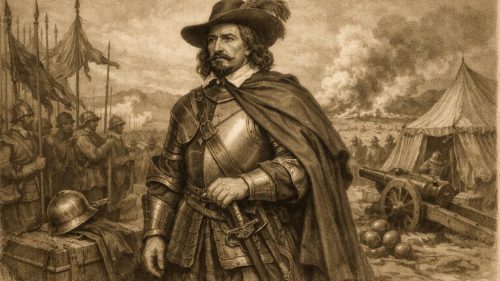
Hugh O’Neill, Earl of Tyrone
Hugh O’Neill, Earl of Tyrone, was born about 1540 in one account, while another gives about 1545. He was the second son of Matthew, Baron of Dungannon. Later biographical accounts describe him as having been brought over to court by Sidney, given a troop in the Queen’s service, and employed in the English army in the Irish wars. Those same accounts place him at the Smerwick massacre in 1580. In the years before the great war in Ulster, O’Neill appears in the records as a man closely tied to English authority.
Dateline
Hugh O’Neill, Earl of Tyrone, was born about 1540 in one account, while another gives about 1545. He was the second son of Matthew, Baron of Dungannon. Later biographical accounts describe him as having been brought over to court by Sidney, given a troop in the Queen’s service, and employed in the English army in the Irish wars. Those same accounts place him at the Smerwick massacre in 1580.
Early Allegiance
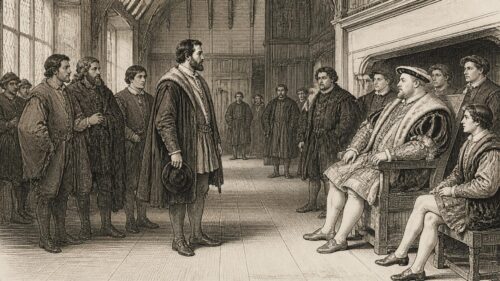
In the years before the great war in Ulster, O’Neill appears in the records as a man closely tied to English authority. An old biography says that he was supported by the English against Turlough, and that efforts were made to conciliate him to the English interest and to imbue him with English ideas. In that account he is described as having written to the Queen in a spirit of complaint about Irish customs, and even as having desired that effectual steps should be taken to suppress the title of The O’Neill. Another historical account presents him as having been brought up with other royal wards at the English Court, among young nobles and officers who were later to play their part in Ireland.
Ulster Power
In 1584 he was put in possession of the south-eastern portion of Tyrone, while Turlough Luineach was restricted to the north-western part. This settlement was followed by hostilities between the rival chieftains, with Hugh aided by the English government. In the Parliament of 1585 he took his seat as Baron of Dungannon. Before that Parliament ended, he was promised the title of Earl of Tyrone, and the Queen confirmed that title to him in 1587. The same biography says that he gave up 240 acres upon the Blackwater for a fort and renounced all authority over his neighbours.
Courtly Policy
In May 1590 he made suggestions to the Privy Council concerning the affairs of Ulster and expressed a wish that the province should be made shire ground. According to the same account, he wanted his people to adopt English tenure, English laws, and English dress. He also promised that he would neither receive nor maintain any Popish priest, monk, friar, or proclaimed traitor. These statements are part of the record of his dealings with the government and show him presenting himself, at that stage, as a man willing to work within English structures.
Marriage Alliance
He also made a notable marriage alliance. One account says that after the death of his second wife, the daughter of MacManus O’Donnell, he won the heart of Mabel, sister of Marshal Bagenal. Another gives the date of the marriage as 3 August 1591, when they were married by the Protestant Bishop of Meath, Thomas Jones. The same biography says that Bagenal opposed the match and removed her first to Dublin, after which O’Neill followed her. These details place the marriage within the wider political relations of the period as well as within his own household history.
From Peace
By June 1593 Sir Turlough abandoned the contest with Hugh O’Neill, and Hugh then stood as undisputed master of Tyrone. An old biography says that this position made him formidable in the eyes of Elizabeth’s advisers. It also says that he became increasingly influential among the surrounding clans. The same account notes that he last served the government in a skirmish against Maguire, where he was wounded in the thigh. Elsewhere he is described as harbouring Hugh Roe O’Donnell after O’Donnell’s escape from Dublin Castle.
War Begins
According to Patrick Weston Joyce, the friendly relations between O’Neill and the government may be said to have ended with the close of 1594. Joyce says that O’Neill had not intended to rebel, but that his determination to recover the ancestral power of his family in Ulster and the pressure of events gradually drew him into rebellion. That same general sequence is reflected in the older biography, which places him at the centre of the conflict that followed. His career before that point had ranged from court service and military employment to negotiations over title, land, and authority; by 1595 the public record presents him as a principal figure in the struggle in Ulster.
Primary Sources
- Irish History Online – The career of Hugh O'Neill, earl of Tyrone, from 1603 to 1607
- Hugh O'Neill, Earl of Tyrone – Irish Biography
- Hugh O'Neill, Earl of Tyrone – History of Ireland and Her People
- The Rebellion of Hugh O'Neill, Earl of Tyrone, 1595-1597 – Concise History of Ireland
- Hugh O'Neill in Irish Historical Discourse c1550-2021
Source References
Hover over a number to see the source. Select it to open the source.

- [1] Irish History Online - The career of Hugh O'Neill, earl of Tyrone, from 1603 to 1607
- [2] Hugh O'Neill, Earl of Tyrone - Irish Biography
- [3] Hugh O'Neill, Earl of Tyrone - History of Ireland and Her People
- [4] The Rebellion of Hugh O'Neill, Earl of Tyrone, 1595-1597 - Concise History of Ireland
- [5] Hugh O'Neill in Irish Historical Discourse c1550-2021