Grace O’Malley
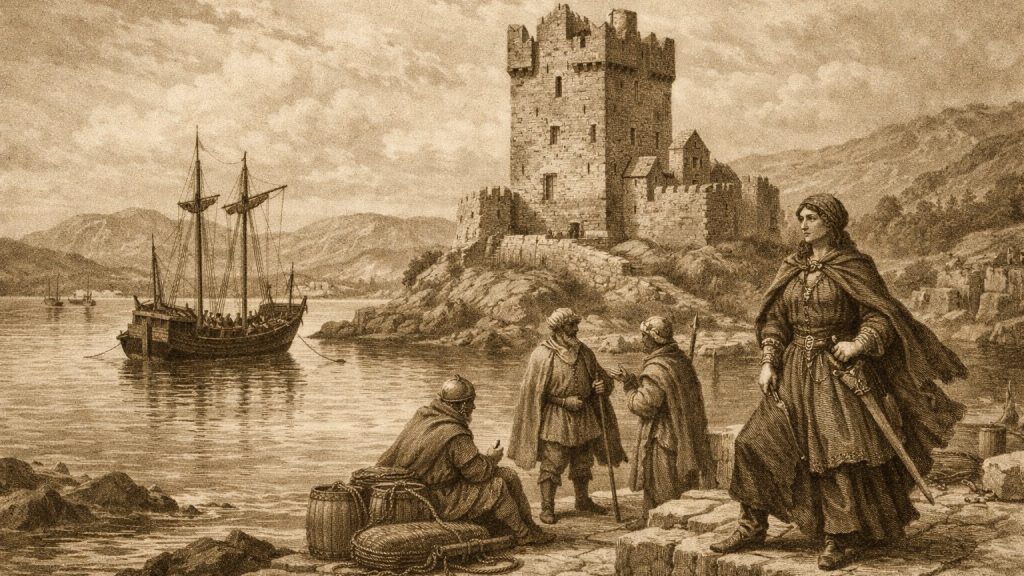
Grace O’Malley, also called Gráinne Ní Mháille and Granuaile in the source material, is identified with Rockfleet Castle in County Mayo. The castle is described as a four-storey tower house, rising from bedrock at the mouth of a small river where it flows into a sheltered inlet on Clew Bay’s northeastern edge. It was built as a stronghold of the Burke clan, descendants of the Anglo-Norman de Burgos, and its plain exterior is said to conceal a carefully arranged interior with spiral staircases, a garderobe that empties into the sea below, and a principal chamber on the top floor with a fireplace and a hoisting door for supplies.
Dateline
Grace O’Malley, also called Gráinne Ní Mháille and Granuaile in the source material, is identified with Rockfleet Castle in County Mayo. The castle is described as a four-storey tower house, rising from bedrock at the mouth of a small river where it flows into a sheltered inlet on Clew Bay’s northeastern edge. It was built as a stronghold of the Burke clan, descendants of the Anglo-Norman de Burgos, and its plain exterior is said to conceal a carefully arranged interior with spiral staircases, a garderobe that empties into the sea below, and a principal chamber on the top floor with a fireplace and a hoisting door for supplies.
Rockfleet Base
The source places Grace O’Malley at Rockfleet as its most famous resident. It says she made the castle her base after marrying Richard an Iarainn Burke in 1564. From the protected harbour there, she commanded her fleet of galleys. The same account describes the activities associated with that seaborne life as continuing her family’s traditions of fishing, trading, and occasional raids on passing merchant vessels. Those details present Rockfleet not merely as a dwelling but as a working stronghold tied to maritime movement and control of the inlet.
The castle’s position is part of the biography that survives in the source. Because it sits at the edge of Clew Bay and above a small river mouth, it is presented as a defensible place with ready access to sheltered water. The protected harbour is specifically linked to her galleys, and the building’s internal hoisting door is a practical reminder of supply and movement within the tower house. The source also notes that the structure once formed part of a larger complex, including a bawn wall and associated settlement.
Seaborne Power
The source characterises Grace O’Malley as the legendary pirate queen who used Rockfleet as her base. It also records that her activities drew the ire of Galway’s merchants. In 1579, they dispatched a fleet under Captain William Martin to besiege the castle. Her forces repelled the attack and nearly captured Martin himself. That episode appears in the source as a direct conflict between her maritime power and the merchant interests opposed to it.
Her seafaring identity in the source is not limited to combat. The same account ties her to fishing and trading as well as raids, suggesting a life shaped by the working use of boats and by the movement of goods along the western coast. The tower house’s defensive features and its harbour setting are both presented as part of that life. The castle’s chamber on the top floor, its spiral staircases, and its upper-floor hoisting door fit the image of a residence designed for a household that required both protection and access to the water below.
Conflict Years
The source then links her fortunes to the political turmoil under English governor Sir Richard Bingham. It states that by 1591 her fleet had been destroyed and her properties confiscated. Those losses are recorded in the source without further elaboration, but they mark a clear change from the earlier depiction of command from Rockfleet’s harbour. The same source nevertheless continues her story beyond those reverses.
According to the account, Grace O’Malley later had a famous audience with Queen Elizabeth I in London. After that meeting, she returned to Rockfleet. The source says she is believed to have died in 1603. That is the final date supplied there, and it is given as a belief rather than as a statement of direct contemporary record. Rockfleet itself remains the central place named in the biography, both as a stronghold of the Burke clan and as the site most closely associated with her residence and command.
Grace O’Malley survives in the source as a figure defined through a castle, a harbour, and a fleet. The account joins domestic structure, maritime use, and political conflict in a single setting at Rockfleet. Her marriage to Richard an Iarainn Burke, her use of the castle from 1564, the siege of 1579, the destruction of her fleet and confiscation of her properties by 1591, her audience with Elizabeth I, and her reported death in 1603 together form the sequence that the source provides.
Source References
Hover over a number to see the source. Select it to open the source.