Cornelius Colbert
Cornelius (Con) Colbert was born at Monaleena, Castlemahon, County Limerick, the son of Michael Colbert, a small farmer, and Nora MacDermott. While he was still a child, the family moved to the Athea area in West Limerick, where his father farmed old family land at Templeathea. He attended Athea national school and, for a brief period, the national school at Kilcolman near Ballysteen. In early adolescence, Colbert went to live with a sister in Dublin, where he received secondary education at the Christian Brothers’ schools at Saint Mary’s Place and North Richmond Street, known as O’Connell’s Schools.
Dateline
Cornelius (Con) Colbert was born at Monaleena, Castlemahon, County Limerick, the son of Michael Colbert, a small farmer, and Nora MacDermott. While he was still a child, the family moved to the Athea area in West Limerick, where his father farmed old family land at Templeathea. He attended Athea national school and, for a brief period, the national school at Kilcolman near Ballysteen.
Early Years
In early adolescence, Colbert went to live with a sister in Dublin, where he received secondary education at the Christian Brothers’ schools at Saint Mary’s Place and North Richmond Street, known as O’Connell’s Schools. When he had completed his secondary education, he secured a clerkship at Kennedy’s bakery in Parnell Street, where he worked until his death. Both sides of his family had a tradition of nationalist and Fenian involvement, and he became politically aware from an early age. He developed an interest in local and national history, and picked up expressions in Irish from people around West Limerick, where the language had not yet entirely died out. He is also said to have become a devout Roman Catholic from early on.
National Activity
In Dublin, Colbert joined the Gaelic League and attended Irish classes, lectures, and other cultural and social activities. He enrolled in Fianna Éireann, the scouting organisation for boys first established by Bulmer Hobson in 1903 and revived by Hobson and Countess Markievicz in August 1909. He became a model member, developing proficiency in drill, marching, scouting, signalling, map-reading, first aid, and the use of small arms. His diligence was soon recognised by promotion to the captaincy of his branch and eventually to the Council. When Patrick Pearse required a part-time drill instructor with Irish for Saint Enda’s in 1910, Colbert took on the role with enthusiasm and refused remuneration when the matter was raised.
Rising Service
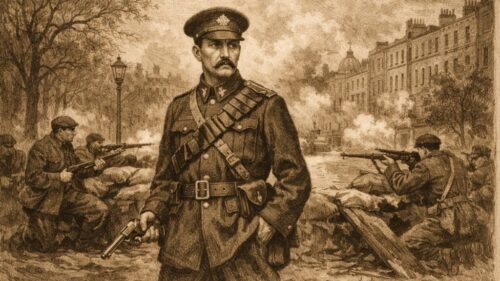
Colbert was recruited to the Irish Republican Brotherhood and later became head of an IRB circle consisting of Fianna Éireann members formed in 1912 by Bulmer Hobson. He was elected to the provisional committee of the Irish Volunteers on their formation in November 1913. He attained the rank of captain in Éamonn Ceannt’s 4th Battalion of the Dublin Brigade, where he became heavily involved in training and developing his company. Although small in stature, he had considerable presence and was highly respected by the Fianna, by the students at Saint Enda’s, and by the Volunteers. During the Rising, Colbert and his company were assigned to Watkins’s brewery, and later joined Séamus Murphy at Jameson’s distillery in Marrowbone Lane near the South Dublin Union.
Final Days
As the British cordon gradually encircled the city centre, the Marrowbone Lane garrison did little fighting and eventually surrendered on Sunday. Colbert was tried by court-martial and sentenced to death. He was executed on 8 May 1916. He was unmarried.
Source References
Hover over a number to see the source. Select it to open the source.