Membership is completely free, giving members unlimited access to all available resources, services, features, and benefits without any restrictions or fees.
Welcome back. Sign in to continue enjoying unlimited access to all available resources, services, features, and member benefits at no cost.
The parliamentary setting was the Home Rule crisis. The Government of Ireland Bill, introduced in 1912 by the Liberal government at Westminster, proposed an Irish legislature while reserving ultimate authority to the Parliament of the United Kingdom. John Redmond’s Irish Parliamentary Party remained committed to securing this constitutional settlement. Its prospects had improved because the Parliament Act of 1911 had curtailed the House of Lords’ absolute veto. Nevertheless, the bill had to survive repeated passage through the Commons before it could become law.
The United Kingdom general election, held between January and February, produced a sweeping Liberal victory. In Ireland, John Redmond’s Irish Parliamentary Party retained the predominant position among nationalist electors, with 82 Irish Parliamentary members returned to Westminster. The result confirmed that Home Rule remained the principal constitutional aim of organised Irish nationalism. Yet it also altered the party’s circumstances. A Liberal government with a very large majority no longer needed Irish votes to survive in office, as earlier Liberal ministries had needed Parnell’s or Redmond’s support.
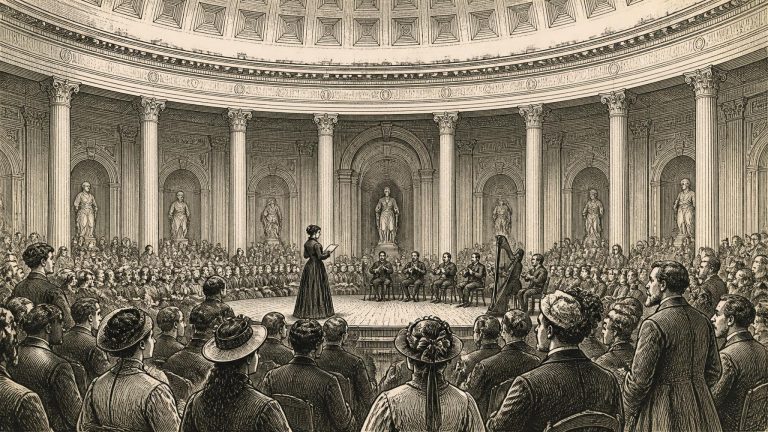
The most consequential firmly dated event came on Tuesday, 28 November. At the Rotunda in Dublin, the first annual convention of the National Council met under the presidency of Edward Martyn. Arthur Griffith presented what was called the “Sinn Féin Policy”. The convention’s importance lay in organisation as much as doctrine: delegates from outside Dublin successfully pressed for a national body with branches, rather than a small metropolitan circle. For that reason, 28 November 1905 is conventionally treated as the founding moment of the movement that became Sinn Féin.
Formal political power still rested outside Ireland. The Conservative government in London was led by Arthur Balfour, while George Wyndham served as Chief Secretary for Ireland. The lord lieutenant, the earl of Dudley, represented the Crown in Dublin. In this framework the Irish Parliamentary Party continued to seek Home Rule: a parliament in Dublin responsible for domestic affairs while remaining within the United Kingdom. Its demand commanded broad nationalist support, but it was not close to enactment in 1904.
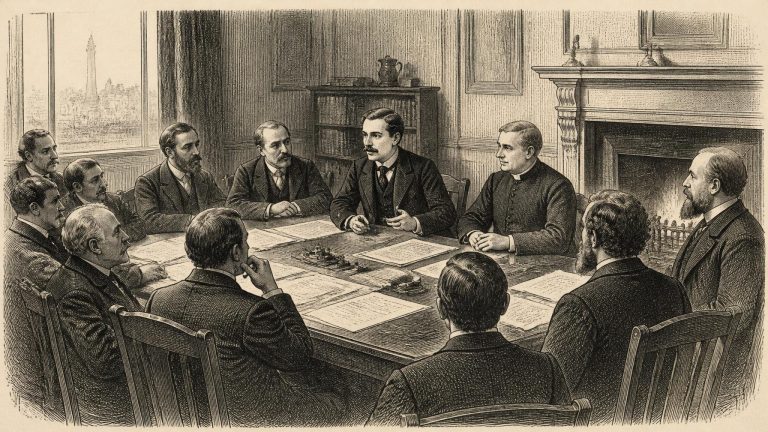
In 1902 Ireland remained part of the United Kingdom, governed through the Lord Lieutenant, the Chief Secretary and the Dublin Castle administration, while Irish MPs sat at Westminster. Yet the year’s most consequential Irish political development did not begin as a parliamentary measure. It emerged from the long and bitter argument over land: who should own it, who should set the rent, and whether the occupier of a farm might finally become its proprietor. By December, that argument had brought landlords and tenant representatives into the Mansion House in Dublin. Their meeting did not settle the matter within the calendar year, but it marked a striking change in political method: men associated with opposed interests agreed to negotiate face to face.
Ireland entered 1901 still within the United Kingdom of Great Britain and Ireland, governed locally through Dublin Castle and represented at Westminster. The year opened under the long shadow of the Union of 1801, whose centenary invited sharply opposed readings. Unionists treated the constitutional connection as the framework of imperial citizenship and commercial security; nationalists regarded it as the removal of Ireland’s parliament and an unfinished political grievance. Neither Home Rule nor a fresh constitutional settlement was near at hand. Yet the Ireland of 1901 was not politically inert: arguments over land, language, education and local power were giving a wider public meaning to nationality.
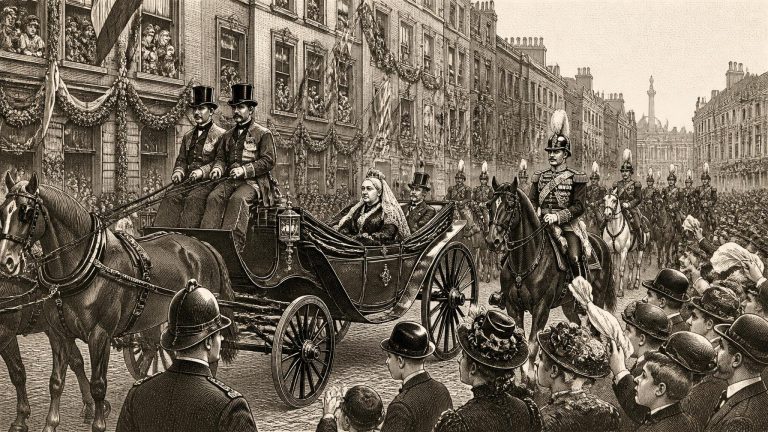
On 1 April, Queen Victoria ordered the formation of the Irish Guards, explicitly recognising Irish soldiers’ service in the South African War, then generally called the Boer War. Three days later, on 4 April, the Queen made her public arrival at Kingstown and travelled into Dublin. It was her final visit to Ireland, and its pageantry was emphatically imperial: decorated streets, official receptions, troops and police, crowds gathered along the route, and ceremonies centred on Dublin Castle and the Phoenix Park. Film survives of her carriage procession in the city, an unusually immediate visual record of a political occasion otherwise filtered through official speeches and partisan newspapers.
The most immediately tangible change came with the first elections held under the Local Government (Ireland) Act of 1898. On 6 April 1899, voters elected county councils and rural district councils across Ireland. The elections replaced the county grand juries, bodies dominated by large property holders and appointed magistrates, in many of their administrative roles. The reform also created urban district councils, producing a more coherent framework for local administration than the scattered older arrangements of grand juries, poor-law unions, town commissioners and borough corporations.
The year opened amid real anxiety in the poorer western districts. The difficult seasons of 1897 and early 1898 had exposed the fragility of many small holdings, especially in Connacht. Potato supplies mattered greatly to households with little margin for failure, while much land was still held as large grazing farms. To small farmers and labourers living on congested or uneconomic plots, the sight of extensive pasture could make the unequal distribution of land appear as immediate a hardship as rent itself.
Irish self-government was not close in 1897. The second Home Rule Bill had been rejected by the House of Lords in 1893, and the Conservative and Liberal Unionist administration returned in 1895 showed no intention of reviving it. The Irish Parliamentary Party was still weakened by the division that followed Charles Stewart Parnell’s fall and death earlier in the decade. Its rival factions continued to send MPs to Westminster, but no longer possessed the disciplined authority which had made Parnell’s party such a formidable force.
Lord Rosebery’s Liberal administration fell in June 1895, having already shown little capacity to revive the cause of Irish self-government after the defeat of the second Home Rule bill in the House of Lords in 1893. A Conservative and Liberal Unionist ministry replaced it. On 4 July Gerald Balfour, younger brother of the former chief secretary Arthur Balfour, became chief secretary for Ireland. His appointment mattered because he entered office at a time when agrarian agitation was quieter than in the Land War years, but the underlying land question remained unsettled, nationalist MPs were divided, and Home Rule had plainly receded from Westminster’s immediate agenda.