Armagh
Armagh is an ancient settlement on the hill that became known in Irish as Ard Mhacha and in older historical references also as Ard Macha. The place-name authority records Armagh as the validated English form and Ard Mhacha as the validated Irish form, while preserving earlier documentary forms such as “go hArd Macha” and “Ard Macha” in historical references 1. The town’s deep antiquity is reflected in historical writing that treats the “Ancient Hill of Armagh” as a long-standing centre of activity before the Christian period, with early settlement and ritual life later giving way to ecclesiastical importance 2.
Dateline
Early settlement and sacred hill
Armagh is an ancient settlement on the hill that became known in Irish as Ard Mhacha and in older historical references also as Ard Macha. The place-name authority records Armagh as the validated English form and Ard Mhacha as the validated Irish form, while preserving earlier documentary forms such as “go hArd Macha” and “Ard Macha” in historical references 1. The town’s deep antiquity is reflected in historical writing that treats the “Ancient Hill of Armagh” as a long-standing centre of activity before the Christian period, with early settlement and ritual life later giving way to ecclesiastical importance 2.
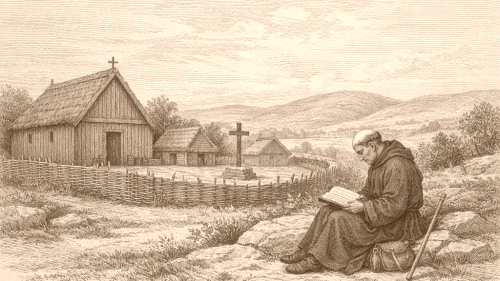
Tradition and later historical description connect the site with the goddess Macha, but the settlement’s documentary history becomes clearer with the foundation narrative of Armagh as an ecclesiastical centre. Lewis’s nineteenth-century topographical account says the ancient city was originally called Druim-sailech (“the hill of sallows”), later Ard-sailech, and then Ard-macha; he presents St Patrick as the figure to whom the city’s origin and pre-eminence were attributed in medieval tradition 2.
Ecclesiastical centre and repeated destruction
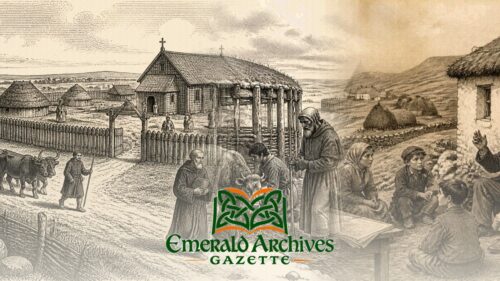
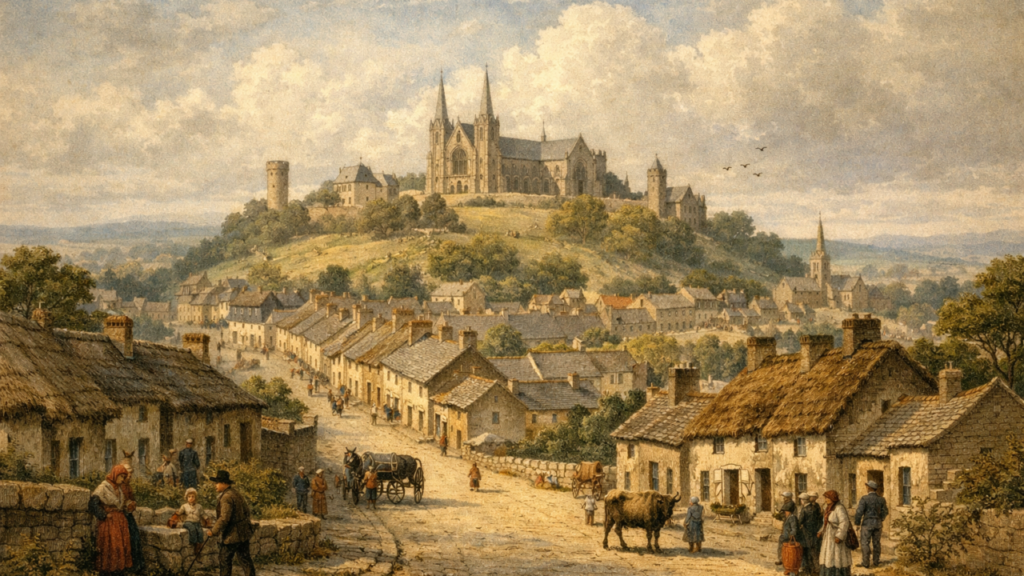
By the medieval period Armagh was renowned as the seat of the Irish primacy. Lewis describes it as “the head of the primacy of all Ireland” and notes its long-standing reputation as one of the great centres of learning in Europe 2. A modern historical essay on English Street in Armagh likewise places early Christian settlement on “the Hill” at the centre of the town’s development and notes that the surrounding secular tracts, or trians, carried specialised functions including trade 3.
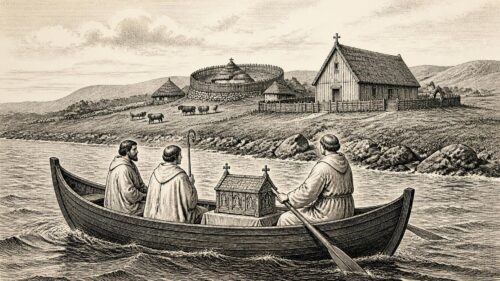
The same historical account emphasises how often Armagh was damaged in war. It says that from the fifth to the seventeenth century the church on the hill was destroyed seventeen times, with major damage in the later sixteenth and seventeenth centuries, including the upheavals around the Nine Years’ War and the 1641 rebellion 3. Lewis’s 1837 gazetteer also records repeated destruction by fire and Viking attacks in the early medieval period, showing that Armagh’s importance made it a repeated target 2.
County status and later historical role
Armagh’s county identity is historically secure. Lewis states that the county of Armagh was made shire ground under its present name in 1586 by Sir John Perrott and explicitly says it took its name from the chief town 4. The place-name authority likewise records Armagh as a town in County Armagh and also documents the county form “(contae) Ard Mhacha” in Irish historical material 1. This confirms that the settlement and the county share a closely linked historical naming tradition.
By the seventeenth and eighteenth centuries, Armagh had begun to recover from repeated destruction and to expand beyond the cathedral hill. Historical writing on the town notes gradual rebuilding after the wars, followed by more regular growth in the eighteenth century 3. Even so, its older identity remained dominant: Armagh was remembered first as a sacred and scholarly centre, then as the county town, and only later as a more dispersed urban settlement 24.