New Nationalism
Limerick Archives — Saturday, 6 October 1900
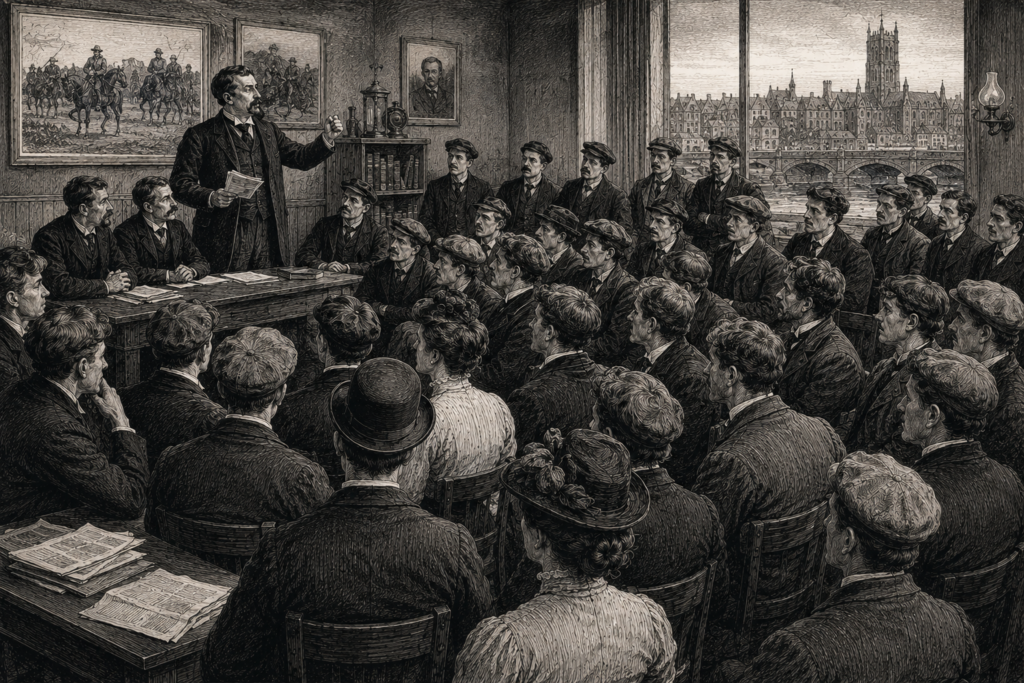
LIMERICK, Saturday — Pro-Boer feeling is giving renewed confidence to younger Irish nationalists who have grown dissatisfied with the pursuit of Home Rule solely through the British Parliament. In Limerick, admiration for the resistance of the Transvaal and Orange Free State has entered political meetings, newspaper discussions and conversations among cultural revivalists. Many continue to support the reunited Irish Parliamentary Party, yet others ask whether speeches and negotiated concessions can secure genuine national freedom. To these younger activists, the Boer struggle appears to show that a small nation must cultivate its own institutions, resources and determination rather than depend upon imperial goodwill.
The war has provided advanced nationalists with a living example more immediate than memories of earlier Irish rebellions. Britain’s campaign against the two Boer republics is presented as evidence that imperial power will not surrender control merely because a smaller people demands political rights. Constitutional nationalists condemn the conflict while continuing to seek an Irish legislature within the United Kingdom. Their separatist critics draw a more sweeping conclusion, arguing that Ireland should abandon dependence upon Westminster and develop independent cultural, economic and political strength. The South African struggle has therefore widened an old disagreement about the methods by which Irish freedom might eventually be secured.
Arthur Griffith’s United Irishman has become an important forum for this emerging argument. Griffith and his associates link support for the Boers with resistance to Anglicisation, encouragement of Irish industries and the recovery of national confidence. Cumann na nGaedheal, whose programme is published today, proposes to advance Irish national independence through history, language, literature, music, native games and economic self-reliance. The organisation does not yet rival the parliamentary movement in numbers or electoral influence. It nevertheless offers younger nationalists a programme extending beyond Home Rule and provides cooperation between separatists, cultural organisations and activists disappointed by repeated reliance upon British political parties.
The Irish Transvaal Committee has already united figures such as Maud Gonne, Arthur Griffith, John O’Leary and William Redmond in organising sympathy for the Boer cause. Michael Davitt’s resignation from Parliament and subsequent journey to South Africa added moral authority to opposition against the war. Major John MacBride and the Irish Brigade supplied separatists with a more militant example by fighting alongside the Boers. Their actions are celebrated by advanced nationalists as proof that Irish sympathy need not be confined to parliamentary protest. Women associated with Inghinidhe na hÉireann have also connected anti-imperialism with cultural revival, social work and the demand for complete independence.
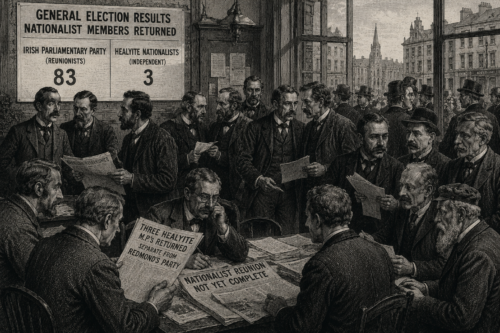
Constitutional nationalism remains the strongest organised force in Limerick, and most voters are unlikely to abandon parliamentary representation suddenly. The Boer conflict has nonetheless altered the language in which younger activists discuss Ireland’s future. They can now point to events abroad when arguing that nationality requires self-reliance, organisation and a willingness to resist political dependence. Advanced nationalism remains fragmented, and its supporters disagree over tactics, social questions and the place of physical force. Yet South Africa has furnished them with an international cause, recognisable heroes and a powerful criticism of empire. Home Rule remains dominant, but it no longer defines every nationalist ambition.
- United Irishman, 6 October 1900, “Formation of Cumann na nGaedheal” — publishes the organisation’s programme for advancing Irish national independence through Irish history, language, literature, music, native games, industry and resistance to Anglicisation. Exact page and column should be confirmed before formal citation.
- Minute Book of the Irish Transvaal Committee, 7 October 1899–6 March 1900, National Library of Ireland — records the organisation of Irish sympathy with the Boers and contains references to Maud Gonne, Arthur Griffith, John O’Leary, T. O’Neill Russell and William Redmond. The exact manuscript call number should be confirmed before formal citation.
- Michael Davitt Papers, Trinity College Dublin, Manuscripts and Archives Research Library, MS 9657 — contains notes, reports and draft material concerning the Boer War and Davitt’s The Boer Fight for Freedom.
- James Connolly, resolution drafted for an Irish Socialist Republican Party public meeting, 27 August 1899, William O’Brien Papers, National Library of Ireland — expresses sympathy with the Boer republics and condemns British interference in the Transvaal. The exact manuscript call number should be confirmed before formal citation.
- United Irishman, issues published during 1900 — contemporary separatist reporting and commentary connecting the Boer struggle with Irish independence, anti-imperialism and criticism of parliamentary dependence. Exact issue, page and column should be confirmed before formal citation.