Unionist Display
Limerick Archives — Thursday, 5 April 1900
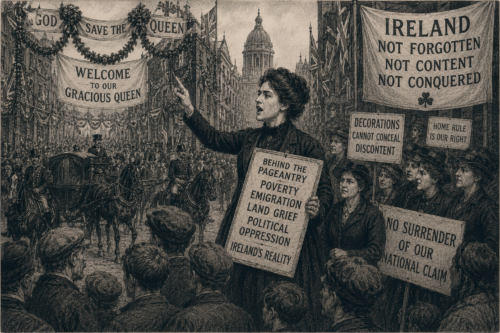
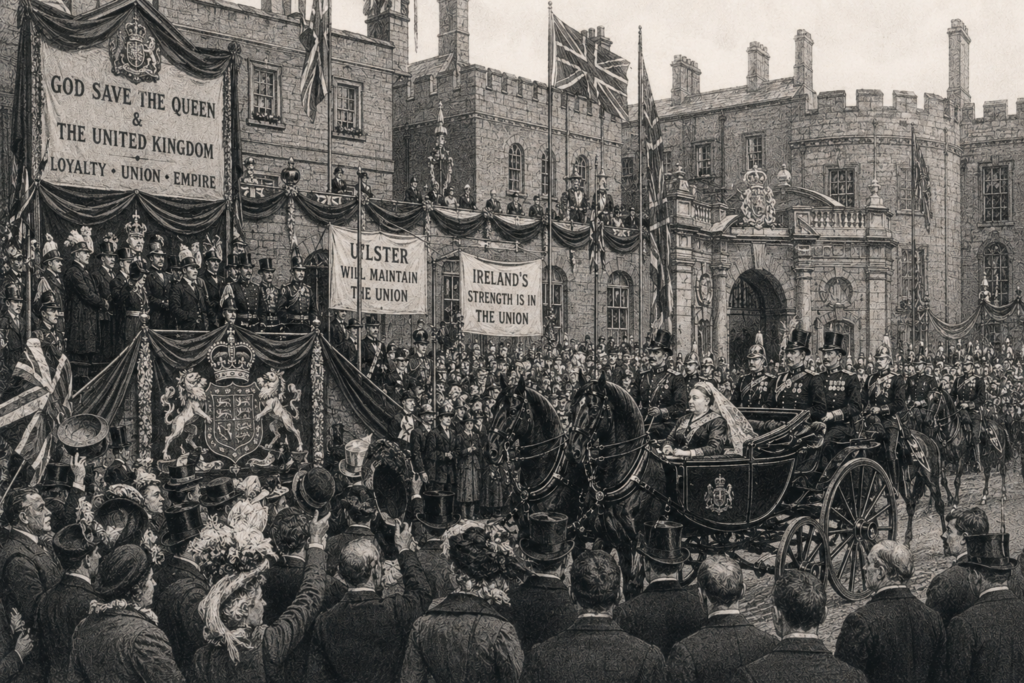
LIMERICK, Thursday — Dublin Castle and unionist organisations have used Queen Victoria’s arrival to affirm Ireland’s constitutional place within the United Kingdom. The administration directed an elaborate programme of ceremonial receptions, military escorts, civic addresses and public decoration intended to display loyalty to the Crown. Reports reaching Limerick describe streets filled with spectators and buildings dressed for the royal occasion. Unionist newspapers and public figures have welcomed the visit as proof that attachment to the monarchy remains substantial despite nationalist demands for Home Rule. The ceremonies present Ireland not as a nation awaiting separation, but as an established and valued part of the Union.
Dublin Castle stands at the centre of British administration in Ireland, housing the officials responsible for government, policing and royal arrangements. The Lord Lieutenant, Earl Cadogan, received the Queen and assisted in organising the programme that will continue throughout April. Castle officials coordinated with the military, Dublin Metropolitan Police, Royal Irish Constabulary, harbour authorities and civic representatives to secure the procession route and manage the crowds. The visit has therefore become an extensive demonstration of administrative power. Every escort, inspection and formal address reinforces the authority of institutions through which British government operates in Ireland.
Irish unionists regard the Queen’s presence as a timely answer to the renewed organisation of constitutional nationalism. The Irish Parliamentary Party has recently restored unity after years of internal division, while the United Irish League is extending nationalist organisation throughout the country. Unionist leaders argue that Home Rule would weaken the connection with Britain, threaten economic stability and place loyal minorities beneath a permanent nationalist majority. Royal ceremony allows them to express an alternative political identity grounded in allegiance to the Crown, Parliament and Empire. The cheering crowds and decorated streets will consequently be cited as evidence that nationalist leaders cannot speak for every Irish citizen.
In Limerick, unionism commands less electoral strength than nationalism but remains visible among sections of the Protestant community, military families, merchants, professional households and those whose employment depends upon imperial institutions. The city’s barracks, courts, police administration and commercial connections ensure that the Union is experienced through ordinary employment as well as political principle. Loyal residents may view the royal visit as reassurance that their identity and interests remain protected. Nationalists, however, will question whether ceremonies arranged by Dublin Castle can demonstrate genuine national consent while Ireland continues to be governed from Westminster without its own legislature.
The visit therefore carries significance extending beyond personal respect for the elderly Queen. Dublin Castle is presenting royal loyalty as a public and constitutional fact, while unionists are using the occasion to defend Ireland’s membership of the United Kingdom. Yet the spectacle also exposes the depth of political disagreement. The same procession that represents stability to loyalists represents foreign rule to separatists and unfinished government reform to Home Rulers. Limerick observers will interpret the ceremonies through local experiences of religion, class, military service, land ownership and political allegiance. Royal pageantry has temporarily united the streets in spectacle without settling the argument over Ireland’s future.
- Queen Victoria, journal entry for 4 April 1900, Royal Archives, Windsor Castle, describing her reception at Kingstown, the military escort and the journey through decorated Dublin. Exact archival volume and folio should be confirmed before formal citation.
- Dublin Castle administrative papers concerning Queen Victoria’s visit to Ireland, April 1900, including ceremonial, policing, harbour and expenditure arrangements. Exact collection, file and folio should be confirmed before formal citation.
- The Irish Times, Dublin, 4–27 April 1900, reports and editorials concerning the royal visit, official receptions and expressions of unionist loyalty. Exact page and column should be confirmed before formal citation.
- Daily Express, Dublin, April 1900, unionist newspaper coverage of Queen Victoria’s arrival, the public decorations and Ireland’s relationship with the Crown. Exact issue, page and column should be confirmed before formal citation.
- Limerick Chronicle, Limerick, April 1900, local reporting and commentary on the royal visit, loyalist opinion and official ceremonies in Dublin. Exact issue, page and column should be confirmed before formal citation.