Kincora Committees
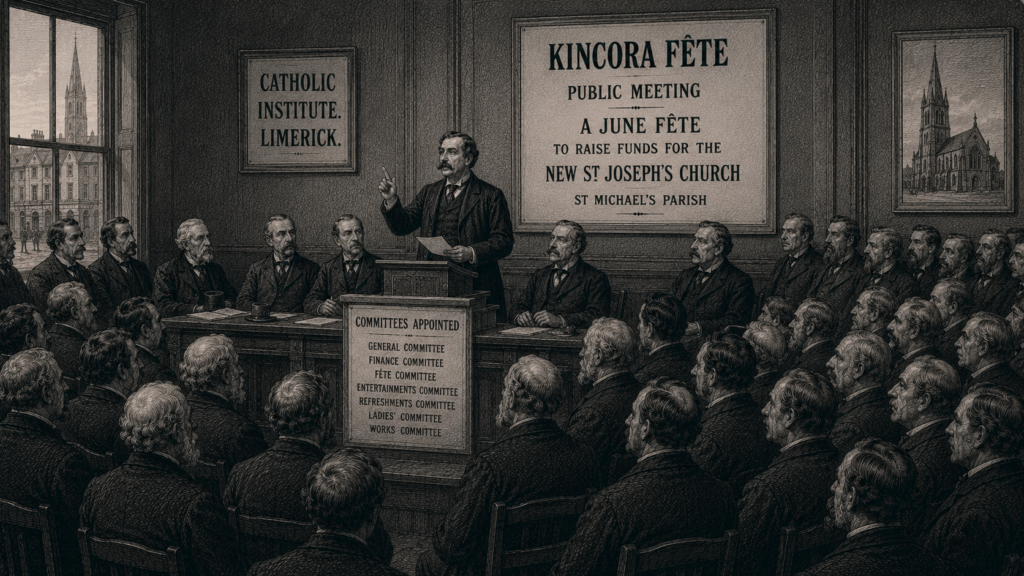
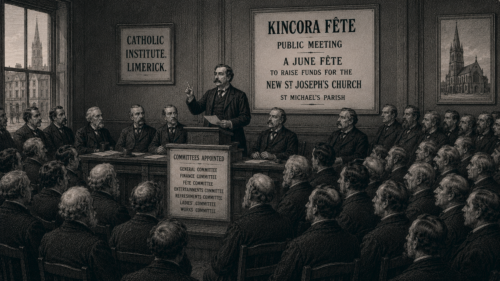
A large public meeting assembled in the Lecture Hall of Limerick’s Catholic Institute to organise a fête and fancy fair for the new church of St Joseph then rising within St Michael’s Parish. The gathering, reported on 4 January 1900, was promoted by the parish clergy and presided over by Bishop Edward Thomas O’Dwyer. Clergy, women and men attended in considerable numbers, demonstrating broad interest in completing the additional parochial church. The meeting agreed that the fundraising celebration would take place in June and established committees to undertake the detailed work required before the event could open.
The proposed church was intended to serve the extensive population of St Michael’s, which reached from central Limerick towards Ballinacurra. Bishop O’Dwyer and the parish clergy had decided in 1897 that an auxiliary church was necessary, and a site on Military Road was donated by Mr Byrnes. William Edward Corbett supplied the design, while John Ryan and Sons became the builders. Construction had advanced sufficiently for the organisers to confront the remaining financial burden. The fête was therefore conceived not as a minor parish entertainment but as a major city fundraising effort supporting an important addition to Limerick’s Catholic infrastructure.
The Reverend Father O’Donnell explained that the organisers had first ensured that their plans would not conflict with a proposed hospitals fête. Only after the hospital committees indicated that they would not stage such an event during the year did the parish proceed. June was selected partly to avoid competition with other public attractions and because the celebrated Limerick tenor Joseph O’Mara had offered to keep himself available to assist. Father O’Donnell also welcomed promised support from Protestant citizens, presenting the undertaking as an opportunity for cooperation extending beyond the congregation that would eventually worship in the new church.
Letters supporting the project were received from several people unable to attend, including Count Moore, who offered a prize. The meeting created a number of organising committees charged with preparing the entertainment, stalls, subscriptions, publicity and other arrangements. The celebration was named the Kincora Fête, drawing upon the royal residence traditionally associated with Brian Boru and giving the undertaking a recognisably Irish cultural character. The choice reflected the elaborate themes commonly adopted by large charitable fêtes, which relied upon spectacle, music, performances and carefully decorated attractions to encourage repeated attendance and generate substantial income.
The preparations culminated in the Kincora Fête at the Markets Field in June 1900. Cardinal Michael Logue formally opened the celebration, and a large choir performed under the direction of Vincent O’Riordan. Advertised attractions included the cinematograph, then still a striking novelty for many Irish audiences. The fête proved financially successful and strengthened the fund for St Joseph’s, although construction continued beyond that summer and the church was not formally opened until April 1904. The January meeting had nevertheless created the organisational structure that transformed a parish need into one of Limerick’s largest public fundraising enterprises of the year.
- Freeman’s Journal, “Proposed Fete in June,” 4 January 1900, p. 6.
- St Joseph’s Parish, St Joseph’s Parish: A History, pp. 13–14, account of the decision to build the church, its financing and the Kincora Fête of June 1900.
- Denis Condon, Early Irish Cinema, 1895–1921, Dublin: Irish Academic Press, 2008, pp. 22–23, identifying the cinematograph among the attractions advertised for Limerick’s Kincora Fête, 4–9 June 1900.
- St Joseph’s Parish, “Parish History,” account of the church’s construction as a chapel of ease for St Michael’s Parish, its architect William Edward Corbett and builders John Ryan and Sons.
- Patrick Comerford, “Saint Joseph’s, a Limerick Church that Features in Angela’s Ashes,” 13 January 2018, architectural and historical account of St Joseph’s Church.