
Roads Conflict(c.1890s)
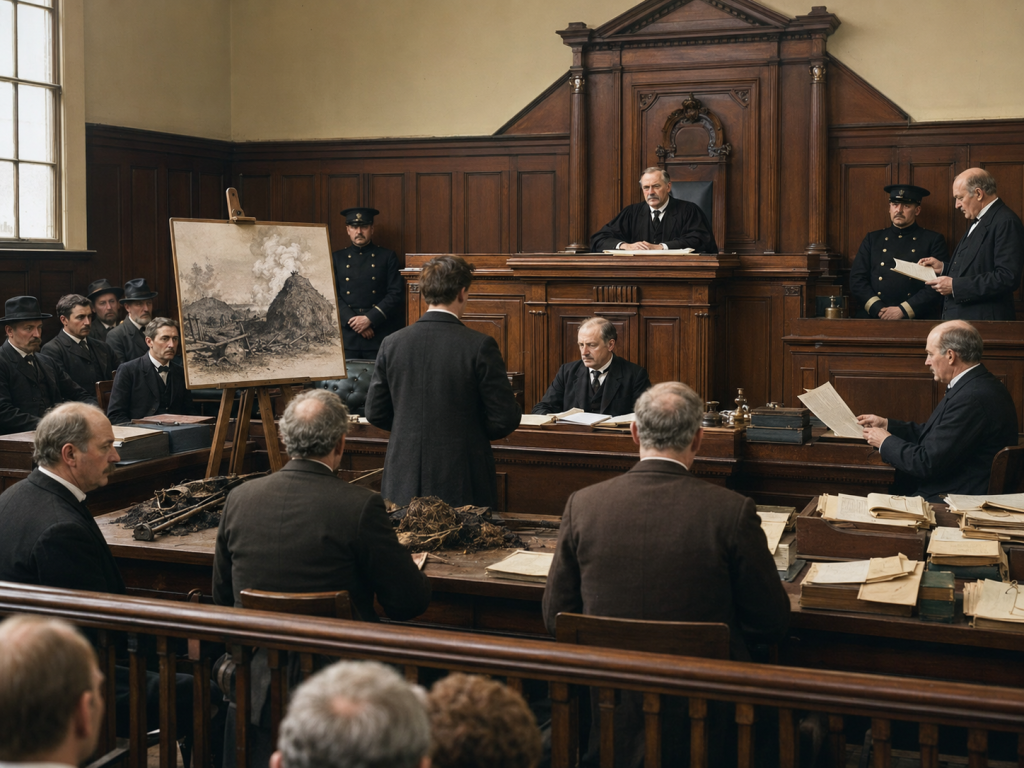
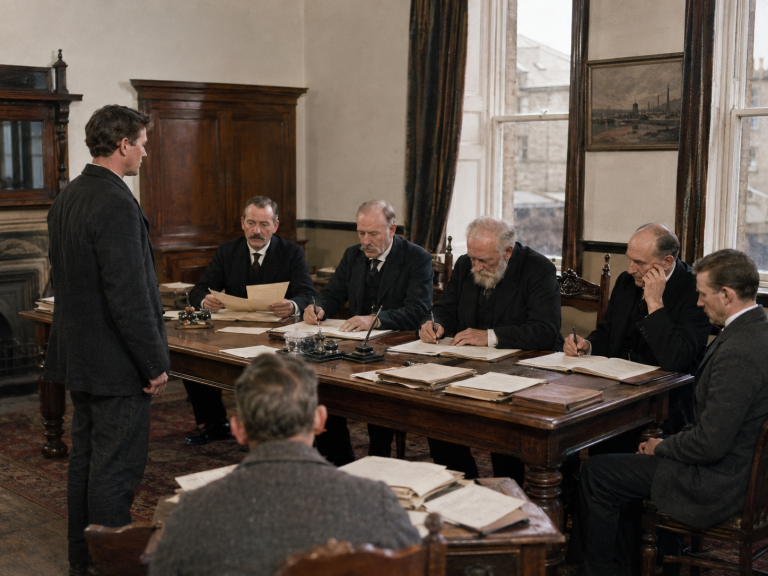
Judge Richard Adams awarded £105 compensation at Limerick County Crown Court for hay maliciously burned at Templebredin on the night of 6 December 1899. The claimant, T. M. English, had sought £116 for the destroyed property and argued that hostility arose from his position during a dispute over the maintenance of public roads. Evidence presented to the court connected the burning with an increasingly bitter campaign for the direct employment of labourers by the newly established local authorities. The case brought a rural employment controversy from council meetings into the formal machinery of criminal injury compensation.
English told the court that he had supported a limited experiment rather than the complete abandonment of road contractors. His proposal was that labourers should maintain half of the main roads for twelve months, allowing the council to compare the expense with the established contracting system. The remaining main roads and smaller roads would continue under contractors. At a district council meeting, however, labourers accompanied by a band and banners reportedly interrupted proceedings, groaned and hooted while English attempted to speak, and allowed one campaigner who was not a council member to address the gathering.
The claimant further alleged that two labourers later attempted to assault him while he was returning from Old Pallas Fair. The destruction of his hay followed soon afterwards, completing what the prosecution presented as an escalation from public obstruction to intimidation and malicious damage. Judge Adams accepted that the crime arose from the direct-labour agitation, though the surviving report does not identify the individuals responsible for setting the fire. His remarks were sharply hostile towards the conduct described in court, and he called for stronger protection of district councils when crowds attempted to disrupt their lawful proceedings.
Adams placed the compensation charge upon County Limerick at large rather than upon the immediate locality. He explained that he would have imposed the burden locally had evidence shown that neighbouring ratepayers supported or assisted the intimidation, but no such proof had been offered. The decision meant that the financial consequence of the burning would be shared through county taxation. It also distinguished ordinary ratepayers and elected councillors from the labourers whom the judge blamed for the agitation, although he criticised the local authorities for what he regarded as timidity in responding to organised pressure.
The case exposed the tensions created by the transfer of road administration to elected county and district councils under the Local Government Act of 1898. Direct labour offered rural workers the prospect of wages controlled through public bodies rather than private contractors, while farmers and ratepayers worried about costs, supervision and political pressure. A related County Council decision permitted roads lacking acceptable tenders to be placed under the county surveyor and worked directly by labourers. The Templebredin burning therefore arose during a wider struggle over employment, local democracy and control of public expenditure in the first years of the new system.
Primary Sources
- Irish Times, “The Direct Labour Agitation: Strong Remarks by Judge Adams,” 5 January 1900, p. 2.
- Irish Times, “Limerick County Council and the Roads,” 5 January 1900, p. 3.
- Irish Times, “The Direct Labour Question,” 18 January 1900, p. 6.
- Local Government (Ireland) Act 1898, 61 & 62 Vict., c. 37.
- County Officers and Courts (Ireland) Act 1877, 40 & 41 Vict., c. 56.