
Archived: 14 October 2026
Abstract
In 1660, Ireland’s Protestant leaders used the General Convention to support Charles II’s restoration, proclaiming him king before his return to England while seeking to preserve parliamentary influence, episcopacy and Cromwellian landholdings. Former Commonwealth figures, notably Charles Coote and Roger Boyle, became royal brokers and regional magnates, while commissioners governed amid uncertainty. Charles’s November Declaration addressed competing claims of Catholic former proprietors, Adventurers and soldiers, protecting many possessors while offering limited restoration through proof of innocence. The Church of Ireland revived under bishops, yet Catholics remained excluded. Restoration restored monarchical institutions but postponed conflict over land, religion, loyalty and power.
Read Article
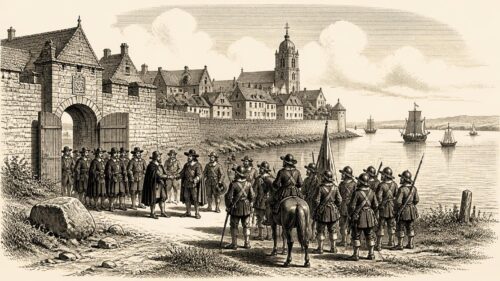
Archived: 14 October 2026
Abstract
In 1652, Galway, the last major Confederate Atlantic port, surrendered to parliamentary forces after siege and blockade, ending its military significance but leaving Catholic inhabitants uncertain. Resistance persisted through irregular fighters, while agreements offered some soldiers foreign service. Charles Fleetwood’s appointment signalled army-backed civil rule. On 12 August, the Rump Parliament’s Act for the Settling of Ireland established punitive categories of guilt, enabling forfeiture, banishment and redistribution of land to soldiers and Adventurers, although later measures shaped transplantation. War, famine, disease and displacement devastated communities. Thus conquest evolved into a programme restructuring property, authority, religion and belonging under Commonwealth rule.
Read Article
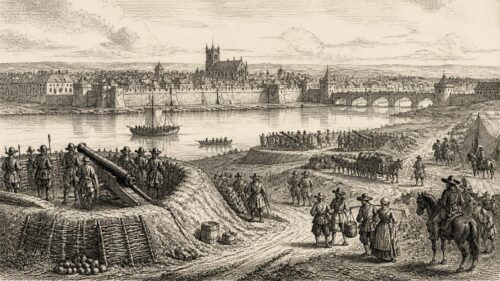
Archived: 14 October 2026
Abstract
In 1651 Commonwealth forces tightened control of Ireland through campaigns in Munster and Connacht. Henry Ireton besieged Limerick, while Lord Broghill defeated Muskerry’s attempted relief army at Knocknaclashy, ending prospects of substantial support. Blockade, artillery, hunger and disease devastated Limerick’s inhabitants, provoking divisions between defenders, clergy and civilians seeking terms. The city surrendered on 27 October after internal betrayal opened key positions. Although many received quarter, leading military, civic and Catholic figures were excluded, imprisoned or executed. Ireton envisaged a more English, Protestant city. Meanwhile Galway came under blockade, becoming the remaining major centre of organised Catholic and royalist resistance.
Read Article
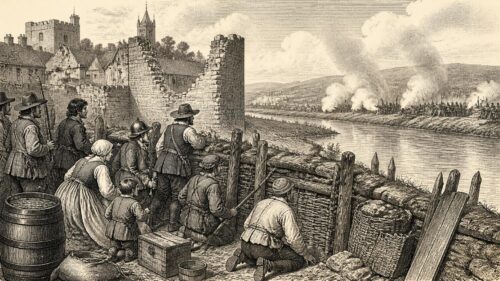
Archived: 14 October 2026
Abstract
In 1650, the Cromwellian conquest advanced despite continuing resistance in Connacht, Limerick and Ulster. Cromwell’s agreement with Protestant royalists weakened Ormond’s Catholic–royalist coalition. At Clonmel, Hugh Dubh O’Neill’s improvised inner defence repelled a costly assault, although shortages enabled the garrison’s escape and the town’s surrender. Broghill defeated a relief force at Macroom, while Scarrifholis destroyed the Ulster Catholic army and led to Heber MacMahon’s execution. After Cromwell departed, Henry Ireton captured plague-stricken Waterford and Duncannon, pressured Athlone and failed before Limerick. Clergy repudiated Ormond; garrisons, blockade, disease and resource seizures established groundwork for further conquest and settlement in Ireland thereafter.
Read Article




