Clonmel Defence1650 CE
In 1650, the Cromwellian conquest advanced despite continuing resistance in Connacht, Limerick and Ulster. Cromwell’s agreement with Protestant royalists weakened Ormond’s Catholic–royalist coalition. At Clonmel, Hugh Dubh O’Neill’s improvised inner defence repelled a costly assault, although shortages enabled the garrison’s escape and the town’s surrender. Broghill defeated a relief force at Macroom, while Scarrifholis destroyed the Ulster Catholic army and led to Heber MacMahon’s execution. After Cromwell departed, Henry Ireton captured plague-stricken Waterford and Duncannon, pressured Athlone and failed before Limerick. Clergy repudiated Ormond; garrisons, blockade, disease and resource seizures established groundwork for further conquest and settlement in Ireland thereafter.
Dateline
In 1650, the war that had consumed Ireland since the rising of 1641 entered a decisive and exceptionally destructive phase. This was not yet the end of the Cromwellian conquest: Connacht, Limerick and several important strongholds still resisted, while guerrilla warfare would persist. But during this calendar year the alliance opposed to the English Commonwealth lost many of its remaining positions, its political cohesion and, in Ulster, its principal field army. The year’s central story was therefore not simply Oliver Cromwell’s advance, but the changing character of the conflict after his departure: Henry Ireton inherited an unfinished conquest, towns were reduced by blockade and disease as much as artillery, and the Catholic–royalist alliance began to fracture beyond repair.
A Coalition Unravels
Ireland’s defenders were divided by religion, local interest, military rivalry and competing ideas of loyalty. The coalition associated with James Butler, marquess of Ormond, joined Irish Catholic Confederates to Protestant royalists in the name of Charles II. Yet its unity had always been precarious. In April, Cromwell secured an agreement with many Protestant royalist forces in Munster and Leinster. They undertook not to fight for the Commonwealth’s enemies; in return, Cromwell promised security for their lives and property. This mattered militarily because it removed much of the Protestant armed support on which Ormond’s alliance depended. It also sharpened the conflict’s confessional edge: those most determined to continue organised resistance were increasingly Irish Catholics.
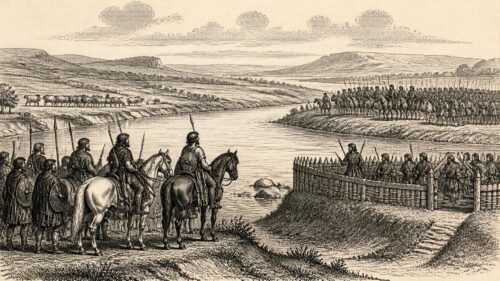
The agreement did not make warfare simple or inevitable in one direction. Towns and garrisons still had to judge whether resistance, negotiation or withdrawal offered the best prospect of survival. Commanders weighed supplies, ammunition, local loyalties and the treatment likely to follow a surrender. Civilians bore the consequences. Armies quartered in houses, requisitioned food and livestock, cut communications and turned bridges, fords and walled towns into strategic assets. The campaigning landscape of 1650 was one in which a river crossing or a small fort could determine whether a larger town could be fed, reinforced or evacuated.
Clonmel’s Costly Defence
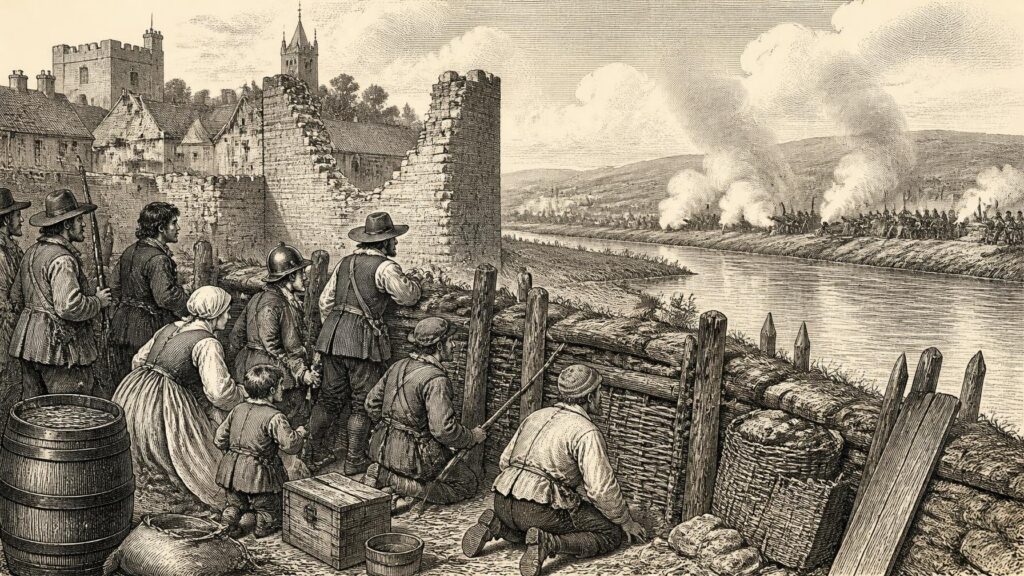
The siege of Clonmel in County Tipperary demonstrated that the New Model Army could be checked, even while its wider strategic position remained formidable. Cromwell arrived before the town on 27 April with substantial reinforcements and artillery. Clonmel lay on the Suir, protected by masonry walls, earthworks and the river. Its defence was directed by Hugh Dubh O’Neill, an experienced soldier of the Ulster army who had served in Spain. The garrison was already strained by shortage and disease, but O’Neill maintained discipline and worked with the town’s civic leadership to sustain the defence.
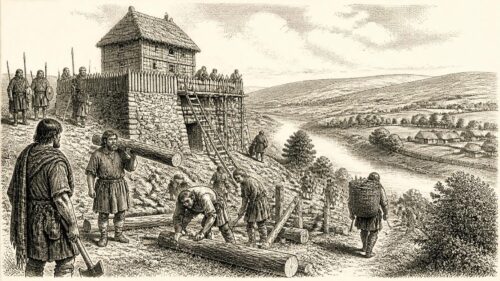
On 17 May, after heavy guns had opened a breach in the northern wall, Cromwell ordered an assault. O’Neill had prepared an inner defensive work behind the breach: an earth-and-timber enclosure that channelled attackers into a confined killing ground under musket and cannon fire. Parliamentarian troops forced their way through the damaged wall but could not break the second line. They withdrew after severe losses. Estimates of the dead vary greatly, and no single total should be stated as certain; what is clear is that Clonmel was one of the most expensive reverses suffered by Cromwell’s army in Ireland.
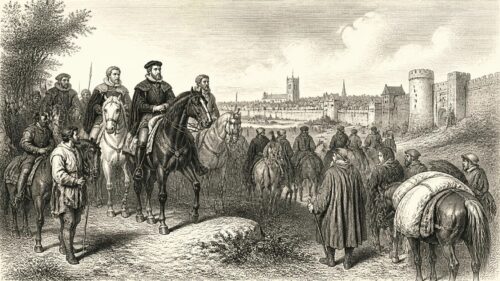
The defence nevertheless could not erase the garrison’s shortages. O’Neill’s men had expended much of their ammunition, food was near exhaustion, and no effective relief was coming. During the night after the assault, most of the soldiers escaped across the Suir. The following day the mayor sought terms for the town. Cromwell granted protections for the inhabitants’ lives and property, apparently unaware at first that the garrison had gone. Thus Clonmel entered Commonwealth hands, but its resistance had bought time and inflicted a conspicuous tactical defeat. It also revealed the practical limits of artillery-led assault against an alert, ingenious defence.
Munster and the Northern Disaster
The pressure on Clonmel was accompanied by fighting elsewhere in Munster. On 10 May, Lord Broghill’s Parliamentarian cavalry defeated an Irish force under David Roche near Macroom in County Cork, preventing a possible attempt to relieve Clonmel. The episode underlined the value of mobile horsemen in a war otherwise dominated by sieges: cavalry could intercept a relief force before it reached a fortified town, while boggy ground and broken country could still offer fugitives a route of escape.
The most consequential battlefield event of the year occurred far to the north-west. Owen Roe O’Neill, the formidable commander of the Ulster Catholic army, had died in November 1649. In March 1650 the provincial leadership chose Heber MacMahon, Catholic bishop of Clogher, as his successor. MacMahon’s appointment was a political compromise, but he faced an extraordinarily difficult command: the Ulster army lacked secure supplies and had to confront Parliamentarian forces led by Sir Charles Coote and supported by other English and settler formations.
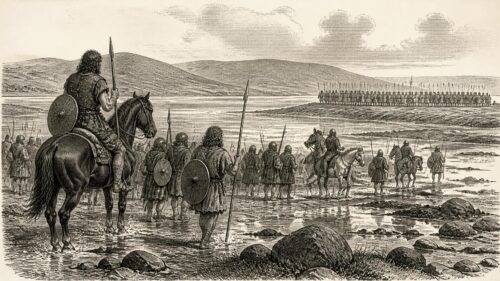
On 21 June at Scarrifholis, near Letterkenny in County Donegal, MacMahon chose to leave a strong position and fight Coote’s reinforced army on less favourable ground. The result was a rout. Contemporary and later accounts differ on numbers, but agree that thousands of Ulster soldiers were killed in the battle and ensuing pursuit, and that the army lost a devastating number of officers. MacMahon escaped briefly but was captured within days and executed. Scarrifholis did not end all resistance in Ulster, yet it destroyed the Ulster army as a force capable of changing the war’s balance. For communities already damaged by almost a decade of conflict, the defeat brought further flight, requisitioning and insecurity.
Ireton’s Command and Waterford’s Surrender
Cromwell left Ireland in the last days of May, recalled by the political and military emergency created by the royalist threat from Scotland. He selected his son-in-law, Henry Ireton, as commander of the Commonwealth army; Parliament confirmed Ireton as lord deputy on 2 July. The transfer did not mean that Ireland had been conquered. Much of Munster, parts of Ulster and all Connacht still lay outside secure Commonwealth control. But Ireton possessed a disciplined army, naval support and an increasingly connected chain of captured towns and garrisons.
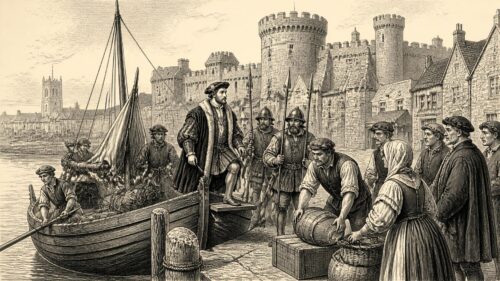
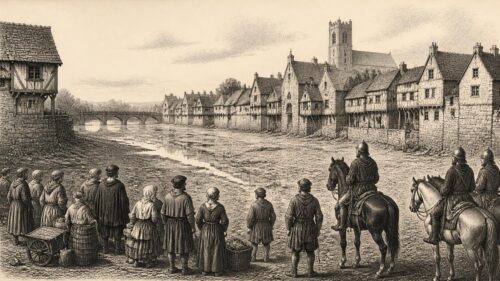
Waterford was the immediate prize. Its port at the mouth of the Suir made it strategically important for overseas supply and for communications with the south-east. The city had resisted Cromwell in late 1649. By the summer of 1650, however, isolation was telling. Parliamentarian garrisons and guards had constricted access by land, while naval forces helped close the harbour. A contemporary Parliamentarian diary records both the city’s distress and sickness raging within it. Plague was sufficiently serious among Commonwealth forces as well that Ireton issued a proclamation from the camp before Waterford on 30 July, calling for fasting and prayer in response to what he regarded as divine visitation.
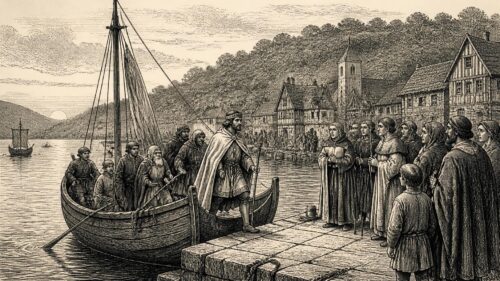
The formal articles for Waterford’s surrender were concluded on 6 August; the garrison marched out on 9 August, a distinction preserved in the contemporary diary and useful against the tempting but misleading search for a single “fall” date. General Thomas Preston and the soldiers were allowed to depart with arms under the agreed terms, while a Parliamentarian garrison entered the city. Nearby Duncannon Fort, commanding the entrance to Waterford Harbour, surrendered later that month. The loss of Waterford was therefore more than the capture of another walled town: it gave the Commonwealth control of a major south-eastern port and narrowed the possibilities for supply, movement and negotiation available to its opponents.
Faith, Authority and the Countryside
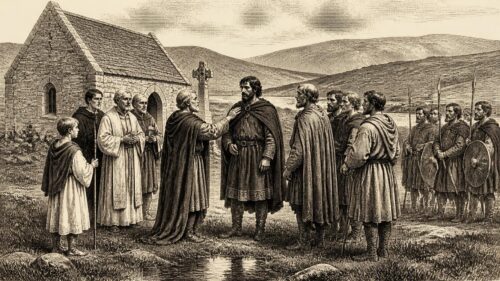
Military collapse intensified political and religious division. On 12 August, Catholic bishops and clergy meeting at Jamestown in County Leitrim repudiated continued obedience to Ormond, whose ability to protect Catholic interests had plainly diminished. The hierarchy’s action reflected anger at defeats, distrust of Protestant royalists, and alarm about the future of Catholic religion and property under Commonwealth rule. Ormond’s authority continued to ebb. A later assembly at Loughrea debated the emergency, and in December he left Ireland for exile. These were firmly dated political developments of 1650, not merely a retrospective judgement that the royalist cause had failed.
Ireton’s autumn movements show why the war could not be reduced to a sequence of city sieges. After Waterford, Commonwealth forces moved through Leinster against armed bands whom their own records branded “tories”. In late August, troops entered the Glenmalure region of Wicklow, taking cattle in an operation intended to deny opponents sustenance and disrupt their local bases. Such entries expose the everyday material stakes of conquest. Cattle were food, wealth, transport and military provision; their seizure could weaken fighters while placing still greater pressure on households and displaced people.
In September Ireton advanced on Athlone, the vital Shannon crossing between Leinster and Connacht. On 16 September, Lord Dillon’s men burned the eastern, Leinster-side portion of the town and withdrew across the river, breaking the bridge behind them. The Commonwealth gained one side but not an easy passage into Connacht. Ireton then turned south towards Limerick, reaching it in early October. The city, defended by Hugh Dubh O’Neill and a seasoned Ulster garrison, was better prepared than he had hoped. With winter approaching and the position unfavourable, Ireton withdrew on 19 October.
An Unfinished Conquest
By the close of 1650, the Commonwealth had made enormous gains, but its hold remained militarised and incomplete. Clonmel and Waterford had fallen; Scarrifholis had shattered the Ulster army; Charlemont, Sir Phelim O’Neill’s last major northern bastion, capitulated in mid-August after a hard siege. Yet Limerick, Galway and much of Connacht remained beyond Commonwealth control, and armed resistance in the countryside meant that travel beyond garrisoned towns could be dangerous. Disease continued to trouble towns and armies alike, while food, fodder, ammunition and transport repeatedly shaped decisions more immediately than grand declarations.
The sweeping confiscations and transplantation usually associated with the Cromwellian settlement belonged chiefly to the years after 1650 and should not be projected backwards as if already complete. What 1650 did establish was the military and administrative groundwork for that later transformation. Ireton’s capture of ports and crossings, his garrison network, his treatment of resistance as both a security and a confessional problem, and the collapse of Ormond’s coalition all changed the range of futures available to Ireland. The empty breach at Clonmel and the plague-stricken walls of Waterford capture the year’s paradox: brave local resistance could still frustrate an assault, but the larger machinery of conquest was steadily closing in.

Primary Sources
- Proceedings of the forces in Ireland under Sir Hardress Waller and Lord-Deputy Ireton by Parliamentary army officers 1650-1651
- An impartial relation of the most memorable transactions of General Owen O'Neill and his party, from the year 1641 to the year 1650
- Ireton, Henry
- MacMahon, Heber (Ever, Emer)
- Coote, Sir Charles
- Butler, James
- O'Neill, Sir Phelim
- Venables, Robert
- O'Neill, Owen Roe (Ó Néill, Eoghan Rua)
- Cliffe, John
- MacGeoghegan, Anthony (Niall)
- King, Sir John
- A declaration and proclamation of the Deputy-General of Ireland: concerning the present hand of God in the visitation of the plague
- Conquest and land in Cromwellian Ireland, 1649-1652
- Cromwell and Ireland: New Perspectives
- The navy and the Cromwellian conquest of Ireland, 1649-53
- The Siege of Clonmel, 1650
- Summer 1650: Waterford, Athlone and Limerick
- ‘Till That Place Be Reduced’—Sir Phelim O’Neill’s Last Stand at Charlemont
- On This Day: 21st June 1650: The Battle of Scarrifhollis
- Ireton's siege of Waterford, July-August 1650
- County Waterford: City Urban Archaeology Survey