

Related Archive: Charles II
Kilmainham’s Soldier Hospital
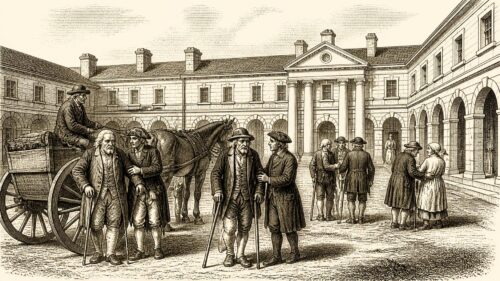
In 1684, Restoration Ireland combined outward peace with unresolved political, military and property tensions. King Charles II chartered the Royal Hospital at Kilmainham for aged and disabled soldiers, linking welfare to the permanent army. A fire damaged Dublin Castle, threatening records and prompting later rebuilding. The Duke of Ormond returned as lord lieutenant but received notice of dismissal, reflecting shifting court influence. The Commission and Court of Grace sought to regularise defective land titles without overturning Protestant dominance. Granard’s regiment improved military organisation. Dublin’s scientific society and Ruaidhrí Ó Flaithbheartaigh’s regional study fostered inquiry, while winter damage exposed material vulnerability.
View Record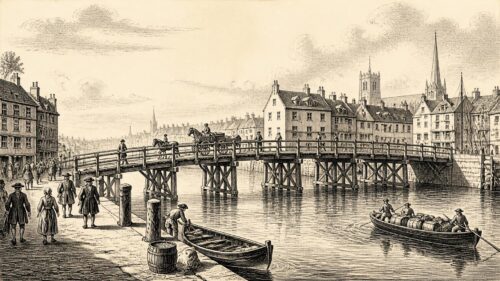
Ormond Bridge, Arran’s Deputyship
In 1682, James Butler, duke of Ormond, retained the lord lieutenancy while his son Richard, earl of Arran, governed from Dublin Castle as lord deputy, maintaining Butler influence under Whitehall’s authority. No parliament met, leaving administration to council, courts, revenue and patronage. Dublin expanded with timber Ormond and Arran Bridges across the Liffey, improving commerce and commemorating the family. Appointments included William Sheridan as bishop of Kilmore and Ardagh, John Lyndon as Third Serjeant-at-Law, and baronetcies. Beneath stability lay Protestant dominance, Catholic exclusion, land settlements, debt disputes and confessional tensions. Ormond’s dukedom affirmed favour but emphasised Ireland’s dependence on court.
View Record
Plunkett’s Tyburn Summer
In 1681, Ireland’s most memorable event was the London execution of Oliver Plunkett, Catholic archbishop of Armagh, after a flawed Popish Plot treason trial. His death exposed Catholic insecurity under Restoration rule. Governed by the duke of Ormond, Ireland lacked a parliament and relied on proclamations, courts and armed institutions. A November order required militia and army officers to receive Church of Ireland communion, affirming confessional loyalty. A July ban on grain exports reflected concern over provisioning, without proving famine. In September, Quakers led by William Bates sailed from Dublin for West Jersey, demonstrating Ireland’s Atlantic religious and migratory connections.
View Record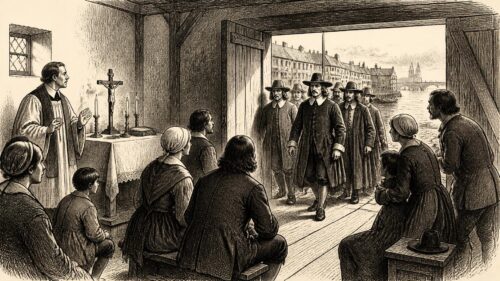
Merchant’s Quay Masshouse
In 1679, amid the Popish Plot scare, Ormond's Irish administration intensified measures against Catholic worship, clergy and suspected disorder. Proclamations targeted bishops, Jesuits, masshouses and tories, linking religious nonconformity with threats to royal authority. Officers entering the Merchants' Quay masshouse met resistance, demonstrating both continuing Catholic worship and contested enforcement. A public Protestant fast nationalised fears of conspiracy. Catholic leaders, including Peter Talbot and Oliver Plunkett, faced confinement; Plunkett's December arrest made him the scare's principal Irish target. Authorities also guarded against Scottish unrest, pursued outlaws, regulated revenue and tobacco, and sponsored rebuilding projects, combining coercion, administration and Restoration display.
View Record
Talbot’s October Arrest
In 1678, the English Popish Plot panic transformed Irish government despite no rebellion or parliament. Lord Lieutenant Ormond pursued revenue collection, army support and land titles, but proposed legislation failed to resolve Restoration property disputes. Catholic structures remained active: Oliver Plunkett held a synod, while Nicholas French died in exile. Peter Talbot, archbishop of Dublin, returned conditionally in May but was arrested in October and imprisoned without evidence. Thereafter proclamations expelled clergy, suppressed religious institutions, disarmed Catholics, restricted access to garrisons and demanded enforcement by officials. These measures intensified sectarian insecurity, while trade, civic regulation and unresolved political tensions continued.
View Record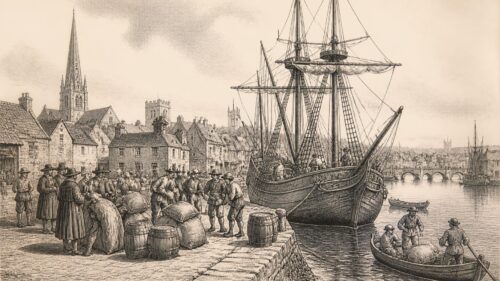
Katherine’s Dublin Cargo
In 1676, under Lord Lieutenant Essex, Ireland’s administration addressed fragile revenue, quit rents, transplantees’ land claims in Connacht and Clare, and unlawful county charges, reflecting unresolved consequences of Cromwellian confiscation. Patronage shaped officeholding, while rewards for Patrick Fleming and Redmond O’Hanlon exposed limited control in Ulster. Dublin changed through Humphrey Jervis’s Essex Bridge, promoting north-side development and commerce. The ship Katherine carried Irish Protestant-organised relief to war-stricken New England, including allied Indigenous recipients. Meanwhile, Francis O’Molloy’s Irish-language Catholic catechism, printed in Rome, demonstrated continental religious networks. These events reveal Ireland as contested, rebuilt and connected across Atlantic and European worlds.
View Record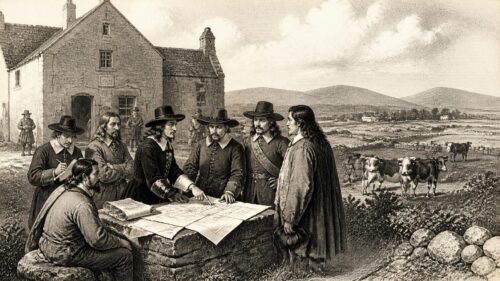
Connacht’s Unfinished Transplantation
In 1675, Ireland remained shaped by unresolved consequences of Cromwellian conquest and Restoration land legislation. On 22 September, Charles II appointed commissioners to decide individual Connacht transplanters’ claims, addressing disputed assignments without reversing Protestant property gains. Lord Lieutenant Essex left for England amid conflict over revenue farming, military finance and Dublin’s dependence on Whitehall; Boyle and Forbes governed as lords justices. Catholic clergy faced continuing, uneven pressure under banishment policy, while parallel Protestant and Catholic hierarchies endured. English restrictions on Irish cattle trade encouraged commercial redirection towards continental and Atlantic markets. Together, these issues exposed an incomplete post-conquest settlement still.
View Record
Oxmantown’s Blue-Coat Opening
On 5 May 1674, the Hospital and Free School of King Charles II opened at Oxmantown, Dublin, admitting sixty poor children, including three girls, and combining education, clothing, food and Protestant instruction. Its civic charity symbolised Restoration order amid poverty and uneven urban recovery. Lord Lieutenant Essex sought administration despite disputed land settlements, financial arrears, unpaid troops and Dublin Castle, where he built lodgings. Government reinforced Protestant authority by expelling Catholic clergy, though worship persisted covertly. Grain restrictions revealed concern over supplies and prices, especially in Ulster, despite peace with the Dutch. Proclamations against robbers and Redmond O’Hanlon exposed insecurity.
View Record
Essex’s Trade Reckoning
In 1673, Lord Lieutenant Essex’s proposed trade report portrayed Restoration Ireland through estimates of land, rents, livestock, housing, goods and scarce circulating coin, privileging taxable wealth over poorer households and local life. English restrictions on cattle imports encouraged exports of processed provisions, wool and fish through Dublin, Cork and Atlantic markets, although benefits were uneven. Essex governed within Protestant political dominance amid English anti-Catholic pressures. Investigation and hostility prompted Archbishop Peter Talbot’s departure for France, while October proclamations targeted Catholic arms, offices, clergy and institutions. Enforcement varied, but Catholic worship became more precarious. Presbyterians retained favour, illustrating selective confessional policy.
View Record
Essex’s August Arrival
In 1672 Arthur Capel, earl of Essex, became lord lieutenant, seeking to centralise Restoration government by curbing provincial power, notably suppressing Munster’s presidency. Ireland supported the Third Anglo-Dutch War through transport, harbour defence, fortification surveys, customs regulation and garrison discipline. Charles II’s Declaration of Indulgence enabled limited, uncertain Catholic activity: bishops and clergy organised synods, appointments and disputes, while Protestant authority remained entrenched. Corporate officeholders faced the Oath of Supremacy, restricting Catholic civic participation. William Petty’s Political Anatomy assessed land, population and resources, reflecting a country still shaped by conquest, redistribution, taxation and religious division. Government combined flexibility with ascendancy.
View Record
Ranelagh’s Revenue Bargain
In 1671, Ireland’s unresolved Restoration settlement shaped politics, finance, trade and religion. Sir Richard Talbot’s petition for Catholic landowners prompted a commission under Prince Rupert, yet threatened no immediate reversal of confiscations. Viscount Ranelagh’s revenue-farming contract transferred collection and government payments to private financiers, provoking army officers’ complaints over arrears. Navigation legislation further constrained Irish colonial commerce, while Sir George Hamilton recruited 1,500 men for French service. Catholic bishops Peter Talbot and Oliver Plunkett maintained precarious church administration amid internal disputes. Scholar Dubhaltach Mac Fhirbhisigh died, while Dublin’s Hospital and Free School received a royal charter, strengthening organised urban charity.
View Record
Plunkett’s Return and Synods
In 1670, under Lord Lieutenant John Berkeley, Ireland remained dominated by the Protestant land settlement and military power established after Cromwellian conquest, yet experienced limited religious latitude. Oliver Plunkett returned as Catholic archbishop of Armagh, rebuilding clerical discipline and hierarchy. Bishops met in Dublin, issued pastoral statutes and declared civil loyalty, despite rivalries between Plunkett and Dublin’s Peter Talbot. Plunkett’s Clones council extended reform and he mediated pardons for Tyrone tories. William Penn defended Quakers while managing Cork estates. Trade adapted to English livestock restrictions, Dublin gained Barrack Bridge, and rebuilding, estate consolidation and constrained negotiation reshaped society across Ireland.
View Record
Robartes at Howth
In 1669, John, Lord Robartes replaced the duke of Ormond as lord lieutenant, reflecting English court politics and concern over Irish revenue and military administration. Arriving quietly at Howth, Robartes inherited a Protestant-led settlement founded on confiscation, unequal landholding and Catholic exclusion. Catholic leadership revived through appointments of Peter Talbot, James Lynch and Oliver Plunkett, consecrated abroad under continuing constraints. Protestant charitable education expanded through Erasmus Smith’s schools and Dublin’s proposed King’s Hospital. George Fox and William Penn documented active Quaker networks, persecution and petitioning. These developments revealed a pacified but unreconciled Ireland, divided by property, religion, power and taxation.
View Record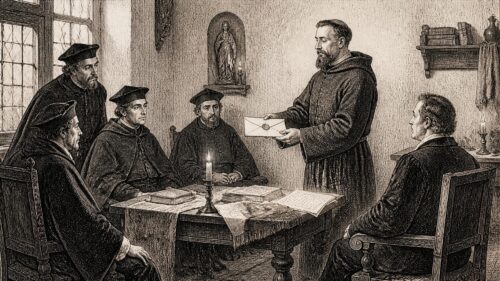
Taaffe’s Counterfeit Commission
In 1668, Restoration Ireland was shaped by contested landownership, religious insecurity and English trade restrictions. Franciscan James Taaffe, claiming forged papal authority, convened clergy, appointed visitors and sought to discipline Catholic divisions over the Remonstrance. Rome repudiated him by October, while alarm over unauthorised papal jurisdiction hastened his collapse. Lord Lieutenant Ormond faced vulnerability and rivalry with the Earl of Orrery, who resigned the Munster presidency. Debt, estate rebuilding and inheritance reflected post-war recovery and unresolved confiscation. English cattle-import prohibitions constrained livestock producers, prompting commercial adaptation. Deaths of George Hamilton and Patrick D'Arcy highlighted property succession and the Catholic generation.
View Record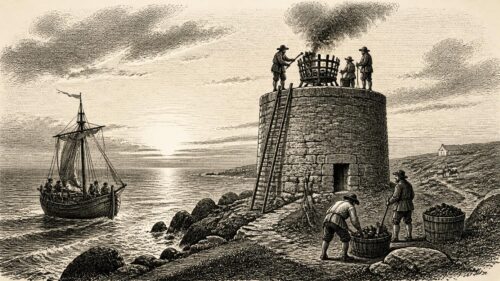
Reading’s Six Coastal Lights
In 1665, Ireland’s Restoration government strengthened its political, economic and institutional framework. The Act of Explanation addressed competing land claims after conquest, requiring many Cromwellian grantees to surrender interests while restricting Catholic restitution. Ormond supervised this fraught settlement, while Michael Boyle’s appointment as lord chancellor reinforced Protestant authority. Dublin’s mayor became lord mayor, reflecting the capital’s growing administrative importance. Charles II authorised Sir Robert Reading’s six coastal lighthouses, linking navigation, commerce and royal privilege during the Second Anglo-Dutch War. Land insecurity affected wider society, investment and local life. These measures established enduring structures while leaving conflict, inequality and uncertainty unresolved.
View Record
St Stephen’s Green Lots
In 1664, Restoration Ireland was reshaped through administrative and cultural initiatives rather than decisive events. Dublin Corporation divided the marshy St Stephen’s Green common into ninety-six building plots, retaining a reduced central green to generate revenue. Land settlement negotiations continued without resolution, as Ormond and rival claimants sought to reconcile confiscated estates; legislation followed in 1665. Londonderry Corporation gained responsibility for its Foyle port, while Portmore Castle symbolised elite estate improvement in Antrim. Sir James Ware published Latin annals of Ireland, and Roger Boyle’s plays reached London. These developments strengthened corporate and proprietary control amid Protestant ascendancy and Catholic exclusion.
View Record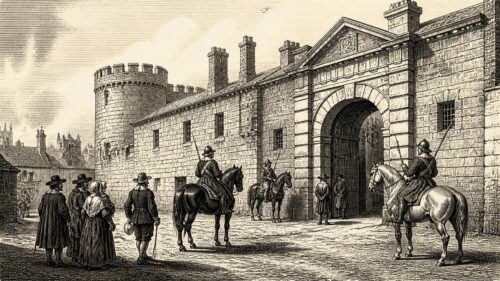
Blood’s Unmade Coup
In 1663, Ireland’s Restoration settlement remained unstable amid competing land claims, religious divisions and memories of war. Ormond’s administration faced Thomas Blood’s failed Protestant radical conspiracy to seize Dublin Castle and abduct the lord lieutenant, exposing divisions within Protestant interests. The Court of Claims issued 829 decrees, including 714 innocence declarations, but lacked land to reconcile restored Catholic proprietors with Cromwellian soldiers and adventurers. Government reinforced authority through registration rules, proclamations and Church of Ireland office requirements, while Margetson became primate. Dublin’s cultural life expanded with Katherine Philips’s Pompey. Trade continued amid imperial uncertainty, while property insecurity constrained uneven recovery.
View Record
Smock Alley and the Claims
In 1662, the Irish Act of Settlement established a Restoration framework for resolving land disputes arising from rebellion, conquest and Cromwellian redistribution. It protected Protestant interests while offering limited restitution to Catholics deemed innocent, subject to reprisal and political tests. The lord lieutenant, Duke of Ormond, oversaw preparations for claims procedures, amid paperwork, proclamations and titles. Government reinforced Anglican conformity, regulated Catholic and dissenting assemblies, reorganised parishes, customs and trade, and improved postal links with Scotland. Dublin’s Theatre Royal at Smock Alley opened as a symbol of Restoration authority. The year converted conquest into an unequal landed and confessional order.
View Record
Claims at Dublin Castle
In 1661, Restoration Ireland began translating conquest and upheaval into law, yet landownership, religion and authority remained unsettled. Charles II’s Irish parliament met in Dublin, advancing legislation that anticipated, but did not enact, the 1662 Act of Settlement. Proclamations regulated rents, protected occupiers and required Catholic innocence claims, while Crown revenue and cattle exports received attention. James Butler, duke of Ormond, was appointed lord lieutenant but arrived only in 1662. The Church of Ireland was reconstituted as Catholics faced pressure and debated loyalism. Events included Book of Kells’ transfer and Florence Newton’s witchcraft trial. Procedures, not peace, defined the year.
View Record
The November Land Declaration
In 1660, Ireland’s Protestant leaders used the General Convention to support Charles II’s restoration, proclaiming him king before his return to England while seeking to preserve parliamentary influence, episcopacy and Cromwellian landholdings. Former Commonwealth figures, notably Charles Coote and Roger Boyle, became royal brokers and regional magnates, while commissioners governed amid uncertainty. Charles’s November Declaration addressed competing claims of Catholic former proprietors, Adventurers and soldiers, protecting many possessors while offering limited restoration through proof of innocence. The Church of Ireland revived under bishops, yet Catholics remained excluded. Restoration restored monarchical institutions but postponed conflict over land, religion, loyalty and power.
View Record